Short answer
The answer, before the reasoning
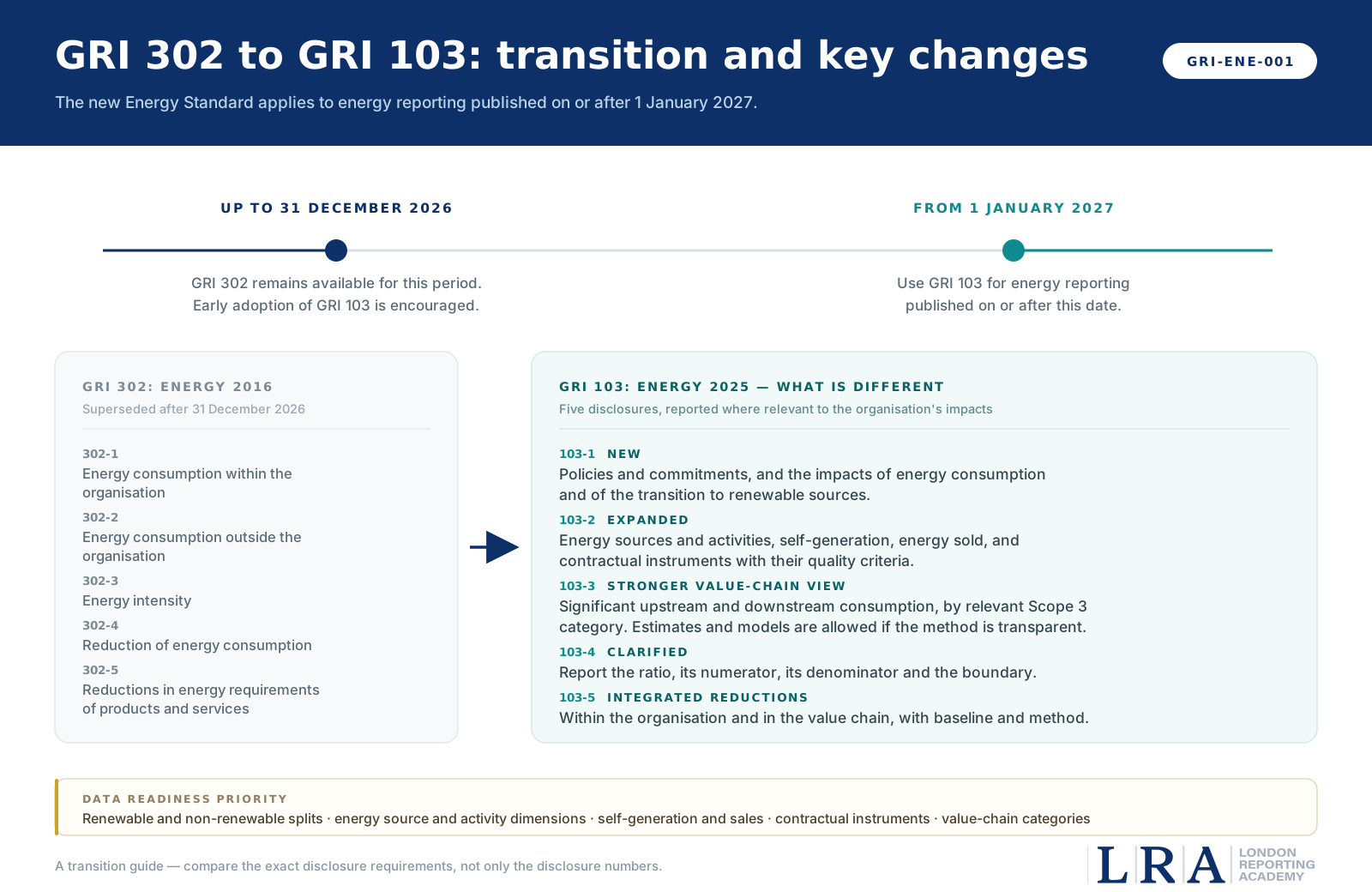
GRI 103: Energy 2025 replaces GRI 302: Energy 2016 for energy reporting published on or after 1 January 2027, and early adoption is encouraged. The change is substantive rather than a renumbering.
GRI 103 adds a disclosure on energy policies and commitments, expands internal consumption and self-generation detail, strengthens the upstream and downstream view, makes the anatomy of an intensity ratio explicit, and folds product and service reductions into one value-chain reduction disclosure. The work that takes time is the data model, not the arithmetic — so it starts well before the effective date.
Why it matters
Why the transition matters
GRI 302 focused on energy consumption, intensity and reductions. GRI 103 keeps those measurement themes but places them inside a clearer impact-reporting architecture. It asks how policies and commitments contribute to reducing consumption, improving efficiency and moving to renewable energy, and it draws attention to the environmental and social impacts that come with energy consumption and with the transition itself.
The hard part of implementation is likely to be data structure rather than arithmetic. Organisations may need renewable and non-renewable splits, activity and source breakdowns, self-generation and sales data, contractual-instrument information, upstream and downstream consumption by value-chain category, and clearer evidence behind reductions and baselines.
Quick orientation
Quick orientation
- Effective date
- Required for energy reporting published on or after 1 January 2027. Early adoption is encouraged.
- Superseded standard
- GRI 302: Energy 2016 remains available through 31 December 2026 and is then superseded for new energy reporting.
- Primary decision
- Which GRI 103 disclosures are relevant to the organisation's energy-related impacts, and what new data has to be collected to report them.
- Common confusion
- Treating GRI 103 as a one-to-one renumbering of GRI 302, or assuming all five disclosures are automatically required.
Rule
Publication date controls the transition
Key concept
Why the number changed from 302 to 103
The change reflects the post-2021 numbering architecture for Topic Standards. GRI no longer assigns Topic Standards to separate economic, environmental and social number series. The “103” does not mean energy has become a Universal Standard: GRI 103 remains a Topic Standard, used together with GRI 1, GRI 2, GRI 3 and any applicable Sector Standards.
Comparison
Disclosure by disclosure
Five disclosures replace five, but only two of them map cleanly. The rest change what has to be held behind the number.
| GRI 302: Energy 2016 | GRI 103: Energy 2025 | Practical change |
|---|---|---|
| No dedicated energy policy disclosure | 103-1 Energy policies and commitments | New narrative on how policies and commitments contribute to consumption reduction, efficiency and the renewable transition, and on the impacts that result. |
| 302-1 Energy consumption within the organisation | 103-2 Energy consumption and self-generation within the organisation | Expanded source and activity detail, renewable and non-renewable information, self-generation, energy sold and contractual-instrument information. |
| 302-2 Energy consumption outside the organisation | 103-3 Upstream and downstream energy consumption | A stronger value-chain structure tied to relevant Scope 3 categories, with measured, estimated or modelled information and transparent methods. |
| 302-3 Energy intensity | 103-4 Energy intensity | The ratio remains, but the numerator, denominator and organisational boundary are made explicit. |
| 302-4 Reduction of energy consumption | 103-5 Reduction in energy consumption | Reductions are reported within the organisation and in the value chain, with categories, baseline and method. |
| 302-5 Reductions in energy requirements of products and services | Integrated into 103-5 | No longer a separate disclosure. Relevant value-chain reductions sit inside the broader reduction architecture. |
Disclosure detail
What each GRI 103 disclosure adds
103-1 Energy policies and commitments
Disclosure 103-1 supplements GRI 3-3. It asks the organisation to describe how its energy-related policies and commitments contribute to reducing energy consumption, improving energy efficiency and transitioning to renewable energy sources. It also asks for the impacts on the economy, the environment and people that may result from energy consumption and from the transition. That builds a clearer bridge between energy metrics and impact management.
103-2 Energy consumption and self-generation within the organisation
Disclosure 103-2 expands the operational data architecture. Reporting teams should prepare controlled classifications for renewable and non-renewable energy, activities, fuel or energy source, purchased and self-generated energy, energy consumed and sold, and relevant contractual instruments and quality criteria. The disclosure also requires transparent calculation methods and conversions. A single total lifted from utility invoices is unlikely to be sufficient.
103-3 Upstream and downstream energy consumption
Disclosure 103-3 strengthens reporting beyond the organisation. Significant energy consumption upstream and downstream is organised by relevant Scope 3 categories. The standard permits measured, estimated or modelled information, but the approach, assumptions and limitations have to be transparent. That raises the importance of supplier information, product-use assumptions, logistics models and clear category ownership.
103-4 Energy intensity
The intensity ratio stays familiar, but the disclosure makes the calculation anatomy visible: the ratio, the numerator, the denominator and the boundary. A useful intensity metric needs a denominator that represents the relevant activity and stays stable enough to compare — and changes in business mix, acquisitions, production volume or methodology need explaining.
103-5 Reduction in energy consumption
Disclosure 103-5 brings reductions within the organisation and in the value chain into one architecture. It calls for clear categories, baseline information and method, and distinguishes measured, estimated and modelled information. The former GRI 302-5 focus on reductions in the energy requirements of products and services is absorbed into this broader value-chain view.
Scope of the requirement
What is required, and what is not
GRI 103 requires
- Applying GRI 103 to energy reporting published on or after 1 January 2027.
- Reporting GRI 3-3 together with the GRI 103 disclosures relevant to the organisation's energy-related impacts.
- Transparent calculation methods and conversions behind the energy figures reported.
- Organising significant upstream and downstream energy consumption by relevant Scope 3 categories.
- Reporting the intensity ratio with its numerator, its denominator and the organisational boundary.
- Reporting reductions with categories, baseline information and method, distinguishing measured, estimated and modelled information.
GRI 103 does not require
- A minimum number of disclosures — there is no such threshold.
- Reporting a disclosure that is irrelevant to the organisation's impacts merely because energy is a material topic.
- Creating a policy, target or process only because a disclosure asks about it. Where one does not exist, the organisation can say so and explain any plans — which is not the same as reporting 'not applicable'.
- Measured data everywhere. Estimated and modelled information is permitted where the approach, assumptions and limitations are transparent.
- Giving up reasons for omission. They remain available for GRI 103 disclosures where the organisation cannot comply, subject to GRI 1 Requirement 6.
Caution
Relevance still controls selection
How to work through it
A practical transition roadmap
Seven steps, in the order that avoids rework. Steps 2 and 3 are the ones that take a reporting cycle rather than a meeting.
- Confirm the publication-date routeDecide whether to early-adopt GRI 103 for 2026 publications or complete the transition for reporting published from 1 January 2027.
- Map GRI 302 to GRI 103 at requirement levelIdentify retained fields, expanded fields, new narrative requirements and the controls that need redesigning.
- Redesign the energy data dictionaryAdd energy-source, renewable and non-renewable, activity, self-generation, consumed and sold, contractual-instrument and value-chain category fields.
- Assess value-chain energy significanceDetermine which upstream and downstream categories are significant, and which data will be measured, estimated or modelled.
- Establish methodology and control recordsVersion conversion factors, estimation models, baselines, intensity denominators, recalculation rules and quality criteria.
- Connect GRI 103 with GRI 102 and applicable Sector StandardsAvoid double counting while preserving the distinct energy and climate information needs.
- Run a dry report and technical reviewProduce a draft GRI Content Index, identify omissions, test the evidence and obtain approval before the first mandatory publication.
Hypothetical scenario
Hypothetical scenario · multinational manufacturer
Illustrative only. It shows how the decision is made, not wording that can be copied or relied on.
Evidence map
Evidence and data readiness
What has to exist in a file somewhere before each part of the disclosure can be signed off, and who owns it.
| Area | Evidence needed | Owner and control |
|---|---|---|
| Policies and commitments | Approved energy policy, targets, transition commitments, affected-stakeholder considerations and governance approvals. | Strategy or sustainability owner. Current-version and claim-consistency review. |
| Internal consumption | Invoices, meters, fuel records, source classifications, conversions and the site boundary. | Facilities and procurement. Reconciliation and source-quality control. |
| Self-generation and sales | Generation meters, internal consumption, exports or sales, and contractual records. | Facilities and finance. Balance and reconciliation control. |
| Value-chain consumption | Supplier data, logistics models, product-use assumptions, category definitions and estimation files. | Procurement, logistics and product teams. Methodology approval and sensitivity review. |
| Intensity | Numerator, denominator, boundary, business-activity data and restatement logic. | Reporting owner. Consistency and comparability review. |
| Reductions | Baseline, project record, measured/estimated/modelled classification, and protection against double counting. | Programme owner. Recalculation and causal-claim challenge. |
Weak vs stronger
Weak versus stronger transition
The difference is rarely effort. It is whether the transition touched the data model or only the Content Index.
| Weak transition | Stronger transition |
|---|---|
| Change the disclosure numbers in the Content Index only. | Perform a requirement-level gap assessment and redesign data, methodology and evidence. |
| Continue reporting one total energy figure. | Create source, activity, renewable and non-renewable, self-generation and value-chain dimensions. |
| Treat estimates as a failure. | Use estimates or models where permitted, with transparent method, assumptions, limitations and an improvement plan. |
| Carry forward an intensity ratio without checking the denominator. | Approve the numerator, denominator, boundary and comparability logic. |
| Describe every efficiency project as a reduction outcome. | Link reported reductions to an approved baseline and to measured, estimated or modelled evidence. |
Common mistakes
Common mistakes
| Mistake | Risk | Correction |
|---|---|---|
| Calling the new standard "GRI 305: Energy" | Confuses the energy and emissions architecture. Some supporting material in circulation contains this typographical error. | Use the authoritative titles: GRI 103: Energy 2025, and the superseded GRI 302: Energy 2016. |
| Assuming all five disclosures are mandatory | Overstates GRI 1 Requirement 5 and creates unnecessary data collection. | Select the disclosures relevant to the organisation's energy-related impacts. |
| Ignoring the publication date | Applies the wrong standard to the report. | Use the publication date and the current transition provisions. |
| Treating self-generation as only a renewable total | Misses consumption, sales or export, and source distinctions. | Design a controlled generation balance and source classification. |
| Reporting value-chain energy without category logic | Produces opaque or double-counted estimates. | Use relevant categories with documented boundaries, methods and assumptions. |
| Copying old Sector Standard references | Creates broken disclosure mappings after alignment. | Use the aligned V1.1 Sector Standard and current climate and energy references. |
Myth
GRI 103 is GRI 302 with new numbers.
Reality
GRI 103 adds a management disclosure, expands source and self-generation information, strengthens upstream and downstream energy reporting, clarifies intensity and integrates value-chain reductions. The transition is a data-model and evidence project, not a find-and-replace in the Content Index.
Assurance readiness
2027 readiness checklist
- The reporting team has confirmed the publication-date transition and the early-adoption decision.
- A requirement-level GRI 302-to-GRI 103 gap assessment is approved.
- The energy data dictionary supports renewable and non-renewable, activity, source, self-generation, consumption and sales or export fields.
- Contractual-instrument and quality-criteria evidence can be linked where required.
- Significant upstream and downstream energy consumption is organised by relevant value-chain categories.
- Measured, estimated and modelled information is distinguished, and methodologies are versioned.
- Intensity ratios show numerator, denominator and boundary, and have restatement rules.
- Reduction claims have approved baselines and methods, with controls against double counting and unsupported causality.
- GRI 102 and aligned Sector Standard mappings have been reviewed.
- The first GRI 103 Content Index and reason-for-omission review has been dry-run before publication.
GRI 103 contains five disclosures: 103-1 Energy policies and commitments; 103-2 Energy consumption and self-generation within the organisation; 103-3 Upstream and downstream energy consumption; 103-4 Energy intensity; and 103-5 Reduction in energy consumption. Together they cover management of impacts, operational energy, value-chain energy, intensity and reductions.
GRI 103 covers management of energy-related impacts, energy consumption, intensity and reductions, while GRI 102 covers the related climate and greenhouse-gas information. The same activity data may support both standards and should reconcile where reused, but energy disclosures and greenhouse-gas emissions disclosures remain distinct.
Test your understanding
- Could the organisation explain every energy total by source, activity, boundary and method?
- Can significant value-chain energy estimates be traced to categories, assumptions and named owners?
- Have all GRI 302 references in templates, Sector Standard mappings, course materials and data systems been reviewed for the 2027 transition?
Questions
Questions people ask
When does GRI 103: Energy 2025 become effective?
GRI 103: Energy 2025 replaces GRI 302: Energy 2016 for energy reporting published on or after 1 January 2027, and early adoption is encouraged. The change is substantive rather than a renumbering.
What happens to GRI 302: Energy 2016?
GRI 103: Energy 2025 replaces GRI 302: Energy 2016 for energy reporting published on or after 1 January 2027, and early adoption is encouraged. The change is substantive rather than a renumbering.
What are the five disclosures in GRI 103?
GRI 103 contains five disclosures: 103-1 Energy policies and commitments; 103-2 Energy consumption and self-generation within the organisation; 103-3 Upstream and downstream energy consumption; 103-4 Energy intensity; and 103-5 Reduction in energy consumption. Together they cover management of impacts, operational energy, value-chain energy, intensity and reductions.
Do organisations need to report all GRI 103 disclosures?
There is no minimum number of GRI 103 disclosures. An organisation reporting in accordance with GRI reports GRI 3-3 and the GRI 103 disclosures relevant to its energy-related impacts. It is not required to report an irrelevant disclosure merely because energy is material.
What new energy data should organisations collect for 2027?
The hard part of implementation is likely to be data structure rather than arithmetic. Organisations may need renewable and non-renewable splits, activity and source breakdowns, self-generation and sales data, contractual-instrument information, upstream and downstream consumption by value-chain category, and clearer evidence behind reductions and baselines.
How does GRI 103 connect with GRI 102 Climate Change?
GRI 103 covers management of energy-related impacts, energy consumption, intensity and reductions, while GRI 102 covers the related climate and greenhouse-gas information. The same activity data may support both standards and should reconcile where reused, but energy disclosures and greenhouse-gas emissions disclosures remain distinct.
Related indicators
Related standards and disclosures
The current energy Topic Standard, required for energy reporting published from 1 January 2027.
The previous energy architecture, available through 31 December 2026 and superseded for new energy reporting after that.
Management of energy as a material topic. Disclosure 103-1 supplements it rather than replacing it.
Related Scope 1, Scope 2 and Scope 3 GHG reporting and climate transition context. Map the two together to avoid double counting.
Updated sector reporting sections referencing GRI 101, 102 and 103. Old references break after alignment.
Sources
Primary sources
Technical status
Technical status
Framework references
Disclosures this page affects
Take it with you
The checklists as a working spreadsheet
Every checklist and table on this page, with empty status, owner and evidence columns for your team to fill in and keep.
✓ Knowledge Hub AI Assistant · Human-in-the-loop

Ask about this guide
It answers from this page, and reaches into the linked disclosure cards when your question is about the standard itself.
Go deeper · GRI
Certified GRI Standards Training
This page settles one disclosure. The GRI Standards Certified Training — two live days, taken as a bundle with an ESRS course — walks the whole cycle: material topics, datapoints, evidence, the Content Index and assurance readiness, with exercises on your own data.
Available as two live training days online or on-site in London, bundled with an ESRS course.