Free course · Practitioner-built

AI for ESG Reporting and Sustainability Disclosures

4.9/5 average satisfaction score across all LRA courses
Delivered in English · inline translation into 20+ languages

The working method of practitioners who use AI on real sustainability disclosures every day — and who build AI tools and automations for that work. This free course runs across the whole ESG reporting lifecycle: standards analysis, double materiality, data quality, drafting, greenwashing review and assurance readiness. Not just a prompt list, and not AI writing your report — a disciplined way of working that keeps human judgment in charge of every disclosure.

ChatGPT Claude Gemini Grok DeepSeek Qwen
AI across the sustainability reporting lifecycle
Compliance Check
Double materiality
Data-quality checks
Disclosure drafting
Greenwashing review
Assurance readiness

Evidence-first — human judgment in charge

Dr. Ross Kurinko — author of the course, presenting the LRA AI method
Course & method by Dr. Ross Kurinko
4.9/5 Student Rating 9,600+ Graduates across EMEA GRI Certified Trainer MarCom Gold Award Winner 15+ Years ESG Experience

AI doesn't write your report. It makes you faster and sharper at every step of preparing it.

The frame for this course is the AI-assisted ESG reporting lifecycle — not "100 prompts" and not automatic report-writing. It's the system LRA's own practitioners use on real disclosures — built around professional judgment, an evidence base, governance and assurance readiness, with AI integrated and the repetitive parts automated where it earns its place. Across 14 modules in three parts, you learn where AI genuinely helps, where it's dangerous, and how to keep a human in charge of every disclosure.

Every practical task is captured as a task card — a single, repeatable format covering the prompt, what to prepare, the expected output, the AI's limits, the red flags, the human-review checklist and the evidence requirements. The course becomes a working reference you keep using long after you finish.

The running case — Mercurius Industries

A fictional industrial-components manufacturer: ~1,200 employees, three EU sites, a group with subsidiaries and leased assets, moving from GRI to ESRS. A rich environmental block (Scope 1–3, energy, waste, water) and a strong social block (health & safety, LTIFR, contractors). Mercurius runs through the entire lifecycle and the capstone, so you practise on one realistic dataset from end to end.

How this free course is different

A deliberate exception — this one is AI-only, on purpose.

Every other London Reporting Academy course is built around real human support — that's our line, AI-powered, always human-in-the-loop. This free course is different by design. Consider it an open door — the same high-quality curriculum built by senior practitioners, the same specialist Study Studio and the practitioner method our paying students use, opened to you free. The trade is honest: Free Access is AI-only self-study, with no support team, no mentor and no graded review. Experience how LRA actually works with AI on real disclosures — then add real human support when you're ready.

When you want a real practitioner in the loop — question support, mentor review of your own drafts, live cohorts and a capstone reviewed by an expert — that lives in our paid courses, such as the Certified ESRS course and the ESG Reporting Full Stack. Browse them all on the courses page. Bringing this to a team? The Corporate Programme below adds full personalisation and human delivery.

AI doesn't replace the ESG expert. It amplifies one — at every step.

ESG reporting isn't learned by memorising definitions, and it can't be handed to a model. It takes judgment — knowing which requirements matter, where data is weak, which claims need evidence and where a confident-sounding answer is simply wrong. AI gives you speed and continuity; the human calibrates direction, owns the decisions and signs off the disclosure.

So the course teaches the boundary as carefully as the capability. AI can be an analyst, a document assistant, an editor, an internal reviewer and an assurance helper. AI cannot own professional judgment, be accountable for disclosures, or be a source of unverified facts. That line runs through every module.

"This is not just a course about prompts. It's a practical system for preparing, checking and governing ESG reporting with AI — with human judgment, an evidence base, governance and assurance readiness."
What sets this course apart

Five reasons it's not another “AI prompts” course.

Built by reporting practitioners who use AI on live disclosures — and build the AI tooling for it — so you learn how the work is really done, not how a model imagines it.

A lifecycle system, not a prompt dump

The course is organised around the real reporting workflow — standards, boundary, double materiality, data collection, data quality, benchmarking, drafting, external requests, internal review, assurance and governance — not a loose collection of prompts to copy.

The task card — a working reference

Each task uses one 12-field format: task, type, lifecycle stage, when AI fits, what to prepare, prompt evolution, expected output, AI limits, red flags, human-review checklist, evidence requirements, and a worked Mercurius example. The Playbook and Prompt Library build from these.

Prompt evolution — not copy-paste

Every card shows a prompt growing Basic → Enhanced → Complete, so you learn the reasoning a practitioner adds — framework text, company context, data, constraints — instead of memorising a finished prompt that ages out.

Risk built into every task

Red flags, human review and evidence requirements sit inside each card. You always paste the current text of the standard — never trust the model's memory — and every claim has to trace to a source.

The AI Reviewer — most courses skip this

Many courses teach you to write with AI. Module 12 teaches you to check with AI — completeness, consistency, KPI-vs-narrative, unsupported claims and greenwashing risk — and how to stop the model from "approving" a claim that has no evidence behind it. It's the module that turns AI from a drafting toy into a quality control tool.

Choose your format

Two routes — free for individuals, personalised for teams.

Same 14-module method. Free Access is AI-only self-study. The Corporate Programme adds full personalisation and human delivery.

Free Access

The full method, free — AI-only self-study.

All 14 modules, the ESG AI Playbook, the Prompt Library and the running Mercurius case — inside the AI-powered Study Studio. Self-study at your own pace, with the AI Tutor and AI Avatar on every lesson. No support team, no mentor, no graded capstone — that's the trade for free.

14 modules · ESG AI Playbook · Prompt Library · Mercurius case · AI Tutor + AI Avatar · verifiable certificate on completion
Free£0 · AI-only self-study · no card needed
Get free access
Corporate Programme

Personalised, human-delivered, for your team.

The full programme tailored to your organisation — your sector, data and reporting context — delivered by a senior trainer. Adds the graded capstone, the ESG AI Governance Pack, an AI usage policy, an AI maturity assessment and a live workshop. Online, on-site at Canary Wharf, London, or hybrid.

All 14 modules + capstone · Governance Pack · ESG AI policy · maturity assessment · live workshop · team certificates · personalised to your context
On requestScope and pricing agreed during planning
Request a quote More about corporate programmes →
Want a human in the loop?

Our paid courses add real practitioner support.

Guided Flex, Live Cohort and 1:1 Expert Mentorship — across ESRS, IFRS S1/S2, GRI, Assurance and the Full Stack programme — all add human guidance, mentor review and a graded path. This free course is the AI taster; those are the supported journey.

Browse all courses →
How each route works

The same method, two ways to take it.

From first lesson to certificate — what the journey looks like on each route.

Free Access

AI-only self-study, at your own pace.

Best for: individual practitioners who want the full method, free, and are happy to learn solo.

  • Quick sign-up — share a few details and your free Studio access opens.
  • Studio access — your personalised learning workspace, with the AI Tutor and AI Avatar on every lesson.
  • Work the 14 modules — lessons, task cards and the running Mercurius case, at your own pace.
  • Self-check, no support team — AI-only — there's no LRA support desk or mentor on this route.
  • Certificate on completion — a verifiable LRA certificate once you finish the course.
Get free access →
Corporate Programme

Personalised, human-delivered, for teams.

Best for: ESG, reporting and finance teams adopting AI across their reporting cycle together.

  • Request a quote — share scope, team size and reporting context.
  • Scope alignment — we map the method to your sector, data and disclosure cycle.
  • Custom programme design — modules, task cards and the capstone built around your team.
  • Human delivery + governance — senior trainer online, on-site or hybrid; ESG AI policy, governance pack and maturity assessment.
  • Team certificates — per-learner credentials, each showing Corporate Programme participation.
Discuss a programme →
Want the full LRA learning model? Onboarding, the Study Studio, human support, certificates and route recognition lines are documented on a dedicated page.
How We Deliver Our Courses →
London Reporting Academy
Study Studio · AI for ESG

Runs inside the AI-powered LRA Study Studio.

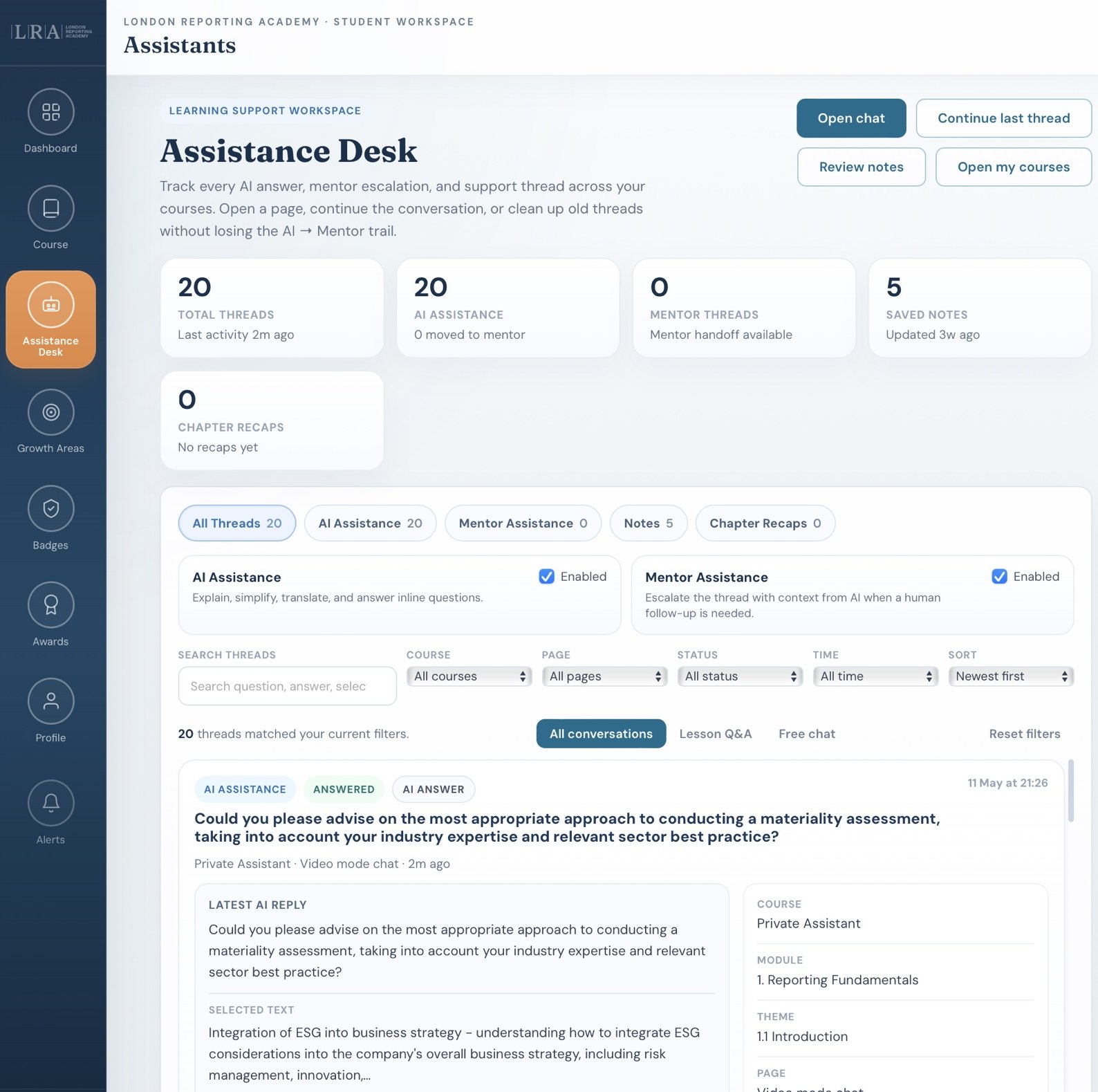
The free course lives in the same specialist Study Studio LRA builds — a new generation of sustainability reporting education, not generic online learning. You get the AI Tutor on every lesson, Dr. Kurinko's AI Avatar, the proprietary ESG knowledge base and the Mistake Coach.

On the Free Access route the AI tooling is included, but the human expert support desk is not — that's reserved for the paid courses and the Corporate Programme. It's the one honest trade for a free, AI-only route.

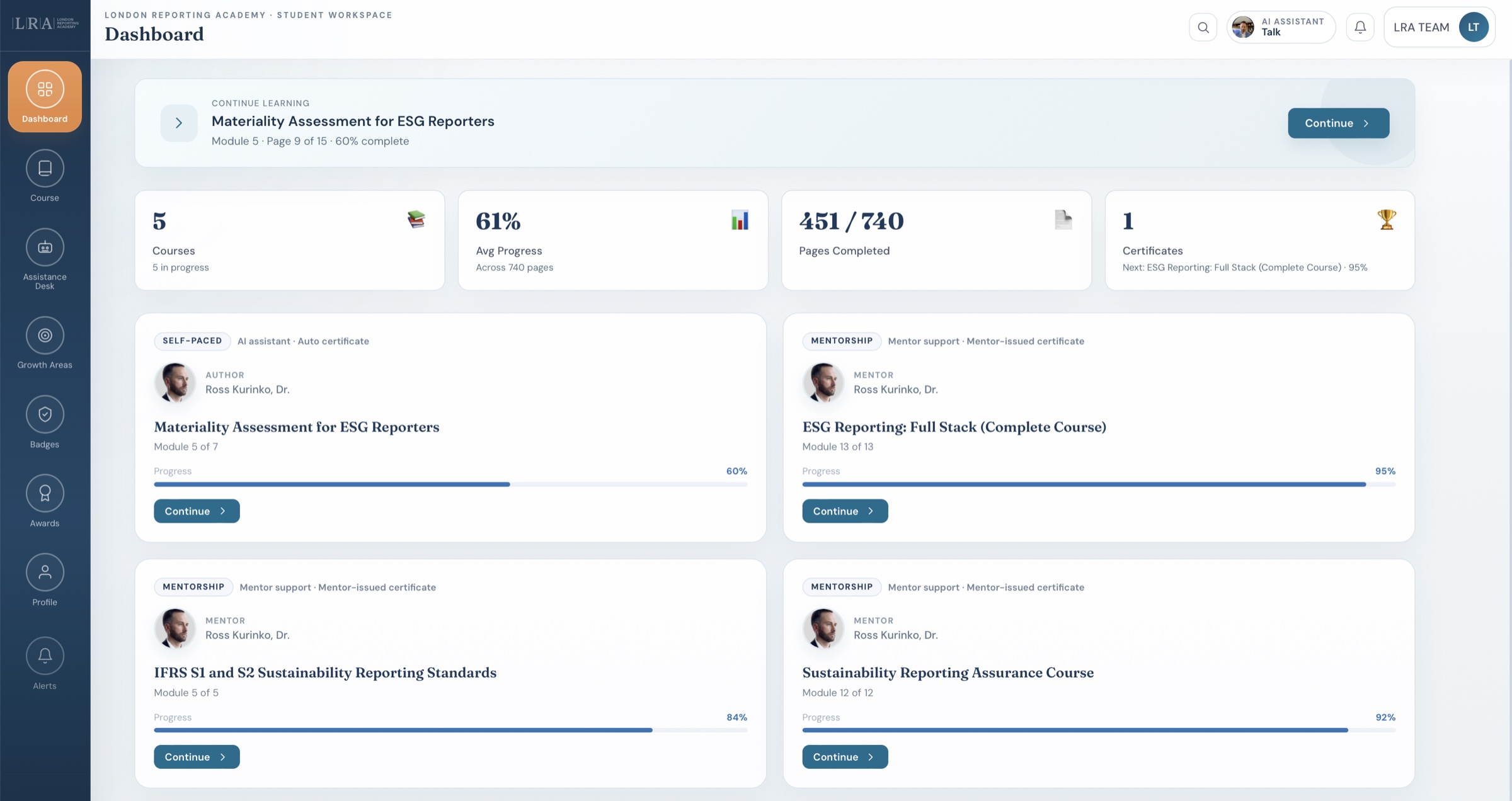
cabinet.reporting.academy/student/dashboard
Study Studio dashboard preview
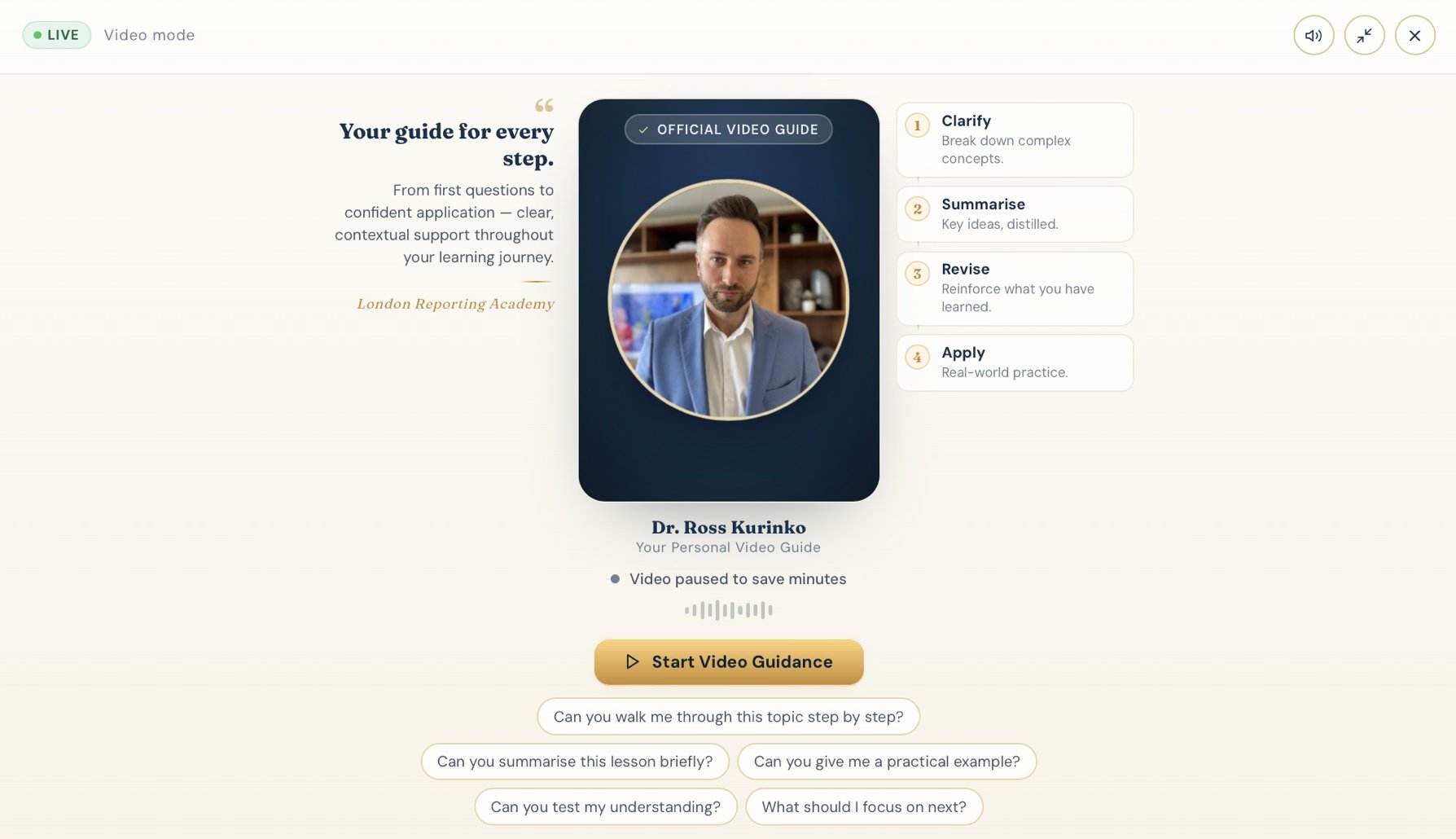
Dr. Ross Kurinko AI avatar AI Avatar
Assistance Desk AI Tutor
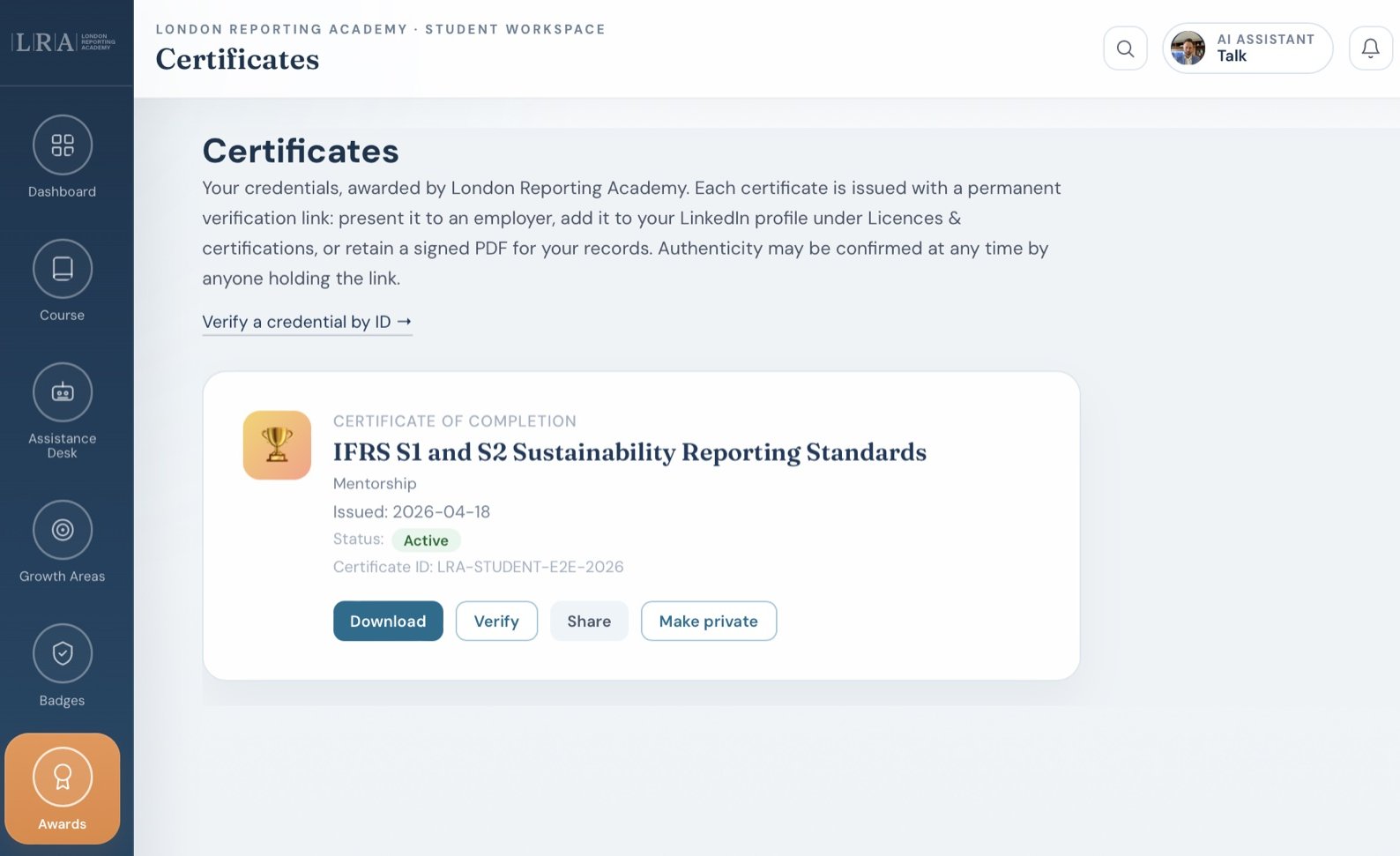
Verifiable certificate Certificate

Step inside the real thing — the Studio our learners enjoy every day, free.

What the Studio helps you do
  • Learn the method, lesson by lesson — the AI Tutor can explain, simplify and apply each concept to your own role and reporting context.
  • Practise on the Mercurius case — work the task cards on one realistic dataset, from standards to assurance readiness.
  • Close weak areas — the Mistake Coach turns weak topics into a focused revision path.
  • Read and reason in your language — highlight any sentence and the AI Tutor translates it inline into 20+ languages.
How the course works

A working method, accelerated by AI.

Every task is a reusable card

Practical tasks follow one 12-field card — so the course doubles as a working reference you keep using on real reporting work.

Prompts you learn to build

Each card grows a prompt Basic → Enhanced → Complete, teaching the practitioner reasoning rather than a finished line to copy.

Evidence-first, version-pinned

You always paste the current standard text and tie every claim to a source. Calculations stay in spreadsheets and systems — AI is for interpretation and review, not arithmetic.

AI Tutor + AI Avatar on every lesson

A frontier-model AI Tutor is pinned to every Studio page — explain, simplify, translate, ask a follow-up. When text isn't enough, Dr. Kurinko's AI Avatar walks you through it.

Course outline

14 modules, three parts — foundation, lifecycle, governance.

Roughly 24–32 hours of core programme, about 40% method and 60% practice, ending in a capstone on the Mercurius case. Each practical module produces a real working artefact.

Part I — Foundation
Module 01

AI for ESG professionals — capabilities and limits.

What generative AI is in plain terms, why it sounds confident even when wrong (hallucination), where it helps in ESG and where it's dangerous, and why it never replaces the expert in regulated disclosure.

Module 02

AI hygiene, security and tool selection.

What you must never upload, data classification across public / enterprise / local environments, anonymisation, audit trail and reproducibility — plus a checklist for choosing tools without locking onto a model that ages out.

Module 03

ESG prompt engineering.

Clarity, specificity, context and format; the Role–Task–Format frame with framework, company and data layers; and the six types of ESG task — descriptive, analytical, comparative, drafting, prescriptive and reviewer.

Module 04

ESG reporting as a process — where AI helps.

A navigator for the whole lifecycle: for each stage, what the specialist does, what AI can do, what can't be delegated, the stage's red flag and the expected output.

Part II — The ESG reporting lifecycle
Module 05

Standards analysis and reporting boundary.

Extract requirements from GRI, ESRS, ISSB and SASB, map between standards, and set the organisational and value-chain boundary. Red flag: never trust the model's memory — always paste the current requirement text.

Output: disclosure checklist + boundary memo
Module 06

Double materiality assessment.

Build a long list, structure stakeholder input, analyse impacts, risks and opportunities, and assemble an IRO register — with the final judgment on materiality kept firmly human.

Output: long list + IRO register
Module 07

ESG data collection and supplier data.

Data-request templates, ESG and supplier questionnaires, Scope 3 requests and follow-ups — using AI to spot gaps and inconsistencies, never to confirm that data is accurate.

Output: data request pack
Module 08

ESG data quality and KPI storytelling.

Find missing data and anomalies, compare year on year, and turn a KPI table into a narrative. Red flag: LLMs are unreliable for calculations — keep arithmetic in spreadsheets and systems.

Output: data quality memo + KPI narrative
Module 09

ESG benchmarking and gap analysis.

Compare competitor disclosures, build a benchmark matrix, find and prioritise gaps, and produce a readiness roadmap — with every figure checked to its source page, never blended across companies.

Output: benchmark matrix + gap roadmap
Module 10

ESG disclosure drafting studio.

Draft governance, climate, workforce and business-conduct disclosures, and rewrite technical text into a neutral reporting style — with a hard rule: only provided facts, no added claims, missing data flagged explicitly.

Output: draft disclosure
Module 11

External ESG requests, communication and monitoring.

Draft responses to CDP, EcoVadis and rating questionnaires, adapt disclosures for investors, and build board summaries and monthly performance reviews — without ever claiming more than the report supports.

Output: questionnaire response + board summary
Module 12 · the key module

AI Reviewer — internal quality control.

Many courses teach writing with AI; this one teaches checking with AI. Completeness, consistency, KPI-vs-narrative, unsupported claims and greenwashing detection — and stopping the model from “approving” a claim with no evidence behind it.

Output: ESG Review Log
Module 13

Assurance readiness.

Build an evidence register, link disclosures to data sources, prepare for auditor questions and find weak evidence — using the source hierarchy, where the strength of evidence must match the risk of the claim.

Output: evidence register
Part III — Governance & capstone
Module 14

ESG AI governance and team adoption.

An operating model (AI draft → specialist review → data-owner validation → legal → approval → assurance → publication), an ESG AI policy, responsible-AI principles and an AI maturity model — turned into a 90-day adoption roadmap.

Output: AI usage policy + 90-day roadmap
Capstone

End-to-end simulation on Mercurius Industries.

Run the full pipeline on one case — extract requirements, find gaps, build DMA elements, request and check data, draft a disclosure, run an AI review, catch unsupported claims, prepare an evidence register and a management summary. Graded against a nine-point rubric on the Corporate Programme.

Upon completion

By the end, you will confidently.

  • Use AI across every stage of the ESG reporting lifecycle — and know exactly where it's dangerous.
  • Build ESG prompts grounded in the standard, your company context and your data.
  • Produce disclosure checklists and gap analyses against GRI, ESRS and ISSB.
  • Apply AI to double materiality, data collection and benchmarking — structuring the work without delegating the judgment.
  • Draft disclosures without invented facts — only provided data, with missing data flagged.
  • Review a report for unsupported claims and greenwashing risk — and rewrite claims more carefully.
  • Prepare an evidence register for assurance — with each claim traced to a source.
  • Embed AI governance in your ESG team — policy, human review and a 90-day roadmap.
What you leave with

Working tools, not just understanding.

ESG AI Playbook

40–60 tested task cards with prompts, limits and review checklists — a working manual for your ESG team.

ESG Prompt Library

Vetted templates by lifecycle stage — quality over quantity, not a raw dump of prompts.

Disclosure Review Toolkit

Completeness, consistency, unsupported claims, KPI-to-narrative, cross-reference and terminology checks.

DMA Toolkit

Long list, stakeholder input, IRO register, scoring review and documentation prompts.

Data Quality + Assurance

Missing-data and anomaly detection, supplier review, period comparison; plus an evidence register and auditor Q&A pack.

ESG AI Governance Pack

AI usage policy, data classification, prompt governance, human-review checklist and maturity assessment. Personalised on the Corporate Programme.

Who this is for

For ESG practitioners — no technical background needed.

Built for people who do the reporting, not for engineers. If you can read a standard, you can take this course.

ESG & sustainability managers

Lead the reporting cycle with AI as a force multiplier — faster analysis, safer drafting, stronger internal review — while staying in control of every disclosure.

ESG / CSRD / GRI / ISSB consultants

Add a repeatable AI method to your advisory toolkit — task cards, prompt evolution and review checklists you can apply across clients and standards.

Reporting & CSRD/ESRS project teams

Give the whole team one shared, safe way to use AI across data collection, drafting and quality control — with governance baked in.

ESG function leads embedding AI

Move your team up the AI maturity model — from ad-hoc use to an AI-enabled operating model — with a policy, human-review workflow and a 90-day adoption roadmap.

Who it's not for

  • Those looking for a technical machine-learning course.
  • Those who want to fully automate an ESG report with no human involvement.
  • Those expecting AI to produce ready-made legal opinions.
Certificate

A verifiable credential — even on the free route.

Finish the course and you earn a verifiable LRA certificate in AI-assisted ESG reporting — confirming you can put AI to work across the reporting lifecycle while keeping human judgment, evidence and governance in charge.

Free in price, not in depth. The free route runs the full method end to end — real standards, a realistic reporting case and the same rigour behind every paid LRA programme. This is serious, practical, hard-won knowledge — and a credential you can be proud to put your name to.

It carries a unique credential ID and a permanent verification link that employers, clients and procurement teams can confirm on request — anywhere in the world, on demand. It's issued on the same verification infrastructure behind every LRA credential: one standard, globally verifiable.

Globally verified

What the certificate signals

  • A practical method, not just theory — you've worked the full task-card system on a realistic case.
  • Evidence-first AI use — drafting without invented facts, claims traced to sources, calculations kept out of the chat.
  • Quality control with AI — completeness, consistency and greenwashing review built into your workflow.
  • Governance awareness — an operating model and policy for using AI responsibly in an ESG team.
  • Verification when it matters — a credential ID and permanent verification link. On the Corporate Programme, the certificate follows a graded capstone.
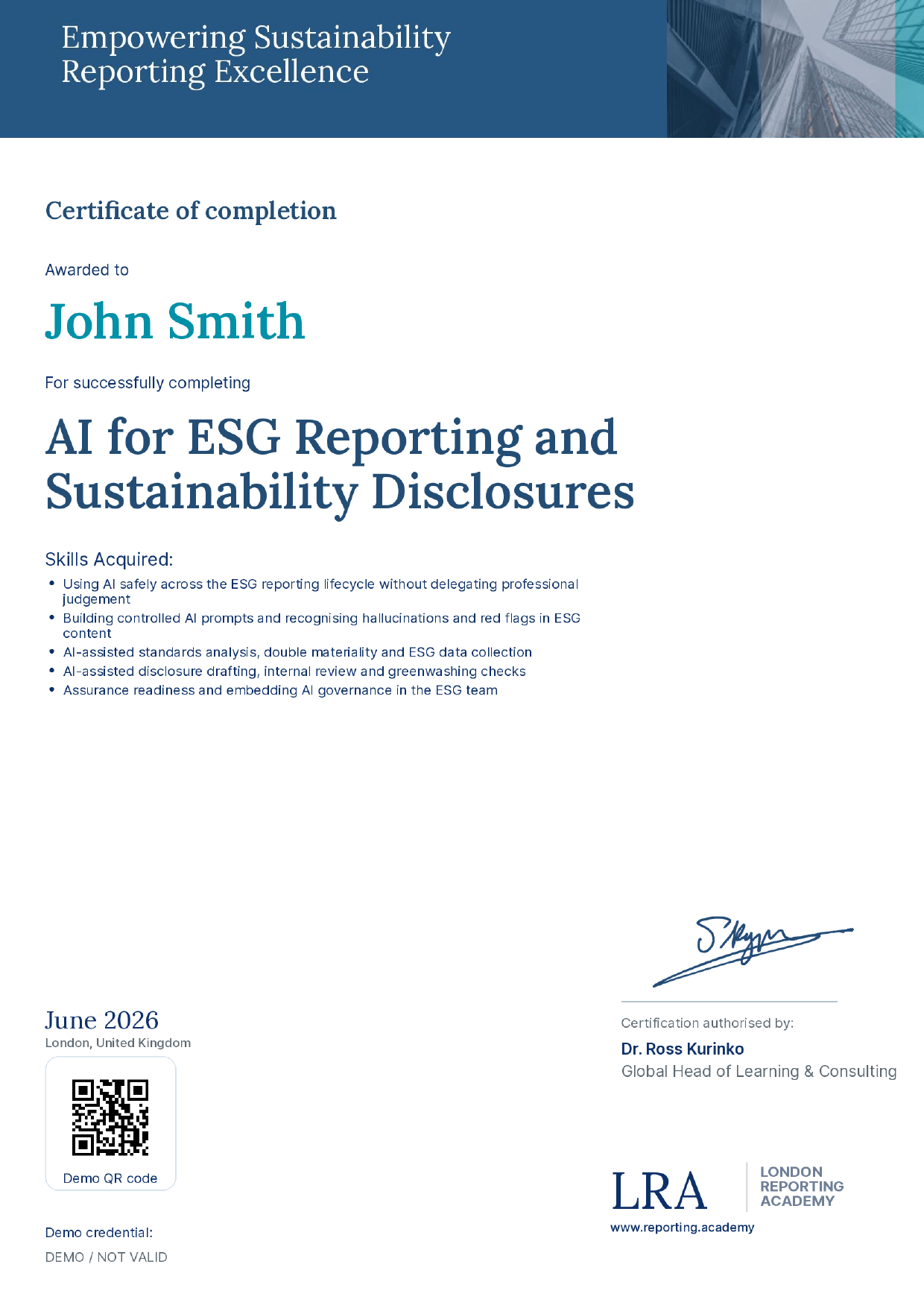
Sample London Reporting Academy certificate — AI for ESG Reporting and Sustainability Disclosures
Dr. Ross Kurinko
Author of the course
Ross Kurinko, Dr.

Distinguished expert with 15+ years in sustainability, integrated communications and corporate reporting. GRI Certified Global Trainer, PhD, University of Cambridge, 15+ years on FTSE 100 and Fortune Global 500 disclosures.

The method behind this course is distilled from 200+ live disclosure projects across sectors — the same practitioner experience behind every LRA course, and behind the AI tools LRA builds for sustainability reporting. It captures how an experienced reporter actually uses AI — and automates the repetitive parts — for speed and review, never as a substitute for judgment.

Trusted by professionals worldwide

Real participants. Real LinkedIn reviews.

Verified posts from sustainability practitioners who completed our programmes — open any to read the original LinkedIn comment in full.

Get access

Free for you — personalised for your team.

The Free Access route is genuinely free and AI-only. The Corporate Programme adds personalisation, governance and human delivery.

Free Access
Free£0 · all 14 modules · AI-only self-study · verifiable certificate
Get free access
Corporate Programme
On requestPersonalised · capstone · governance pack · live workshop · team certificates
Request a quote

Want human support? The free route is AI-only by design. For question support, mentor review of your own drafts, live cohorts and a graded capstone, see the paid LRA courses on the courses page — every one is built around real practitioner support.

AI for ESG — frequently asked

Questions before you start.

What this free course is, what's included, and where the human support lives.

Is this really free? What's the catch?

Yes — genuinely free. No card, and no trial that quietly converts. And it's not a watered-down taster: it's the full 14-module practitioner method, built to the same professional standard as every other LRA course — just opened up at no cost. The honest trade is that it's AI-only self-study: you get the AI-powered Study Studio, but no support team, no mentor and no graded capstone. Think of it as an open door to how LRA works with AI on ESG reporting — and, we hope, a reason to come back for a supported, paid course later.

Is this a “prompts” course? Will AI write my report?

No, and no. It's the working method LRA's own practitioners use across the whole ESG reporting lifecycle — not just a list of prompts and not automatic report-writing. You learn where AI helps and where it's dangerous, and how to keep a human in charge of every disclosure. AI drafts and reviews; you decide, evidence and sign off.

Do I need a technical or AI background?

No. It's built for ESG practitioners without a technical background. If you can read a reporting standard, you can take this course. We deliberately don't tie the method to any specific model or vendor — the tool names age out in months, the judgement doesn't.

Why is there no human support on the free route?

Because it's free. Every other LRA course is always human-in-the-loop — question support, mentor review, live cohorts. To offer this one at no cost we made it AI-only and self-study. When you want a real practitioner in the loop, that lives in the paid courses and the Corporate Programme.

What's the difference between Free Access and the Corporate Programme?

Free Access is the full 14-module method, AI-only, for individuals. The Corporate Programme takes the same method and personalises it to your team — your sector, data and reporting context — delivered by a senior trainer, with the graded capstone, the ESG AI Governance Pack, an AI usage policy, a maturity assessment and a live workshop. It's enquiry-led; pricing is agreed during planning.

Can I safely use my company's data with AI in this course?

Module 2 is dedicated to exactly this — AI hygiene and data classification. You learn what must never be uploaded, how to work across public, enterprise and local environments, and how to keep an audit trail. The course teaches the discipline; your own tooling and policy decide what you put where.

Do I get a certificate on the free route?

Yes — finish the course and you earn a verifiable LRA certificate with a credential ID and a permanent verification link. On the Corporate Programme the certificate follows a graded capstone reviewed against a nine-point rubric.

Which standards does it cover — GRI, ESRS, ISSB?

The method is standard-aware — it works across GRI, ESRS, ISSB (IFRS S1/S2) and SASB, and teaches you to map between them. It's not a deep course on any single standard. For deep, human-supported standard mastery, see the Certified ESRS course or the ESG Reporting Full Stack.

Question about the wider LRA learning model? See How We Deliver Our Courses. Anything specific to this course? Email lra@reporting.academy.

Free · access starts on day one

Start working with AI on ESG reporting — free.

Get instant, no-cost access to the full 14-module method in the Study Studio. It's AI-only self-study — when you want a practitioner in the loop, our paid courses are one click away.