TNFD · GRI 101 · ESRS E4 · IFRS S1

Professional Certificate in Nature and Biodiversity Reporting

4.9/5 average satisfaction score across all LRA courses
Course text and video: EN

Nature has moved from a sustainability footnote to a reporting obligation in its own right — the TNFD recommendations (Taskforce on Nature-related Financial Disclosures), GRI 101: Biodiversity 2024, ESRS E4 Biodiversity and Ecosystems and IFRS S1 (the ISSB's general requirements for sustainability-related financial disclosure) all now expect location-specific, evidence-backed disclosure. This programme takes you from the reporting object and the reporting boundary, through priority locations and the LEAP assessment, to nature metrics, targets and an integrated, assurance-ready nature disclosure package. Practitioner-led by Dr. Ross Kurinko, with real human guidance on every learning route.

4.9/5 Student Rating 9,600+ Graduates across EMEA GRI Certified Trainer MarCom Gold Award Winner 15+ Years ESG Experience

One nature programme for every framework that now asks about it.

Nature-related reporting used to mean a paragraph on biodiversity. It now means a reporting boundary, priority locations, dependencies and impacts traced through ecosystem services, a register of risks and opportunities, metrics with baselines, targets with transition plans — and the same facts reported consistently under the TNFD (Taskforce on Nature-related Financial Disclosures), GRI 101: Biodiversity 2024, ESRS E4 Biodiversity and Ecosystems and IFRS S1 General Requirements for Disclosure of Sustainability-related Financial Information. This Professional Certificate is a complete, practitioner-built path through that work, built on 15+ years of ESG-reporting practice and delivered inside the AI-powered LRA Study Studio, with real human support on every route.

What you leave with
A reporting-boundary memo · a priority-location screen · a DIRO register (dependencies, impacts, risks, opportunities) · a nature data architecture · an integrated TNFD / GRI / ESRS / IFRS disclosure package · a verifiable LRA certificate

No basic. No advanced. Just report-ready.

Many training providers teach nature as a one-day introduction to the TNFD, or as a single standard taught in isolation. We don't. Every LRA graduate should be able to work towards real, high-complexity nature-related reporting — from defining the reporting object and the boundary, through geospatial screening and ecological evidence, to metrics, targets, governance and assurance readiness — in whichever framework their organisation reports under.

The difference is in how you get there. The AI-powered LRA Study Studio adapts to your background, role, sector and current level of maturity — and so do the people behind it. Senior LRA mentors and the experienced LRA support team meet you at your level — ready to take any question, from the most basic to the most genuinely complex. An ecologist moving into reporting, a sustainability manager, a consultant and a board-level executive do not need the same explanations — but they all need the same professional outcome: the ability to prepare, review and defend credible nature-related disclosures.

"We don't teach 'basic' or 'advanced' nature reporting. We teach people to become report-ready — at the level their role, organisation and reporting context require."
What sets this course apart

Five reasons it's not another TNFD webinar.

Four frameworks, one set of facts

The programme is built around the question every reporter actually faces: how do I report nature once and satisfy the TNFD (Taskforce on Nature-related Financial Disclosures), GRI 101: Biodiversity 2024, ESRS E4 Biodiversity and Ecosystems and IFRS S1 together? Module 21 assembles the integrated disclosure package; everything before it builds the evidence it rests on.

Location-specific, not generic

Nature reporting is about where. You work through the reporting boundary, value chain and portfolio, priority locations, geospatial screening and ecological evidence — the parts of nature disclosure that assurance providers and investors now examine first.

Two running cases on every module

Every module carries two case pages — Northland, an operating company, and HarbourBank, a financial institution — so you practise each step twice: once for direct operations and the value chain, once for a portfolio. Six optional sector laboratories add your own industry's specifics.

Human-in-the-loop across every route

Across every route — including Guided Flex — you can hand the AI thread to a real human. Async support from the LRA team, or scheduled live time with Dr. Kurinko, mentors or trainer. Never AI-only.

One expert curriculum, five professional learning routes

Same curriculum, different cadences and audiences. Pick what fits your role, your schedule and your budget. Multilingual: inline AI translation into 20+ languages across the curriculum, on top of every format.

Choose your format

One expert curriculum, five professional learning routes.

Same materials, same standards — different formats, different cadences, different audiences. Human support is available on every route.

Guided Flex

Learn on your schedule, never on your own.

Flexible learning through the AI-powered LRA Study Studio, with structured assessments and specialist ESG reporting professionals available to answer your questions through the platform.

About 145 hours of guided study · 12 months Studio access · human question support through the platform · knowledge checks and assessed assignments
€349+ VAT where applicable
Enrol & Pay
Live Cohort

Learn alongside peers, guided by senior ESG mentors.

Everything in Guided Flex, plus scheduled live online sessions, cohort-based progression, mentor-reviewed exercises and peer learning around real nature-related disclosure challenges.

About 145 hours of guided study · live online sessions · mentor-reviewed exercises · peer cohort · 12 months Studio access
Intakes: First Nature cohort forming — dates confirmed on request
On requestNext intake pricing by arrangement
Reserve a seat
1:1 Expert Mentorship

Private expert guidance for your reporting context.

Everything in Guided Flex, plus direct mentor sessions with Dr. Ross Kurinko or a senior LRA mentor (subject to mentor availability), personalised guidance and line-by-line review of your disclosure drafts.

About 145 hours of guided study · private mentor sessions · personalised guidance · draft review · 12 months Studio access
€1,199+ VAT · 5 × 1.5h mentor sessions · online or Canary Wharf by agreement
Enrol & Pay
1:1 Expert Mentorship — Applied Practice

Blended study + consulting on your real working documents.

Everything in 1:1 Expert Mentorship, plus your existing working documents are reviewed alongside the mentor sessions — priority-location screen · DIRO register · draft nature disclosures. Mentor + practitioner-consultant in one engagement, working with your real cycle via email, file-share and scheduled mentor sessions under NDA. Studio platform stays standard — your documents are not uploaded to the platform; we work them as files.

10 × 1.5h mentor sessions · your working documents in scope (NDA) · improved outputs returned · 12 months Studio access
€2,499+ VAT · 10 × 1.5h · Deep Review · online or Canary Wharf by agreement
Enrol & Pay

What's included on each route

Every route includes the same expert curriculum, real human support and one verifiable certificate — the table shows what each format adds on top.

Scroll sideways to compare →

What you get Guided Flex€349 Live CohortOn request 1:1 Expert Mentorship€1,199 Applied Practice€2,499
12 months Study Studio access Included Included Included Included
Expert-built nature curriculum — 23 modules plus six optional sector laboratories Included Included Included Included
Knowledge checks and three assessed assignments Included Included Included Included
Real human supportAsk questions through the platform and get practical, timely replies from experienced ESG professionals, so you can keep moving through the course. Included Included Included Included
Peer cohort + scheduled live online sessions Not included Included Not included Not included
Private 1:1 mentor sessions (online or Canary Wharf by agreement) Not included Not included Included Included
Line-by-line review of your disclosure drafts Not included Not included Included Included
Your real working documents reviewed, under NDA Not included Not included Not included Included
Verifiable certificate Core certificate + cohort recognition + mentorship recognition + mentorship recognition

Corporate Programme is bespoke and quoted on request — see below. Not sure which route fits your reporting context?

For teams

Train your team with a bespoke nature-reporting programme.

Custom nature and biodiversity reporting training for sustainability, finance, risk, reporting and leadership teams — delivered online, on-site, in London, or as a hybrid programme. Price on request.

View corporate programmes →
How each route works

The same nature programme, shaped to four professional paths.

From day one to certificate — what the journey looks like on each route.

Guided Flex

Independent learning, with human support through the platform.

Best for: professionals who need nature reporting to fit around a busy reporting cycle.

  • Onboarding — tell the Studio your role, sector, jurisdiction and reporting context.
  • Studio access — your personalised learning workspace opens.
  • Core learning — lessons, case pages, applied activities, knowledge checks and assessed assignments.
  • LRA support team — experienced ESG professionals provide practical, timely replies through the platform, so you can keep moving through the course.
  • Certificate — issued on completion of the knowledge checks and assessed assignments.
Enrol in Guided Flex →
Live Cohort

Studio first, cohort layered on.

Best for: professionals who want peer learning and scheduled live sessions with senior LRA mentors.

  • Onboarding — tell the Studio your role, sector, jurisdiction and reporting context.
  • Start in the Studio today — no waiting for the next intake to begin.
  • Core certificate path — progress through the curriculum at your pace.
  • Cohort intake — join the first Nature cohort as it forms — dates confirmed on request.
  • Live sessions + cohort recognition — Scheduled mentor sessions; your course certificate confirms the learning outcome and does not name the delivery format.
Reserve a cohort seat →
1:1 Expert Mentorship

Dual onboarding, private mentor time.

Best for: professionals with a real nature assessment, draft disclosure, project or organisation-specific context that needs personalised expert guidance.

  • Studio onboarding — tell the Studio your role, sector, jurisdiction and reporting context.
  • Mentor kickoff — dedicated session to map your reporting context and goals.
  • Personalised plan — your mentor calibrates focus areas and pace.
  • Private sessions + draft review — Mentor time with Dr. Kurinko or a senior LRA mentor (subject to mentor availability), online or at Canary Wharf by agreement; line-by-line drafts.
  • Certificate + mentorship recognition — your certificate is updated to show 1:1 expert mentorship.
Choose 1:1 Expert Mentorship →
Corporate Programme

Bespoke programme for your team.

Best for: sustainability, finance, risk, reporting and leadership teams aligning on nature-related disclosure together.

  • Request a quote — share scope, team size and reporting context.
  • Scope alignment — we map the nature topics and frameworks to your sector and disclosure cycle.
  • Custom programme design — modules, exercises and cases built around your team.
  • Delivery — online, on-site, Canary Wharf London or hybrid blend.
  • Team certificates — Per-learner course credentials confirming the learning outcome, without a delivery-format line.
Discuss a programme →
Want the full learning model? Dive into onboarding, the Study Studio, human support, certificates and the full delivery model on a dedicated page.
How We Deliver Our Courses →
London Reporting Academy
Study Studio · Nature

Your nature-reporting workspace — standards, AI and expert support in one place.

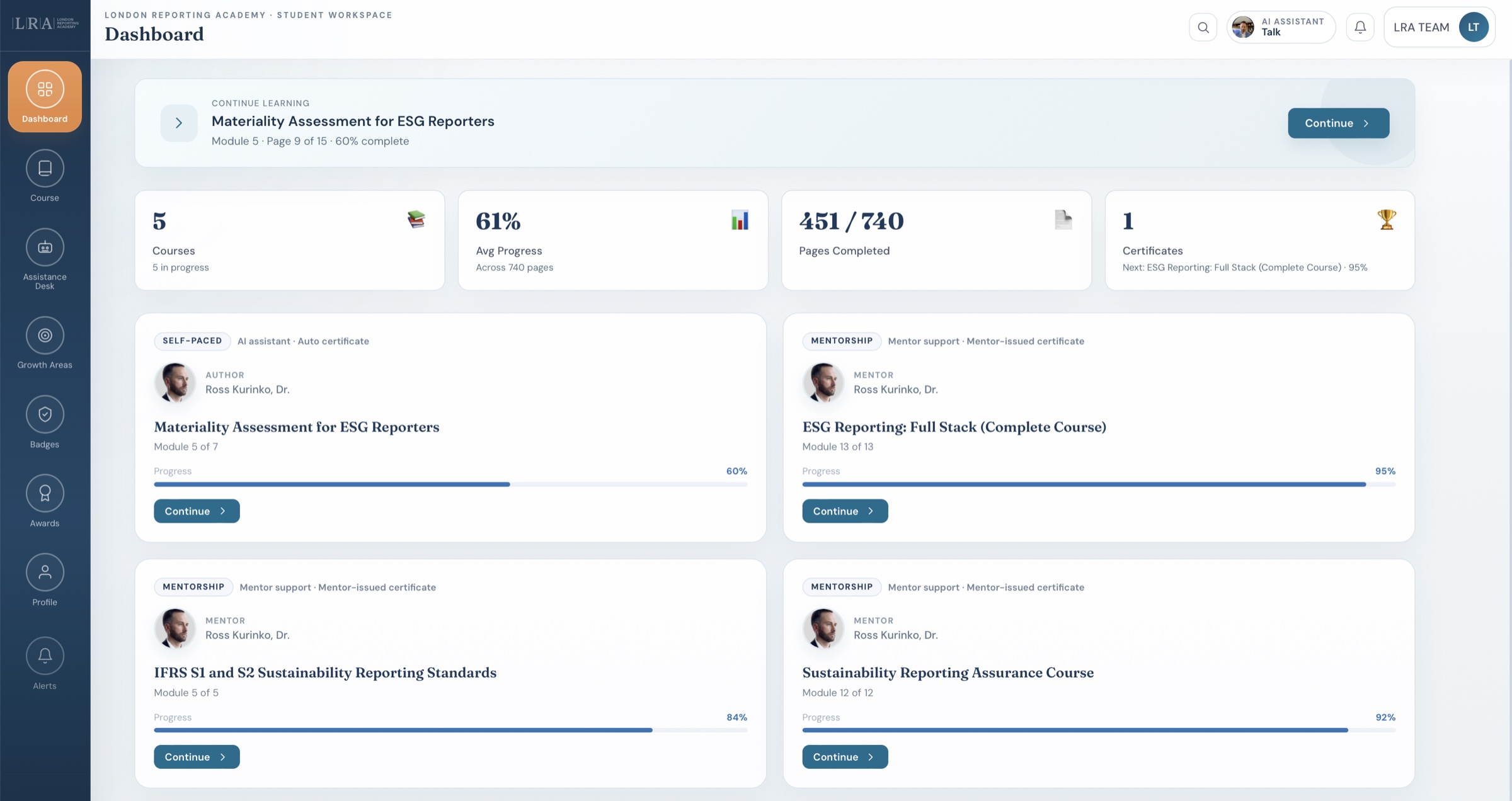
The programme runs inside the AI-powered LRA Study Studio: a purpose-built workspace where you learn the frameworks, practise nature-related disclosure tasks, check your understanding and get support — without leaving the course environment.

It is built for sustainability reporting — not generic online learning. The Studio combines expert-built nature content, a specialist AI Tutor, Dr. Kurinko's AI Avatar, applied assessments, growth-area tracking and access to experienced ESG reporting professionals through the platform.

cabinet.reporting.academy/student/dashboard
Study Studio dashboard preview
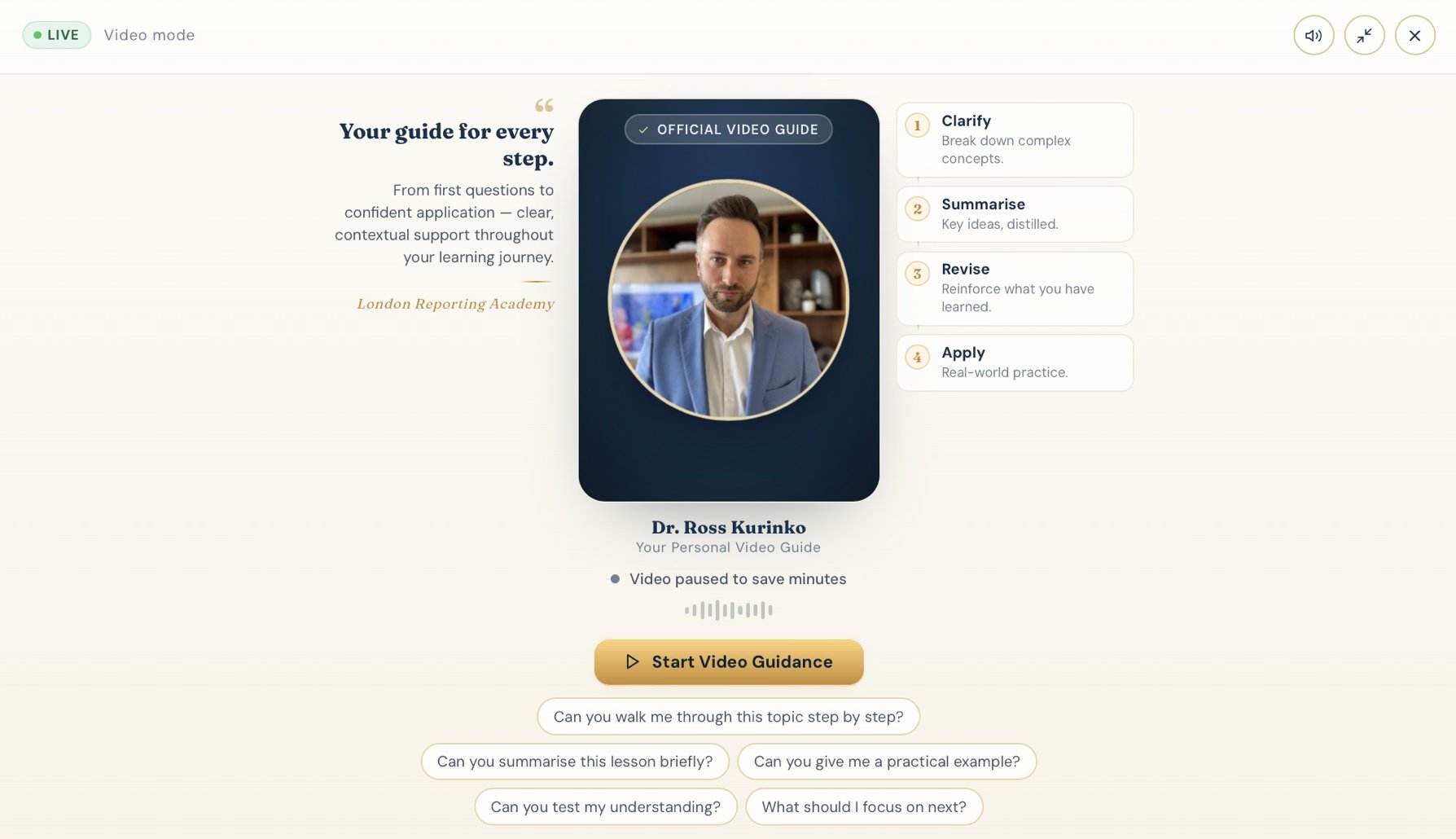
Dr. Ross Kurinko AI avatar AI Avatar
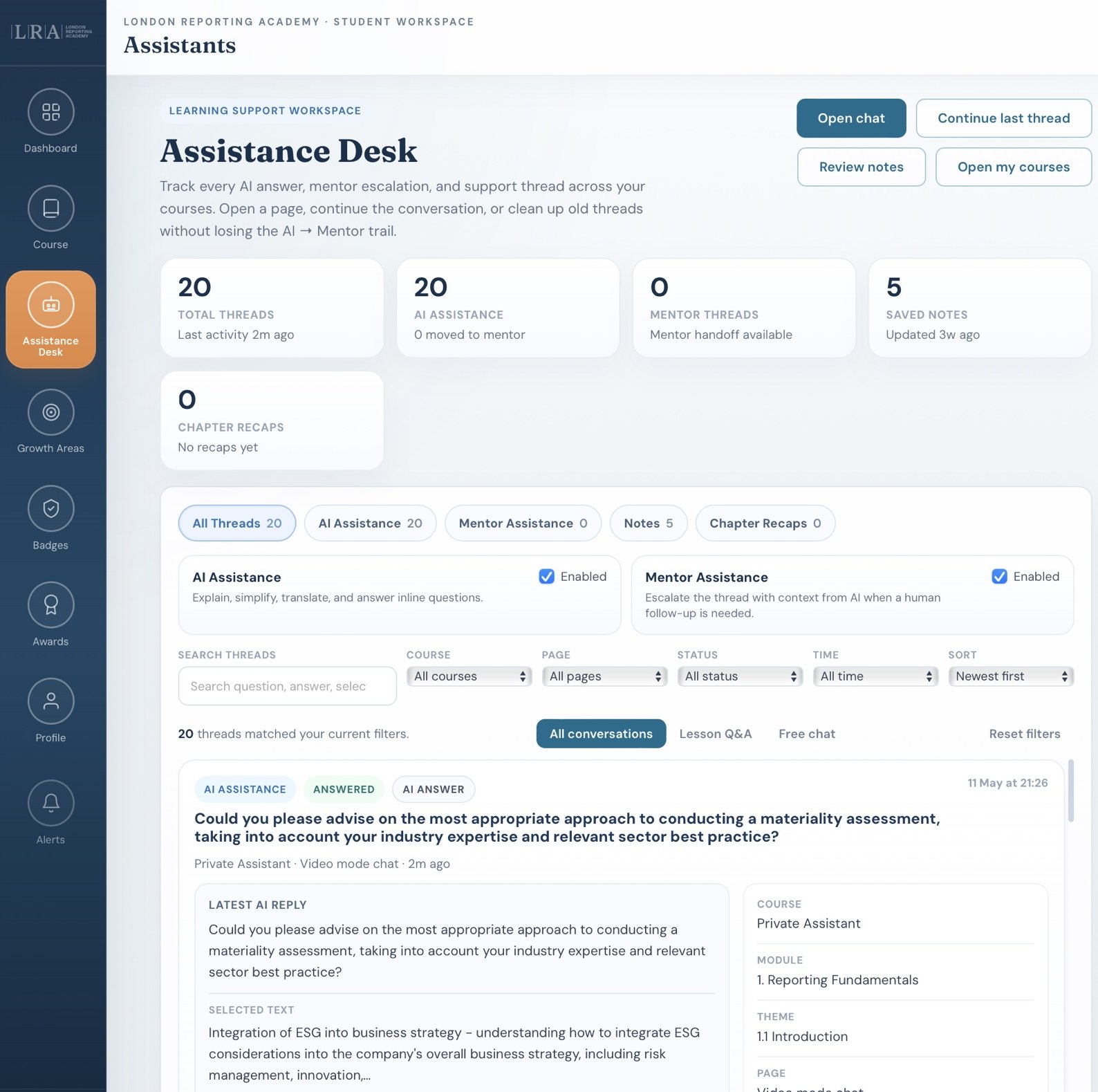
Assistance Desk Assistance Desk
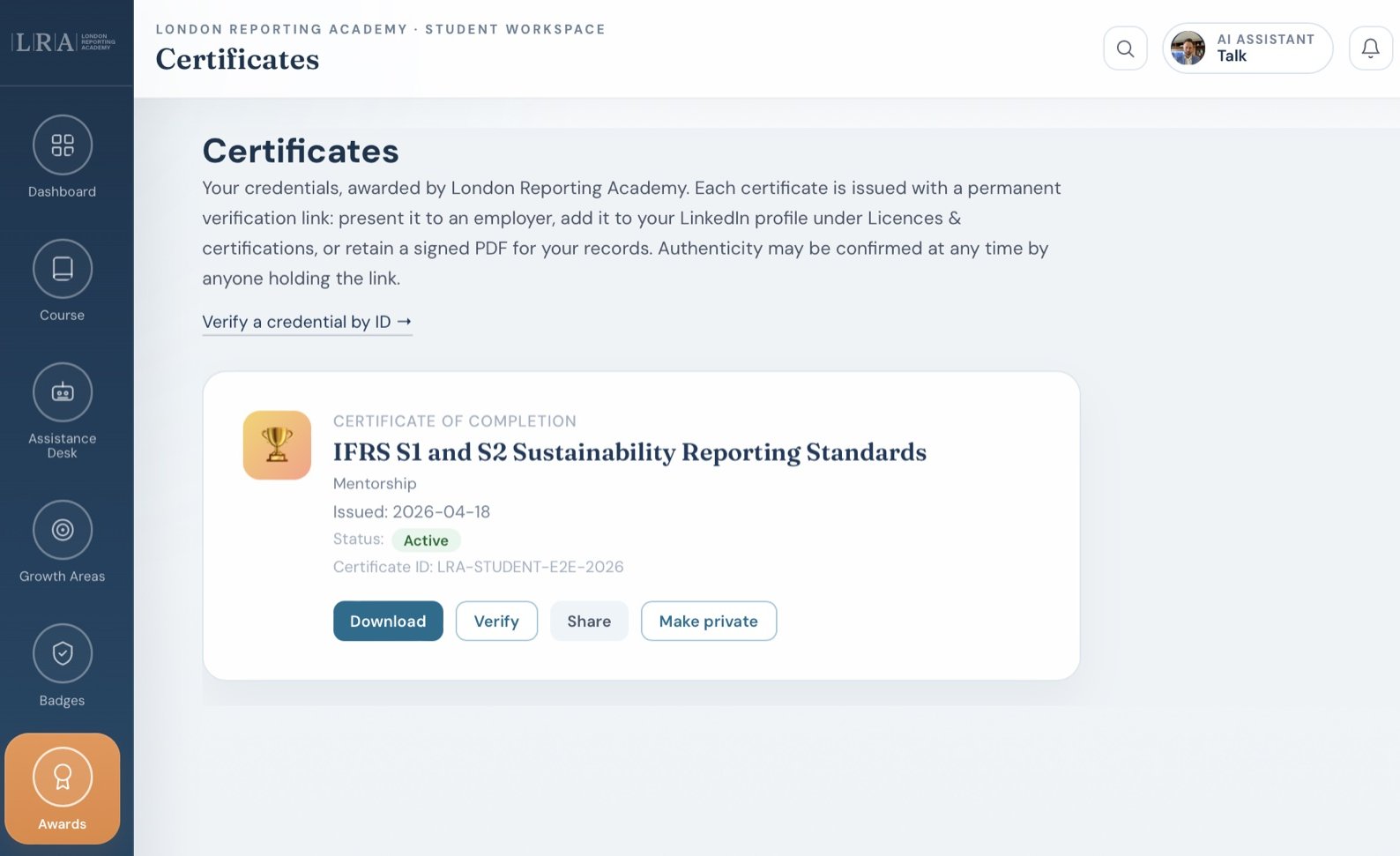
Verifiable certificate Certificates

Your dashboard, your AI Tutor, your progress — in one workspace.

What the Studio helps you do
  • Understand nature reporting in your context — the AI Tutor explains, simplifies, translates and applies TNFD (Taskforce on Nature-related Financial Disclosures), GRI 101: Biodiversity 2024, ESRS E4 and IFRS S1 concepts to your role, sector and reporting situation.
  • Practise real disclosure work — applied activities across the reporting boundary, priority locations, the DIRO register, metrics, targets and report-ready outputs.
  • Close weak areas before they become reporting gaps — Mistake Coach turns weak topics into a focused revision path.
  • Get human support when judgment matters — through the Assistance Desk, experienced ESG reporting professionals can answer questions that require practical interpretation.
  • Read and reason in your language — highlight any sentence in any lesson and the AI Tutor translates it inline into 20+ languages — Arabic, Mandarin, Hindi, French, German, Japanese, Korean, Spanish and more.
How the course works

Practitioner-led learning, accelerated by AI.

Applied activities on two running cases

Every module carries applied activities and two case pages — Northland (an operating company) and HarbourBank (a financial institution) — so you practise the reporting boundary, the priority-location screen, the DIRO register and the disclosure wording the way they appear in actual corporate, financial, NGO or advisory work.

Live faculty for judgment calls

Direct mentor time with Dr. Kurinko on 1:1 Expert Mentorship, normally online or at Canary Wharf by agreement. Live Cohort uses live online sessions with senior LRA mentors; Corporate uses on-site, online or hybrid sessions with a senior trainer. The form of contact varies; the human presence stays.

AI Tutor + AI Avatar accelerate every lesson

A frontier-model AI Tutor pinned to every page — translate, simplify, exemplify, ask a follow-up. Each module opens and closes with a short film, and when text isn't enough, push-to-talk video walkthrough by Dr. Kurinko's official AI avatar.

Mistake Coach closes the gaps

Wrong answers and weak topics auto-surface into a ranked revision list — the gap closes before it shows in your real report. On 1:1 Expert Mentorship, Live Cohort and Corporate routes, a senior mentor reviews drafts line by line on top.

Course outline

23 modules, 276 lessons — plus six optional sector laboratories.

About 145 hours of guided study across 23 core modules, each with an opening and a summary film, two case pages, applied activities and a knowledge check — plus three assessed assignments and six optional sector laboratories (around 22 further hours) for your own industry.

Chapter 01 · Foundations

From the reporting object to the global policy frame.

  • Module 00 · Getting Started and Navigating Nature-related Reporting Standards
  • Module 01 · Nature, Biodiversity and the Reporting Object
  • Module 02 · Ecosystem Services and Business Dependencies
  • Module 03 · Direct Drivers of Biodiversity Loss and the Environmental Nexus
  • Module 04 · Global Biodiversity Policy, GBF, Rights and Access and Benefit-sharing
Chapter 02 · The frameworks

TNFD, GRI 101 and the tools that support them.

  • Module 05 · TNFD Recommendations and the LEAP Assessment Process
  • Module 06 · GRI 101: Biodiversity 2024 — Disclosure by Disclosure
  • Module 07 · Supporting Systems and Tools — Choosing the Right Tool for the Job
Chapter 03 · Scoping the assessment

Boundary, locations, pathways and affected stakeholders.

  • Module 08 · Reporting Boundary: Operations, Value Chain and Portfolio
  • Module 09 · Priority Locations, Geospatial Screening and Ecological Evidence · Assignment 1
  • Module 10 · Impact, Dependency, Risk and Opportunity Pathways
  • Module 11 · Indigenous Peoples, Local Communities and Affected Stakeholders
Chapter 04 · Materiality, risk and data

From decision-useful information to metrics and controls.

  • Module 12 · Materiality and Decision-useful Nature Information
  • Module 13 · DIRO Register, Scenarios, Resilience and Financial Effects
  • Module 14 · Nature-related Data Architecture, Quality and Internal Controls
  • Module 15 · Nature Metrics, Baselines, Footprints and Valuation · Assignment 2
Chapter 05 · Governance, targets and the cross-standard view

Policies, transition plans, ESRS E4, IFRS S1 and the climate–nature nexus.

  • Module 16 · Governance, Policies, Mitigation Hierarchy and Biodiversity Offsets
  • Module 17 · GRI 102 and GRI 103: The Climate–Nature Nexus
  • Module 18 · Nature Targets and Transition Plans
  • Module 19 · ESRS E4 and Connected Sustainability Disclosures
  • Module 20 · IFRS S1, Climate Connections and ISSB Nature-related Developments
Chapter 06 · Integration and assurance

One disclosure package, defensible under scrutiny.

  • Module 21 · Integrated Nature Disclosure Package: GRI, TNFD, ESRS and IFRS
  • Module 22 · Claims, Greenwashing and Assurance Readiness · Assignment 3
Optional · Sector laboratories

Apply the method to your own industry.

  • Lab 1 · Mining, Quarrying, Construction and Infrastructure
  • Lab 2 · Agriculture, Food, Forestry, Aquaculture and Fisheries
  • Lab 3 · Energy, Utilities and Transition Minerals
  • Lab 4 · Financial Institutions, Investment and Insurance
  • Lab 5 · Real Estate, Hospitality, Transport and Cities
  • Lab 6 · Consumer Goods, Apparel, Pharmaceuticals, Technology and Professional Services
Upon completion

By the end, you will confidently.

  • Navigate the TNFD (Taskforce on Nature-related Financial Disclosures), GRI 101: Biodiversity 2024, ESRS E4 Biodiversity and Ecosystems and IFRS S1 as one system — know what each framework asks about nature, where they overlap, and how to report one set of facts across all of them.
  • Define the reporting object and boundary — direct operations, value chain and portfolio — and defend the choices in front of auditors and investors.
  • Identify priority locations with geospatial screening and ecological evidence — and know which tools and datasets are fit for the job.
  • Run the LEAP approach end to end — locate, evaluate, assess and prepare — and keep a DIRO register of dependencies, impacts, risks and opportunities, with scenarios and financial effects.
  • Build nature metrics, baselines and a data architecture with internal controls — so the numbers survive assurance.
  • Set nature targets and transition plans, apply the mitigation hierarchy — and draft an integrated, claim-safe disclosure package ready for assurance.
Who this is for

From C-level to graduate.

Same curriculum, different starting points. The Studio calibrates to your role and context from day one.

Director or C-level executive

Nature is arriving on the board agenda through TNFD adoption, CSRD and investor questionnaires. Get to working depth fast — the vocabulary, the regulatory map and the ability to direct, challenge and sign off your team's nature-related disclosure with confidence.

In-house Sustainability / ESG manager

Lead your organisation's first full nature assessment — from the reporting boundary and priority locations through the DIRO register to targets — and report it consistently under the TNFD (Taskforce on Nature-related Financial Disclosures), GRI 101: Biodiversity 2024, ESRS E4 Biodiversity and Ecosystems and IFRS S1.

Reporting / disclosure lead

Master location-specific drafting, evidence chains and assurance readiness for nature. Leave with a disclosure package you can defend in front of auditors and boards.

Consultant / advisor

Add nature and biodiversity reporting to your advisory toolkit. Translate the frameworks to clients across sectors, with six sector laboratories and a mentor-reviewed draft to anchor your practice.

Ecologist or environmental scientist moving into reporting

You already understand the science. This programme adds the reporting craft — boundaries, materiality, metrics, controls and framework wording — so your knowledge lands in a disclosure that counts.

Financial institution, investment or insurance professional

Portfolio-level nature assessment, the HarbourBank running case and a dedicated sector laboratory for banks, investors and insurers.

NGO sustainability lead, academic researcher or graduate in sustainability

Apply reporting-grade rigour to nature and biodiversity work, bring current disclosure practice into teaching or research, or bridge from theory to professional practice with a recognised LRA credential and hands-on drafting experience.

What you get

Six things most nature courses don't have.

Authored by Dr. Ross Kurinko

GRI and ISSB-IFRS S1 & S2 Certified Global Trainer, PhD, University of Cambridge, 15+ years on FTSE 100 and Fortune Global 500 disclosures. Not a third-party content licence.

Two running cases, six sector labs

Northland and HarbourBank follow you through every module; six optional sector laboratories apply the method to mining, agriculture, energy, finance, real estate and consumer sectors.

AI for speed, humans for judgment

Async LRA-team support on Guided Flex; scheduled live time with Dr. Kurinko, mentors or trainer on 1:1 Expert Mentorship, Live Cohort and Corporate routes.

AI Tutor + AI Avatar

Frontier-model AI on every lesson, anchored to your role and disclosure context. 58 module films plus push-to-talk video walkthrough by Dr. Kurinko's official AI avatar when text isn't enough.

Mistake Coach

Weak topics auto-surface into a focused revision plan — gaps close before they show in your real report.

Multilingual

Highlight any sentence in any lesson and the AI Tutor translates it inline into 20+ languages — Arabic, Mandarin, Hindi, French, German, Japanese, Korean, Spanish and more. Standards stay; language barrier disappears.

Certificate

An internationally recognised credential.

The LRA certificate goes beyond methodological knowledge. It certifies that the graduate has demonstrated practical capability to apply the TNFD (Taskforce on Nature-related Financial Disclosures) recommendations, GRI 101: Biodiversity 2024, ESRS E4 Biodiversity and Ecosystems and IFRS S1 in real nature-related disclosure scenarios — from the reporting boundary and priority locations to metrics, targets and an integrated, assurance-ready disclosure package.

Recognised among sustainability reporting professionals, the LRA certificate confirms that every graduate has gained and demonstrated the practical capability to work on real nature-related disclosures — across corporate, financial, NGO, advisory and academic contexts.

Globally verified

LRA-certified capability in nature and biodiversity reporting

  • Practical competence, not just methodology — graduates demonstrate the ability to translate the nature frameworks into report-ready disclosures.
  • Real assignments, expert review — every learner completes three assessed assignments and applied activities; on 1:1 Expert Mentorship, Live Cohort and Corporate routes, mentors review line by line on top of AI feedback.
  • Built on the current standards — the TNFD recommendations, GRI 101: Biodiversity 2024, ESRS E4 in its 2026 edition and IFRS S1, with the ISSB's nature-related developments tracked.
  • A recognised credential for sustainability teams — fits sustainability managers, reporting leads, consultants, financial institutions, NGO sustainability leads and academic researchers.
  • Verification when it matters — credentials carry a QR code, a unique credential ID and a permanent verification link auditors, employers, procurement teams and counterparties can confirm on request.
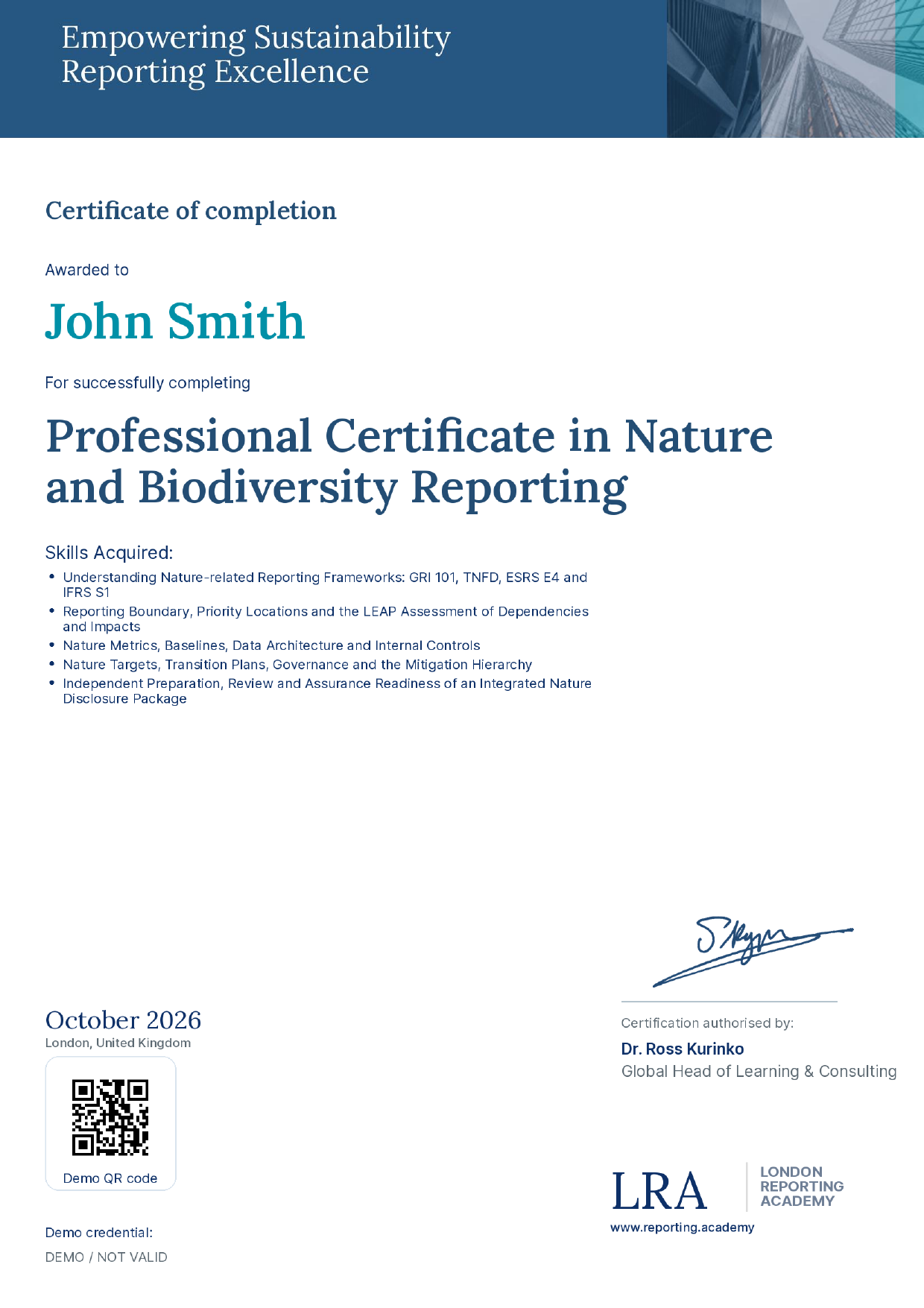
London Reporting Academy — sample certificate of completion
Dr. Ross Kurinko
Author and facilitator of the course
Ross Kurinko, Dr.

Distinguished expert with 15+ years in sustainability, ESG, integrated ESG communications and corporate reporting. PhD, University of Cambridge · GRI and ISSB-IFRS S1 & S2 Certified Global Trainer · Strategic ESG Advisor on IFRS S1 & S2, GRI and ESRS.

Throughout his career, he has been instrumental in establishing ESG governance frameworks and comprehensive disclosure systems — notably building one from scratch for one of Europe's largest railway companies — and has guided over 20 prominent businesses and educated hundreds of professionals across FTSE 100 and Fortune Global 500 disclosures.

The LRA Alumni Club

Graduate once. Stay connected — for life.

Complete this course on a Live Cohort, 1:1 Mentorship, Applied Practice or Deep Review route and you join the LRA Alumni Club — a private network of LRA graduates with continuing access to expertise, peers and tangible benefits for life — no expiry. Reporting is a profession, not a one-time course — the Club is built to support your career, not just your enrolment.

01

Annual LRA Alumni Summit

Once a year, hybrid event (London + online): case studies from peer alumni, expert panels on emerging frameworks, and structured networking. Free attendance for Club members.

02

Quarterly peer benchmarking calls

Small-group calls with Dr. Kurinko and 6–12 alumni — we work through your real reports under NDA, compare approaches, debug edge cases. The kind of conversation reporting professionals can't get anywhere else.

03

Monthly office hours with Dr. Kurinko

60-minute Zoom Q&A every month — open to Club members. Bring a specific question from your current reporting cycle, get a direct, practitioner-grade answer.

04

Alumni-only Slack channel

A private workspace where alumni from every cohort exchange tips, share intel on new regulations, and ask peer questions. The kind of network you'd otherwise need to attend a year of conferences to build.

05

30% off any future LRA course — for life

30% off any LRA course, any format, any standalone — including the five new courses launching by end of 2026 and every LRA course after that. Stack credentials across the LRA portfolio at member pricing.

06

Early access to new courses

Four weeks of early access before every public launch — plus a vote on which frameworks LRA covers next. Alumni shape the curriculum.

07

Quarterly briefings on emerging regulations

Short, member-only video briefings on what's actually changing — ESRS amendments, IFRS S1/S2 updates, SB 253 enforcement, CSRD waves. Built so you stay current without doomscrolling LinkedIn.

08

Job board & talent network

LRA quietly maintains relationships with corporate ESG teams and consultancies. When they ask for trained reporters, Club members go on the shortlist. Featured Alumni Spotlight on LRA channels every quarter.

Routes that unlock the Club: Live Cohort · 1:1 Expert Mentorship · Applied Practice · Deep Review.

Guided Flex doesn't unlock Club membership — that's deliberate. The Club is designed for learners who chose an engaged format: live time, mentorship or applied work. It's a long-term commitment from LRA, so we reserve it for learners who made an equivalent commitment.

Mapped to national occupational standards

We specialise in ESG Disclosure and Sustainability Reporting training, mapped to Skills England ST0934 and ST0748, with practical coverage of GRI, ISSB/IFRS S1/S2, ESRS/CSRD, data controls, materiality, assurance readiness and anti-greenwashing.

Trusted by professionals worldwide

Real participants. Real LinkedIn reviews.

Verified posts from sustainability practitioners who completed our programmes — open any to read the original LinkedIn comment in full.

Fees

Choose your nature-reporting learning route.

All routes include the full 23-module curriculum and the six optional sector laboratories, 12 months of Studio access, knowledge checks, three assessed assignments and a verifiable LRA certificate. Prices exclude VAT where applicable.

Guided Flex
€349+ VAT where applicable
Buy · €349
Live Cohort
On requestFirst Nature cohort forming — dates confirmed on request
Book a call
1:1 Expert Mentorship
€1,199+ VAT · 5 × 1.5h mentor sessions · online or Canary Wharf by agreement
Buy · €1,199
1:1 Expert Mentorship — Applied Practice
€2,499+ VAT · 10 × 1.5h · Deep Review · online or Canary Wharf by agreement
Buy · €2,499
Corporate Programme
On requestScope agreed during planning
Request a quote

Reporting under CSRD as well? ESRS E4 is one module of this programme; the full set of twelve ESRS standards is the Certified ESRS (CSRD) Applied course, and the complete reporter foundation across GRI, ESRS and IFRS S1/S2 is the Full Stack programme. Alumni Club members take any of them at 30% off.

Flexible payment. Need to spread the cost? Instalment plans are available — email lra@reporting.academy and we'll set one up for your enrolment. Self-funded learners and groups of three or more from the same organisation can request a 20% discount (the two don't stack). And you're covered by a 14-day cancellation right: a full refund within 14 days of purchase if you haven't yet entered the Study Studio.

Nature course — frequently asked

Course-specific questions — before you enrol.

Coverage, currency, what you'll actually leave with — answered for this nature and biodiversity course. For methodology questions that apply to every LRA course, see /how-we-deliver/.

01Coverage & curriculum

Which frameworks does this course cover — is it a TNFD course or a GRI course?

Both, and more. The programme is built around the four places nature now has to be reported — TNFD first, because it sets the assessment method the others draw on — and treats them as one system:

  • TNFD (Taskforce on Nature-related Financial Disclosures) recommendations and the LEAP assessment process — locate, evaluate, assess, prepare (Module 05), carried through the boundary, priority-location and DIRO modules.
  • GRI 101: Biodiversity 2024 (Global Reporting Initiative) — disclosure by disclosure (Module 06), with GRI 102 and GRI 103 for the climate–nature nexus (Module 17).
  • ESRS E4 Biodiversity and Ecosystems and its connected disclosures, in the 2026 edition of the ESRS (Module 19).
  • IFRS S1 (General Requirements for Disclosure of Sustainability-related Financial Information), its climate connections and the ISSB's nature-related developments (Module 20).

Module 21 then assembles one integrated nature disclosure package that satisfies all four, and Module 22 tests it against greenwashing rules and assurance readiness. The global policy frame — the Kunming-Montreal Global Biodiversity Framework, rights, and access and benefit-sharing — sits in Module 04.

How long is the course, and does it carry a CPD figure?

The 23 core modules total about 145 hours of guided study on the authors' own module estimates — reading, case pages, applied activities and knowledge checks — plus three assessed assignments. The six optional sector laboratories add around 22 hours for learners who want their own industry worked through.

We state study hours rather than a CPD figure because the curriculum does not carry an accredited CPD allocation. If your professional body accepts self-certified learning hours, the module estimates and your Studio activity record are the evidence to use.

Is the curriculum current with the latest TNFD guidance, GRI 101 and ESRS 2026?

Yes. The ESRS content follows the revised ESRS as adopted in 2026 (the edition that replaces the 2023 delegated act), GRI 101 is the 2024 standard, and the TNFD material follows the published recommendations and LEAP guidance. Each module names its sources and the boundaries of what it covers.

Where a standard changes between reviews, the Studio's expert support desk and the Mistake Coach surface the relevant updates in the affected modules.

02Is it right for me?

Do I need an ecology background — or prior reporting experience — to start?

Neither is required. Module 00 orients you in the nature-related reporting landscape, and Modules 01 to 04 build the conceptual foundation — the reporting object, ecosystem services and dependencies, drivers of biodiversity loss, and the global policy frame — before any framework-specific work begins.

Ecologists and environmental scientists can move quickly through the science and spend their time on the reporting craft; experienced reporters can do the reverse. The AI Tutor adapts depth and pace to the experience level you set in your Learning Profile.

Should I take this course — or the ESRS course or the Full Stack programme?

Take this course if nature and biodiversity is the specific capability you need — you are leading a TNFD-aligned assessment, answering GRI 101 or ESRS E4 in depth, or your investors and lenders are asking location-specific nature questions. ESRS E4 is one module here; the other eleven ESRS standards belong to the Certified ESRS (CSRD) Applied course.

Take the Full Stack programme if this is your first reporting cycle or you need the complete reporter foundation across GRI, ESRS and IFRS S1/S2 — and add nature afterwards. Alumni Club members take this course at 30% off. See the Full Stack programme page for the full picture.

Either way, completing on a Live Cohort, 1:1, Applied Practice or Deep Review route makes you a member of the LRA Alumni Club — 30% off any future LRA course — for life (Guided Flex routes don't unlock Club membership).

03What's included & how it runs

What templates and worked examples will I get?

Every module ships its own working templates — a reporting-object worksheet, a framework and tool selection matrix, boundary and priority-location worksheets, a DIRO register, a data-architecture and controls map, a target-setting template and the integrated disclosure-package outline — alongside two running cases, Northland and HarbourBank, worked on every module.

Email lra@reporting.academy and we'll send the current template list for your enrolment route.

Realistically, how long until I can lead my company's first nature assessment?

On Guided Flex, most learners work through the core modules over five to seven months at roughly five to six hours per week; a focused learner on a deadline can compress that. The course is about 145 hours of material, but the applied work on your own boundary, locations and register takes the additional time.

On 1:1 Expert Mentorship, the same depth is typically reached faster because mentor sessions accelerate the applied work on your own assessment, against your own organisation's sites, value chain or portfolio.

Who is the lead mentor on the 1:1 Expert Mentorship route?

Dr. Ross Kurinko or a senior LRA mentor, subject to mentor availability. The mentor kickoff session (a separate scheduled call before regular sessions begin) captures your reporting context and is used to assign the best-fit mentor for your route.

Your mentor engagement starts and finishes within six months of purchase. Studio access continues for the full 12-month term in parallel.

Is there an alumni programme — and what do I get?

Yes — the LRA Alumni Club. When you complete this course on an engaged format (Live Cohort, 1:1 Expert Mentorship, Applied Practice or Deep Review) you become a member of the LRA Alumni Club for life — no expiry from the day you graduate. See the full Alumni Club section on the Full Stack programme page.

Guided Flex doesn't unlock the Club — that's deliberate. The Club is reserved for learners who chose an engaged format (live time, mentorship or applied work).

What is the Applied Practice tier — and when should I choose it?

1:1 Expert Mentorship — Applied Practice is an upgrade of the 1:1 Expert Mentorship route. It adds a consulting layer on your real working documents — your reporting-boundary memo, priority-location screen, DIRO register, metrics and baselines, draft TNFD / GRI 101 / ESRS E4 disclosures. Mentor + practitioner-consultant in one engagement.

This work happens outside the Studio platform — via email, file-share and scheduled mentor sessions under explicit NDA. The Studio learning environment stays standard; your documents are not uploaded to the platform — we work them as files. Across 10 × 1.5h sessions, the mentor reviews your documents before each call and works with you on improvements during.

Choose Applied Practice if you are leading an active nature assessment or reporting cycle right now and want senior-practitioner judgement applied to your real materials — not just the frameworks.

Can this be funded through a Skills England apprenticeship (ST0934)?

Yes — there are three ways in.

1 · Through your employer (apprenticeship-led). If your team genuinely needs ESG reporting capability — a finance or sustainability function, a listed or private company, or a consultancy — ask your employer to:

  1. Search ST0934 (Corporate Responsibility & Sustainability Practitioner) on the GOV.UK Find apprenticeship training service.
  2. Shortlist 3–5 approved training providers.
  3. Ask each: "Can you deliver ST0934 with a specialist ESG Disclosure / Sustainability Reporting pathway, using London Reporting Academy as a delivery partner?"

The provider gets in touch with us and enrols you — they handle the apprenticeship administration and all programme logistics, and London Reporting Academy delivers the specialist teaching.

2 · Apprenticeship funding & an official Level 4 pathway (employer-led). If your organisation already wants to use apprenticeship funding and the official Level 4 standard, we work with approved apprenticeship providers as a specialist ESG Disclosure delivery partner — get in touch and we'll connect you.

3 · Direct / self-funded. Individuals and companies who'd rather train directly, without apprenticeship funding, can start straight away — the routes and pricing above apply.


04Practical matters

How current is the course content — and how often is it reviewed?

Every LRA curriculum is reviewed monthly. We re-read it against the standard or regulation it teaches — ESRS and EFRAG guidance, IFRS S1 & S2, GRI and the jurisdictional rules each course covers — and revise the material whenever something has actually moved. A month in which the standard didn't move is a month in which the course doesn't change; the review still happens.

The date of the most recent review is shown on this page — in the header and under the course outline. It's a record rather than a badge: it moves only when a review has been done, and it is removed rather than quietly carried forward if one lapses.

Because every route runs inside the Study Studio, a revision reaches everyone with active access — there's no superseded edition to be stuck on.

Is there a final exam — how is the work assessed?

No academic-style multiple-choice exam. Across every route, assessment is built around applied disclosure work: you draft, structure and defend disclosures the way you'd produce them in a real reporting environment.

  • On every route, your homework is reviewed by people — by the LRA team on Guided Flex, Live Cohort and Corporate Programme, and by your mentor on 1:1 Expert Mentorship. Along the way, the Studio's AI feedback flags missing data, weak logic and thin evidence in your drafts, and the Mistake Coach groups gaps by topic.
  • On 1:1 Expert Mentorship, your mentor also reviews your disclosure drafts line by line in private sessions. Live Cohort adds live online sessions with senior LRA mentors in a shared group, and a Corporate Programme is delivered to your team by a senior trainer.

GRI Standards Certified Training follows the GRI partner format — see the GRI course page.

What do 1:1 Expert Mentorship sessions actually cover?

Private sessions move you from theory to your own reporting context. Depending on your goals and the mentor kickoff (a separate scheduled call before regular sessions begin), they typically include:

  • clarifications on standards, regulations and disclosure requirements
  • line-by-line review of your programme and course disclosure drafts and assignments
  • discussion of real-life reporting examples and best practice
  • personalised assignments and feedback
  • additional materials, templates and resources
  • support with developing an ESG reporting roadmap
  • advice on data collection, validation and stakeholder communication
  • adaptation of the curriculum to your specific industry, region or learning objectives

Sessions are normally held online so learners across time zones can join. For London-based learners, in-person 1:1 sessions at our Canary Wharf, London office can be arranged by prior agreement, subject to mentor and room availability.

I've bought a course on 1:1 Expert Mentorship — what happens next?

You get immediate Studio access plus a dual onboarding sequence:

  • Studio onboarding — the same flow as Guided Flex. Your Learning Profile (role, sector, jurisdiction, reporting context, preferred output language) feeds the AI Tutor.
  • Mentor kickoff — a separate scheduled call with Dr. Ross Kurinko or a senior LRA mentor (subject to mentor availability) before regular sessions begin. The mentor captures your real objectives, current draft work and organisational challenges, and tailors the rest of the route around them.

After kickoff you receive a scheduling link to book sessions at times that work for you. You can begin and complete your mentor engagement within six months of purchase.

Can I start with Guided Flex and add 1:1 Expert Mentorship later?

Yes. Format upgrades from Guided Flex to 1:1 Expert Mentorship are available on an individual basis — your Studio progress and Learning Profile carry over, so you keep the work you've already done and layer mentor sessions on top.

Email lra@reporting.academy to review options for your enrolment.

What if I can't finish within 12 months?

Standard Studio access is 12 months — usually comfortable, since the materials are concise and applied rather than padded.

If life intervenes, contact lra@reporting.academy: a further 12-month extension is available for 25% of the original fee.

Does the Studio work in my language?

Yes. The Study Studio and AI Tutor read and reason in eight languages — Arabic, English, French, German, Italian, Dutch, Russian, Spanish.

Your output language is set in your Learning Profile, so explanations, drafts and feedback come back in your preferred language. Standards quotations and regulatory text are preserved in their official versions; everything else adapts.

Are there discounts for self-funded learners or groups?

Yes — two discounts on the standard course fee:

  • Self-funded individuals — if you're paying personally rather than through a company or organisation, you can request a 20% discount. Email lra@reporting.academy before you enrol.
  • Groups — when three or more people from the same organisation enrol on the same course, the group qualifies for 20% off, regardless of who settles the invoice.

The two don't stack — the maximum on any enrolment is 20%. Three self-funded colleagues enrolling together get 20%, not 40%.

This is a simple headcount discount on a standard course — not the Corporate Programme. The Corporate Programme is a bespoke engagement: tailored materials, a dedicated trainer and scoped delivery. A group discount just means several people from one organisation taking the same standard course. See the Corporate Programme →

Can I pay in instalments?

Yes — and it's interest-free, with no charge for spreading the cost. As a rule of thumb, fees up to £1,000 are split into two payments, and larger fees step up on the same basis — broadly one further instalment for each additional £1,000 or so. We'll confirm the exact split for your course and fee — email lra@reporting.academy and we'll set up your plan.

Your first payment confirms your enrolment and opens your Study Studio access straight away. Each subsequent instalment is normally due one month after the previous due date, according to the payment schedule agreed with you.

Instalment plans follow the same cancellation rules, pro-rata to the amount paid — see the refund question below.

What's your refund / cancellation policy?

14-day cancellation right. If you haven't yet entered the Study Studio, you can cancel within 14 days of purchase for a full refund (UK consumer statutory right under the Consumer Contracts Regulations 2013). Email lra@reporting.academy.

Once you enter the Studio, that statutory right ends — at checkout you give explicit consent to immediate digital access. After that, refunds are at LRA's discretion, considered on individual circumstances.

  • 1:1 Expert Mentorship — your mentor engagement starts and finishes within 6 months of purchase. If LRA can't assign a senior mentor and schedule your kickoff within roughly four weeks, the mentorship component is pro-rata refunded (Studio access stays for its full 12-month term). Sessions not commenced within the 6-month window lapse; extensions by written agreement only.
  • Live Cohort — if a cohort doesn't run, the cohort layer is fully refunded or rolled to the next intake (Autumn / Spring). Studio access stays.
  • Instalment plans — same rules, pro-rata to the amount paid.
  • Corporate Programme — governed by your enrolment agreement.

Postponements (extending Studio access rather than refunding) can usually be arranged — contact us before opening a refund case.

Full terms: Terms of Use §8. Governed by the laws of England and Wales.

Still have a question we haven't covered? Email lra@reporting.academy — a real human reads every message.

Access starts on day one

Ready to report nature at practitioner depth?

Enrol on a course and the workspace, the AI Tutor — and your route's human support — go live the same day. We're never AI-only.