Take the Full Stack programme if this is your first reporting cycle — your company is doing CSRD, climate or sustainability reporting for the first time. Even if assurance looks like a "narrow" framework on paper, a first-time reporter needs more mentor time, broader context and the full reporter foundation. A single standalone course will leave gaps you'll only spot under deadline.
Also take Full Stack if you're new to sustainability reporting in general, or you're tackling a multi-framework programme (EU + global + jurisdictional) and want one enrolment that holds it all together — with four certificates and read-mode access to the Assurance and Materiality Assessment courses.
Take this standalone course if you've already delivered at least one reporting cycle and now want to move into assurance of sustainability reports — ISSA 5000, ISAE 3000, AA1000AS. You know the territory — you just want the focused practitioner mentorship on this specific standard.
Or take this standalone course if you have a functional background (finance, audit, risk, strategy, IR) and want to layer this reporting profile on top of it — e.g. an audit, internal-control or risk professional extending into sustainability-report assurance. Your functional anchor gives you the structure a standalone course assumes.
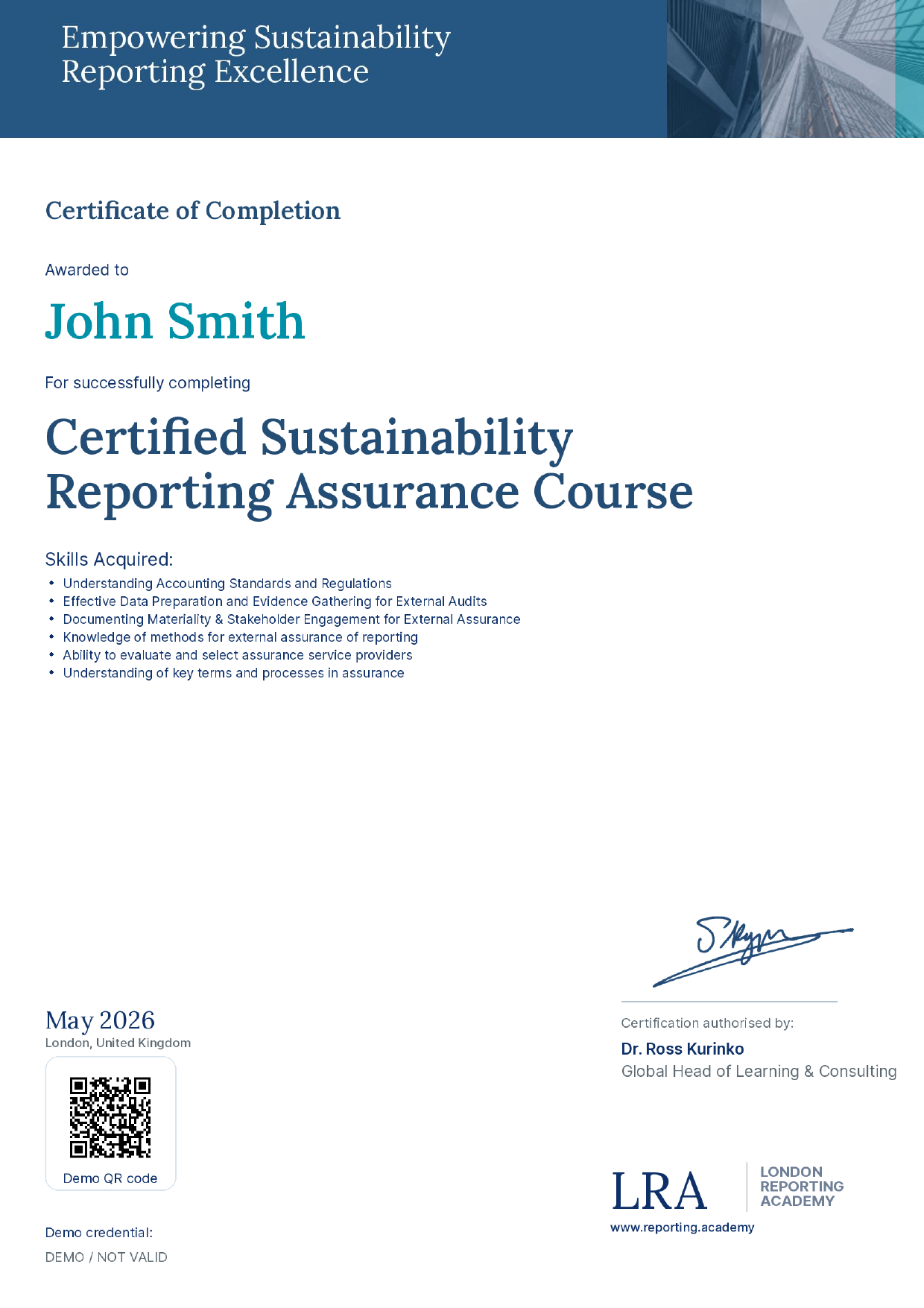
Full Stack starts higher (from £1,049 Guided Flex, up to £2,249 Applied Practice) than this standalone course (from £199 Guided Flex, up to £1,495 Applied Practice) but includes four certificates — Full Stack diploma + ESRS + IFRS S1/S2 + official GRI Standards Certified — plus read-mode access to the Assurance and Materiality Assessment courses. See the Full Stack programme page for the full picture. Either way, completing on a Live Cohort, 1:1, Applied Practice or Deep Review route makes you a member of the LRA Alumni Club — 30% off any future LRA course — for life (Guided Flex routes don't unlock Club membership).