VSME — the EU Voluntary Standard for non-listed SMEs

Certified VSME Sustainability Reporting Course

4.9/5 average satisfaction score across all LRA courses
Delivered in English · inline translation into 20+ languages

Your bank, your largest customer or your insurer has started asking for sustainability data. The VSME is the standard written so that a small or medium-sized company can answer them once, properly, and without being pulled into full CSRD reporting. This course takes you through the whole standard — Basic Module, Comprehensive Module, Annex II — and out the other side with a finished report. Practitioner-led by Dr. Ross Kurinko, human-in-the-loop on every learning route.

Best if:
  • You are an SME receiving ESG questionnaires from banks, customers or investors.
  • You advise SMEs — accountant, auditor, consultant — and need a repeatable service line.
  • You want a report that is proportionate: no double materiality, no mandatory assurance.
4.9/5 Student Rating 9,600+ Graduates across EMEA GRI Certified Trainer MarCom Gold Award Winner 15+ Years ESG Experience

The standard that lets a smaller company answer once — and stop.

The VSME is the EU's voluntary sustainability reporting standard for non-listed micro, small and medium-sized undertakings. It exists because SMEs were being asked for CSRD-grade data they were never in scope to produce. This course is a complete, practitioner-built path through it — built on 15+ years of ESG-reporting practice and delivered inside the AI-powered LRA Study Studio, with real human support on every route.

What you leave with
A completed VSME report · a datapoint-by-datapoint evidence file · a repeatable annual cycle · a verifiable LRA certificate
Why this lands on your desk

You are not in scope for CSRD. You are in someone's value chain.

That is the whole problem the VSME was written to solve — and the sequence almost every SME goes through.

1

The request arrives

A bank renewing your facility, a large customer running supplier due diligence, or an insurer sends a sustainability questionnaire. Often several, all different.

2

The obvious answers fail

Full ESRS reporting is disproportionate and expensive. Ignoring the request risks the facility, the contract or the renewal. Answering each questionnaire separately never ends.

3

You publish a VSME report

One proportionate report, built to a recognised EU standard — Basic Module alone, or Basic plus Comprehensive when your counterparties need more.

4

You point everyone at it

The next questionnaire gets one answer: the report. Each year you refresh the data rather than start again — which is what modules 11 to 13 of this course build.

No basic. No advanced. Just report-ready.

Many training providers split sustainability reporting into "basic", "advanced" or "professional" levels — or confine it to one methodology, or to a single standard taught in isolation. We don't. Our goal is different: every LRA graduate should be able to produce a real, defensible sustainability report — from scoping and data collection to the finished, issued document.

The difference is in how you get there. The AI-powered LRA Study Studio adapts to your background, role, sector and current level of maturity — and so do the people behind it. A finance director in a 40-person manufacturer, an accountant serving thirty SME clients and a sustainability lead in a mid-cap do not need the same explanations — but they all need the same professional outcome: a report their counterparties accept and their board can sign.

"Proportionate does not mean casual. A VSME report still has to be right — and it still has to survive the questions a lender asks about it."
What sets this course apart

Five reasons it's not another VSME webinar.

The whole standard — not the summary slide

Every Basic Module disclosure B1 to B11 and every Comprehensive Module disclosure C1 to C9, plus Annex II for banks and investors. Most VSME training stops at "there are two modules". This one works through each datapoint.

Built by senior practitioners

Designed by Dr. Ross Kurinko — GRI Certified Global Trainer, PhD, University of Cambridge, 15+ years on FTSE 100 and Fortune Global 500 disclosures — and delivered by seasoned ESG practitioners. Not third-party content licensors.

You finish with a report, not notes

Three full modules are dedicated to running the cycle: launching and planning it, collecting and validating the data, then reviewing, approving, issuing and maintaining the report. That is the part most courses leave out.

Human-in-the-loop across every route

Across every route — including Guided Flex — you can hand the AI thread to a real human. Async support from the LRA team, or scheduled live time with Dr. Kurinko, mentors or trainer. Never AI-only.

One expert curriculum, four professional learning routes

Same curriculum, different cadences and audiences. Pick what fits your role, your schedule and your budget. Multilingual: inline AI translation into 20+ languages across the curriculum, on top of every format.

How the standard is built

Two modules. You decide how far you go.

The Basic Module is the floor for any VSME report. The Comprehensive Module is added when your counterparties — usually lenders and larger customers — need more. The course teaches you to choose deliberately, and to defend the choice. Each disclosure below is described in the course's own words and anchored to its exact Annex I paragraph; these are not reproductions of EFRAG's official titles.

Basic Module

B1–B11 — the report every VSME reporter produces

General basis for preparation, the environmental metrics and the workforce metrics. This is the module a bank or customer questionnaire is normally satisfied by.

  • B1Basis for preparation
  • B2Practices, policies and future initiatives for transitioning towards a more sustainable economy
  • B3Energy and greenhouse gas emissions
  • B4Pollution of air, water and soil
  • B5Biodiversity
  • B6Water
  • B7Resource use, circular economy and waste management
  • B8Workforce — general characteristics
  • B9Workforce — health and safety
  • B10Workforce — remuneration, collective bargaining and training
  • B11Convictions and fines for breaches of anti-corruption and anti-bribery law
Comprehensive Module

C1–C9 — added when your counterparties need more

Strategy, transition and climate risk, deeper workforce and human-rights information, and the two disclosures lenders ask for most: sector revenues and governance gender diversity.

  • C1Strategy: business model and sustainability-related initiatives
  • C2Description of practices, policies and future initiatives for transitioning towards a more sustainable economy
  • C3GHG reduction targets and climate transition
  • C4Climate risks
  • C5Additional (general) workforce characteristics
  • C6Additional own workforce information — human rights policies and processes
  • C7Severe negative human rights incidents
  • C8Revenues from certain sectors and exclusion from EU reference benchmarks
  • C9Gender diversity ratio in the governance body
The part nobody tells SMEs about

The value chain cap — why the cap is a ceiling, not a shopping list

Annex II sets a maximum on what a company reporting under the Accounting Directive may ask a protected undertaking to provide for that reporting purpose — nine rows for undertakings with 10 employees or fewer, twenty-three rows above that. Modules 02 and 10 teach it at row level: the two-part protected-undertaking test, the self-declaration, how to map a “VSME complete” questionnaire back to the exact rows it is actually entitled to, and the statutory right to decline the rest — with the model response letter to send.

The course teaches the decision method and is explicit that the legal instrument behind the cap is still moving: Module 01 tracks adoption, scrutiny, Official Journal publication, entry into force and first application separately, and instructs you to reconfirm the citation before relying on it in real correspondence.

See Modules 02 & 10 →
Controlled position

What the Voluntary Standard does not require.

Most of the fear around SME sustainability reporting comes from assuming CSRD obligations apply. They do not. Four things you can stop worrying about — taught in the course, and worth knowing before you enrol.

Double materiality

It does not require an ESRS-style double materiality assessment. The course uses a proportionate relevance and applicability process suited to the Voluntary Standard.

Independent assurance

It does not require independent assurance. Information should still be supported, reviewed and verifiable — and the course builds the evidence file that makes it so.

Public availability

It does not require every sustainability report to be public. An undertaking may prepare a controlled report for identified business counterparties.

Answering every questionnaire

It does not make every sustainability questionnaire mandatory. The purpose, protected status, exact Annex II mapping and any separate legal or contractual basis must be assessed before the response decision.

Choose your format

One expert curriculum, four professional learning routes.

Same materials, same standard — different cadences, different audiences. Human support is available on every route.

Guided Flex

Learn on your schedule, never on your own.

Flexible learning through the AI-powered LRA Study Studio, with structured assessments and specialist ESG reporting professionals available to answer your questions through the platform.

13 modules · 91 lessons · ≈45 hours of structured study · 12 months Studio access · human question support through the platform · final assessments
€249+ VAT where applicable
Enrol & Pay
Live Cohort

Learn alongside peers, guided by senior ESG mentors.

Everything in Guided Flex, plus scheduled live online sessions, cohort-based progression, mentor-reviewed exercises and peer learning around real VSME reporting problems — most of them shared across every SME in the room.

13 modules · ≈45 hours of structured study · live online sessions · mentor-reviewed exercises · peer cohort · 12 months Studio access
Intakes: first VSME cohort is forming — dates confirmed on request
On requestNext intake pricing by arrangement
Reserve a seat
1:1 Expert Mentorship

Private expert guidance for your reporting context.

Everything in Guided Flex, plus direct mentor sessions with Dr. Ross Kurinko or a senior LRA mentor (subject to mentor availability), personalised guidance and line-by-line review of your draft VSME disclosures.

13 modules · ≈45 hours of structured study · private mentor sessions · personalised guidance · draft review · 12 months Studio access
€1,199+ VAT · 5 × 1.5h mentor sessions · online or Canary Wharf by agreement
Enrol & Pay
1:1 Expert Mentorship — Applied Practice

Blended study + consulting on your real first report.

Everything in 1:1 Expert Mentorship, plus your existing working documents are reviewed alongside the mentor sessions — data collection workbook · evidence file · draft VSME disclosures · the counterparty questionnaires you are trying to answer. Mentor + practitioner-consultant in one engagement, working with your real cycle via email, file-share and scheduled mentor sessions under NDA. Studio platform stays standard — your documents are not uploaded to the platform; we work them as files.

10 × 1.5h mentor sessions · your working documents in scope (NDA) · improved outputs returned · 12 months Studio access
€1,749+ VAT · 10 × 1.5h · Deep Review · online or Canary Wharf by agreement
Enrol & Pay

What's included on each route

Every route includes the same expert curriculum, real human support and one verifiable certificate — the table shows what each format adds on top.

Scroll sideways to compare →

What you get Guided Flex€249 Live CohortOn request 1:1 Expert Mentorship€1,199 Applied Practice€1,749
12 months Study Studio access Included Included Included Included
Full VSME curriculum — Basic B1–B11, Comprehensive C1–C9, Annex II Included Included Included Included
13 graded module assessments Included Included Included Included
Real human supportAsk questions through the platform and get practical, timely replies from experienced ESG professionals, so you can keep moving through the course. Included Included Included Included
Peer cohort + scheduled live online sessions Not included Included Not included Not included
Private 1:1 mentor sessions (online or Canary Wharf by agreement) Not included Not included Included Included
Line-by-line review of your draft VSME disclosures Not included Not included Included Included
Your real working documents reviewed, under NDA Not included Not included Not included Included
LRA Alumni Club membership Included Included Included
Verifiable certificate Core certificate + cohort recognition + mentorship recognition + mentorship recognition

Corporate Programme is bespoke and quoted on request — see below. Not sure which route fits your reporting context?

For teams and for advisers

Train a finance team — or a whole client portfolio.

Bespoke VSME programmes for SME finance and operations teams, and for accountancy firms, audit practices and consultancies setting up a VSME service line for their SME clients. Delivered online, on-site, in London, or as a hybrid programme. Price on request.

View corporate programmes →
If your scope changes

Growing into CSRD? The ESRS course is the next step, not a restart

The VSME shares its logic — and much of its data — with the full European standards. If your company crosses into CSRD scope, or your clients do, the Certified ESRS (CSRD) course picks up exactly where this one stops: double materiality, all 12 ESRS and assurance readiness. Complete this course on an engaged route and Alumni Club pricing applies to it.

See the ESRS course
How each route works

The same VSME programme, shaped to four professional paths.

From day one to certificate — what the journey looks like on each route.

Guided Flex

Independent learning, with human support through the platform.

Best for: finance and operations people in an SME who have to fit this around the day job.

  • Onboarding — tell the Studio your role, sector, company size and who is asking you for data.
  • Studio access — your personalised learning workspace opens.
  • Core learning — 13 modules, applied exercises and structured assessments.
  • LRA support team — experienced ESG professionals provide practical, timely replies through the platform, so you can keep moving through the course.
  • Certificate — issued on completion of the final assessments.
Enrol in Guided Flex →
Live Cohort

Studio first, cohort layered on.

Best for: people who want to see how other SMEs are answering the same questionnaires.

  • Onboarding — tell the Studio your role, sector, company size and who is asking you for data.
  • Start in the Studio today — no waiting for the next intake to begin.
  • Core certificate path — progress through the curriculum at your pace.
  • Cohort intake — join the next scheduled cohort — the first VSME cohort is forming now.
  • Live sessions + cohort recognition — scheduled mentor sessions; your certificate is updated to show cohort participation.
Reserve a cohort seat →
1:1 Expert Mentorship

Dual onboarding, private mentor time.

Best for: anyone producing a first VSME report on a deadline set by a lender or a customer.

  • Studio onboarding — tell the Studio your role, sector, company size and who is asking you for data.
  • Mentor kickoff — dedicated session to map your reporting context, counterparties and deadline.
  • Personalised plan — your mentor calibrates Basic-only or Basic plus Comprehensive, and the data you actually have.
  • Private sessions + draft review — Mentor time with Dr. Kurinko or a senior LRA mentor (subject to mentor availability), online or at Canary Wharf by agreement; line-by-line drafts.
  • Certificate + mentorship recognition — your certificate is updated to show 1:1 expert mentorship.
Choose 1:1 Expert Mentorship →
Corporate Programme

Bespoke programme for your team or your client base.

Best for: SME finance teams reporting together — and advisory firms building a VSME service line.

  • Request a quote — share scope, team size and reporting context.
  • Scope alignment — we map the Basic and Comprehensive modules to your sector and counterparties.
  • Custom programme design — modules, exercises and cases built around your team or your client portfolio.
  • Delivery — online, on-site, Canary Wharf London or hybrid blend.
  • Team certificates — per-learner credentials, each showing Corporate Programme participation.
Discuss a programme →
Want the full learning model? Dive into onboarding, the Study Studio, human support, certificates and the full delivery model on a dedicated page.
How We Deliver Our Courses →
London Reporting Academy
Study Studio · VSME

Your VSME workspace — the standard, AI and expert support in one place.

The expert-built VSME curriculum runs inside the AI-powered LRA Study Studio: a purpose-built workspace where you learn the standard, practise the disclosures, check your understanding and get support — without leaving the course environment.

It is built for sustainability reporting — not generic online learning. The Studio combines expert-built VSME content, a specialist AI Tutor, Dr. Kurinko's AI Avatar, applied assessments, growth-area tracking and access to experienced ESG reporting professionals through the platform.
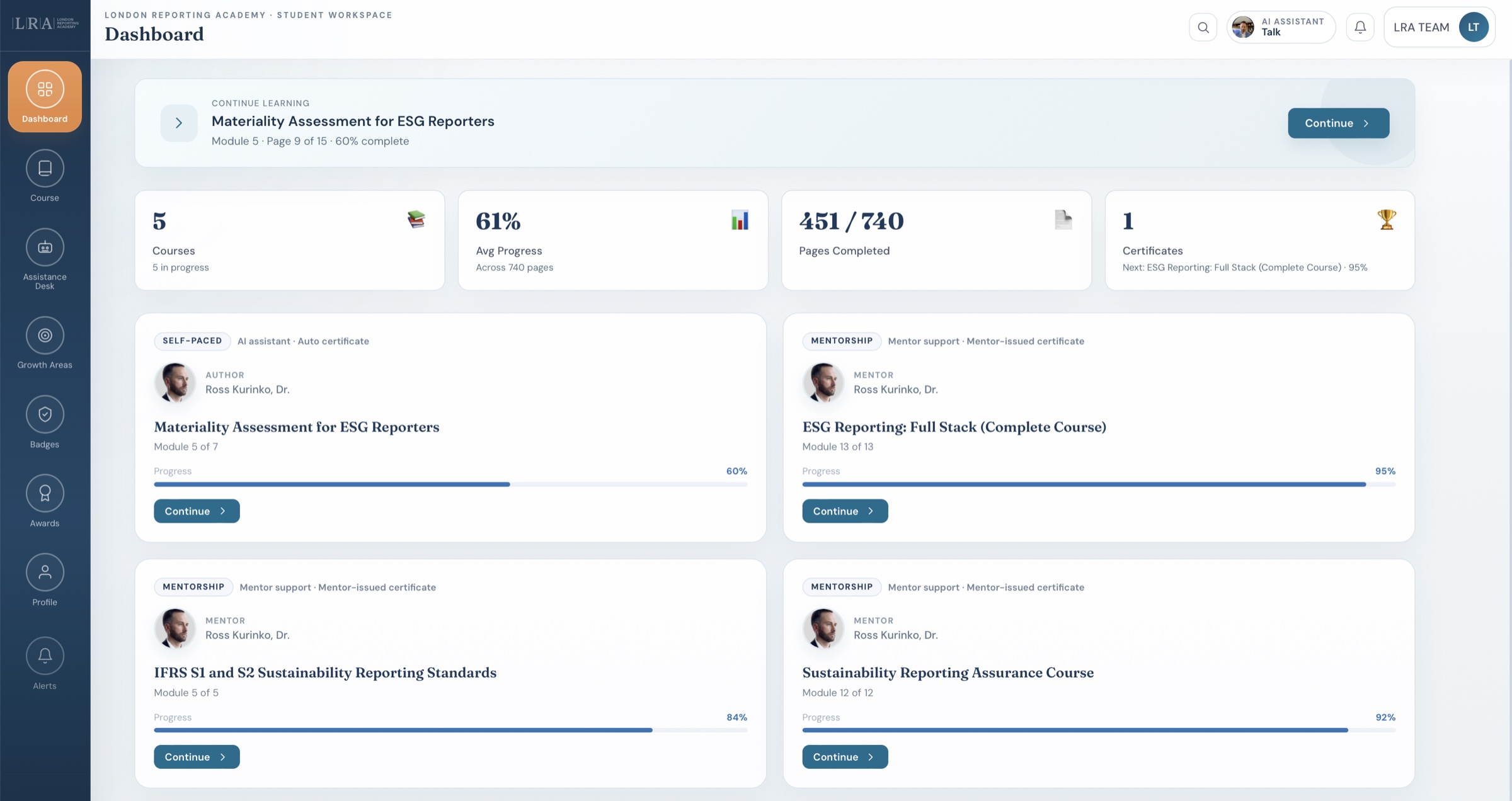
cabinet.reporting.academy/student/dashboard
Study Studio dashboard preview
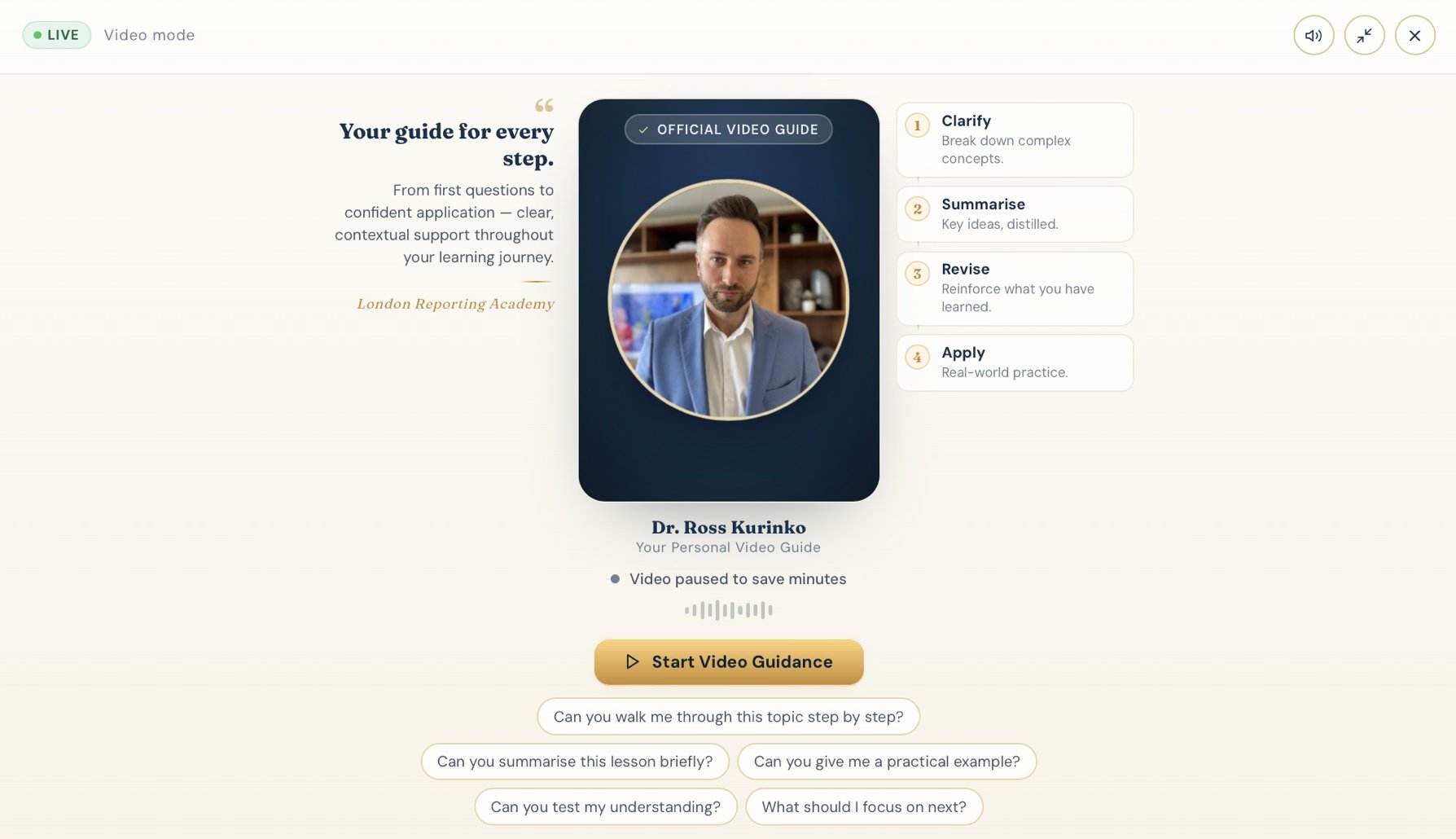
Dr. Ross Kurinko AI avatar AI Avatar
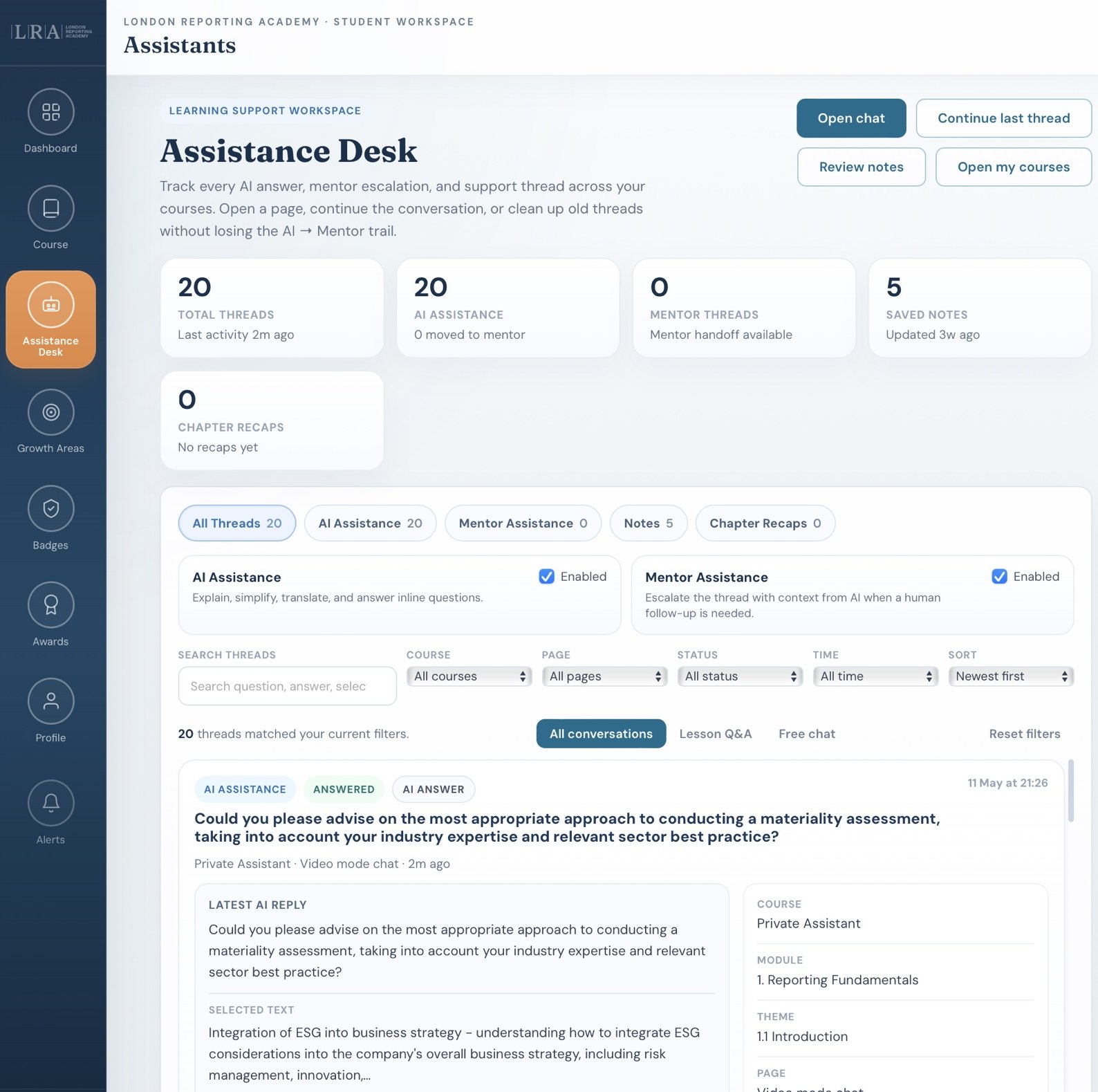
Assistance Desk Assistance Desk
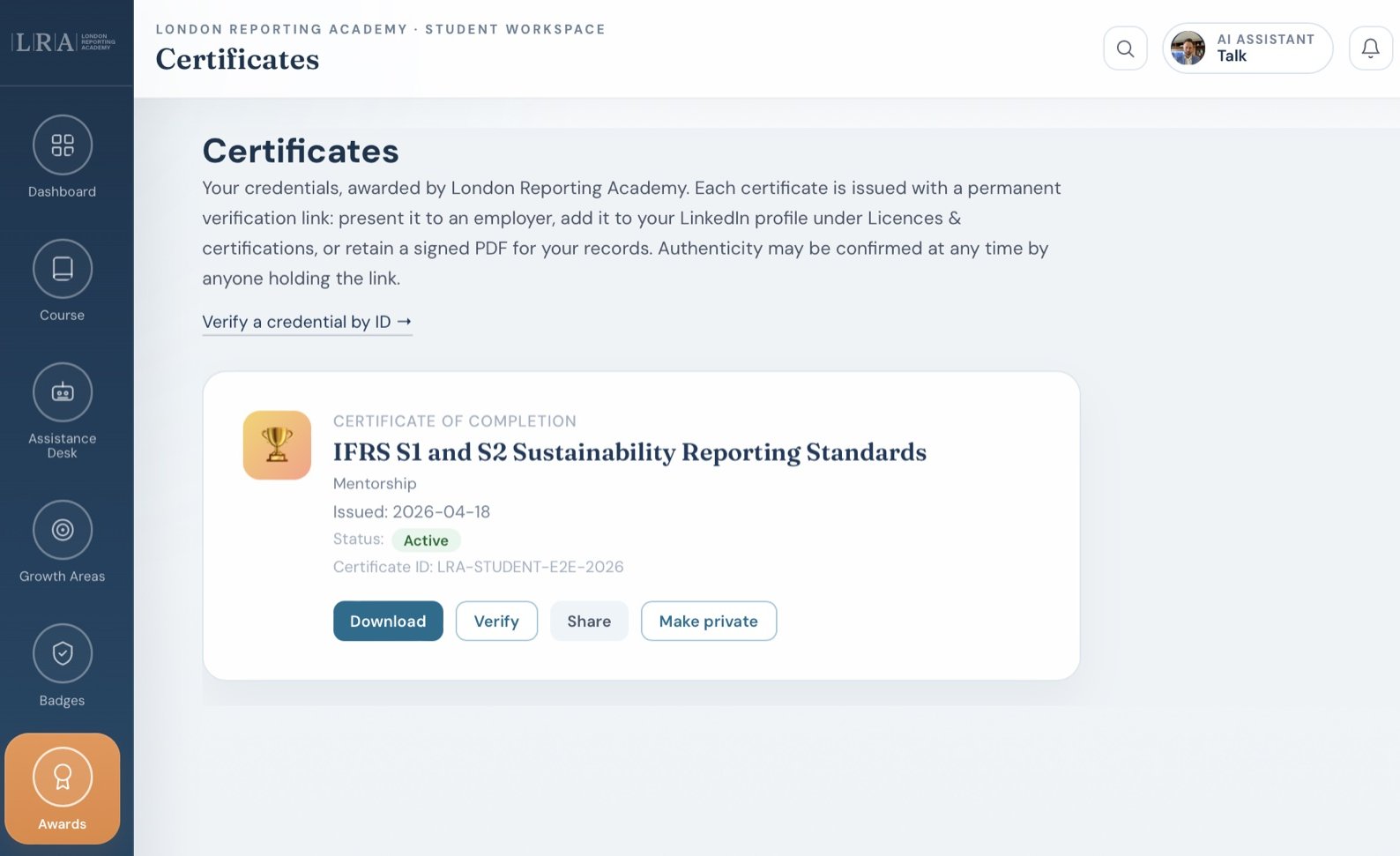
Verifiable certificate Certificates

Your dashboard, your AI Tutor, your progress — in one workspace.

What the Studio helps you do
  • Understand the standard in your context — the AI Tutor explains, simplifies, translates and applies each disclosure to your role, sector and company size.
  • Practise the real deliverables — applied tasks across the applicability matrix, the energy and emissions workbook, the evidence register and the Annex II mapping.
  • Close weak areas before they become reporting gaps — Mistake Coach turns weak topics into a focused revision path.
  • Get human support when judgment matters — through the Assistance Desk, experienced ESG reporting professionals can answer questions that require practical interpretation.
  • Read and reason in your language — highlight any sentence in any lesson and the AI Tutor translates it inline into 20+ languages — Arabic, Mandarin, Hindi, French, German, Japanese, Korean, Spanish and more.
How the course works

Practitioner-led learning, accelerated by AI.

One case company, all the way through

You work a manufacturing group with a foreign subsidiary through the whole cycle — and a second, eight-person case for the micro reliefs. Every module ends in a real deliverable: a register, a workbook, a memo, a mapped questionnaire. Not a multiple-choice quiz.

Live LRA mentors for judgment calls

Direct mentor time with Dr. Kurinko on 1:1 Expert Mentorship, normally online or at Canary Wharf by agreement. Live Cohort uses live online sessions with senior LRA mentors; Corporate uses on-site, online or hybrid sessions with a senior trainer. The form of contact varies; the human presence stays.

AI Tutor + AI Avatar accelerate every lesson

A frontier-model AI Tutor pinned to every page — translate, simplify, exemplify, ask a follow-up. When text isn't enough, push-to-talk video walkthrough by Dr. Kurinko's official AI avatar. Not "chatgpt" with an ESG hat on.

Checkpoints and gates, not just lessons

The course is built around formal checkpoints — report assembly checkpoints, a project launch gate, a draft readiness gate and a final completion gate — plus 12 knowledge-check questions per module at a 75% pass mark. You cannot drift to the end with gaps.

Course outline

13 modules, 91 lessons — scope to signed report.

Roughly 45 hours of structured study. 91 lessons across 13 modules, 156 knowledge-check questions (12 per module, 75% pass mark), applied workshops on a live case, and 13 graded module assessments closing your progression from eligibility test to issued report.

Chapter 01 · Scope and protection

Why the request reached you — and what you are entitled to refuse.

  • Module 01 · Sustainability reporting landscape, regulatory framework and current status · 7 lessons · graded assessment
  • Module 02 · Protected undertakings and the value chain cap · 6 lessons · graded assessment
Chapter 02 · The standard and the project

How the Voluntary Standard is built, and how to set the project up.

  • Module 03 · Architecture of the Voluntary Standard · 6 lessons · graded assessment
  • Module 04 · Reporting principles and project set-up · 5 lessons · graded assessment
Chapter 03 · Basic Module (B1–B11)

The report every VSME reporter produces, disclosure by disclosure.

  • Module 05 · Basic Module: B1 and B2 · 5 lessons · applied workshop · graded assessment
  • Module 06 · Basic environmental metrics: B3–B7 · 8 lessons · graded assessment
  • Module 07 · Basic social and governance metrics: B8–B11 · 6 lessons · applied workshop · graded assessment
Chapter 04 · Comprehensive Module (C1–C9)

Strategy, transition, climate risk and the disclosures lenders ask for.

  • Module 08 · Comprehensive Module: C1–C4 · 5 lessons · applied workshop · graded assessment
  • Module 09 · Comprehensive Module: C5–C9 · 6 lessons · applied workshop · graded assessment
Chapter 05 · Annex II and financial users

The cap at row level, banks and investors, and producing the report.

  • Module 10 · Annex II, financial users and report production · 8 lessons · graded assessment
Chapter 06 · Running the reporting cycle

Launch it, collect the data, draft it, approve it, issue it, keep it.

  • Module 11 · Launching and planning the first reporting cycle · 9 lessons · graded assessment
  • Module 12 · Collecting, validating and drafting the sustainability report · 10 lessons · graded assessment
  • Module 13 · Reviewing, approving, issuing and maintaining the sustainability report · 10 lessons · graded assessment
Upon completion

By the end, you will confidently.

  • Establish whether the Voluntary Standard applies to you — work the eligibility test, the average 1,000-employee threshold and the separate 10-employee micro-relief threshold without confusing them with the headcount you disclose.
  • Choose and defend your reporting basis — Basic only or Basic plus Comprehensive, individual or consolidated, and record the decision so a reviewer can follow it a year later.
  • Produce every disclosure B1–B11 and C1–C9 — with the registers, workbooks and method notes behind them, including energy and Scope 1 / Scope 2 emissions, water, waste, workforce metrics, climate risk and targets.
  • Map any questionnaire back to the value chain cap — identify the reporting purpose, confirm protected status, map row by row, and exercise the right to decline the rest in writing without damaging the relationship.
  • Build a verifiable evidence file without buying assurance — a trace a knowledgeable reviewer can follow, and honest language that never implies an assurance engagement you did not have.
  • Run the cycle again next year in a fraction of the time — a reporting project charter, a master datapoint register, a data dictionary and an annual roll-forward plan, so year two is a refresh rather than a restart.
Who this is for

From the owner-manager to the graduate.

Same curriculum, different starting points. The Studio calibrates to your role and context from day one.

Owner-manager, Director or C-level executive

You have to decide whether to report at all, how far to go, and what to sign. Get to working depth fast — the eligibility test, the Basic-versus-Comprehensive decision, what the report commits you to, and the ability to direct, challenge and sign off the work without becoming the person who does it.

Finance director or financial controller

In most SMEs this lands on finance. Leave with a reporting project you can run the way you run a year-end: a charter, a datapoint register, a data dictionary, review gates and a management representation pack.

In-house sustainability, HR or operations lead

You own the source data — energy, waste, water, headcount, accidents, training, pay. Learn exactly which figure each disclosure wants, on which boundary, and how to evidence it so nobody re-derives it next year.

Reporting or disclosure lead

Master the drafting itself: the disclosure index, the omission log, the narrative claim register, and the difference between verifiable and assured — with the honest-language drills that keep an unassured report clean.

Accountant, auditor or consultant advising SMEs

The strongest commercial case on this page. VSME reporting is a repeatable, standardised engagement across your whole client base — and the course gives you the templates, gates and method notes to deliver it at scale rather than reinventing it per client.

Procurement or supplier-management lead

You are on the other side of the request. Learn what you may legitimately ask a protected supplier for, what falls outside the cap, and how to design a supplier request that gets answered instead of declined.

MA graduate or final-year student in sustainability

Bridge from theory to professional practice on the standard that the largest population of European companies will actually use. Graduate with a recognised LRA credential, a finished worked report and a network of senior practitioners.

What you get

Six things a VSME webinar doesn't have.

Authored by Dr. Ross Kurinko

GRI Certified Global Trainer, PhD, University of Cambridge, 15+ years on FTSE 100 and Fortune Global 500 disclosures. Not a third-party content licence.

A full template and register pack

Applicability matrix · relevance screen · boundary memo · omission log · energy and emissions workbook with factor register · water, waste and biodiversity registers · climate risk register · evidence register · disclosure index · release manifest.

The Annex II cap cards

The nine-row cap card for undertakings with 10 employees or fewer, the twenty-three-row matrix above that, a request-purpose questionnaire, a protected-undertaking self-declaration and a model response letter.

AI for speed, humans for judgment

Async LRA-team support on Guided Flex; scheduled live time with Dr. Kurinko, mentors or trainer on 1:1 Expert Mentorship, Live Cohort and Corporate routes.

Mistake Coach

Weak topics auto-surface into a focused revision plan — gaps close before they show in your real report.

Multilingual

Highlight any sentence in any lesson and the AI Tutor translates it inline into 20+ languages — Arabic, Mandarin, Hindi, French, German, Japanese, Korean, Spanish and more. Standards stay; language barrier disappears.
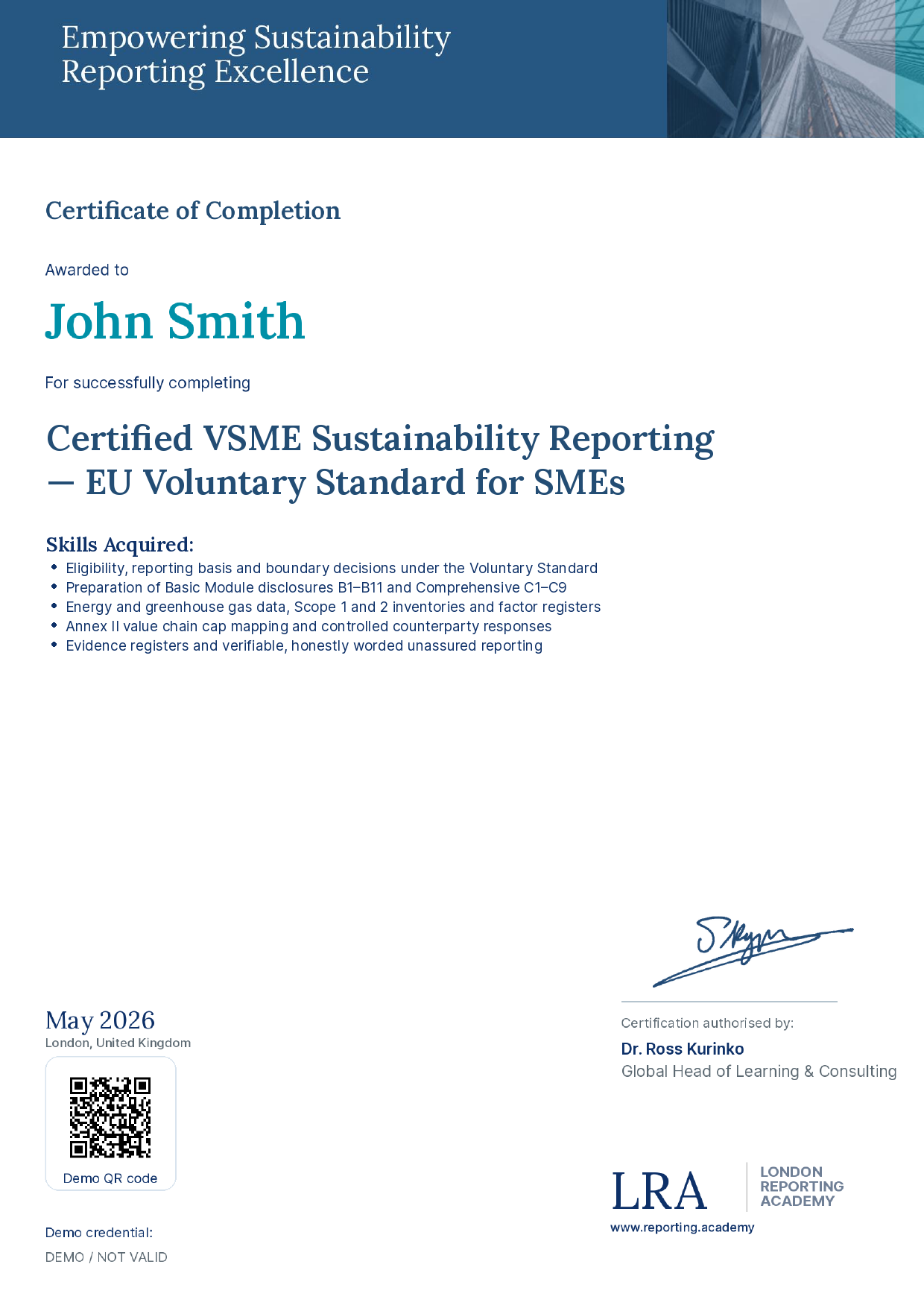
Certificate

An internationally recognised credential.

The LRA certificate goes beyond methodological knowledge. It certifies that the graduate has demonstrated practical capability to prepare a report under the EU Voluntary Standard — from the eligibility and reporting-basis decision, through the Basic and Comprehensive disclosures and the evidence behind them, to an approved and issued report.

The core certificate is the same on every route. Route recognition lines show which additional layer you completed — a recognition line is a route-completion entry on the certificate, not a grade.

Globally verified

LRA-certified capability in VSME sustainability reporting

  • Practical competence, not just methodology — graduates demonstrate the ability to turn the Voluntary Standard into a finished, defensible report.
  • Real assignments, expert review — every learner completes applied disclosure tasks; on 1:1 Expert Mentorship, Live Cohort and Corporate routes, mentors review line by line on top of AI feedback.
  • Built on real disclosures — curriculum and case work distilled from 200+ live ESG disclosure projects across sectors.
  • A recognised credential for SMEs and their advisers — fits finance directors, sustainability and operations leads, accountants, auditors and consultants building a VSME service line.
  • Verification when it matters — credentials carry a QR code, a unique credential ID and a permanent verification link auditors, employers, procurement teams and counterparties can confirm on request. Counts toward the LRA International Diploma in Sustainability Reporting.

LRA-issued certificates confirm completion of the relevant LRA professional training programme and any route recognition lines shown on the certificate. They do not constitute a licence to practise, a statutory qualification, regulatory accreditation, or accreditation by any regulator, professional body or standard-setter, unless expressly stated for a named third-party credential.

London Reporting Academy — sample certificate of completion
Dr. Ross Kurinko
Author and facilitator of the course
Ross Kurinko, Dr.

Distinguished expert with 15+ years in sustainability, ESG, integrated ESG communications and corporate reporting. PhD, University of Cambridge · GRI Certified Global Trainer · Strategic ESG Advisor on IFRS S1 & S2, GRI and ESRS.

Throughout his career, he has been instrumental in establishing ESG governance frameworks and comprehensive disclosure systems — notably building one from scratch for one of Europe's largest railway companies — and has guided over 20 prominent businesses and educated hundreds of professionals across FTSE 100 and Fortune Global 500 disclosures.

The LRA Alumni Club

Graduate once. Stay connected — for life.

Complete this course on a Live Cohort, 1:1 Mentorship or Applied Practice route and you join the LRA Alumni Club — a private network of LRA graduates with continuing access to expertise, peers and tangible benefits for life — no expiry. Reporting is a profession, not a one-off course — the Club is built to support your career, not just your enrolment.

01

Annual LRA Alumni Summit

Once a year, hybrid event (London + online): case studies from peer alumni, expert panels on emerging frameworks, and structured networking. Free attendance for Club members.

02

Quarterly peer benchmarking calls

Small-group calls with Dr. Kurinko and 6–12 alumni — we work through your real reports under NDA, compare approaches, debug edge cases. The kind of conversation reporting professionals can't get anywhere else.

03

Monthly office hours with Dr. Kurinko

60-minute Zoom Q&A every month — open to Club members. Bring a specific question from your current reporting cycle, get a direct, practitioner-grade answer.

04

Alumni-only Slack channel

A private workspace where alumni from every cohort exchange tips, share intel on new regulations, and ask peer questions. The kind of network you'd otherwise need to attend a year of conferences to build.

05

30% off any future LRA course — for life

30% off any LRA course, any format, any standalone — including the five new courses launching by end of 2026 and every LRA course after that. Stack credentials across the LRA portfolio at member pricing.

06

Early access to new courses

Four weeks of early access before every public launch — plus a vote on which frameworks LRA covers next. Alumni shape the curriculum.

07

Quarterly briefings on emerging regulations

Short, member-only video briefings on what's actually changing — the Voluntary Standard's legal status, ESRS amendments, IFRS S1/S2 updates, CSRD waves. Built so you stay up to date without doomscrolling LinkedIn.

08

Job board & talent network

LRA quietly maintains relationships with corporate ESG teams and consultancies. When they ask for trained reporters, Club members go on the shortlist. Featured Alumni Spotlight on LRA channels every quarter.

Routes that unlock the Club: Live Cohort · 1:1 Expert Mentorship · Applied Practice.

Guided Flex doesn't unlock Club membership — that's deliberate. The Club is designed for learners who chose an engaged format: live time, mentorship or applied work. It's a long-term commitment from LRA, so we reserve it for learners who made an equivalent commitment.

Mapped to national occupational standards

We specialise in ESG Disclosure and Sustainability Reporting training, mapped to Skills England ST0934 and ST0748, with practical coverage of GRI, ISSB/IFRS S1/S2, ESRS/CSRD, data controls, materiality, assurance readiness and anti-greenwashing.

Trusted by professionals worldwide

Real participants. Real LinkedIn reviews.

Verified posts from sustainability practitioners who completed our programmes — open any to read the original LinkedIn comment in full.

Fees

Choose your VSME learning route.

All routes include the full 13-module curriculum, 12 months of Studio access, the template and register pack, final module assessments and a verifiable LRA certificate. Prices exclude VAT where applicable.

Guided Flex
€249+ VAT where applicable
Enrol — request a payment link
Live Cohort
On requestFirst VSME cohort forming — dates confirmed on request
Book a call
1:1 Expert Mentorship
€1,199+ VAT · 5 × 1.5h mentor sessions · online or Canary Wharf by agreement
Enrol — request a payment link
1:1 Expert Mentorship — Applied Practice
€1,749+ VAT · 10 × 1.5h · Deep Review · online or Canary Wharf by agreement
Enrol — request a payment link
Corporate Programme
On requestScope agreed during planning
Request a quote

Grown into CSRD scope? If your group crosses the mandatory reporting thresholds after you enrol, email lra@reporting.academy — we credit your VSME enrolment against the Certified ESRS (CSRD) course so you are not paying twice to learn the same data twice.

Flexible payment. Need to spread the cost? Instalment plans are available — email lra@reporting.academy and we'll set one up for your enrolment. Self-funded learners and groups of three or more from the same organisation can request a 20% discount (the two don't stack). And you're covered by a 14-day cancellation right: a full refund within 14 days of purchase if you haven't yet entered the Study Studio.

VSME course — frequently asked

Course-specific questions — before you enrol.

Coverage, currency, what you'll actually leave with — answered for this VSME course. For methodology questions that apply to every LRA course, see /how-we-deliver/.

01Coverage & curriculum

Does the course cover both the Basic and the Comprehensive Module?

Both, in full. Every Basic Module disclosure B1 to B11 and every Comprehensive Module disclosure C1 to C9, each anchored to its exact Annex I paragraph.

  • Basic (11): basis for preparation · practices, policies and targets · energy and GHG emissions · pollution · biodiversity · water · resource use, circular economy and waste · workforce characteristics · health and safety · remuneration, collective bargaining and training · convictions and fines for anti-corruption and anti-bribery breaches.
  • Comprehensive (9): strategy and business model · description of practices and policies · GHG reduction targets and climate transition · climate risks · additional workforce characteristics · human-rights policies and processes · severe negative human-rights incidents · revenues from certain sectors · gender diversity ratio in the governance body.
  • Plus: Annex II at row level, the Scope 3 screening consideration that has no C-number of its own (and is therefore the one most often missed), the micro reliefs for undertakings with 10 employees or fewer, and Appendix C on how banks and investors reuse the data.

Delivered across 13 modules / 91 lessons (roughly 45 hours of structured study), with 156 knowledge-check questions and 13 graded module assessments. Disclosures are described in the course's own words with exact paragraph anchors — the course does not reproduce EFRAG's official disclosure titles.

The VSME's legal status is still moving. Is the course current — and does it overclaim?

This is handled explicitly rather than glossed over. Module 01 keeps five events separate — Commission adoption, scrutiny, publication in the Official Journal, entry into force, and the instrument's own first-application rule — and teaches you to check where the instrument actually is before relying on it.

Module 02 carries a standing instruction to reconfirm the final citation, entry into force, first-application year, national implementation and the identity of the reporting undertaking before relying on the statutory right to decline in real correspondence. The course teaches the decision method; it deliberately does not freeze a date-sensitive legal conclusion.

Curriculum content is reviewed on a rolling basis and the month of the most recent review is published on this page once recorded.

Does it teach double materiality?

No — and that is deliberate, not a gap. The Voluntary Standard does not ask you to reproduce an ESRS double materiality assessment. It starts from a defined reporting architecture: some datapoints are always required, some apply only when a stated condition exists, some are voluntary, and some become voluntary for undertakings with 10 employees or fewer.

The course teaches a proportionate relevance and applicability process instead — an Applicability Matrix and a Relevance Screen that record facts, horizon, evidence, user and the B/C link so a reviewer can follow the conclusion later. There is no numerical materiality score, and the course is explicit that this tool must never be described as an ESRS double materiality assessment.

If you need the full double-materiality methodology — because you are in CSRD scope or advising someone who is — that is the Certified Materiality Assessment course.

02Is it right for me?

Do I need prior sustainability reporting knowledge to start?

No. The course opens where most SMEs actually start: a questionnaire arriving from a customer and a different one from the bank. Module 01 builds the regulatory picture from there, and Modules 02 to 04 set scope, architecture and project structure before any disclosure work begins.

Practitioners who already report under GRI, ESRS or IFRS S1/S2 can move quickly through the early modules and spend their time on the value chain cap, the micro reliefs and the cycle modules — the parts that have no equivalent in those frameworks. The AI Tutor adapts depth and pace to the experience level you set in your Learning Profile.

My company is not in the EU. Is this relevant to me?

Often, yes — because the request travels down the value chain rather than following your country of incorporation. If you supply, lend to, insure or contract with an EU company that reports under the Accounting Directive, the questionnaires reach you regardless of where you are registered.

Two honest caveats. The statutory right to decline above-cap information attaches to undertakings covered by the amended Directive, so a non-EU supplier should treat the cap as a strong negotiating structure rather than an automatic legal shield. And a VSME report is voluntary everywhere — its value is that it is a recognised, consistent answer, not that it is compulsory.

Should I take this course — or the ESRS (CSRD) course?

Take this VSME course if your organisation is not subject to mandatory reporting under Accounting Directive Articles 19a and 29a, and does not exceed an average of 1,000 employees — and the reporting pressure is coming from customers, lenders, insurers or tenders rather than from a law addressed to you.

Take the ESRS (CSRD) course instead if you are in mandatory scope, or expect to be within your next two reporting cycles. ESRS is a different obligation with a different method — double materiality, all 12 standards, assurance readiness — and starting on VSME will not get you there.

Take both if you advise clients — most advisory portfolios contain companies on either side of the threshold, and the cap module is exactly the conversation your in-scope clients need to have with their suppliers. Complete this course on a Live Cohort, 1:1 Expert Mentorship or Applied Practice route and you join the LRA Alumni Club — 30% off any future LRA course, for life (Guided Flex routes don't unlock Club membership).

03What's included & how it runs

What templates and worked examples do I actually get?

The course is built around deliverables rather than handouts, so the templates are the course. Across the 13 modules you build: an Applicability Matrix and Relevance Screen · a Boundary Memo and Omission Log · a company profile and site register · a practices, policies, initiatives and targets register · a B3 energy and emissions workbook with a factor register · pollution, biodiversity, water and waste registers · workforce aggregates with a restricted evidence index · a Scope 3 fifteen-category screen · a C3 target table and C4 climate risk register · an Evidence Register and Disclosure Index · a Final Report Template.

Plus the value chain pack: a Request Purpose Questionnaire, a Protected Undertaking Self-Declaration, the nine-row Annex II cap card for undertakings with 10 employees or fewer, the twenty-three-row matrix above that, a model response letter, a Publication and Access Decision Matrix and a Release Manifest.

Realistically, how long until I can produce my company's first VSME report?

Two different clocks, and it is worth separating them. The course is roughly 45 hours of structured study — on Guided Flex most learners cover it over 8–12 weeks at four to six hours a week.

The reporting cycle itself is the second clock, and Module 11 plans it explicitly: an illustrative twelve-week calendar worked backwards from the release date, and a 90-day implementation roadmap. Data collection, not learning, is what takes the time in a first cycle.

On 1:1 Expert Mentorship the two clocks overlap — you learn the module and apply it to your own data in the same week, with a mentor reviewing the output.

Who is the lead mentor on the 1:1 Expert Mentorship route?

Dr. Ross Kurinko or a senior LRA mentor, subject to mentor availability. The mentor kickoff session (a separate scheduled call before regular sessions begin) captures your reporting context and is used to assign the best-fit mentor for your route.

Your mentor engagement starts and finishes within six months of purchase. Studio access continues for the full 12-month term in parallel.

Can my accountancy or advisory firm train a team on this?

Yes — and for advisory firms this is usually the right route. VSME reporting is unusually well suited to a productised service line: the same registers, gates and method notes apply across an entire SME client base, so the marginal cost of the second client is far lower than the first.

Corporate Programmes are scoped and quoted individually — delivered online, on-site, at Canary Wharf or hybrid, with per-learner credentials showing Corporate Programme participation. Request a quote here.

The standard doesn't require assurance. So why does the course spend time on evidence?

Because verifiable and assured are not the same thing. The Voluntary Standard does not oblige you to obtain assurance, but it does require information that is supported, reviewed and verifiable — a trace a knowledgeable reviewer can follow to a reasonably consistent conclusion.

That reviewer is real. It is the bank's credit analyst, the customer's supplier-risk team, or your own auditor asking where a number came from. Module 10 teaches the evidence trail and the honest-language drills that go with it — including why "independently verified by management" and "assurance-ready certified" are claims you must not make, and the model statement to use instead.

Is there an alumni programme — and what do I get?

Yes — the LRA Alumni Club. When you complete this course on an engaged format (Live Cohort, 1:1 Expert Mentorship or Applied Practice) you become a member of the LRA Alumni Club for life — no expiry from the day you graduate. See the full Alumni Club section on the Full Stack programme page.

What's inside the Club: 30% off any future LRA course in any format; the annual LRA Alumni Summit (London + online); quarterly peer benchmarking calls with Dr. Kurinko under NDA; monthly office hours; an alumni-only Slack channel; early access to new courses and a vote on what we cover next; member-only briefings on emerging regulations; and the LRA job board / talent network.

Guided Flex doesn't unlock the Club — that's deliberate. The Club is reserved for learners who chose an engaged format (live time, mentorship or applied work).

Can this be funded through a Skills England apprenticeship (ST0934)?

Yes — there are three ways in.

1 · Through your employer (apprenticeship-led). If your team genuinely needs ESG reporting capability — a finance or sustainability function, a listed or private company, or a consultancy — ask your employer to:

  1. Search ST0934 (Corporate Responsibility & Sustainability Practitioner) on the GOV.UK Find apprenticeship training service.
  2. Shortlist 3–5 approved training providers.
  3. Ask each: "Can you deliver ST0934 with a specialist ESG Disclosure / Sustainability Reporting pathway, using London Reporting Academy as a delivery partner?"

The provider gets in touch with us and enrols you — they handle the apprenticeship administration and all programme logistics, and London Reporting Academy delivers the specialist teaching.

2 · Apprenticeship funding & an official Level 4 pathway (employer-led). If your organisation already wants to use apprenticeship funding and the official Level 4 standard, we work with approved apprenticeship providers as a specialist ESG Disclosure delivery partner — get in touch and we'll connect you.

3 · Direct / self-funded. Individuals and companies who'd rather train directly, without apprenticeship funding, can start straight away — the routes and pricing above apply.

04Practical matters

How current is the course content — and how often is it reviewed?

Every LRA curriculum is reviewed monthly. We re-read it against the standard or regulation it teaches — ESRS and EFRAG guidance, IFRS S1 & S2, GRI and the jurisdictional rules each course covers — and revise the material whenever something has actually moved. A month in which the standard didn't move is a month in which the course doesn't change; the review still happens.

The date of the most recent review is shown on this page — in the header and under the course outline. It's a record rather than a badge: it moves only when a review has been done, and it is removed rather than quietly carried forward if one lapses.

Because every route runs inside the Study Studio, a revision reaches everyone with active access — there's no superseded edition to be stuck on.

Is there a final exam — how is the work assessed?

No academic-style multiple-choice exam. Across every route, assessment is built around applied disclosure work: you draft, structure and defend disclosures the way you'd produce them in a real reporting environment.

  • On Guided Flex, the Studio runs AI-checked feedback on your drafts — flagging missing data, weak logic and thin evidence — and the Mistake Coach groups gaps by topic.
  • On 1:1 Expert Mentorship, Live Cohort and Corporate Programme, a senior LRA mentor, faculty or corporate trainer reviews your drafts line by line on top of the AI feedback layer.

GRI Standards Certified Training follows the GRI partner format — see the GRI course page.

What do 1:1 Expert Mentorship sessions actually cover?

Private sessions move you from theory to your own reporting context. Depending on your goals and the mentor kickoff (a separate scheduled call before regular sessions begin), they typically include:

  • clarifications on standards, regulations and disclosure requirements
  • line-by-line review of your programme and course disclosure drafts and assignments
  • discussion of real-life reporting examples and best practice
  • personalised assignments and feedback
  • additional materials, templates and resources
  • support with developing an ESG reporting roadmap
  • advice on data collection, validation and stakeholder communication
  • adaptation of the curriculum to your specific industry, region or learning objectives

Sessions are normally held online so learners across time zones can join. For London-based learners, in-person 1:1 sessions at our Canary Wharf, London office can be arranged by prior agreement, subject to mentor and room availability.

I've bought a course on 1:1 Expert Mentorship — what happens next?

You get immediate Studio access plus a dual onboarding sequence:

  • Studio onboarding — the same flow as Guided Flex. Your Learning Profile (role, sector, jurisdiction, reporting context, preferred output language) feeds the AI Tutor.
  • Mentor kickoff — a separate scheduled call with Dr. Ross Kurinko or a senior LRA mentor (subject to mentor availability) before regular sessions begin. The mentor captures your real objectives, current draft work and organisational challenges, and tailors the rest of the route around them.

After kickoff you receive a scheduling link to book sessions at times that work for you. You can begin and complete your mentor engagement within six months of purchase.

Can I start with Guided Flex and add 1:1 Expert Mentorship later?

Yes. Format upgrades from Guided Flex to 1:1 Expert Mentorship are available on an individual basis — your Studio progress and Learning Profile carry over, so you keep the work you've already done and layer mentor sessions on top.

Email lra@reporting.academy to review options for your enrolment.

What if I can't finish within 12 months?

Standard Studio access is 12 months — usually comfortable, since the materials are concise and applied rather than padded.

If life intervenes, contact lra@reporting.academy: a further 12-month extension is available for 25% of the original fee.

Does the Studio work in my language?

Yes. The Study Studio and AI Tutor read and reason in eight languages — Arabic, English, French, German, Italian, Dutch, Russian, Spanish.

Your output language is set in your Learning Profile, so explanations, drafts and feedback come back in your preferred language. Standards quotations and regulatory text are preserved in their official versions; everything else adapts.

Are there discounts for self-funded learners or groups?

Yes — two discounts on the standard course fee:

  • Self-funded individuals — if you're paying personally rather than through a company or organisation, you can request a 20% discount. Email lra@reporting.academy before you enrol.
  • Groups — when three or more people from the same organisation enrol on the same course, the group qualifies for 20% off, regardless of who settles the invoice.

The two don't stack — the maximum on any enrolment is 20%. Three self-funded colleagues enrolling together get 20%, not 40%.

This is a simple headcount discount on a standard course — not the Corporate Programme. The Corporate Programme is a bespoke engagement: tailored materials, a dedicated trainer and scoped delivery. A group discount just means several people from one organisation taking the same standard course. See the Corporate Programme →

Can I pay in instalments?

Yes — and it's interest-free, with no charge for spreading the cost. As a rule of thumb, fees up to £1,000 are split into two payments, and larger fees step up on the same basis — broadly one further instalment for each additional £1,000 or so. We'll confirm the exact split for your course and fee — email lra@reporting.academy and we'll set up your plan.

Your first payment confirms your enrolment and opens your Study Studio access straight away. Each subsequent instalment is normally due one month after the previous due date, according to the payment schedule agreed with you.

Instalment plans follow the same cancellation rules, pro-rata to the amount paid — see the refund question below.

What's your refund / cancellation policy?

14-day cancellation right. If you haven't yet entered the Study Studio, you can cancel within 14 days of purchase for a full refund (UK consumer statutory right under the Consumer Contracts Regulations 2013). Email lra@reporting.academy.

Once you enter the Studio, that statutory right ends — at checkout you give explicit consent to immediate digital access. After that, refunds are at LRA's discretion, considered on individual circumstances.

  • 1:1 Expert Mentorship — your mentor engagement starts and finishes within 6 months of purchase. If LRA can't assign a senior mentor and schedule your kickoff within roughly four weeks, the mentorship component is pro-rata refunded (Studio access stays for its full 12-month term). Sessions not commenced within the 6-month window lapse; extensions by written agreement only.
  • Live Cohort — if a cohort doesn't run, the cohort layer is fully refunded or rolled to the next intake (Autumn / Spring). Studio access stays.
  • Instalment plans — same rules, pro-rata to the amount paid.
  • Corporate Programme — governed by your enrolment agreement.

Postponements (extending Studio access rather than refunding) can usually be arranged — contact us before opening a refund case.

Full terms: Terms of Use §8. Governed by the laws of England and Wales.

Still have a question we haven't covered? Email lra@reporting.academy — a real human reads every message.

Access starts on day one

Ready to answer the questionnaire once — properly?

Enrol on a course and the workspace, the AI Tutor — and your route's human support — go live the same day. Human-in-the-loop on every route. We're never AI-only.