Short answer
The answer, before the reasoning
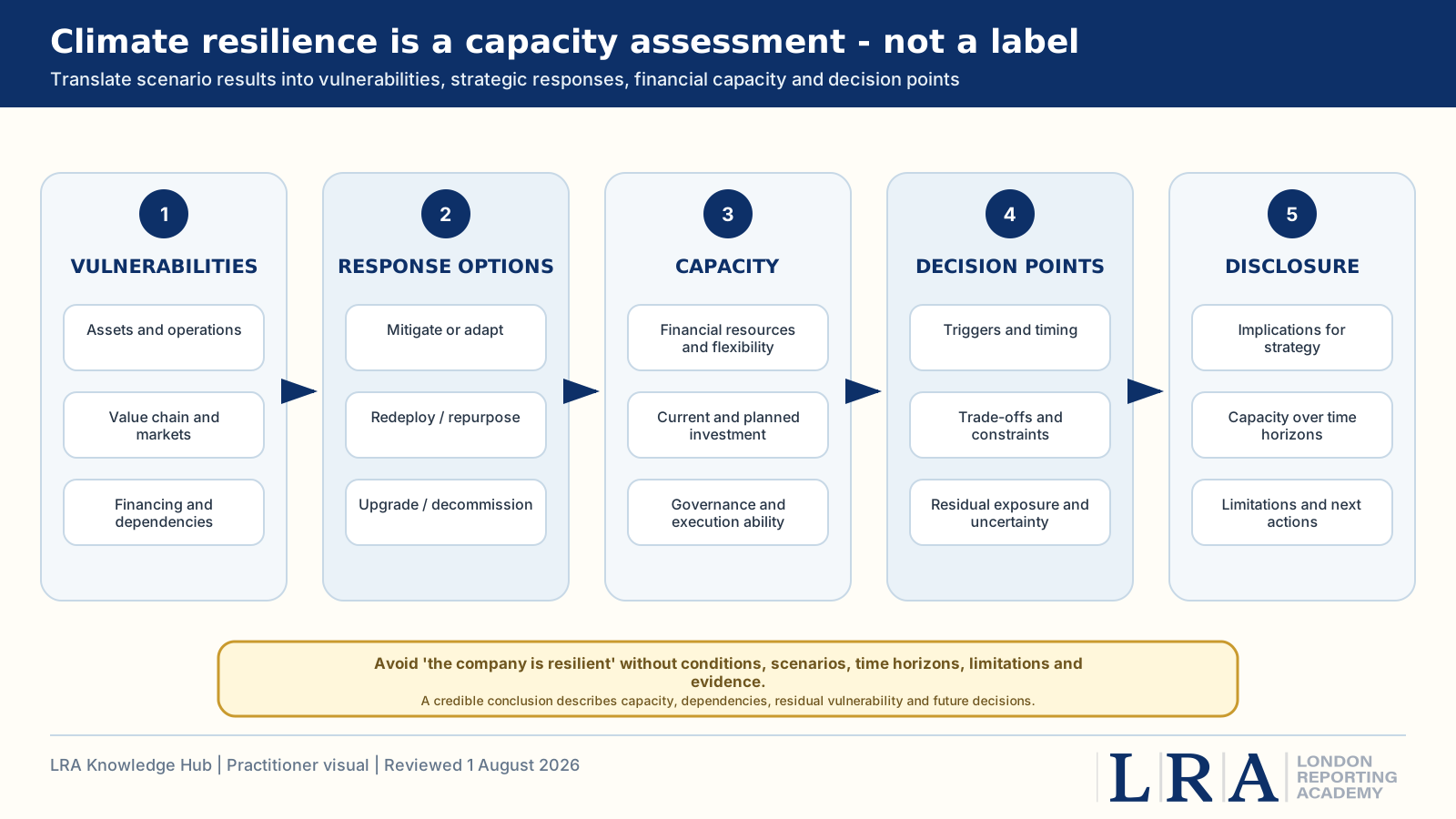
Climate resilience under IFRS S2 is the entity’s assessed capacity to adjust or adapt its strategy and business model to climate-related changes, developments and uncertainties. It is not a generic statement that the business is “resilient”.
The assessment is informed by climate-related scenario analysis and must explain implications for strategy and business model, significant uncertainty and the entity’s capacity to respond over the short, medium and long term. That capacity includes the availability and flexibility of financial resources, the ability to redeploy, repurpose, upgrade or decommission assets, and the effect of current and planned mitigation, adaptation and opportunity-related investments. The resilience conclusion is updated at every reporting date and should remain connected to financial effects, capital allocation and decision points.
Rule
IFRS-RES-001
IFRS S2 Climate Resilience: How to Assess and Disclose Capacity to Adapt Vulnerabilities, strategic responses, financial capacity, decision points, uncertainty and evidence-based resilience claims
In practice
Type
| Type | Tier | Audience — Current context |
|---|---|---|
| Climate-resilience assessment guide | Tier 3 · Deep Guide | Reporting, finance, strategy, risk, operations, treasury, board and assurance teams — IFRS S2 paragraph 22 and current IFRS Foundation implementation materials checked to 1 August 2026 |
Scenario analysis is the test; resilience is the assessed capacity
Scenario analysis and climate resilience are closely connected but they are not interchangeable. Scenario analysis supplies contrasting conditions, assumptions and results. The resilience assessment is management’s evidence-based evaluation of what those results imply for the strategy and business model, what the entity can change, what resources are available, where the critical decision points lie and what vulnerabilities or uncertainties remain.
A technically sophisticated scenario model can still produce a weak disclosure if management does not explain the strategic implication. Conversely, a confident statement that the business is resilient is not supportable merely because the entity has diversified revenue, insurance or a transition target.
Quick orientation
Quick orientation
- Applies to
- Entities applying IFRS S2 paragraph 22 and assessing the resilience of strategy and business model.
- Primary decision
- What capacity does the entity actually have to adjust or adapt, over what horizon, with which resources, assets, investments and constraints?
- Key requirements
- IFRS S2 paragraph 22, supported by B1-B18 and the connected strategy and financial-effects requirements.
- Common confusion
- Describing scenario results or risk controls without reaching a supported conclusion on capacity to adapt.
What IFRS S2 requires the resilience disclosure to cover
The entity’s assessment of climate resilience as at the reporting date.
The implications of that assessment for strategy and business model, including how the entity would need to respond to effects identified in the scenario analysis.
The significant areas of uncertainty considered in the assessment.
The capacity to adjust or adapt strategy and business model over the short, medium and long term.
The availability of, and flexibility in, existing financial resources to address risks and take advantage of opportunities.
The ability to redeploy, repurpose, upgrade or decommission existing assets.
The effect of current and planned investments in mitigation, adaptation and climate-related opportunities on climate resilience.
How and when the scenario analysis was conducted, including scenarios, sources, diversity, horizons, scope and key assumptions.
Rule
UNSUPPORTED WORDING TO AVOID
“Our strategy is climate resilient” is too broad unless the article or report explains the scenarios tested, vulnerabilities, adaptive capacity, resources, asset options, investment effects, uncertainty and conditions on which the conclusion depends.
Seven dimensions of capacity to adapt
The seven-dimension model below is an LRA implementation tool. IFRS S2 specifies the information to disclose, but it does not prescribe this assessment template or scoring method.
In practice
| Dimension | Questions to test | Evidence |
|---|---|---|
| Vulnerability | Which physical and transition drivers affect critical assets, products, locations, suppliers, customers or financing? What thresholds or failure modes emerge? | Scenario results, asset screens, engineering studies, supply-chain analysis and financial sensitivities. |
| Strategic optionality | Can the business change product, market, route, process, supplier, location or technology? How quickly? | Approved strategy options, market analysis, technology roadmap, contracts and operational constraints. |
| Financial capacity | Are cash, borrowing capacity, insurance, grants, project finance or other resources available and flexible enough? | Liquidity plan, financing headroom, covenants, credit terms, insurance, budgets and capital plan. |
| Asset flexibility | Can assets be redeployed, repurposed, upgraded or decommissioned without unacceptable loss or delay? | Asset lives, impairment indicators, conversion studies, closure obligations, residual values and capex estimates. |
| Operational and value-chain capacity | Can people, systems, suppliers, logistics and customers support the response? | Workforce capability, supplier alternatives, lead times, dependencies and contingency plans. |
| Investment effect | Do current and planned mitigation, adaptation and opportunity investments reduce vulnerability or increase strategic options? | Approved capex and opex, implementation milestones, performance evidence and dependency analysis. |
| Governance and decision points | Who monitors signals, approves action and decides when a strategic pivot, investment, relocation or exit is required? | Trigger framework, management papers, board minutes, delegated authority and monitoring dashboards. |
A practical resilience assessment workflow
1. Start with the current climate risk and opportunity register and the latest scenario-analysis results.
2. Identify the vulnerabilities, opportunity conditions and critical assumptions that could change the strategy or business model.
3. For each material item, define plausible response options rather than assuming the existing plan is the only response.
4. Test the timing, feasibility, dependencies and effectiveness of each response across the relevant horizons and scenarios.
5. Assess financial capacity and flexibility, including competition for capital, financing access, insurance and other constraints.
6. Assess asset, operational and value-chain flexibility, including stranded-asset, relocation, workforce and supplier issues.
7. Identify decision points and leading indicators: the conditions under which management must accelerate, delay, redesign, relocate, divest or exit.
8. Evaluate residual exposure and uncertainty after planned responses, not only the gross risk before management action.
9. Connect the conclusion to current and anticipated financial effects, capital deployment, targets and financial planning.
10. Obtain cross-functional challenge and governance approval, then update the conclusion at the reporting date.
In practice
Decision points make resilience operational
| Decision-point field | Illustrative content |
|---|---|
| Trigger | A measurable event or condition: regulation enacted, hazard frequency exceeded, input unavailable, technology cost threshold reached or customer demand shifted. |
| Decision required | Upgrade, protect, redesign, relocate, change supplier, change product, finance, divest, decommission or discontinue. |
| Lead time | Time needed for approvals, procurement, construction, workforce, customer transition or financing. |
| Latest safe decision date | The point after which the response is no longer feasible or becomes materially more costly. |
| Funding and capacity | Capex, liquidity, financing, skills, supplier and management capacity required. |
| Owner and governance | Responsible executive, escalation route, board or committee gate and evidence required. |
| Monitoring metric | Leading indicator, threshold, frequency, data source and review control. |
Connect resilience to financial capacity and financial effects
The question is not simply whether an adaptation project exists, but whether the entity can fund and execute the response while maintaining a viable strategy. An entity may have technically feasible adaptation options but limited financial headroom, incompatible debt covenants, insufficient insurance or competing mandatory investment. These constraints are part of the resilience assessment.
In practice
| Resilience finding | Potential financial-effect connection |
|---|---|
| Asset requires major adaptation | Capital expenditure, depreciation, useful life, impairment indicators, operating cost and financing need. |
| Asset can be repurposed | Conversion cost, downtime, residual value, future revenue mix and execution risk. |
| Asset may need decommissioning | Impairment, closure or restoration obligation, lost cash flows and workforce cost. |
| Supply chain can be diversified | Input cost, working capital, contract changes, quality, logistics and margin. |
| Opportunity needs rapid investment | R&D, capex, acquisition, revenue timing, finance access and risk of non-delivery. |
| Financial resources are constrained | Higher finance cost, delayed response, reduced optionality and greater residual exposure. |
Assess current and planned investments honestly
Distinguish approved and funded investment from an aspiration, pipeline or unapproved business case.
Explain the exposure or opportunity the investment addresses and the scenario assumptions on which it depends.
Identify timing, scope, milestones, dependencies and expected effect on vulnerability or optionality.
Avoid claiming that expenditure creates resilience without evidence of implementation or outcome.
Show trade-offs and residual exposure: an investment may reduce one risk while increasing cost, transition dependency or another vulnerability.
Connect material investment to capital deployment disclosures, financial planning and targets.
Hypothetical case: coastal industrial group
A hypothetical industrial group operates a coastal plant with flood exposure and an inland plant dependent on water-intensive cooling. Scenario analysis shows increasing coastal disruption under several physical pathways and tighter emissions policy under transition pathways. Management initially describes the group as resilient because production can be shifted between plants.
The detailed assessment challenges that conclusion. The inland plant has limited spare capacity, the products are not fully interchangeable, grid reinforcement is needed and debt covenants constrain simultaneous investment. The group identifies decision points for flood protection, product qualification, water-system upgrades and possible relocation. Its disclosure explains that the strategy has adaptive options but remains vulnerable until specified investments, permits, financing and customer approvals are secured. That conditional conclusion is more decision-useful than a binary “resilient/not resilient” label.
In practice
Weak versus stronger resilience wording
| Weak or unsupported | Stronger, evidence-based wording |
|---|---|
| “Our diversified footprint makes us resilient.” | Explains which concentrations remain, what can be shifted, capacity limits, lead times and dependencies. |
| “Insurance mitigates physical risk.” | Explains coverage, exclusions, deductibles, renewal uncertainty and risks not transferred by insurance. |
| “Planned capex will protect our assets.” | Identifies approved versus unapproved investment, timing, scope, funding and expected effect on the vulnerability. |
| “No significant resilience issues were identified.” | Describes scenarios, scope, uncertainty, thresholds, residual vulnerabilities and conditions behind the conclusion. |
| “We can adapt over the long term.” | Defines the horizon, decision points, latest safe decision dates, financial resources and asset options. |
In practice
How to disclose limitations and uncertainty
| Limitation | Transparent treatment |
|---|---|
| Incomplete location or supplier data | Identify the affected scope, proxy used, possible direction of bias and remediation plan. |
| Uncertain technology cost or availability | Provide ranges or scenario conditions and avoid assuming deployment without dependencies. |
| Unfunded response | State the approval and funding status and how limited financing affects the conclusion. |
| Non-modelled second-order effects | Explain excluded demand, macroeconomic, ecosystem or network effects that could change the assessment. |
| Scenario limitations | Explain that scenarios are not predictions and identify the uncertainties most significant to the conclusion. |
| Analysis not rerun this year | State when it was performed, what was reviewed annually and why the resilience conclusion changed or remained appropriate. |
Common mistakes
Treating resilience as a positive communications claim rather than a supported assessment at the reporting date.
Repeating scenario outputs without explaining implications for strategy and business model.
Assessing technical adaptation options without testing financing, lead times, capacity and governance.
Assuming insurance, geographic diversification or a transition target proves resilience.
Counting planned or aspirational investments as if they were approved, funded and effective.
Ignoring opportunity execution risk and the resources needed to capture the opportunity.
Failing to identify decision points and the latest date at which options remain feasible.
Reporting gross risk but not residual vulnerability after management responses.
Using one group-wide conclusion that hides materially different business-unit or location outcomes.
Failing to update the resilience assessment annually because scenario analysis is on a multi-year cycle.
Myth
A business is climate resilient if it has a transition plan, insurance and a diversified asset base.
Reality
Those features may support resilience, but the conclusion depends on the entity’s actual vulnerabilities, response options, financial and asset flexibility, investment effects, dependencies, uncertainty and decision points under relevant scenarios.
Readiness
Climate resilience disclosure checklist
- The assessment is dated and updated for the current reporting period.
- It is based on identified climate risks and opportunities and a proportionate scenario analysis.
- Material vulnerabilities and concentrations are described at the level needed for investor understanding.
- Implications for strategy and business model are explicit.
- Short-, medium- and long-term capacity to adjust or adapt is assessed separately where outcomes differ.
- Financial resources and flexibility are evidenced, not assumed.
- Asset redeployment, repurposing, upgrade and decommissioning options are tested for feasibility and timing.
- Current and planned investments are linked to vulnerabilities, opportunities, funding status and expected effect.
- Decision points, triggers, lead times and governance ownership are identified.
- Residual exposure, significant uncertainty, limitations and dependencies remain visible.
- The conclusion is connected to financial effects, capital deployment, targets and financial planning.
- Any use of the word “resilient” is appropriately qualified and supported by the disclosed evidence.
In practice
Related requirements and next steps
| Relation | Reference | Why it matters |
|---|---|---|
| Direct | IFRS S2 paragraph 22(a) | Required resilience assessment, strategic implications, uncertainty and capacity to adapt. |
| Direct | IFRS S2 paragraph 22(b) and B1-B18 | Scenario-analysis method, inputs, assumptions, timing and scope. |
| Supporting | IFRS S2 paragraphs 13-21 | Concentrations, strategy, resource allocation and financial effects. |
| Supporting | IFRS S2 paragraphs 29-37 | Capital deployment, metrics and targets supporting the conclusion. |
| Next step | IFRS S2 Scope 1, 2 and 3 Emissions | Build controlled measurement evidence for emissions-related strategy and targets. |
Scenario analysis supplies contrasting conditions, assumptions and results. Climate resilience is management's evidence-based assessment of what those results mean for the strategy and business model, the capacity and resources to adapt, and the remaining vulnerabilities, decision points and uncertainty.
Questions
Questions people ask
What does climate resilience mean under IFRS S2?
Climate resilience under IFRS S2 is the entity’s assessed capacity to adjust or adapt its strategy and business model to climate-related changes, developments and uncertainties. It is not a generic statement that the business is “resilient”.
How is it different from scenario analysis?
Scenario analysis supplies contrasting conditions, assumptions and results. Climate resilience is management's evidence-based assessment of what those results mean for the strategy and business model, the capacity and resources to adapt, and the remaining vulnerabilities, decision points and uncertainty.
What financial and asset capacity must be assessed?
The assessment is informed by climate-related scenario analysis and must explain implications for strategy and business model, significant uncertainty and the entity’s capacity to respond over the short, medium and long term. That capacity includes the availability and flexibility of financial resources, the ability to redeploy, repurpose, upgrade or decommission assets, and the effect of current and planned mitigation, adaptation and opportunity-related investments. The resilience conclusion is updated at every reporting date and should remain connected to financial effects, capital allocation and decision points.
How should uncertainty be disclosed?
Scenario analysis supplies contrasting conditions, assumptions and results. The resilience assessment is management’s evidence-based evaluation of what those results imply for the strategy and business model, what the entity can change, what resources are available, where the critical decision points lie and what vulnerabilities or uncertainties remain.
Sources
Primary sources
- IFRS S2 Climate-related Disclosures, including December 2025 amendments
- Climate resilience and climate-related scenario analysis requirements in IFRS S2 - factsheet (March 2026)
- Disclosing information about an entity's climate-related transition, including transition plans, in accordance with IFRS S2 (June 2025)
- IFRS S1 General Requirements for Disclosure of Sustainability-related Financial Information
- IFRS S2 Climate-related Disclosures navigator and supporting materials
Framework references
Disclosures this page affects
Take it with you
The checklists as a working spreadsheet
Every checklist and table on this page, with empty status, owner and evidence columns for your team to fill in and keep.
✓ Knowledge Hub AI Assistant · Human-in-the-loop

Ask about this guide
It answers from this page, and reaches into the linked disclosure cards when your question is about the standard itself.
Go deeper · IFRS S1 / S2
Certified IFRS S1 & S2 (ISSB) Applied Sustainability Reporting
This page settles one requirement. The IFRS S1 & S2 course walks the whole ISSB workflow — governance, strategy, risk management, metrics and targets — with drafting exercises on your own data.