Short answer
The answer, before the reasoning
Under GRI 2, the organisation reports the highest governance body's role in overseeing the management of impacts, how responsibilities are delegated and whether that body reviews and approves the reported information, including material topics. GRI 3 guidance says the highest governance body should review and approve the list of material topics; where no such body exists, senior executives should do so.
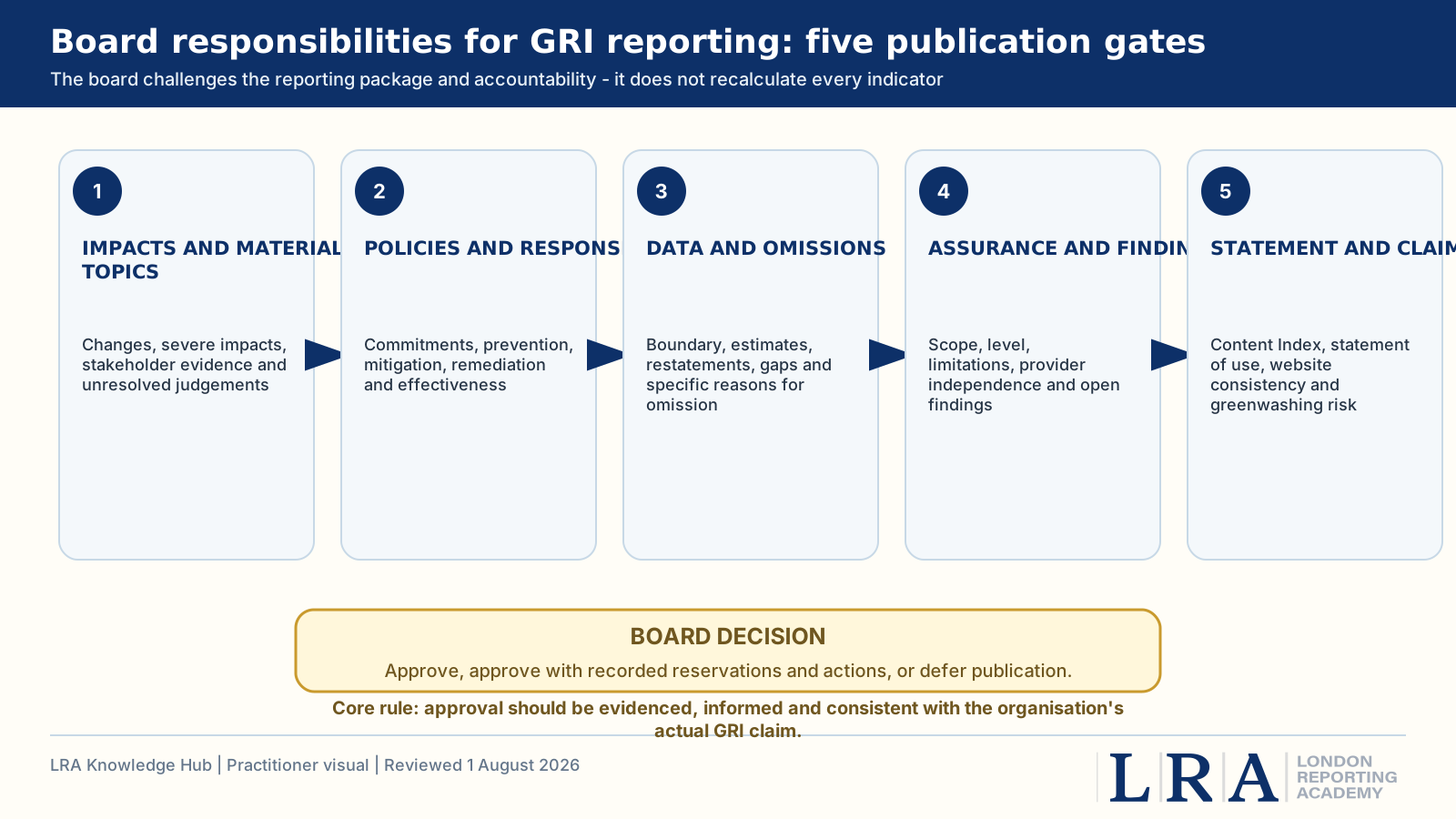
The board should not be expected to recalculate every indicator. It should challenge the impact assessment, significant changes, severe impacts, data and omission risks, assurance scope, and the accuracy of the statement of use and other public claims, then evidence its decision to approve, approve with actions or defer publication.
Rule
GRI-GOV-001
Board Responsibilities for GRI Reporting: Material Topics, Oversight and Final Approval A governance model for impacts, policies, reporting quality, assurance, publication claims and an evidenced release decision
In practice
Type
| Type | Tier | Audience — Current context |
|---|---|---|
| Board briefing / governance guide | Tier 3 · Deep Guide | Board members, company secretaries, executives, reporting teams and advisers — GRI 2 governance disclosures and GRI 3 materiality guidance checked to 1 August 2026 |
In practice
Required disclosure versus governance practice
| Area | What GRI requires the organisation to report | Practical board implication |
|---|---|---|
| Impact oversight - GRI 2-12 | Role in developing/approving/updating purpose, strategies, policies and goals; oversight of due diligence and impact processes; consideration of stakeholder outcomes; review of effectiveness and frequency. | Board papers should show how impacts enter strategy and oversight, not only present the finished report. |
| Delegation - GRI 2-13 | How responsibility for managing impacts is delegated and how/when senior executives or other employees report back. | Define management ownership, escalation thresholds and reporting cadence. |
| Reporting approval - GRI 2-14 | Whether and how the highest governance body reviews and approves reported information, including material topics; if it does not, explain why. | The release process and minutes should match the published description. |
| External assurance - GRI 2-5 | Policy and practice for assurance, including board and executive involvement; scope, level and limitations where assurance exists. | Board challenge should distinguish selected-indicator assurance from report-wide confidence. |
| Policy commitments - GRI 2-23/2-24 | Commitments, approval level, scope and how they are embedded. | Confirm public policy claims reflect actual approval and operational reach. |
| Material topics - GRI 3 guidance | The highest governance body should review and approve the list of material topics. | Record the list, changes, challenges and unresolved views rather than only a final matrix. |
Rule
IMPORTANT DISTINCTION
GRI 3 uses “should” for highest-governance-body approval of the material-topic list. GRI 2-14, however, requires the organisation to report whether the highest governance body reviews and approves the reported information, including material topics, and to explain the process or why it does not do so.
What the board is accountable for - and what it can delegate
In practice
| Board / highest governance body | Management and reporting team | Independent or specialist review |
|---|---|---|
| Set oversight expectations and decision thresholds. | Operate due diligence, materiality, data collection and controls. | Challenge methodology, evidence, specialist topics and assurance findings. |
| Review significant changes in impacts and material topics. | Prepare impact inventory, rationale and proposed topic list. | Test severe-impact logic, stakeholder evidence and omissions. |
| Challenge policies, response and effectiveness evidence. | Explain actions, resources, outcomes, limitations and corrective plans. | Review whether claims are supported and balanced. |
| Approve the reporting-status claim or require a narrower claim. | Build the Content Index and complete the requirements checklist. | Technical and legal review of statement of use and claims. |
| Decide whether publication risks are acceptable. | Resolve findings, document residual gaps and maintain the release pack. | Assurance conclusion, legal advice or specialist opinion within defined scope. |
In practice
A board-paper structure that supports a real decision
| Section | Minimum content | Decision or challenge |
|---|---|---|
| 1. Decision requested | Approve, approve with conditions or defer the GRI reporting package and statement of use. | Is the decision clear and within the board's authority? |
| 2. Reporting basis | Organisation name, period, entity perimeter, applicable Sector Standards, proposed status and publication locations. | Does the perimeter match the impacts and data presented? |
| 3. Material impacts and topics | Impact universe, threshold, changes, severe human-rights/environmental impacts, stakeholder evidence and exclusions. | Were difficult impacts considered and why were borderline topics included or excluded? |
| 4. Management response | Policies, actions, prevention, mitigation, remediation, targets, resources and effectiveness evidence. | Are commitments operational and are adverse results reported? |
| 5. Data and control status | Owners, methodologies, estimates, restatements, reconciliations, missing entities and reasons for omission. | Which gaps could change the reader's understanding or the GRI claim? |
| 6. Assurance and review | Scope, level, criteria, findings, limitations, independence and unresolved matters. | What remains unassured and what did assurance not test? |
| 7. Claims and communications | Statement of use, Content Index status, key impact/target claims, website and tender wording. | Could any wording overstate performance, completeness or assurance? |
| 8. Actions and reservations | Open actions, owners, deadlines, post-publication corrections plan and update triggers. | Are residual risks explicitly accepted and minuted? |
In practice
Questions directors should ask
| Theme | Board questions |
|---|---|
| Severe impacts | Which actual or potential impacts are most severe? Did severity take precedence over likelihood for potential human-rights impacts? What evidence contradicts management's conclusion? |
| Material topics | What changed since the previous period? Which Sector Standard topics were assessed as not material, and what evidence supports that conclusion? |
| Stakeholders | Which affected stakeholders were heard directly? Whose perspective is missing, and how was that limitation handled? |
| Boundaries | Which subsidiaries, joint ventures, suppliers, products or geographies are excluded from data or impact analysis? Could those exclusions change the materiality conclusion? |
| Data gaps | Which disclosed figures use estimates? Which missing entities or systems require an omission, and by when will the gap close? |
| Performance and balance | Where did performance deteriorate? Are negative results and corrective actions as prominent as positive achievements? |
| Assurance | What exactly was assured, at what level and against which criteria? What remains outside scope? |
| Greenwashing risk | Which headline claims are most vulnerable to challenge? Are website, press release, tender and report statements consistent? |
| Statement of use | Has every GRI 1 requirement been checked? Is the proposed in-accordance or with-reference statement supported by the final Content Index? |
Hypothetical case: board challenge changes the report
A hypothetical diversified manufacturer presents a near-final report and an in-accordance statement. The board paper highlights improvements in injury frequency and emissions intensity. A director asks for absolute fatalities, serious incidents, plant closures and contractor coverage. The review identifies that contractor injuries in two countries are outside the data system and that limited assurance covers only emissions and employee data. The board approves publication only after the Content Index records the incomplete contractor information precisely, the narrative explains corrective actions, the assurance wording is narrowed, and management commits to a dated integration plan.
In practice
Weak versus stronger evidence of approval
| Weak record | Why weak | Stronger record |
|---|---|---|
| “The sustainability report was noted.” | Does not show review, challenge, material topics or approval. | Minutes identify the reporting package, material-topic list, principal judgements, assurance scope, open actions and the approval decision. |
| Board approved the ESG report. | The approved version and statement of use are unclear. | Approval references the controlled final version, Content Index, reporting period and exact GRI claim. |
| Audit committee reviewed the data. | Does not explain board role or division of responsibilities. | Published disclosure explains committee review, board oversight and final approval route. |
| Management confirmed all information is accurate. | A broad representation is not evidence of challenge. | Data-owner confirmations, control results, exception log and board questions are retained. |
Common mistakes
Sending the board a polished report without the impact inventory, judgement log or unresolved findings.
Treating the materiality matrix as a communications product rather than a decision supported by impact evidence.
Asking the board to approve the report but not the Content Index or statement of use.
Assuming external assurance transfers responsibility for completeness or balanced presentation.
Reporting that the board approved material topics when minutes show only an information presentation.
Failing to disclose that the highest governance body does not review and approve the reported information.
Hiding severe impacts or data gaps in appendices without board-level escalation.
Leaving website and press-release claims outside the approval perimeter.
Myth
Board approval means directors must validate every calculation and write every disclosure.
Reality
Management prepares and controls the information. The board oversees impacts, challenges significant judgements and gaps, confirms that assurance and public claims are correctly described, and takes an evidenced release decision.
Readiness
Board decision checklist
- The report version and decision requested are unambiguous.
- Material topics and changes are approved or otherwise handled consistently with the published governance process.
- Severe impacts and contradictory stakeholder evidence are visible.
- Policies, actions and effectiveness claims are supported and balanced.
- Entity, impact and metric boundaries are explained.
- Material estimates, restatements and data gaps are disclosed.
- Every reason for omission is specific and permitted.
- Assurance scope, level and limitations are correctly described.
- The Content Index and statement of use have passed technical review.
- Website, press release and tender claims are reconciled.
- Reservations, actions, owners and deadlines are recorded in the minutes.
External assurance does not replace board or highest-governance-body approval. Management remains responsible for preparation, while the governing body challenges material impacts, judgements and gaps, confirms that assurance scope and public claims are described accurately, and makes an evidenced decision to approve, condition or defer publication.
Self-check
- Can the board see the significant judgements and evidence, not only the final narrative?
- Do minutes support the governance process described under GRI 2-14?
- Could any unassured or incomplete information be mistaken for fully assured or complete?
- What would cause the board to defer publication?
Questions
Questions people ask
Must the board approve GRI material topics?
GRI 3 guidance says the highest governance body should review and approve the list of material topics; where no such body exists, senior executives should do so. The board should not be expected to recalculate every indicator.
What does GRI 2-14 require?
GRI 3 uses “should” for highest-governance-body approval of the material-topic list. GRI 2-14, however, requires the organisation to report whether the highest governance body reviews and approves the reported information, including material topics, and to explain the process or why it does not do so.
What should a GRI board paper contain?
The board should not be expected to recalculate every indicator. It should challenge the impact assessment, significant changes, severe impacts, data and omission risks, assurance scope, and the accuracy of the statement of use and other public claims, then evidence its decision to approve, approve with actions or defer publication.
What questions should directors ask about GRI reporting?
The board should not be expected to recalculate every indicator. It should challenge the impact assessment, significant changes, severe impacts, data and omission risks, assurance scope, and the accuracy of the statement of use and other public claims, then evidence its decision to approve, approve with actions or defer publication.
Does assurance replace board approval?
External assurance does not replace board or highest-governance-body approval. Management remains responsible for preparation, while the governing body challenges material impacts, judgements and gaps, confirms that assurance scope and public claims are described accurately, and makes an evidenced decision to approve, condition or defer publication.
In practice
Related standards and next learning steps
| Relation | Reference | Why it matters |
|---|---|---|
| Direct | GRI 2-12 to 2-14 | Impact oversight, delegation and review/approval of reported information. |
| Direct | GRI 3 materiality guidance | Review and approval of the material-topic list. |
| Supporting | GRI 2-5 | Board and executive involvement in assurance policy and practice. |
| Supporting | GRI 2-23 to 2-25 | Policy commitments, embedding and remediation. |
| Application | GRI 1 Complete Requirements Checklist | Final reporting-status and publication review. |
Sources
Primary sources
Framework references
Disclosures this page affects
Take it with you
The checklists as a working spreadsheet
Every checklist and table on this page, with empty status, owner and evidence columns for your team to fill in and keep.
✓ Knowledge Hub AI Assistant · Human-in-the-loop

Ask about this guide
It answers from this page, and reaches into the linked disclosure cards when your question is about the standard itself.
Go deeper · GRI
Certified GRI Standards Training
This page settles one disclosure. The GRI Standards Certified Training — two live days, taken as a bundle with an ESRS course — walks the whole cycle: material topics, datapoints, evidence, the Content Index and assurance readiness, with exercises on your own data.
Available as two live training days online or on-site in London, bundled with an ESRS course.