Short answer
The answer, before the reasoning
TNFD does not impose a general requirement for external assurance. Assurance may nevertheless be requested by management, investors, lenders, contracts or another reporting regime.
Readiness begins by defining the exact subject matter: which disclosures, locations, processes, models, metrics, targets and claims are in scope; which criteria apply; the entity/portfolio boundary and period; and the intended level of assurance. TNFD Recommendations may form part of the reporting criteria, but they are not an assurance standard. A provider may use ISSA 5000 or another applicable standard together with the organisation’s stated methodologies. The most difficult areas are usually DIRO judgements, priority locations, model outputs, value-chain coverage, target baselines, outcome claims and connected financial information.
Figure 1. Define the assurance subject matter.
Quick orientation
At a glance
- Applies to
- Voluntary assurance, readiness reviews, internal audit, board approval and high-risk public claims
- Primary decision
- What exactly is being assured, against which criteria and with what evidence?
- Key sources
- TNFD Recommendations and ISSA 5000
- Common confusion
- A TNFD-aligned statement or screening heatmap is automatically assurance-ready
No general TNFD assurance mandate
TNFD is a voluntary risk-management and disclosure framework. “Assure our TNFD report” is not a sufficiently precise engagement description because a report can include recommendations, entity methodologies, forward-looking models, estimates, external datasets and claims that require different procedures. Assurance readiness should begin before drafting the assurance statement.
Define subject matter and criteria
ISSA 5000 is a framework-neutral sustainability assurance standard designed for sustainability information across topics and frameworks. It supports limited and reasonable assurance. It does not make TNFD assurance compulsory; it provides a professional framework where assurance is undertaken.
In practice
| Decision | Questions |
|---|---|
| Subject matter | Which disclosures, metrics, locations, models, targets and claims are included? |
| Criteria | Which TNFD recommendations, entity methodologies, definitions or other recognised criteria apply? |
| Boundary and period | Which entity, portfolio, product, value-chain population and reporting period are covered? |
| Level | Readiness review, limited assurance or reasonable assurance? |
| Evidence | What is sufficient and appropriate for estimates, models and professional judgement? |
| Report wording | How will scope, level, exclusions, criteria and limitations be stated? |
Seven high-risk assurance areas
DIRO process. Evidence that dependencies, impacts, risks and opportunities were identified, prioritised and approved using the stated process.
Locations. Coordinates, site/portfolio populations, sensitive-location definitions, spatial methods and validation.
Models and tools. Versions, inputs, assumptions, limitations, overlays, overrides and change approval.
Metrics. Definitions, units, populations, calculations, estimates, reconciliations and changes.
Targets. Baseline, scope, period, dependencies, progress and revisions; activity is not automatically outcome.
Claims. “Nature positive”, “restored”, “no impact”, “net gain”, “aligned” and “verified” need precise support.
Governance and connections. Board oversight, risk integration, financial effects and cross-report consistency require operating evidence.
DIRO and location evidence
A strong file retains the activity and location population, tool versions, evidence considered, stakeholder inputs, decision criteria, challenge records, exclusions and approvals. Where an issue was screened out, the file explains whether it was absent, not significant, outside the boundary or insufficiently evidenced. Geospatial evidence records coordinate source, geometry, dataset version, join method, buffer rationale, resolution, false-positive risks and local validation.
Metrics, targets and models
Each metric needs a controlled definition, boundary, unit, population, formula, source lineage, estimate method, reconciliation, owner, reviewer and prior-period treatment. Each target needs a baseline, target period, approval, dependencies, planned actions, progress calculation and explanation of adverse performance. Models require purpose, owner, version, input controls, sensitivity, validation, management overlays and approved use.
Greenwashing often begins with wording
A correct activity metric can support a misleading claim if the boundary is omitted, a pilot is described as portfolio-wide performance, avoided harm is called restoration, or a screening score is presented as measured impact. A claim ledger should link each sensitive statement to its definition, boundary, period, method, evidence, limitation and approval.
In practice
| Claim | Additional challenge |
|---|---|
| Nature positive | Reference state, impact coverage, trade-offs, time horizon and outcome evidence |
| No material impact | Complete population, method, threshold, locations and documented judgement |
| Restored X hectares | Condition, baseline, durability, ownership and double-counting controls |
| TNFD aligned | Clear basis, scope, recommendations addressed, omissions and no implication of TNFD endorsement |
| Assured / verified | Provider, criteria, level, subject matter, period and conclusion |
A 90-day pre-assurance plan
Weeks 1-2. Define subject matter, criteria, boundary, intended level and exclusions.
Weeks 2-4. Map every disclosure and high-risk claim to evidence, owner, method, control and report location.
Weeks 4-7. Reperform calculations, trace locations, review models, test baselines and challenge claims.
Weeks 7-9. Correct errors, narrow unsupported claims and document estimates and limitations.
Weeks 10-12. Lock versions, obtain management representations, complete governance approval and prepare provider access.
Hypothetical example
An asset manager proposes to describe a thematic fund as “nature positive” because most holdings pass a biodiversity-screening threshold and several investees have restoration projects. A readiness review finds that the threshold measures exposure, not net outcomes; the portfolio boundary excludes some instruments; restoration data covers only a few holdings; and negative impacts are not assessed. The manager changes the wording to describe screening, engagement and allocation, reports coverage and limitations, and postpones the outcome claim.
Hypothetical scenario
Illustrative wording - not an assurance opinion
The organisation prepared the disclosures using the TNFD Recommendations and the methodologies described in [reference]. Independent limited assurance was obtained over [precisely listed subject matter] for [period], using [criteria] under [assurance standard]. The engagement did not cover [exclusions]. Modelled and estimated information within scope is identified in the methodology note. The provider’s report describes the procedures, conclusion and limitations.
Illustrative only. It shows how the decision is made, not wording that can be copied or relied on.
Common findings
Scope drift. The report, evidence matrix and assurance wording describe different populations.
Uncontrolled location file. Coordinates changed after screening without change history or re-performance.
Screenshot as evidence. Inputs, version, settings and transformations are unavailable.
Target without baseline control. The baseline changed but progress and comparatives did not.
Policy described as performance. The narrative implies effectiveness without outcome evidence.
Ambiguous “verified”. Internal review is presented as external assurance.
Readiness
Checklist
- Subject matter, criteria, boundary, period and intended level are documented.
- TNFD recommendations map to exact report locations and omissions.
- DIRO and location evidence is reproducible.
- Models and estimates have governance and validation.
- Metrics and targets can be re-performed.
- High-risk claims pass legal and technical challenge.
- Management representations cover completeness, estimates and limitations.
- The report and evidence package are version-locked.
Myth versus reality
Figure 2. Show five claim gates.
Myth
A report can only be described as TNFD aligned if it has external assurance.
Reality
TNFD does not impose a general assurance mandate. Assurance can increase confidence, but the reporting basis, methods, omissions and claims must be accurate whether or not assurance is obtained.
Related learning path
Prerequisite: TNFD Explained - Recommendations, LEAP, DIROs and how to start.
Apply next: TNFD LEAP Approach - a step-by-step guide.
Evidence: Geospatial Data for TNFD - coordinates, maps, data quality and confidentiality.
Advanced: TNFD metrics, targets and the limits of composite biodiversity scores.
Rule
AI / FAQ answer
TNFD assurance is generally voluntary unless another rule or contract requires it. Define the exact subject matter, criteria, boundary, period and intended assurance level. Build traceable evidence for DIRO decisions, locations, models, metrics, targets, governance and claims; test controls and estimates; and challenge high-risk wording such as “nature positive” or “no impact”. TNFD Recommendations can support the criteria, but the engagement also needs a suitable assurance standard and an entity-specific methodology.
Questions
Questions people ask
Does TNFD require external assurance?
TNFD does not impose a general requirement for external assurance. Assurance may nevertheless be requested by management, investors, lenders, contracts or another reporting regime.
What criteria can be used?
TNFD Recommendations may form part of the reporting criteria, but they are not an assurance standard. A provider may use ISSA 5000 or another applicable standard together with the organisation’s stated methodologies.
Can ISSA 5000 be used?
ISSA 5000 is a framework-neutral sustainability assurance standard designed for sustainability information across topics and frameworks. It supports limited and reasonable assurance. It does not make TNFD assurance compulsory; it provides a professional framework where assurance is undertaken.
What is hardest to assure?
Readiness begins by defining the exact subject matter: which disclosures, locations, processes, models, metrics, targets and claims are in scope; which criteria apply; the entity/portfolio boundary and period; and the intended level of assurance. The most difficult areas are usually DIRO judgements, priority locations, model outputs, value-chain coverage, target baselines, outcome claims and connected financial information.
How should nature-positive claims be controlled?
A correct activity metric can support a misleading claim if the boundary is omitted, a pilot is described as portfolio-wide performance, avoided harm is called restoration, or a screening score is presented as measured impact. A claim ledger should link each sensitive statement to its definition, boundary, period, method, evidence, limitation and approval.
Sources
Primary sources
- TNFD Recommendations, Version 1.0 (September 2023). Voluntary framework with 14 recommended disclosures
- TNFD LEAP guidance, Version 1.0. Official
- TNFD Additional Guidance for Financial Institutions, Version 2.0 (June 2024). Entity-level sector guidance; not a product-disclosure standard
- ISSA 5000 (November 2024). Framework-neutral assurance standard; does not create a TNFD assurance mandate
Take it with you
The checklists as a working spreadsheet
Every checklist and table on this page, with empty status, owner and evidence columns for your team to fill in and keep.
✓ Knowledge Hub AI Assistant · Human-in-the-loop

Ask about this guide
It answers from this page, and reaches into the linked disclosure cards when your question is about the standard itself.
Go deeper · TNFD
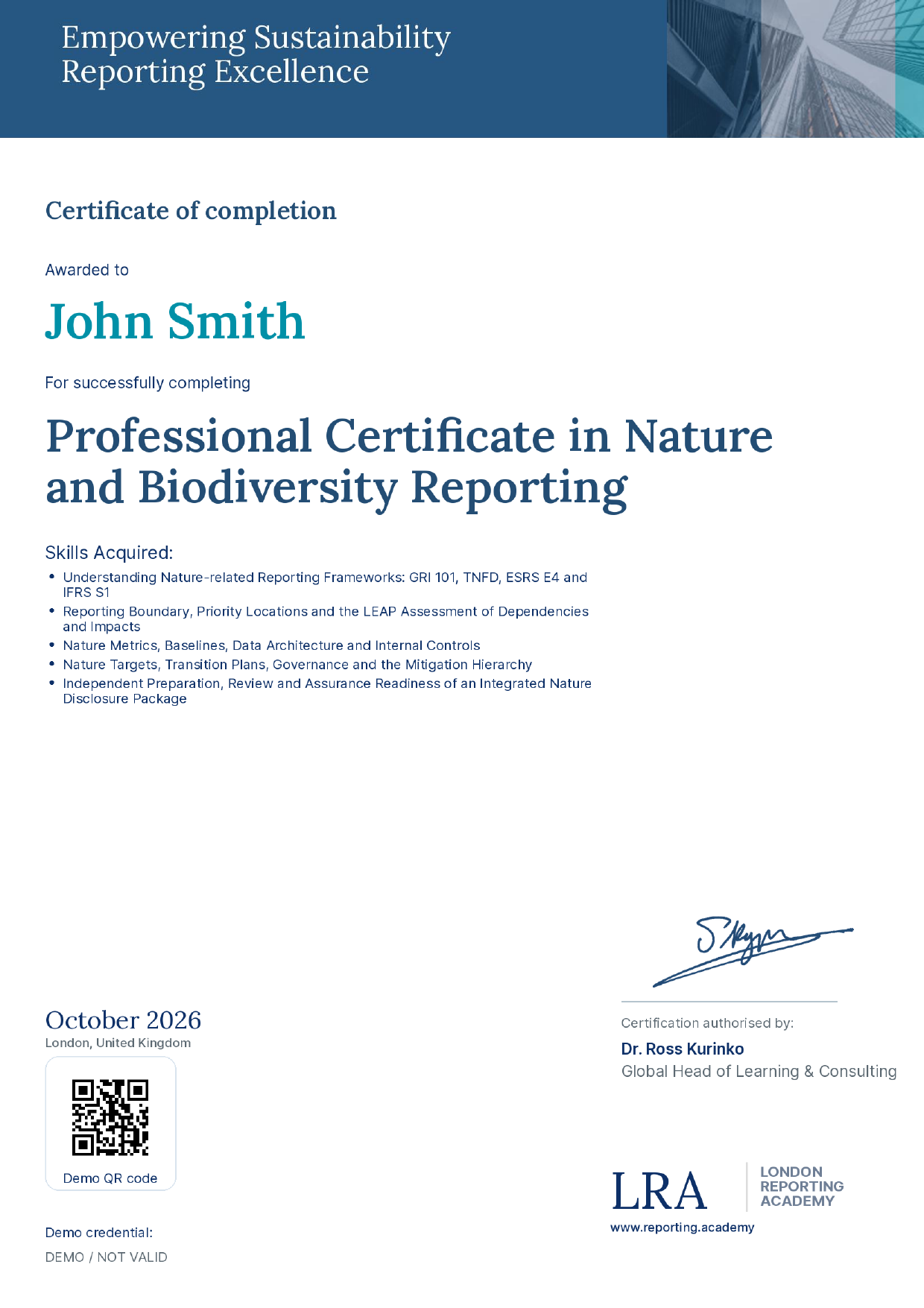
Professional Certificate in Nature and Biodiversity Reporting
TNFD (Taskforce on Nature-related Financial Disclosures) and LEAP, GRI 101: Biodiversity 2024, ESRS E4 and IFRS S1 — from reporting boundary and priority locations to an integrated, assurance-ready nature disclosure package.
Available as Guided Flex, Live Cohort, 1:1 Expert Mentorship or Corporate Programme.