Short answer
The answer, before the reasoning
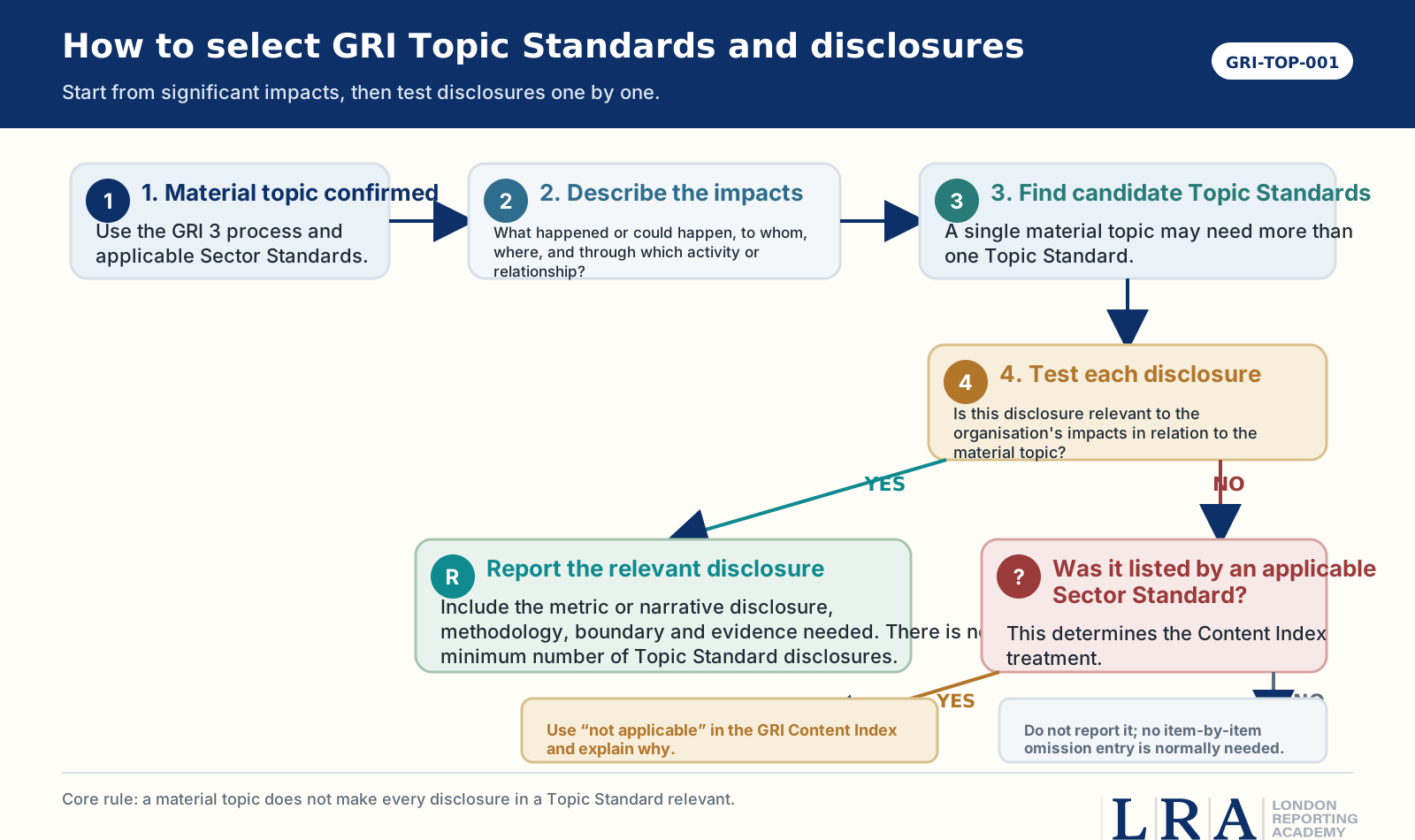
Select GRI Topic Standards by starting with the organisation's actual or potential impacts, not with a checklist of standard titles. For each material topic, identify one or more Topic Standards that contain disclosures capable of explaining those impacts, then test every candidate disclosure for relevance.
GRI requires only the Topic Standard disclosures relevant to the organisation's impacts. If an applicable Sector Standard lists a disclosure for a material topic, the organisation must either report it or record a justified “not applicable” reason in the GRI Content Index.
In practice
Type
| Type | How-to / decision guide | Tier — Tier 3 · Deep Guide |
|---|---|---|
| Audience | Sustainability reporting teams, consultants and reviewers | Current context — GRI Universal Standards 2021; current Topic and Sector Standards checked to 31 July 2026 |
Why this decision matters
Many reporting teams move too quickly from a material topic label to a complete Topic Standard. The result is often a report containing metrics that are technically adjacent to the topic but do not describe the organisation's significant impacts. The opposite problem also occurs: a team selects a single familiar disclosure and overlooks another Topic Standard that better explains a different dimension of the same impact.
The selection decision affects data requests, reporting boundaries, the GRI Content Index, the credibility of the materiality process and the review burden. A traceable method makes the report shorter where information is irrelevant and more complete where one topic needs several disclosures or additional organisation-developed information.
Quick orientation
Quick orientation
- Applies to
- Organisations reporting in accordance with, or using selected disclosures with reference to, the GRI Standards.
- Primary decision
- Which Topic Standard disclosures are relevant to the organisation's impacts for each material topic.
- Key sources
- GRI 1: Foundation 2021, Requirement 5; GRI 3: Material Topics 2021; applicable GRI Sector Standards.
- Common confusion
- Treating a material topic as an instruction to report every disclosure in one Topic Standard.
In practice
Key concepts to keep separate
| Concept | What it means in this decision |
|---|---|
| Material topic | A topic representing the organisation's most significant impacts on the economy, environment and people, including human rights. |
| Topic Standard | A standard containing disclosures for reporting impacts in relation to a particular topic. It is a source of candidate disclosures, not an automatic reporting bundle. |
| Relevant disclosure | A disclosure that addresses the organisation's impacts in relation to the material topic and therefore helps information users make informed assessments and decisions. |
| Applicable Sector Standard | A Sector Standard covering a sector represented in the reporting boundary. It identifies likely material topics and disclosures expected for those topics. |
| Additional disclosure | Information from another source, an additional sector disclosure, or an organisation-developed disclosure used when GRI Topic Standards alone do not provide sufficient information. |
What GRI requires
For every material topic, identify the Topic Standard disclosure or disclosures that explain the relevant impacts.
Where an applicable Sector Standard covers that material topic, use its reporting section as a structured starting point for identifying expected Topic Standard disclosures.
If a Sector Standard-listed disclosure is not relevant to the organisation's impacts, list it in the GRI Content Index with “not applicable” and briefly explain why.
If the Topic Standards do not provide sufficient information, consider additional disclosures with comparable rigour, including additional sector disclosures, information from authoritative sources or organisation-developed disclosures.
Continue to report how the material topic is managed through GRI 3-3; Topic Standard metrics do not replace the management-of-topic disclosure.
Rule
REQUIREMENT BOUNDARY
GRI 1 Requirement 5-a requires an organisation to report disclosures from the GRI Topic Standards for each material topic. The accompanying guidance states that only disclosures relevant to the organisation's impacts are required, that there is no minimum number of Topic Standard disclosures, that more than one Topic Standard may be needed, and that not every disclosure in a selected Topic Standard will necessarily be relevant.
What GRI does not require
Caution
DO NOT INVENT A COMPLETION RULE
GRI does not require a minimum number of Topic Standard disclosures and does not require every disclosure in a Topic Standard simply because one disclosure is relevant. Nor does a broad topic label such as “emissions”, “water”, “employment” or “energy” determine the correct standard without an impact-level analysis.
A seven-step selection method
Lock the material topic conclusion. Confirm the material topic, the significant impacts it represents, the reporting boundary and the evidence supporting the conclusion. Do not begin with a Topic Standard title.
Describe each significant impact precisely. Record what happened or could happen, whether the impact is positive or negative, who or what is affected, where it occurs, the activities or business relationships involved, and the time horizon.
Search the Topic Standards by impact, not by label. Identify all standards that could explain the impact. A material topic may draw on several Topic Standards, while a single standard may contain only one relevant disclosure.
Test each candidate disclosure. Compare the disclosure's required information with the impact description, boundary, value-chain position and information need. Record why the disclosure is relevant or not relevant.
Apply the Sector Standard overlay. Check whether an applicable Sector Standard lists the disclosure for the material topic. If it does, the disclosure requires explicit Content Index treatment even when it is not relevant.
Assess sufficiency. Ask whether the selected disclosures, together with GRI 3-3, provide a balanced and sufficiently complete account of the impact. Add other rigorous information where a material information gap remains.
Approve and preserve the decision trail. Have the topic owner, data owner and technical reviewer approve the mapping. Retain the impact-to-disclosure matrix, exclusions, data requests and Content Index instructions.
Disclosure-level relevance test
In practice
| Test question | Evidence of a sound answer |
|---|---|
| Does the disclosure address the impact itself? | A direct link between the information requested and the impact described in the materiality record. |
| Is the required boundary relevant? | The operations, workers, communities, products, suppliers or other business relationships affected can be included or clearly explained. |
| Would the information change a user's assessment? | The disclosure adds decision-useful information about scale, scope, management, performance, trend or limitation. |
| Can the terms and methodology be applied correctly? | Definitions, units, methodology and period are understood; transformations or estimates are documented. |
| Is the disclosure listed in an applicable Sector Standard? | The relevant Sector Standard topic and disclosure list have been checked and recorded. |
| Is additional information needed? | The team has assessed whether Topic Standard disclosures leave a material narrative or metric gap. |
The Sector Standard rule changes the Content Index treatment
The same disclosure can have different publication treatment depending on whether it is listed under a material topic in an applicable Sector Standard. Without that Sector Standard link, an irrelevant disclosure normally remains outside the selected disclosure set. With that link, GRI 1 Requirement 5-b requires the organisation either to report it or to state “not applicable” in the GRI Content Index and explain why it is not relevant to the organisation's impacts.
Rule
IMPORTANT DISTINCTION
A Sector Standard does not make every listed topic material. It strengthens the review discipline: each likely material topic must be assessed, and each listed Topic Standard disclosure for a material topic must receive an explicit reporting or “not applicable” decision.
Hypothetical example: ammonia emissions at a manufacturing site
The team may also need other disclosures. For example, GRI 3-3 is required to explain management of the material topic; occupational health and safety or affected-community information may be relevant if the impact extends to workers or local residents; and an organisation-developed incident or remediation metric may be needed if no Topic Standard disclosure fully explains response effectiveness. Each addition should follow from the impact, not from a desire to make the index look comprehensive.
Evidence to retain for the example
The approved materiality record and impact description for the release and recurring emissions.
Environmental monitoring data, methodology, units, site boundary and quality controls.
Community complaints, regulator correspondence, incident investigation and remediation records.
The disclosure relevance matrix showing why GRI 305-7 was selected and why other disclosures were or were not selected.
The applicable Sector Standard check, including any Content Index “not applicable” explanations.
A transition check for standards effective from the publication date of the report.
Hypothetical scenario
HYPOTHETICAL SCENARIO
A chemical manufacturer identifies air emissions affecting nearby communities as a material topic after a significant ammonia release and recurring local complaints. The impact description concerns non-GHG air emissions, exposure pathways and local environmental and health consequences. The reporting team should therefore test GRI 305-7, which addresses nitrogen oxides, sulphur oxides and other significant air emissions, as a primary candidate. It should not automatically select every other disclosure in GRI 305 merely because they sit in the same Topic Standard. Separate greenhouse-gas impacts may justify climate disclosures, but that conclusion requires its own impact evidence. For reporting published from 1 January 2027, the team must also apply the revised climate architecture, under which GRI 102: Climate Change 2025 replaces the GHG disclosures formerly located in GRI 305.
Illustrative only. It shows how the decision is made, not wording that can be copied or relied on.
In practice
Weak versus stronger selection logic
| Weak approach | Stronger approach |
|---|---|
| “Emissions is material, so complete all of GRI 305.” | Describe the significant emissions impacts, then select each disclosure that addresses those impacts and document the reason. |
| Select one standard for each topic label. | Allow one material topic to draw on several Topic Standards where different impacts require different information. |
| Exclude an inconvenient metric without a record. | Use a documented relevance test and, where required, a permitted reason for omission in the Content Index. |
| Use the Sector Standard as an automatic materiality list. | Review every likely topic, preserve the organisation's own impact assessment and explain non-material conclusions. |
| Freeze the mapping from last year. | Revalidate impacts, standard editions, Sector Standards and effective dates for every reporting cycle. |
In practice
Common mistakes and how to correct them
| Mistake | Why it happens | Correction |
|---|---|---|
| Starting with disclosure numbers | The team treats GRI as a compliance checklist rather than an impact-reporting system. | Start with the significant impact statement and map disclosures only afterwards. |
| Assuming all disclosures in one Topic Standard are required | The standard title is mistaken for the disclosure-level relevance test. | Record a relevance decision for each disclosure. |
| Ignoring multiple Topic Standards | The material topic is framed too broadly and the team searches for a single “home”. | Break the topic into impact pathways and map each one. |
| Missing the Sector Standard overlay | Applicability was not determined early or the reporting boundary changed. | Maintain an annual sector-applicability memo and use it in the mapping review. |
| Using “not applicable” for a data gap | Relevance and availability are confused. | If the disclosure is relevant but data are missing, assess “information unavailable / incomplete” and provide the required explanation. |
| Keeping superseded mappings | The disclosure register is copied forward without version control. | Store standard edition and effective period against every mapping record. |
Rule
MYTH VERSUS REALITY
Myth: “Once a topic is material, the whole Topic Standard becomes mandatory.” Reality: GRI requires the disclosures relevant to the organisation's impacts. A Sector Standard can require explicit Content Index treatment for listed disclosures, but it still does not turn an irrelevant disclosure into relevant impact information.
Readiness
Reader checklist
- Each material topic has a clear impact description rather than only a broad ESG label.
- All plausible Topic Standards have been considered, including combinations of standards.
- Every selected disclosure has a documented relevance rationale and an identified data owner.
- Applicable Sector Standards have been checked and Sector Standard-listed disclosures receive the correct Content Index treatment.
- GRI 3-3 and any necessary additional disclosures complete the account of the material topic.
- The mapping records the standard edition, publication-date transition and reviewer approval.
- Omissions use only permitted GRI reasons and do not disguise poor performance or weak project planning.
- Can you explain why each selected disclosure changes a reader's understanding of a significant impact?
- Can you identify any disclosure included only because it appears in the same Topic Standard?
- Can a reviewer trace every “not applicable” decision to an impact-level rationale and, where relevant, an applicable Sector Standard?
In practice
Related standards and indicators
| Relationship | Standard or disclosure | Role |
|---|---|---|
| Direct | GRI 1: Foundation 2021, Requirements 3, 5, 6 and 7 | Material-topic determination, Topic Standard disclosure selection, omissions and Content Index treatment. |
| Direct | GRI 3: Material Topics 2021, Disclosures 3-1 to 3-3 | Process, material-topic list and management of each material topic. |
| Implementation | Applicable GRI Sector Standard(s) | Likely material topics, sector reference numbers, expected Topic Standard disclosures and additional sector disclosures. |
| Example / transition | GRI 305: Emissions 2016 and GRI 102: Climate Change 2025 | Illustrates disclosure-level relevance and the need to manage effective-date transitions. |
Questions
Questions people ask
Do I need to report every disclosure in a GRI Topic Standard?
GRI 1 Requirement 5-a requires an organisation to report disclosures from the GRI Topic Standards for each material topic. The accompanying guidance states that only disclosures relevant to the organisation's impacts are required, that there is no minimum number of Topic Standard disclosures, that more than one Topic Standard may be needed, and that not every disclosure in a selected Topic Standard will necessarily be relevant.
Can one material topic use more than one GRI Topic Standard?
GRI 1 Requirement 5-a requires an organisation to report disclosures from the GRI Topic Standards for each material topic. The accompanying guidance states that only disclosures relevant to the organisation's impacts are required, that there is no minimum number of Topic Standard disclosures, that more than one Topic Standard may be needed, and that not every disclosure in a selected Topic Standard will necessarily be relevant.
How do GRI Sector Standards change disclosure selection?
Without that Sector Standard link, an irrelevant disclosure normally remains outside the selected disclosure set. With that link, GRI 1 Requirement 5-b requires the organisation either to report it or to state “not applicable” in the GRI Content Index and explain why it is not relevant to the organisation's impacts.
When should “not applicable” appear in the GRI Content Index?
Without that Sector Standard link, an irrelevant disclosure normally remains outside the selected disclosure set. With that link, GRI 1 Requirement 5-b requires the organisation either to report it or to state “not applicable” in the GRI Content Index and explain why it is not relevant to the organisation's impacts.
What should I do when no Topic Standard fully covers a material topic?
The team may also need other disclosures. For example, GRI 3-3 is required to explain management of the material topic; occupational health and safety or affected-community information may be relevant if the impact extends to workers or local residents; and an organisation-developed incident or remediation metric may be needed if no Topic Standard disclosure fully explains response effectiveness.
Sources
Primary sources
- GRI 1: Foundation 2021 - Requirements 3, 5, 6 and 7; guidance on disclosure relevance and Sector Standards
- GRI 3: Material Topics 2021 - Material-topic process and Disclosure 3-3
- GRI 305: Emissions 2016 - Disclosure 305-7 and historical emissions architecture
- GRI 102: Climate Change 2025 - Current transition context for GHG disclosures from 1 January 2027
Framework references
Disclosures this page affects
Take it with you
The checklists as a working spreadsheet
Every checklist and table on this page, with empty status, owner and evidence columns for your team to fill in and keep.
✓ Knowledge Hub AI Assistant · Human-in-the-loop

Ask about this guide
It answers from this page, and reaches into the linked disclosure cards when your question is about the standard itself.
Go deeper · GRI
Certified GRI Standards Training
This page settles one disclosure. The GRI Standards Certified Training — two live days, taken as a bundle with an ESRS course — walks the whole cycle: material topics, datapoints, evidence, the Content Index and assurance readiness, with exercises on your own data.
Available as two live training days online or on-site in London, bundled with an ESRS course.