Short answer
The answer, before the reasoning
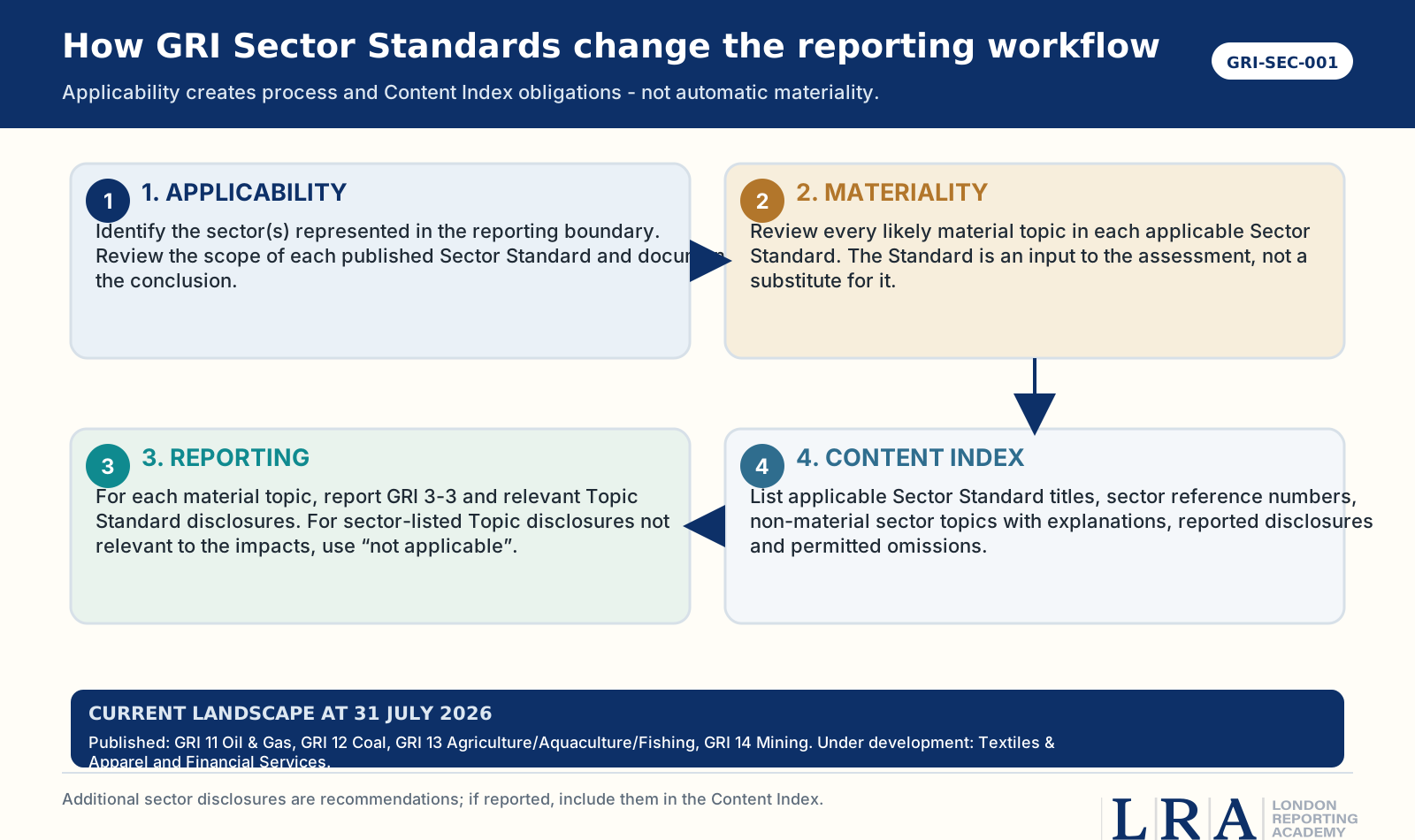
A GRI Sector Standard applies when the organisation's reporting boundary includes activities within that standard's defined sector scope. If an applicable Sector Standard is available, the organisation must use it when determining material topics and what to report for each material topic.
It must review every likely material topic in the standard, explain in the GRI Content Index why any such topic is not material, and apply the special reporting or “not applicable” treatment to listed Topic Standard disclosures for material topics. The Sector Standard informs the assessment; it does not automatically make every listed topic material.
In practice
Type
| Type | Applicability / decision guide | Tier — Tier 3 · Deep Guide |
|---|---|---|
| Audience | GRI reporting teams, diversified groups, consultants and reviewers | Current context — Published Sector Standards and aligned V1.1 editions current at 31 July 2026 |
Why applicability is more than a classification exercise
Sector applicability influences the materiality review, disclosure selection and GRI Content Index. A missed standard can leave likely impacts untested and required index information absent. Over-application creates the opposite problem: teams treat the Sector Standard as a mandatory topic list and report irrelevant disclosures simply to avoid making a judgement.
The correct workflow separates three questions. First, does the Sector Standard apply to activities inside the reporting boundary? Second, which likely material topics are actually material for this organisation? Third, which listed Topic Standard disclosures and additional sector disclosures are relevant to reporting those impacts? Each conclusion should be documented.
Quick orientation
Quick orientation
- Applies to
- Any organisation whose reporting boundary contains activities covered by a published GRI Sector Standard.
- Primary decision
- Which Sector Standard or Standards apply and how their topic and disclosure lists affect the materiality process and Content Index.
- Key sources
- GRI 1 Requirements 3, 5 and 7; GRI 3; the scope and reporting sections of each applicable Sector Standard.
- Common confusion
- Assuming all likely material topics in the Sector Standard are automatically material.
Current Sector Standard landscape at 31 July 2026
In practice
| Status | Sector Standard | Current note |
|---|---|---|
| Published | GRI 11: Oil and Gas Sector 2021 | V1.1 published January 2026; applies to oil and gas organisations irrespective of location, specialism or size. |
| Published | GRI 12: Coal Sector 2022 | V1.1 published January 2026; supports coal organisations irrespective of location, specialism or size. |
| Published | GRI 13: Agriculture, Aquaculture and Fishing Sectors 2022 | V1.1 published January 2026; covers organisations involved in crop cultivation, animal production, aquaculture or fishing. |
| Published | GRI 14: Mining Sector 2024 | V1.1 published January 2026; available for mining organisations and effective for reporting from January 2026. |
| Under development | Textiles and Apparel | Not yet a published Sector Standard; monitor the project but do not present a draft as a current reporting requirement. |
| Under development | Financial Services | Separate work is under way for banking, capital markets and insurance; current organisations still apply Universal and Topic Standards and any other applicable published Sector Standard. |
What GRI requires when a Sector Standard applies
Identify the organisation's sector or sectors and consult the applicable published Sector Standard or Standards.
Review every topic described in each applicable Sector Standard when determining material topics.
For each Sector Standard topic determined not material, list the topic in the GRI Content Index and explain why it is not material.
For each material topic covered in an applicable Sector Standard, report the relevant Topic Standard disclosures listed for that topic or use the required “not applicable” treatment for listed disclosures that are not relevant to the organisation's impacts.
Include the title of each applicable Sector Standard in the GRI Content Index and use the sector reference numbers for relevant reported disclosures.
If an additional sector disclosure is reported, include it in the GRI Content Index. Reporting additional sector disclosures is a recommendation rather than a requirement, so no reason for omission is needed when one is not reported.
Rule
MATERIALITY REMAINS ORGANISATION-SPECIFIC
A Sector Standard identifies impacts and topics likely to be significant in a sector. It is an authoritative input to the organisation's assessment, not a substitute for assessing the organisation's actual and potential impacts in its activities and business relationships.
How to determine applicability
Define the reporting boundary. Use the entities and activities included in sustainability reporting, not only the parent company's primary industry code.
Inventory activities. Record operations, products, services, controlled entities, joint arrangements and relevant business activities by sector and geography.
Read the scope of each published Sector Standard. Compare the defined sector scope with the activities inside the reporting boundary.
Assess diversified and vertically integrated activities. More than one Sector Standard can apply where the boundary contains activities in several covered sectors.
Document the conclusion. Prepare an applicability memo showing included activities, excluded activities, evidence, responsible owner, version and reviewer approval.
Monitor new standards and boundary changes. An acquisition, disposal, new activity or newly published Sector Standard can change the conclusion in the next cycle.
Recommended applicability memo
In practice
| Field | What to record |
|---|---|
| Reporting boundary | Entities, operations, joint arrangements and period covered by the sustainability reporting. |
| Activity inventory | Activities, products and services that may fall within a published Sector Standard scope. |
| Sector Standard test | Standard title and edition, exact scope language reviewed, and the matched activities. |
| Conclusion | Applicable, not applicable or requires specialist review, with a concise rationale. |
| Multiple-sector treatment | How more than one applicable Sector Standard will be used without duplicating or losing topic decisions. |
| Owner and approval | Prepared by, technical reviewer, approval date and update triggers. |
The reporting workflow after applicability
1. Review likely material topics
Use the Sector Standard topic descriptions as structured evidence. Compare them with the organisation's impact inventory, stakeholder evidence, due-diligence findings, incidents, geographic context and business relationships. Preserve both positive and negative impacts and avoid a simple workshop vote.
2. Decide material or not material
Apply the organisation's approved GRI material-topic methodology. For a non-material conclusion, record the impact evidence and reasoning. GRI 1 requires the organisation to list Sector Standard topics determined not material and explain why in the GRI Content Index.
3. Select disclosures for material topics
For a material topic, review the Topic Standard disclosures listed in the Sector Standard. Report those relevant to the organisation's impacts. Where a listed disclosure is not relevant, use “not applicable” in the Content Index and briefly explain why. Other permitted reasons for omission remain available where the disclosure is relevant but the organisation cannot comply.
4. Consider additional sector disclosures
Additional sector disclosures address sector-specific information not contained in current Topic Standards. Reporting them is recommended, not mandatory. If the organisation reports one, it should appear in the Content Index and be supported with evidence and appropriate methodological rigour.
Hypothetical example: a diversified resources group
The group should not choose only the Sector Standard matching its largest revenue stream. Nor should it duplicate the same narrative mechanically. A controlled sector-topic matrix can show which entities and impacts support each conclusion, which standard lists the topic, which disclosures are relevant and whether any “not applicable” explanation is needed.
Illustrative sector-topic control matrix
Hypothetical scenario
HYPOTHETICAL SCENARIO
A diversified group owns a mining subsidiary, a coal operation and a renewable-energy service company. The reporting boundary includes all three. GRI 14 applies to the mining activities and GRI 12 applies to the coal activities. No published Sector Standard currently applies solely because of the renewable-energy service activity. The group reviews each likely material topic in both GRI 14 and GRI 12, consolidates overlapping impacts without losing sector context, and records separate sector reference numbers in the Content Index. A topic listed in both standards is assessed once at group level only if the evidence and impact pathways are genuinely integrated; otherwise the group preserves sector-specific conclusions and disclosures.
Illustrative only. It shows how the decision is made, not wording that can be copied or relied on.
In practice
| Sector activity | Applicable standard | Topic decision — Reporting treatment |
|---|---|---|
| Mining operations | GRI 14 V1.1 | Review every likely topic against mining impacts and evidence. — Report relevant disclosures; list non-material sector topics and explanations. |
| Coal operations | GRI 12 V1.1 | Review every likely topic against coal impacts and transition context. — Report relevant disclosures; list non-material sector topics and explanations. |
| Renewable-energy services | No dedicated published Sector Standard identified solely for this activity | Apply GRI 3 using the organisation's impacts and relevant Topic Standards. — Do not invent a Sector Standard requirement; monitor future Sector Program updates. |
2026 aligned V1.1 editions and the 2027 transition
Version control therefore matters at two levels: the Sector Standard edition and the Topic Standard effective date. A report should not combine old sector reference numbers with new climate or energy disclosures without a documented, technically reviewed transition route.
Rule
CURRENT EDITION NOTE
GRI published aligned V1.1 editions of GRI 11, GRI 12, GRI 13 and GRI 14 in January 2026. They incorporate references to GRI 101: Biodiversity 2024, GRI 102: Climate Change 2025 and GRI 103: Energy 2025 and are available for immediate use. Earlier versions may be used for climate- and energy-related reporting through 31 December 2026; the aligned reporting sections are required with the new Topic Standards from 1 January 2027.
In practice
Weak versus stronger application
| Weak application | Stronger application |
|---|---|
| Use the parent company's main industry code only. | Analyse every activity inside the reporting boundary against the scope of each published Sector Standard. |
| Treat every sector topic as automatically material. | Use the Sector Standard as an evidence input and document the organisation-specific materiality conclusion. |
| Ignore non-material sector topics in the Content Index. | List each non-material Sector Standard topic and provide a concise explanation. |
| Report every listed disclosure. | Select relevant disclosures and use explicit “not applicable” treatment where the Sector Standard rule requires it. |
| Skip additional sector disclosures without considering them. | Evaluate whether they are needed for sufficient sector-specific information; remember they are recommendations. |
| Use an old Sector Standard edition indefinitely. | Record edition, transition status and update trigger in the mapping register. |
In practice
Common mistakes
| Mistake | Why it happens | Correction |
|---|---|---|
| Assuming applicability depends on size or location | The team confuses regulatory thresholds with Sector Standard scope. | Apply the scope wording; GRI 11, 12 and 13 explicitly describe broad applicability irrespective of location, specialism or size. |
| Using only one Sector Standard for a diversified group | Primary-revenue classification replaces reporting-boundary analysis. | Assess all covered activities and use all applicable published standards. |
| Letting the Sector Standard determine materiality automatically | Likely material topics are mistaken for mandatory topics. | Perform and document the organisation-specific impact assessment. |
| Forgetting Content Index explanations | The assessment file and publication workflow are disconnected. | Generate the non-material topic and disclosure-treatment fields directly from the controlled sector-topic matrix. |
| Treating additional sector disclosures as mandatory | The recommendation is read as a requirement. | Distinguish Topic Standard disclosures listed for material topics from additional sector disclosures. |
| Treating a draft sector project as a current standard | Teams want early certainty for uncovered sectors. | Monitor projects, but base current claims on published standards and current GRI requirements. |
| Mixing V1.0 and V1.1 references | The transition is managed only in prose. | Version every sector reference and revalidate climate, energy and biodiversity mappings. |
Rule
MYTH VERSUS REALITY
Myth: “A Sector Standard is a mandatory list of material topics.” Reality: it identifies topics likely to be material and requires the organisation to review them. The organisation still determines material topics from its own significant impacts and explains why any likely topic is not material.
Readiness
Applicability and reporting checklist
- The reporting boundary and activity inventory are current and approved.
- Every published Sector Standard scope has been checked against activities inside the boundary.
- More than one Sector Standard has been applied where the group contains several covered sectors.
- Every likely material topic in each applicable Sector Standard has a documented material / non-material conclusion.
- Non-material Sector Standard topics are listed and explained in the GRI Content Index.
- For material topics, listed Topic Standard disclosures are reported or receive the correct omission treatment.
- Additional sector disclosures are clearly identified as recommendations and included in the Content Index when reported.
- Sector reference numbers, standard titles and editions are correct.
- V1.1 and the 2027 GRI 101/102/103 transition have been addressed.
- Future standards for textiles and apparel or financial services are monitored without being presented as current requirements.
- Could a reviewer reconstruct sector applicability from the reporting boundary and activity inventory?
- Can every non-material Sector Standard topic be traced to a substantive impact-based explanation?
- Does the Content Index distinguish required listed Topic disclosures, “not applicable” decisions and optional additional sector disclosures?
In practice
Related standards and requirements
| Relationship | Standard or requirement | Role |
|---|---|---|
| Direct | GRI 1: Foundation 2021, Requirement 3-b | Review applicable Sector Standards when determining material topics and explain non-material sector topics. |
| Direct | GRI 1 Requirement 5-b | Report listed Topic disclosures for material sector topics or provide “not applicable” treatment. |
| Direct | GRI 1 Requirement 7 | Sector Standard titles, sector reference numbers and non-material topic explanations in the Content Index. |
| Implementation | GRI 11, 12, 13 and 14 V1.1 | Current published sector-specific likely topics, disclosures and additional sector disclosures. |
| Transition | GRI 101, 102 and 103 | Revised biodiversity, climate and energy Topic Standards reflected in aligned Sector Standards. |
A GRI Sector Standard applies when the organisation’s reporting boundary contains activities within that standard’s defined sector scope. Check all activities instead of relying on the parent entity’s label or main revenue code; if more than one published Sector Standard covers the boundary, assess and use each applicable standard in the material-topic and disclosure process.
The GRI Content Index should carry its title, the statement of use, the edition of GRI 1 used, every applicable Sector Standard, the material topics, each reported disclosure and its location, and any permitted omission with its reason and explanation. It should also identify applicable Sector topics found not material and explain why, use sector reference numbers for relevant reported disclosures, and list any additional sector disclosure that the organisation reports.
Questions
Questions people ask
Which GRI Sector Standards are currently published?
GRI published aligned V1.1 editions of GRI 11, GRI 12, GRI 13 and GRI 14 in January 2026. They incorporate references to GRI 101: Biodiversity 2024, GRI 102: Climate Change 2025 and GRI 103: Energy 2025 and are available for immediate use. Earlier versions may be used for climate- and energy-related reporting through 31 December 2026; the aligned reporting sections are required with the new Topic Standards from 1 January 2027.
How do I know whether a GRI Sector Standard applies?
A GRI Sector Standard applies when the organisation’s reporting boundary contains activities within that standard’s defined sector scope. Check all activities instead of relying on the parent entity’s label or main revenue code; if more than one published Sector Standard covers the boundary, assess and use each applicable standard in the material-topic and disclosure process.
Does a Sector Standard make every listed topic material?
It must review every likely material topic in the standard, explain in the GRI Content Index why any such topic is not material, and apply the special reporting or “not applicable” treatment to listed Topic Standard disclosures for material topics. The Sector Standard informs the assessment; it does not automatically make every listed topic material.
Can more than one Sector Standard apply to a group?
Assess diversified and vertically integrated activities. More than one Sector Standard can apply where the boundary contains activities in several covered sectors.
What must appear in the GRI Content Index?
The GRI Content Index should carry its title, the statement of use, the edition of GRI 1 used, every applicable Sector Standard, the material topics, each reported disclosure and its location, and any permitted omission with its reason and explanation. It should also identify applicable Sector topics found not material and explain why, use sector reference numbers for relevant reported disclosures, and list any additional sector disclosure that the organisation reports.
Are additional sector disclosures mandatory?
Additional sector disclosures address sector-specific information not contained in current Topic Standards. Reporting them is recommended, not mandatory.
What changed in the January 2026 V1.1 Sector Standards?
GRI published aligned V1.1 editions of GRI 11, GRI 12, GRI 13 and GRI 14 in January 2026. They incorporate references to GRI 101: Biodiversity 2024, GRI 102: Climate Change 2025 and GRI 103: Energy 2025 and are available for immediate use. Earlier versions may be used for climate- and energy-related reporting through 31 December 2026; the aligned reporting sections are required with the new Topic Standards from 1 January 2027.
Sources
Primary sources
- GRI 1: Foundation 2021 - Requirements 3, 5 and 7; Sector Standard applicability and Content Index treatment
- GRI 3: Material Topics 2021 - Organisation-specific significant-impact and material-topic process
- GRI Sector Program - Published and under-development sectors, V1.1 alignment and transition
- GRI 11: Oil and Gas Sector 2021 - Scope, use and January 2026 V1.1 alignment
- GRI 12: Coal Sector 2022 - Scope, use and January 2026 V1.1 alignment
- GRI 13: Agriculture, Aquaculture and Fishing Sectors 2022 - Scope, use and January 2026 V1.1 alignment
- GRI 14: Mining Sector 2024 - Scope, use, effective status and January 2026 V1.1 alignment
Take it with you
The checklists as a working spreadsheet
Every checklist and table on this page, with empty status, owner and evidence columns for your team to fill in and keep.
✓ Knowledge Hub AI Assistant · Human-in-the-loop

Ask about this guide
It answers from this page, and reaches into the linked disclosure cards when your question is about the standard itself.
Go deeper · GRI
Certified GRI Standards Training
This page settles one disclosure. The GRI Standards Certified Training — two live days, taken as a bundle with an ESRS course — walks the whole cycle: material topics, datapoints, evidence, the Content Index and assurance readiness, with exercises on your own data.
Available as two live training days online or on-site in London, bundled with an ESRS course.