Short answer
The answer, before the reasoning
Limited assurance on selected GRI indicators is assurance only on the information expressly identified in the practitioner's report. It does not become assurance of the whole GRI report, the materiality process, the Content Index or the organisation's in-accordance claim unless those items are explicitly within scope and covered by the signed conclusion.
GRI 2-5 requires the organisation to describe what was assured and on what basis, including the assurance standard, level and limitations, and to link to the assurance report. Publication wording must therefore repeat the actual scope rather than summarise it as “our sustainability report is assured”.
Rule
GRI-ASR-001
Limited Assurance on Selected GRI Indicators vs Assurance of the Whole Report How to define scope, criteria, level and publication wording without allowing a narrow assurance conclusion to become a report-wide claim
In practice
Type
| Type | Tier | Audience — Current context |
|---|---|---|
| Expert note / procurement guide | Tier 4 · Expert Note | Reporting teams, assurance procurement leads, boards, consultants and reviewers — GRI 2-5 and GRI 1, with ISSA 5000 transition context checked to 1 August 2026 |
Why the distinction matters
Assurance is often purchased incrementally: greenhouse-gas emissions, energy, workforce numbers or a small set of priority indicators may be covered first. The risk appears later, when a cover page, website banner, tender answer or board paper compresses the conclusion into a broader phrase such as “externally assured GRI report”. A reader can reasonably understand that phrase to mean that the whole reporting package has been tested.
The assurance statement, engagement terms and public explanation must describe the same subject matter. A logo beside the report title, an assurance badge or a general sentence in the chair's statement cannot extend the practitioner's conclusion. The organisation remains responsible for the unassured information, its Content Index and its GRI statement of use.
In practice
Quick orientation
| Field | What to establish |
|---|---|
| Subject matter information | The exact indicators, tables, narrative statements or processes that the practitioner examined. |
| Criteria | The GRI disclosure requirements, calculation methodologies and any entity-developed criteria used to evaluate the information. |
| Scope and boundary | Reporting period, entities, sites, countries, value-chain information and any explicit exclusions. |
| Level | Limited, reasonable or different levels for different parts of the information. |
| Conclusion | The signed form of conclusion and whether it is modified, qualified or subject to other explanatory paragraphs. |
| Publication wording | A plain-language description that reproduces, rather than enlarges, the signed scope and limitations. |
What GRI 2-5 requires
Describe the organisation's policy and practice for seeking external assurance, including whether and how the highest governance body and senior executives are involved.
Where sustainability reporting has been externally assured, provide a link or reference to the assurance report or statement.
Describe what was assured and on what basis, including the assurance standards used, the level obtained and any limitations of the assurance process.
Describe the relationship between the organisation and the assurance provider.
GRI guidance also points to accessible information about scope, responsibilities, the signed conclusion, work performed and the provider's experience and qualifications.
What GRI does not say
External assurance is not a condition for reporting in accordance with the GRI Standards. GRI encourages it as one way to enhance credibility.
Assurance on one indicator does not verify the organisation's complete compliance with the GRI reporting requirements.
A review of the Content Index is not automatically assurance of the data or narrative to which the index points.
Limited assurance is not “light certification”. It is a defined assurance level with procedures and a conclusion that differ from reasonable assurance.
The provider's work does not remove management's responsibility for preparing the sustainability information and maintaining appropriate controls.
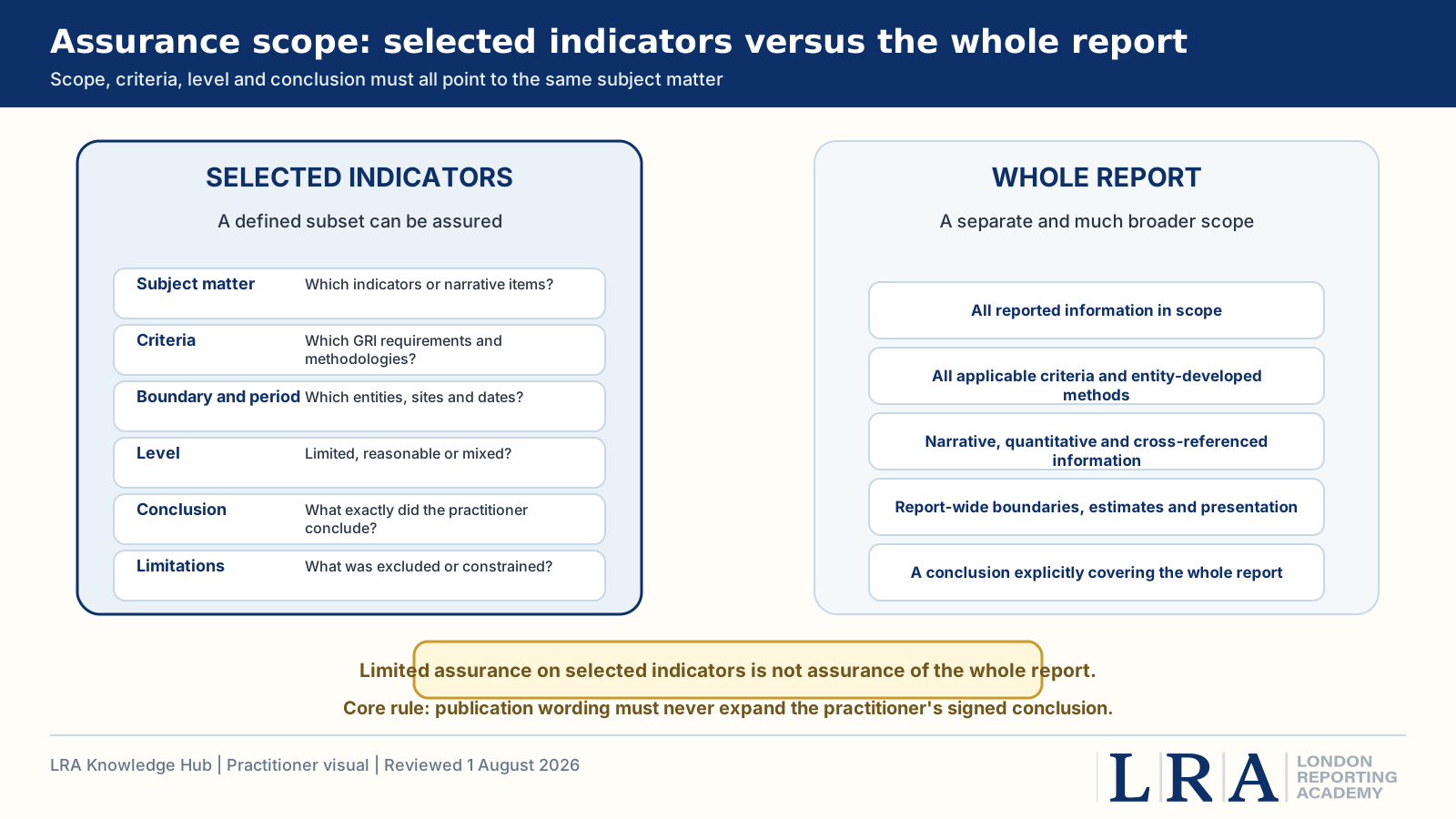
Selected indicators and whole-report assurance are different engagements
In practice
| Dimension | Selected indicators | Whole report |
|---|---|---|
| Subject matter | Named indicators or tables, for example Scope 1 and Scope 2 emissions and total energy consumption. | All sustainability information described as within the report-level engagement scope. |
| Criteria | GRI disclosure requirements plus specified calculation methodologies for each selected item. | A complete set of applicable framework and entity-developed criteria across quantitative and narrative information. |
| Boundary | May cover only defined entities, sites or geographies for each metric. | Must address the report-wide perimeter and any information distributed across referenced documents. |
| Procedures | Focused testing, enquiries, analytics, recalculation and samples relevant to the selected items. | Broader work across systems, narratives, estimates, presentation, aggregation and report-level controls. |
| Conclusion | Names the selected information and the applicable level. | Expressly identifies the whole report or all sustainability information in scope. |
| Public claim | “Limited assurance was obtained over the indicators listed below.” | Only use whole-report language where the signed conclusion actually covers that scope. |
Limited assurance versus reasonable assurance
ISSA 5000 addresses both limited and reasonable assurance and permits an engagement to cover all sustainability information or only part of it. Under the standard, limited-assurance procedures vary in nature and timing and are less extensive than procedures for reasonable assurance. The limited conclusion is expressed in a form that conveys whether anything has come to the practitioner's attention to cause the practitioner to believe the information is materially misstated. A reasonable-assurance opinion is expressed positively.
Rule
2026 TRANSITION NOTE
ISSA 5000 is generally effective for sustainability information reported for periods beginning on or after 15 December 2026, with early application permitted; adoption dates and local requirements vary. For a 2026 procurement exercise, identify the assurance standard actually applicable to the engagement rather than assuming ISSA 5000 is already mandatory everywhere.
Quick orientation
Procurement questions that prevent scope ambiguity
- Question
- Why it matters
- What decision or user need is the engagement intended to support?
- Prevents buying a generic badge without a defined purpose.
- Exactly which information is in scope?
- A disclosure number alone may contain several requirements, boundaries and methodologies.
- Which criteria will be used?
- The practitioner needs suitable criteria for all information in scope.
- What period, entities, sites and value-chain information are covered?
- Metric labels can conceal material perimeter differences.
- What level applies to each item?
- Mixed engagements can contain limited and reasonable assurance.
- How will estimates, restatements and prior-year comparatives be treated?
- These can change the conclusion or comparability.
- How will group components and specialists be used?
- Coverage and competence may vary across countries or technical topics.
- What limitations or scope constraints are anticipated?
- Management needs to know whether a clean conclusion is achievable.
- What will the final report say, and where will it appear?
- Avoids a late disagreement over the signed conclusion and marketing summary.
- How is independence managed?
- GRI 2-5 asks for the relationship with the provider; independence supports objective conclusions.
Hypothetical scenario
ILLUSTRATIVE ONLY
This matrix shows how an organisation can describe the engagement internally and publicly. The assurance provider must agree the formal terms and conclusion; this is not model assurance wording.
Illustrative only. It shows how the decision is made, not wording that can be copied or relied on.
In practice
Illustrative scope matrix
| Information | Criteria | Boundary / period — Level — Status |
|---|---|---|
| GRI 305-1 Scope 1 emissions | GRI 305-1 and approved GHG methodology v4.2 | All controlled operations; year ended 31 December 2026 — Limited — In scope |
| GRI 305-2 Scope 2 emissions | GRI 305-2 and market/location methodology note | All controlled operations; same period — Limited — In scope |
| GRI 302/103 energy table | Applicable energy disclosure and conversion-factor register | UK and EU sites only — Limited — In scope with stated geographic limitation |
| GRI 3-1 materiality process | GRI 3-1 requirements and methodology | Group process — None — Not assured |
| GRI Content Index and statement of use | GRI 1 requirements | Published index — None — Not assured unless separately included |
| Remaining narrative disclosures | Relevant GRI requirements | Whole report — None — Not assured |
Hypothetical scenario
Illustrative wording - adapt to the signed assurance statement
The organisation obtains external assurance over selected sustainability information. For the year ended 31 December 2026, [provider] performed a limited assurance engagement over the indicators listed in the scope table on pages [x-y], using [assurance standard]. The engagement covered [entities/sites] and the methodologies identified in the assurance statement. It did not cover the remainder of the sustainability report, the process for determining material topics, the GRI Content Index or the statement of use. The independent assurance report, including the conclusion, criteria, limitations and the relationship with the provider, is available at [precise location]. The exclusions sentence is crucial where layout or marketing could otherwise imply that the entire report was assured.
Illustrative only. It shows how the decision is made, not wording that can be copied or relied on.
In practice
Weak versus stronger wording
| Weak wording | Why it misleads | Stronger pattern |
|---|---|---|
| Our GRI report is independently assured. | Does not identify scope, level, criteria or exclusions. | Limited assurance was obtained over the selected indicators listed on pages [x-y]; the remainder of the report was not assured. |
| Our emissions have been verified. | May confuse verification, assurance level and boundary. | [Provider] expressed a limited assurance conclusion on Scope 1 and Scope 2 emissions for [boundary/period] against [criteria]. |
| The report has limited assurance. | The level is attached to the whole document even if only metrics were covered. | The assurance engagement was limited in scope and level as described in the assurance statement; it covered [items]. |
| Assured by [provider]. | A logo or badge carries no scope information. | Place a scoped text label beside the badge and link directly to the signed assurance statement. |
Common mistakes
Using “assured report” in the title while the assurance statement covers only a handful of indicators.
Listing GRI disclosure numbers without identifying the individual requirements, methodologies or geographic coverage included.
Failing to distinguish limited and reasonable assurance or mixed levels across different indicators.
Omitting the assurance provider's limitations, qualifications or scope constraints from the organisation's summary.
Describing a provider's review of the Content Index as external assurance of the underlying information.
Allowing press releases, tenders or websites to use broader language than the report itself.
Treating the assurance engagement as a substitute for management controls, data-owner confirmation or board challenge.
Myth
If an assurance provider signs any conclusion on the report, the organisation can describe the whole report as externally assured.
Reality
The public claim is limited by the signed subject matter, criteria, boundary, period and level. Any information outside that scope remains unassured and should be described as such.
Readiness
Pre-publication assurance-scope checklist
- The assurance statement is final, signed and linked directly.
- Every assured item is named at requirement or table level, not merely by topic.
- Criteria and methodology versions are identified.
- Entity, site, geographic and reporting-period boundaries are visible.
- The level of assurance is attached to each information set.
- Exclusions and limitations are repeated in accessible language.
- Report cover, contents page, website, press release and tenders use the same scope wording.
- The board paper distinguishes assurance findings from management's own completeness and GRI claim review.
- The relationship with the provider and independence considerations are disclosed under GRI 2-5.
GRI 2-5 requires the organisation to describe its policy and practice for seeking external assurance, including whether and how the highest governance body and senior executives are involved. Where reporting has been assured, it must link or refer to the assurance report and describe the assured subject matter and basis, including standards, level, limitations and the provider relationship.
An assurance scope matrix should identify each subject-matter item, criteria and methodology version, reporting period, entities, sites, geographies and value-chain boundary, assurance level, exclusions and signed conclusion. It should also specify publication wording and report location so the public claim reproduces, rather than enlarges, the signed scope and limitations.
Self-check
- Could a reader identify every assured item without interpreting a logo or marketing sentence?
- Does the organisation's summary use exactly the same subject matter and level as the signed conclusion?
- Which parts of the report remain unassured, and is that fact visible?
- Would the claim still be accurate if the assurance statement were read on its own?
Questions
Questions people ask
Does GRI require external assurance?
External assurance is not a condition for reporting in accordance with the GRI Standards. GRI encourages it as one way to enhance credibility.
What does limited assurance cover?
Limited assurance on selected GRI indicators is assurance only on the information expressly identified in the practitioner's report. It does not become assurance of the whole GRI report, the materiality process, the Content Index or the organisation's in-accordance claim unless those items are explicitly within scope and covered by the signed conclusion.
Can selected metrics be described as an assured report?
Limited assurance on selected GRI indicators is assurance only on the information expressly identified in the practitioner's report. It does not become assurance of the whole GRI report, the materiality process, the Content Index or the organisation's in-accordance claim unless those items are explicitly within scope and covered by the signed conclusion. GRI 2-5 requires the organisation to describe what was assured and on what basis, including the assurance standard, level and limitations, and to link to the assurance report.
What must be disclosed under GRI 2-5?
GRI 2-5 requires the organisation to describe its policy and practice for seeking external assurance, including whether and how the highest governance body and senior executives are involved. Where reporting has been assured, it must link or refer to the assurance report and describe the assured subject matter and basis, including standards, level, limitations and the provider relationship.
What should an assurance scope matrix include?
An assurance scope matrix should identify each subject-matter item, criteria and methodology version, reporting period, entities, sites, geographies and value-chain boundary, assurance level, exclusions and signed conclusion. It should also specify publication wording and report location so the public claim reproduces, rather than enlarges, the signed scope and limitations.
In practice
Related standards and next learning steps
| Relation | Reference | Why it matters |
|---|---|---|
| Direct | GRI 2-5 External assurance | Requires policy, scope, basis, level, limitations, provider relationship and a link to the assurance report. |
| Supporting | GRI 1 section 5.2 | Explains credibility mechanisms and the characteristics of external assurance. |
| Assurance criteria | ISSA 5000 | Separates limited and reasonable assurance and requires clear identification of information, criteria and conclusion. |
| Governance | GRI 2-14 | Connects assurance policy and findings with review and approval of reported information. |
| Evidence | GRI Evidence Pack | Prepares source data, calculations, controls and sign-offs for the agreed scope. |
Sources
Primary sources
Framework references
Disclosures this page affects
Take it with you
The checklists as a working spreadsheet
Every checklist and table on this page, with empty status, owner and evidence columns for your team to fill in and keep.
✓ Knowledge Hub AI Assistant · Human-in-the-loop

Ask about this guide
It answers from this page, and reaches into the linked disclosure cards when your question is about the standard itself.
Go deeper · GRI
Certified GRI Standards Training
This page settles one disclosure. The GRI Standards Certified Training — two live days, taken as a bundle with an ESRS course — walks the whole cycle: material topics, datapoints, evidence, the Content Index and assurance readiness, with exercises on your own data.
Available as two live training days online or on-site in London, bundled with an ESRS course.