Short answer
The answer, before the reasoning
A GRI report can be technically structured yet still create greenwashing risk if its overall presentation is selective, unsupported or inconsistent. The main controls come from GRI's reporting principles: accuracy, balance, clarity, comparability, completeness and verifiability.
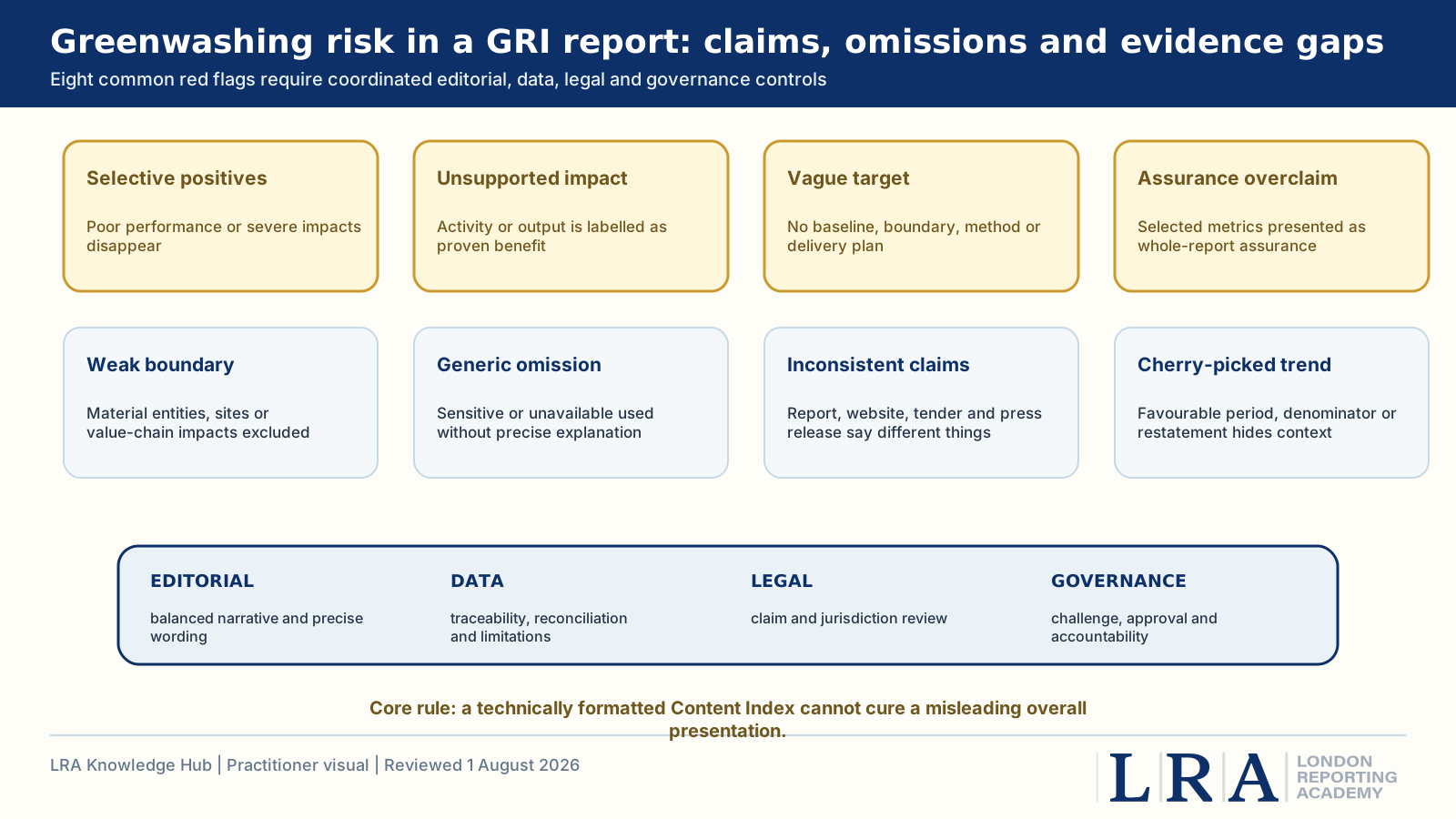
High-risk patterns include prominent positive stories that obscure severe negative impacts, impact claims based only on activities, vague targets, generic omissions, assurance wording broader than the signed scope, weak boundaries and website claims that contradict the report. Each claim should be traceable to evidence, limitations and an accountable approval decision.
Rule
GRI-EVD-002
Greenwashing Risks in GRI Reports: Claims, Omissions and Evidence Gaps A pre-publication risk map linking misleading sustainability communication to editorial, data, legal and governance controls
In practice
Type
| Type | Tier | Audience — Current context |
|---|---|---|
| Risk guide / pre-publication control tool | Tier 4 · Expert Note | Reporting, communications, legal, data, governance and assurance teams — GRI reporting principles and UK green-claims guidance checked to 1 August 2026 |
What “greenwashing risk” means in this article
This article uses greenwashing risk as a practical description of sustainability communication that could mislead users about impacts, performance, plans, evidence or assurance. Legal definitions and enforcement tests differ by jurisdiction and sector. GRI is a reporting standard, not a substitute for legal review of environmental or sustainability claims.
For UK-facing communications, the Competition and Markets Authority's Green Claims Code is a useful supplementary control source for environmental claims. It emphasises truthful, clear, substantiated claims that do not omit important information and consider the full lifecycle where relevant. Sector-specific rules, such as the FCA anti-greenwashing rule for authorised firms, require separate applicability analysis.
The GRI principles that act as anti-greenwashing controls
In practice
| GRI principle | Risk it addresses | Review question |
|---|---|---|
| Accuracy | Unsupported numbers, false precision, incorrect claims and hidden methodological changes. | Can each material statement be traced to a current source, calculation and methodology? |
| Balance | Positive-only storytelling and omission of negative impacts or deteriorating performance. | Are adverse results, limitations and corrective actions presented with comparable prominence? |
| Clarity | Vague terms such as sustainable, green, net zero, positive impact or assured. | Would a non-specialist understand the scope, boundary, period and limitation? |
| Comparability | Cherry-picked baselines, changing denominators and unexplained restatements. | Can users understand changes over time and between entities? |
| Completeness | Missing entities, value-chain impacts, poor performance or required disclosure elements. | Could omitted information change the user's understanding of the impact? |
| Verifiability | Claims that cannot be reproduced or challenged. | Are sources, assumptions, decisions, controls and approvals retained? |
In practice
Greenwashing risk map
| Risk pattern | Typical symptom | Primary control — Supporting control |
|---|---|---|
| Selective positive storytelling | Success case dominates; severe impact or poor trend appears only in a footnote. | Editorial balance review against material-impact inventory. — Board challenge and legal review of overall impression. |
| Unsupported positive-impact claim | Training, donations, sales or trees planted are labelled as proven impact. | Evidence ladder separating activity, output, outcome and impact. — Stakeholder/evaluation review and cautious causal language. |
| Omitted poor performance | A previously reported indicator disappears after deterioration. | Disclosure continuity and exception log. — Legal/assurance review of omission and restatement. |
| Vague target | Ambition without baseline, boundary, milestones, resources or approved method. | Target register and methodology control. — Governance approval and communications claim review. |
| Misleading assurance language | Limited assurance on selected metrics is presented as assurance of the report. | Assurance-scope reconciliation. — Legal/editorial review of every assurance reference. |
| Weak or changing boundary | Acquisitions, high-impact sites, contractors or value-chain activities are excluded without explanation. | Entity and impact-boundary register. — Board and assurance challenge. |
| Generic reason for omission | “Confidential” or “data unavailable” with no requirement-level explanation. | Content Index requirement-level review. — Legal decision log and remediation plan. |
| Inconsistent external statements | Website says “100% green” while report describes partial coverage or residual impacts. | Single claims register across channels. — Final cross-channel approval gate. |
| Cherry-picked trend or denominator | Intensity improves while absolute impact increases; favourable base year selected. | Reconciliation, absolute-and-intensity review and restatement control. — Editorial context and board challenge. |
In practice
Four coordinated control layers
| Control layer | Core responsibilities | Evidence retained |
|---|---|---|
| Editorial | Test overall impression, balance, terminology, prominence, cross-references and consistency between text and graphics. | Annotated draft, claim comments, before/after changes and final copy approval. |
| Data and technical | Validate boundary, period, methods, estimates, reconciliations, trends and source traceability. | Source register, calculation files, owner confirmations and exception log. |
| Legal and compliance | Assess public-claim risk, jurisdictional requirements, confidentiality, forward-looking statements and disclaimers. | Claim review, legal advice record, decisions and approved wording. |
| Governance | Challenge severe impacts, unresolved evidence gaps, targets, assurance and statement of use; accept or reject residual risk. | Board/committee paper, minutes, conditions and release decision. |
A claim ledger is more useful than a late legal read
High-risk claims should be identified before the report is fully designed. A controlled claim ledger connects wording to the affected impact, evidence, boundary, methodology, owner, limitation, assurance status and approval. It also captures where the same claim appears on the website, in a tender or in a press release.
In practice
| Claim field | Example control |
|---|---|
| Claim ID and wording | Exact sentence, chart title, badge or visual statement. |
| Claim type | Performance fact, target, positive impact, comparative claim, assurance statement or reporting-status claim. |
| Boundary and period | Entities, sites, products, value chain, baseline and reporting dates. |
| Evidence | Source system, methodology, calculation, stakeholder evidence and reviewer. |
| Limitations | Estimates, missing entities, uncertainty, residual negative impacts and exclusions. |
| Assurance status | Assured/not assured, level, criteria and exact scope. |
| Other channels | Web page, press release, tender, investor deck, product page or social asset. |
| Approval | Data owner, technical, legal, communications and governance status. |
Hypothetical case: a renewable-energy claim
A hypothetical industrial group reports that 80% of purchased electricity is covered by renewable instruments and highlights “operations powered by clean energy”. The assurance statement covers the purchased-electricity metric for European subsidiaries only. Several Asian sites and self-generated fossil-fuel electricity are outside the metric, and the website uses “100% renewable worldwide”. The pre-publication review replaces the global claim with a scoped statement, reports location and market-based information separately, explains the excluded sites and instruments, distinguishes purchased electricity from total energy use, and labels the assurance scope precisely.
In practice
Weak versus stronger communication
| Weak claim | Greenwashing risk | Stronger pattern |
|---|---|---|
| We are a sustainable business. | Undefined and unsupported overall claim. | Describe the specific impact, action, boundary, period, evidence and residual limitation. |
| Our programme positively impacted 50,000 people. | Reach or participation is presented as outcome or impact. | Report outputs separately from evidenced outcomes for defined groups and period. |
| We will be net zero by 2040. | No scope, baseline, pathway or treatment of residual emissions. | State covered scopes, baseline, interim milestones, methodology, dependencies and current progress. |
| Our report is assured. | Could imply whole-report assurance. | Identify selected information, level, criteria, period and exclusions. |
| No data is reported due to confidentiality. | Generic omission can hide poor performance. | Specify the exact requirement and constraint, alternatives tested and residual information reported. |
Red flags that should stop publication
A headline claim cannot be linked to a named evidence owner and source.
The same metric has different boundaries, periods or values in the report and website.
A positive-impact claim relies only on expenditure, participation or intended benefit.
A material negative trend is omitted, moved to an inaccessible document or described less prominently than the corresponding positive result.
The target lacks a baseline, boundary, methodology, approved milestones or implementation resources.
Assurance wording is broader than the signed statement.
A reason for omission is generic, repeated from last year or unsupported by a decision log.
A chart uses intensity improvement without the absolute measure needed to understand the impact.
Acquisitions, disposals, high-impact sites, contractors or value-chain activities are excluded without explanation.
The report claims reporting in accordance before the Content Index and final requirements check are complete.
Legal or technical reviewers have unresolved critical findings.
Common mistakes in control design
Relying on one final legal review after claims have been embedded in design and executive messages.
Reviewing individual sentences but not the overall impression created by ordering, prominence and imagery.
Assuming a GRI Content Index proves that the underlying disclosure is accurate, balanced or complete.
Allowing communications teams to shorten claims without preserving scope and limitations.
Treating external assurance as a blanket greenwashing defence.
Using disclaimers to contradict an otherwise misleading headline.
Leaving website claims, tender answers and social content outside the controlled reporting package.
Myth
A report prepared in accordance with GRI cannot be greenwashing because the Content Index proves compliance.
Reality
The organisation remains responsible for accurate, balanced, complete and verifiable information and for the overall impression created by its claims. A technically complete index does not validate unsupported evidence or misleading presentation.
Readiness
Pre-publication red-flag checklist
- Every headline and infographic claim appears in the claim ledger.
- Material negative impacts and deteriorating indicators are visible and contextualised.
- Positive-impact claims distinguish activity, output, outcome and impact.
- Targets include baseline, boundary, method, milestones, dependencies and current status.
- Absolute and intensity measures are reconciled where both are needed for understanding.
- Entity and impact boundaries are consistent across report sections.
- Omissions are permitted, specific and supported by evidence and approvals.
- Assurance, certification and GRI-use claims are precisely scoped.
- Website, tender, press-release and report wording are consistent.
- Board or delegated governance approval covers the final controlled version and open reservations.
Common red flags include positive stories that obscure severe negative impacts, impact claims based only on activity or expenditure, vague targets, unsupported omissions, assurance wording broader than the signed scope, unexplained boundaries and inconsistent website claims. Publication should stop where a claim lacks a named evidence owner, material adverse information is hidden or legal or technical findings remain unresolved.
External assurance does not prevent greenwashing and is not a blanket defence. Its scope is the signed subject matter, criteria, boundary and level, so management remains responsible for ensuring that the report and related communications are accurate, balanced, complete, verifiable and not broader than the assurance conclusion.
Self-check
- What is the most unfavourable material fact a reader needs to understand this claim?
- Would the claim remain accurate if the boundary and limitations appeared in the headline?
- Is the evidence strong enough for the level of causality or certainty used?
- Which other public channel could contradict this report wording?
Questions
Questions people ask
Can a GRI report be greenwashing?
A GRI report can be technically structured yet still create greenwashing risk if its overall presentation is selective, unsupported or inconsistent. The main controls come from GRI's reporting principles: accuracy, balance, clarity, comparability, completeness and verifiability.
Which GRI principles reduce greenwashing risk?
A GRI report can be technically structured yet still create greenwashing risk if its overall presentation is selective, unsupported or inconsistent. The main controls come from GRI's reporting principles: accuracy, balance, clarity, comparability, completeness and verifiability.
What are common greenwashing red flags in ESG reports?
Common red flags include positive stories that obscure severe negative impacts, impact claims based only on activity or expenditure, vague targets, unsupported omissions, assurance wording broader than the signed scope, unexplained boundaries and inconsistent website claims. Publication should stop where a claim lacks a named evidence owner, material adverse information is hidden or legal or technical findings remain unresolved.
Does assurance prevent greenwashing?
External assurance does not prevent greenwashing and is not a blanket defence. Its scope is the signed subject matter, criteria, boundary and level, so management remains responsible for ensuring that the report and related communications are accurate, balanced, complete, verifiable and not broader than the assurance conclusion.
How should claims be reviewed before publication?
High-risk claims should be identified before the report is fully designed. A controlled claim ledger connects wording to the affected impact, evidence, boundary, methodology, owner, limitation, assurance status and approval.
In practice
Related standards and next learning steps
| Relation | Reference | Why it matters |
|---|---|---|
| Direct | GRI 1 reporting principles | Accuracy, balance, clarity, comparability, completeness and verifiability. |
| Supporting | GRI 3-1 and 3-3 | Material impacts, methods, evidence, actions and effectiveness. |
| Supporting | GRI 2-5 and 2-14 | Assurance scope and governance approval. |
| UK legal context | CMA Green Claims Code | Supplementary principles for environmental claims in UK-facing communication. |
| Application | Positive vs Negative Impacts; GRI Claims; GRI Omissions | Specific controls for high-risk claim types. |
Sources
Primary sources
Framework references
Disclosures this page affects
Take it with you
The checklists as a working spreadsheet
Every checklist and table on this page, with empty status, owner and evidence columns for your team to fill in and keep.
✓ Knowledge Hub AI Assistant · Human-in-the-loop

Ask about this guide
It answers from this page, and reaches into the linked disclosure cards when your question is about the standard itself.
Go deeper · GRI
Certified GRI Standards Training
This page settles one disclosure. The GRI Standards Certified Training — two live days, taken as a bundle with an ESRS course — walks the whole cycle: material topics, datapoints, evidence, the Content Index and assurance readiness, with exercises on your own data.
Available as two live training days online or on-site in London, bundled with an ESRS course.