Short answer
The answer, before the reasoning
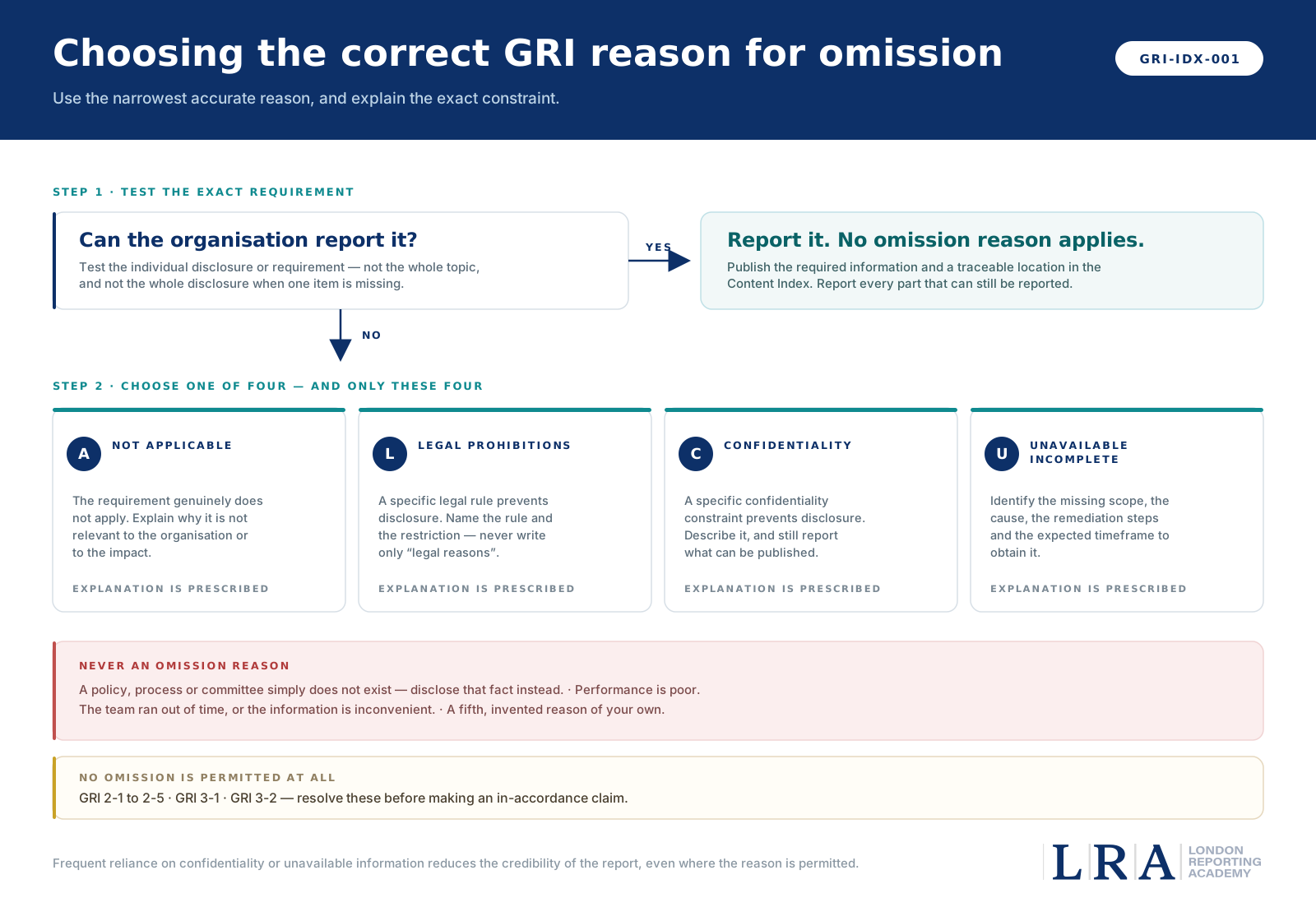
GRI permits only four reasons for omission: not applicable, legal prohibitions, confidentiality constraints, and information unavailable or incomplete. The Content Index must identify the exact disclosure or requirement that cannot be met, select one permitted reason and give the explanation prescribed for it.
"Not applicable" means genuine non-applicability, not missing data or the absence of a policy. Poor performance, inconvenience, lack of time and management preference are not permitted reasons.
Why it matters
An omission is a controlled explanation, not a disclaimer
A reason for omission is not a general disclaimer. It is a controlled explanation for a particular disclosure — or a particular requirement inside a disclosure — that the organisation cannot meet. A vague reason weakens the Content Index because the reader cannot tell what is missing, why, how much of the required scope is affected, or whether the organisation intends to close the gap.
Omissions also bear on the reporting claim. An organisation reporting in accordance with the GRI Standards must comply with GRI 1 Requirement 6 wherever a reason for omission is permitted. Frequent reliance on confidentiality or unavailable information can reduce the credibility and usefulness of a report even where the formal reason is allowed.
Quick orientation
Before you choose a reason
- Applies to
- Disclosures, or individual disclosure requirements, for which GRI permits a reason for omission.
- Primary decision
- Which of the four permitted reasons most accurately explains the constraint, and what detail has to be published with it.
- Key source
- GRI 1: Foundation 2021, Requirement 6 and Table 1.
- Common confusion
- Using "not applicable" when the requirement does apply but the organisation lacks the policy, process or data.
The permitted set
Four reasons, and the explanation each one demands
There is no fifth reason. If the facts do not fit one of these four, the information has to be reported.
| Permitted reason | When it applies | Required explanation |
|---|---|---|
| Not applicable | The disclosure or requirement genuinely does not apply because of the organisation's characteristics — or a Sector Standard-listed topic disclosure is not relevant to the organisation's impacts for that material topic. | Explain why it is not applicable, or not relevant to the impacts. |
| Legal prohibitions | A specific law forbids collecting the required information or reporting it publicly. | Describe the specific legal prohibition. |
| Confidentiality constraints | The law does not prohibit collection or reporting, but a specific confidentiality constraint prevents public disclosure. | Describe the specific confidentiality constraint. |
| Information unavailable / incomplete | The item or impact exists, but the required information is missing, incomplete, unobtainable or not of adequate quality. | Identify the missing information or scope; explain why it is unavailable; describe the steps and the expected timeframe to obtain it. |
Rule
Seven disclosures allow no omission at all
Choosing
How to choose the correct reason
Work down the list. Each step narrows the claim, and the narrowest accurate reason is always the defensible one.
- Identify the exact missing requirementState whether the whole disclosure is affected, or only one item, entity, site, period or data field.
- Ask whether the requirement applies at allIf it genuinely does not, document the characteristic or impact-based reason. If it does apply, do not reach for "not applicable".
- Test for a specific legal prohibitionIdentify the legislation and the precise restriction. A general reference to "data protection law" is not enough where aggregation or anonymisation remains possible.
- If no law prohibits it, look for a specific confidentiality constraintExplain what would be exposed, and why a less detailed or aggregated disclosure cannot resolve it.
- If the information should exist but is missing, say soUse "information unavailable / incomplete", and specify the missing scope, the cause, the remediation action and the expected timeframe.
- Report everything that can still be reportedAn omission should be as narrow as possible. Do not remove available information because one component of the disclosure is missing.
- Approve the wording and retain the evidenceThe Content Index owner, a legal or privacy specialist where relevant, the data owner and the technical reviewer should all sign the decision off.
Critical distinction
A missing policy is not "not applicable"
Where a disclosure asks about a policy, committee, practice or process and the item does not exist, the organisation complies by stating that it does not exist. It may explain why, and describe any plan to develop one. The absence of the item does not make the disclosure inapplicable, and does not itself require a reason for omission.
Critical distinction
A non-material topic is not an omitted disclosure
A topic excluded through the materiality process is addressed through the material-topic requirements and, where relevant, the Sector Standard requirements. A reason for omission applies to a disclosure the organisation would otherwise have to report. It is not a substitute for explaining why an applicable Sector Standard topic was determined not to be material.
Critical distinction
Legal prohibition is not confidentiality
Legal prohibition means the law itself prevents collection or public reporting. Confidentiality means the organisation cannot publish the information because of a specific constraint, even though the law does not expressly forbid it. The distinction decides both the explanation you write and the evidence legal and technical review will expect.
Critical distinction
Partial information is still incomplete information
If data are missing for certain entities, sites, geographies or periods, specify the missing scope. Publish the available portion where it remains meaningful, and identify the limitation clearly rather than withdrawing the whole disclosure.
Writing it
How to write a defensible Content Index entry
The test is simple: could an independent reader tell exactly what is missing, and why?
- Name the exact disclosure or requirementAvoid a blanket note covering a whole topic unless the whole disclosure is genuinely affected.
- State the permitted reason in GRI's own termsUse the wording of the four reasons rather than a paraphrase of your own.
- Describe the factual constraintInclude the affected entity, site, period, population or data element where relevant.
- Explain why no other route worksAggregation, anonymisation, estimation, partial reporting or a reference to another publication — say why each fails to resolve the gap.
- For unavailable information, give a correction pathIdentify the remediation steps, the owner and the expected timeframe.
- Cross-reference what is still reportedMake the omission easy to locate, and point to the available information alongside it.
- Retain the supporting fileLegal advice, the confidentiality assessment, the data-gap record, the approval and the next review date.
Illustrative wording
Weak and stronger omission wording
Illustrative only — adapt to your own facts. The pattern to copy is the specificity, not the sentences.
| Reason | Weak wording | Stronger illustrative wording |
|---|---|---|
| Not applicable | "Not applicable to us." | "The requirement is not applicable because the organisation has no shareholders; its legal form is a foundation. The controlling-shareholder information the requirement asks for therefore does not exist." |
| Legal prohibitions | "Cannot disclose for legal reasons." | "The requirement is omitted because [identified law or order] prohibits public disclosure of the specified information. The restriction applies to [scope]. Aggregated information that is legally permitted is reported at [reference]." |
| Confidentiality constraints | "Commercially sensitive." | "The contract-level information is subject to a specific confidentiality clause covering [scope]. Reporting it would identify the counterparty and the negotiated terms. The available aggregated information is reported at [reference]." |
| Unavailable / incomplete | "Data not available." | "Data for 14 of 18 sites are reported. Information for four newly acquired sites is incomplete because source systems have not yet been integrated. The integration owner is migrating the records and expects complete reporting for the next annual cycle." |
Hypothetical scenario
Hypothetical scenario
Illustrative only. It shows how the decision is made, not wording that can be copied or relied on.
Practice
Weak versus stronger omission practice
| Weak practice | Stronger practice |
|---|---|
| One blanket "data unavailable" note covering several disclosures. | A disclosure-level record specifying the missing field, scope, cause, action and timeframe. |
| Confidentiality claimed without challenge. | A documented assessment of whether aggregation, redaction or anonymisation would permit a useful disclosure. |
| The whole disclosure removed because one component is missing. | The available information reported, and the omission restricted to the missing requirement. |
| A policy gap labelled "not applicable". | A statement that the policy does not exist, with any development plan. |
| The same omission copied forward every year. | The owner reviews progress, updates the timeframe and escalates a recurring gap. |
Mistakes
Common mistakes, and what to do instead
| Mistake | Why it is a problem | Correction |
|---|---|---|
| Inventing a fifth reason | GRI permits only the four reasons in Requirement 6. | Translate the facts into the narrowest permitted category, or report the information. |
| "Not applicable" for poor performance | Performance does not determine whether a disclosure applies. | Report the result and the management response. Do not omit it. |
| Citing "GDPR" without specificity | A broad legal reference does not show that disclosure is actually prohibited. | Identify the precise rule, and assess aggregation or anonymisation. |
| Calling awkward information confidential | Management discomfort is not a specific confidentiality constraint. | Document the actual restriction, and the alternative disclosure available. |
| No expected timeframe for missing data | The explanation then fails the detail prescribed for unavailable or incomplete information. | State the actions, the owner and a realistic expected timeframe. |
| Omitting core GRI 2 or GRI 3 disclosures | No reason for omission is permitted for 2-1 to 2-5, 3-1 or 3-2. | Resolve the reporting requirement before making an in-accordance claim. |
Myth
A reason for omission protects the organisation from reporting bad news.
Reality
Omission is available only for the specified constraints. Negative performance, incidents, missed targets and the absence of a policy should be reported transparently wherever the disclosure applies.
Before you publish
Review checklist
- The exact disclosure or sub-requirement is identified.
- The selected reason is one of the four permitted GRI reasons.
- "Not applicable" is supported by genuine non-applicability, or by the Sector Standard relevance rule.
- Legal and confidentiality claims are specific, and have been challenged for possible aggregation, anonymisation or partial reporting.
- Unavailable or incomplete information identifies what is missing, why, the remediation steps and the expected timeframe.
- All available and meaningful information is still reported.
- The disclosure is not one of GRI 2-1 to 2-5, or GRI 3-1 to 3-2.
- The evidence, owner, approval and next review date are retained.
- Recurring omissions are escalated — frequent confidentiality or availability reasons reduce reporting credibility.
Self-check
- Would an independent reader understand exactly what information is missing, and how much of the required scope is affected?
- Can the organisation show why the selected reason is narrower and more accurate than the other three?
- Does the wording show a credible correction path, rather than a permanent reporting blind spot?
Questions
Questions people ask
What are the four GRI reasons for omission?
GRI permits only four reasons for omission: not applicable, legal prohibitions, confidentiality constraints, and information unavailable or incomplete. The Content Index must identify the exact disclosure or requirement that cannot be met, select one permitted reason and give the explanation prescribed for it.
When can I use “not applicable” in a GRI Content Index?
"Not applicable" means genuine non-applicability, not missing data or the absence of a policy. If it genuinely does not, document the characteristic or impact-based reason.
What must I disclose when information is unavailable or incomplete?
If data are missing for certain entities, sites, geographies or periods, specify the missing scope. Publish the available portion where it remains meaningful, and identify the limitation clearly rather than withdrawing the whole disclosure.
What is the difference between legal prohibition and confidentiality constraints?
Legal prohibition means the law itself prevents collection or public reporting. Confidentiality means the organisation cannot publish the information because of a specific constraint, even though the law does not expressly forbid it. The distinction decides both the explanation you write and the evidence legal and technical review will expect.
Which GRI disclosures do not permit reasons for omission?
GRI 1 states that reasons for omission are not permitted for GRI 2 Disclosures 2-1 to 2-5, or for GRI 3 Disclosures 3-1 and 3-2. These cover organisational details, entities included, reporting period and contact point, restatements, external assurance, the process for determining material topics, and the list of material topics. If one of these cannot be reported, the reporting requirement has to be resolved before an in-accordance claim is made.
Can poor performance be a reason for omission?
"Not applicable" means genuine non-applicability, not missing data or the absence of a policy. Poor performance, inconvenience, lack of time and management preference are not permitted reasons.
Where this sits
Related standards and requirements
The permitted reasons and the explanation each one requires.
The special "not applicable" treatment for Sector Standard-listed topic disclosures that are not relevant.
Publication of reasons for omission in the GRI Content Index.
The core disclosures for which no reason for omission is permitted.
Technical status
Technical status
Sources
Primary sources
Framework references
Disclosures this page affects
Take it with you
The checklists as a working spreadsheet
Every checklist and table on this page, with empty status, owner and evidence columns for your team to fill in and keep.
✓ Knowledge Hub AI Assistant · Human-in-the-loop

Ask about this guide
It answers from this page, and reaches into the linked disclosure cards when your question is about the standard itself.
Go deeper · GRI
Certified GRI Standards Training
This page settles one disclosure. The GRI Standards Certified Training — two live days, taken as a bundle with an ESRS course — walks the whole cycle: material topics, datapoints, evidence, the Content Index and assurance readiness, with exercises on your own data.
Available as two live training days online or on-site in London, bundled with an ESRS course.