A method, not an explanation
Partial GRI disclosures: reporting missing requirements without misleading readers
Report the information that is available, but do not present a disclosure as complete when a required item or required scope is missing. For reporting in accordance, identify the exact disclosure requirement that cannot be met, confirm that a reason for omission is permitted, and record the permitted reason and the required explanation in the Content Index. Additional voluntary information, an alternative KPI or a reference to a Topic Standard does not cure a missing requirement. If the missing item is one for which omissions are not permitted, an omission cannot support an in-accordance claim — the disclosure has to be corrected, or the reporting status reconsidered.
Why it matters
A disclosure can look substantial and still be incomplete
A disclosure can carry a great deal of information and still be missing one decisive element: a category, a geographic scope, a denominator, a methodology component or a required explanation. The risk grows when the Content Index lists only the disclosure number and a page reference, because nothing in that row tells the reader what was not reported.
GRI 1 addresses this at the level of a disclosure or a requirement within a disclosure. That precision is the whole point. A transparent partial disclosure remains useful; an unlabelled one creates a completeness problem and can put the reporting claim in question.
Quick orientation
What you are actually deciding
- Applies to
- Any disclosure where information, entities, sites, geographies, categories or required narrative elements are missing.
- Primary decision
- Is the item genuinely not required, permitted to be omitted, unavailable, replaced by voluntary information — or merely referenced without being fully reported?
- Key source
- GRI 1 Requirements 5 to 7 and Appendix 1; the Universal Standards FAQ on reasons for omission.
- Common confusion
- Treating some information about a topic as equivalent to reporting every requirement in the cited GRI disclosure.
Classification
Six situations that should never be mixed
Most partial-disclosure problems are really classification problems. Decide which of these you are in before writing anything into the Content Index.
| Situation | What it means | Content Index treatment |
|---|---|---|
| Complete reported disclosure | Every applicable requirement and the required scope are reported. | List the disclosure with its location. |
| Incomplete requirement | The disclosure is relevant, but a required item or part of its scope is missing. | Specify the exact requirement, the permitted reason and the prescribed explanation. |
| Disclosure not relevant under Requirement 5-a | A Topic Standard disclosure does not address your impacts for the material topic, and no applicable Sector Standard requires it. | Do not list it, and do not write an omission entry for it. |
| Sector Standard-listed disclosure judged not relevant | The disclosure is listed for a material topic in an applicable Sector Standard but does not address your impacts. | List it, and use "not applicable" with an impact-based explanation. |
| Additional voluntary information | An organisation-developed KPI, another framework's datapoint or extra narrative supplements the reporting. | Label it as additional information, separately from the reported GRI disclosures. |
| A simple reference to a Topic Standard | The report mentions or draws on a Standard without reporting a complete named disclosure. | Do not list the disclosure as reported. |
The rule
What is required, and what is not
What GRI 1 requires for an incomplete item
- Where a reason for omission is permitted, the Content Index identifies the disclosure — or the specific requirement — that cannot be met.
- One of the four permitted reasons is used, with the explanation prescribed for that reason.
- For information unavailable or incomplete: what is missing, why, the steps being taken and the expected timeframe to obtain it.
- Where only certain entities, sites or locations are missing, those parts are named rather than hidden inside a general limitation note.
- The disclosure is checked against the list for which no reason for omission is permitted.
What an omission is not
- Poor performance is never a reason for omission.
- A policy, committee or process that does not exist is not automatically "not applicable" — where the disclosure asks whether it exists, report that it does not.
- A different metric is not a substitute unless it supplies the required information, or is clearly labelled as additional.
- A general data-quality disclaimer does not replace the requirement-level entry in the Content Index.
- A broad statement that the organisation uses a Topic Standard does not establish that each listed disclosure has been reported.
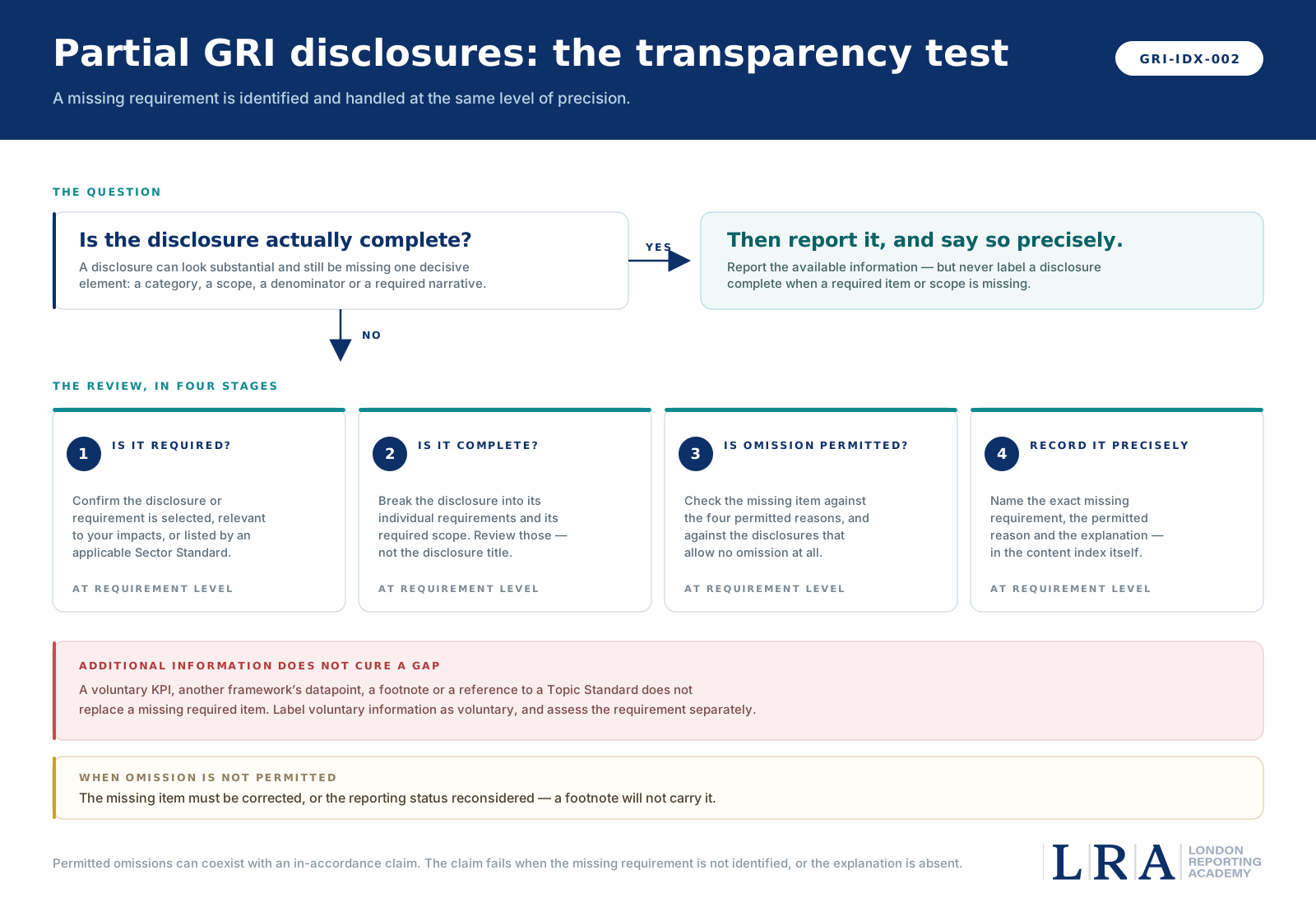
The method
Decision logic for partial information
This is the sequence to run over someone else's Content Index — or your own, before it is published.
- Confirm why the disclosure is in scopeRelevant to your impacts, listed in an applicable Sector Standard, or selected for with-reference reporting.
- Break the disclosure into its requirementsReview the individual requirements and the required scope, not the disclosure title.
- Mark the status of each requirementComplete, not applicable on its facts, unavailable, confidential, legally prohibited, or simply not reported.
- Check whether omission is permitted thereFor that disclosure and for that specific requirement — the two are not the same question.
- Report what is available, and place the omission preciselyAt the exact missing requirement, not across the whole disclosure.
- Test the location, the wording and the row togetherThe Content Index row must not imply more completeness than the underlying disclosure delivers.
- Assess the reporting statusA non-permitted missing item blocks in-accordance reporting. Permitted omissions can coexist with the claim when every omission requirement is met.
In practice
Six situations and their correct treatment
| Scenario | Correct treatment |
|---|---|
| Scope 3 data available for 70% of purchasing spend | Report the available calculation, identify the missing supplier categories or entities, and explain the gap with steps and an expected timeframe. |
| A human-rights policy commitment has not been developed | Report that the commitment does not exist, and optionally explain the plan to develop one. This is not an omission. |
| A Topic Standard has five disclosures; only two address the material impact | Report the two relevant disclosures. The other three need no omission entry unless an applicable Sector Standard lists them. |
| A Sector Standard lists a disclosure that is not relevant to your impacts | List the disclosure and give "not applicable" with a brief impact-based explanation. |
| The organisation reports a custom employee-wellbeing index | Identify it as an organisation-developed or other-source disclosure, and explain its method. |
| A with-reference report uses one part of a multi-part disclosure | Use a scope column or note to identify the reported requirement and the limitation. Do not present the whole disclosure as reported. |
Hypothetical scenario
Illustrative wording — adapt to the actual disclosure
Illustrative only. It shows how the decision is made, not wording that can be copied or relied on.
The claim
When an in-accordance claim becomes hard to defend
| Finding | Effect on the claim |
|---|---|
| The missing item is in Disclosure 2-1 to 2-5, 3-1 or 3-2 | No reason for omission is permitted. The requirement has to be corrected for in-accordance reporting. |
| The Content Index names the disclosure but not the missing requirement | Requirement 6 is not met at the level of precision it demands. |
| The reason given is not one of the four permitted reasons | The omission does not meet GRI 1. |
| "Information unavailable" is used with no steps or expected timeframe | The prescribed explanation is incomplete. |
| Many central disclosures are omitted on exceptional reasons | The claim may remain technically available where each omission is permitted, but credibility and the comprehensive-picture objective both suffer. |
| Only additional voluntary metrics are reported | The underlying GRI disclosures have not necessarily been reported. With-reference wording may be the accurate claim. |
Presentation
Weak versus stronger Content Index rows
Illustrative only — the pattern to copy is the precision, not the sentences.
| Weak | Stronger |
|---|---|
| "305-3 — pages 45–46. Data is incomplete." | "305-3 [named requirement] — pages 45–46. Information unavailable / incomplete for [named entities or categories]. Reason, remediation steps and expected timeframe stated." |
| "GRI 403 used. See people chapter." | Reported requirements from the named disclosure are listed separately with exact pages; unreported requirements are not represented as complete. |
| "Not applicable — no policy." | The disclosure applies. The organisation reports that the policy does not exist, and explains the current plan where relevant. |
| "See alternative KPI." | The alternative KPI is labelled additional voluntary information. The GRI requirement is separately assessed and, if missing, handled through a permitted omission. |
Common mistakes
What reviewers find most often
- Reviewing disclosure numbers, but not the requirements inside them.
- Using "not applicable" for an item the organisation should have but has not implemented.
- Reporting available data without identifying the excluded entities or scope.
- Assuming every unselected Topic Standard disclosure needs a reason for omission.
- Using a voluntary KPI or another framework's datapoint as a silent substitution.
- Listing a full disclosure in a with-reference index when only one requirement is reported.
- Keeping omission detail in an internal gap log rather than in the public Content Index.
Myth
Any missing information automatically prevents reporting in accordance with the GRI Standards.
Reality
Permitted reasons for omission can be used while reporting in accordance, provided the exact disclosure or requirement and the prescribed explanation appear in the Content Index. The claim fails when the missing requirement is not identified, when the reason is not one of the four, or when the explanation is absent.
Review tests
Eight tests to run over a Content Index
- Can the reviewer identify every individual requirement in the selected disclosure?
- Does the reported information cover the complete required scope?
- Is the missing part named in the Content Index, rather than only in the report narrative?
- Is the reason one of the four permitted categories, with the correct explanation?
- Is this a disclosure for which omission is permitted at all?
- Is voluntary information clearly separated from reported GRI disclosures?
- Does the Content Index row avoid implying complete reporting?
- Does the final statement of use match the result of this review?
Self-check
- Would a reader know exactly what is missing, without comparing the report against the Standard?
- If the alternative KPI were removed, would the GRI requirement still be complete?
- Is this a true omission — or should the organisation simply report that the item does not exist?
- Would the same Content Index row be accurate for both an in-accordance and a with-reference claim?
Questions
Questions people ask
Can a GRI disclosure be partly reported?
GRI 1 addresses this at the level of a disclosure or a requirement within a disclosure. That precision is the whole point. A transparent partial disclosure remains useful; an unlabelled one creates a completeness problem and can put the reporting claim in question.
Can reasons for omission apply to one requirement?
GRI 1 addresses this at the level of a disclosure or a requirement within a disclosure. That precision is the whole point. A transparent partial disclosure remains useful; an unlabelled one creates a completeness problem and can put the reporting claim in question.
Does missing data prevent reporting in accordance?
Permitted reasons for omission can be used while reporting in accordance, provided the exact disclosure or requirement and the prescribed explanation appear in the Content Index. The claim fails when the missing requirement is not identified, when the reason is not one of the four, or when the explanation is absent.
Do all unreported Topic Standard disclosures need an omission?
Report the two relevant disclosures. The other three need no omission entry unless an applicable Sector Standard lists them.
Can a custom KPI replace a GRI disclosure?
The alternative KPI is labelled additional voluntary information. The GRI requirement is separately assessed and, if missing, handled through a permitted omission.
Where this sits
Related requirements and next steps
Selecting relevant Topic Standard disclosures, and handling Sector Standard-listed ones.
Requirement-level omissions and the explanation each reason demands.
Where omissions and locations sit in the Content Index.
The disclosures for which no reason for omission is permitted.
Selected disclosures and the precise locations a with-reference claim needs.
Technical status
Technical status
Sources
Primary sources
Framework references
Disclosures this page affects
Take it with you
The checklists as a working spreadsheet
Every checklist and table on this page, with empty status, owner and evidence columns for your team to fill in and keep.
✓ Knowledge Hub AI Assistant · Human-in-the-loop

Ask about this guide
It answers from this page, and reaches into the linked disclosure cards when your question is about the standard itself.
Go deeper · GRI
Certified GRI Standards Training
This page settles one disclosure. The GRI Standards Certified Training — two live days, taken as a bundle with an ESRS course — walks the whole cycle: material topics, datapoints, evidence, the Content Index and assurance readiness, with exercises on your own data.
Available as two live training days online or on-site in London, bundled with an ESRS course.