Short answer
The answer, before the reasoning
The GRI statement of use must match the reporting option the organisation has actually earned, identify the reporting organisation, include the start and end dates of the reporting period, and appear in the GRI content index. For reporting in accordance, the statement is available only after all nine GRI 1 requirements have passed.
For reporting with reference, it is available only after the separate three requirements have passed. The statement may be repeated elsewhere, but repetition does not replace mandatory placement in the content index or cure an unsupported claim.
The statement is also a scope control. It names the organisation making the claim and the period covered. If the statement names a parent company while Disclosure 2-2 covers a different group, or if the dates do not match Disclosure 2-3, the reader cannot tell what the claim actually applies to. The wording therefore needs technical, entity-scope, governance and publishing review, not just copy-editing.
Quick orientation
Quick orientation
- Applies to
- Every organisation reporting either in accordance with or with reference to the GRI Standards.
- Primary decision
- Which reporting option is supportable, what organisation and period the statement covers, and whether the exact claim is publication-ready.
- Mandatory placement
- The completed statement must appear in the GRI content index.
- Common confusion
- Treating the statement as a marketing phrase, certification mark, assurance conclusion or shorthand for using some GRI disclosures.
In practice
Choose the reporting option before drafting the sentence
| Reporting option | Eligibility gate | What the statement communicates |
|---|---|---|
| In accordance | All nine requirements in GRI 1 section 3 have been met. | The organisation has completed the full GRI reporting route for the named period and can use the mandated in-accordance core phrase. |
| With reference | The three with-reference requirements have been met: publish a GRI content index, provide the with-reference statement and notify GRI. | The organisation reports selected information cited in the content index using the GRI Standards, without claiming the full in-accordance route. |
| Neither claim | The relevant gate has not been completed or evidence is insufficient. | The organisation may describe individual standards or disclosures used factually, but should not use either GRI statement of use until the requirements are met. |
Approved drafting patterns
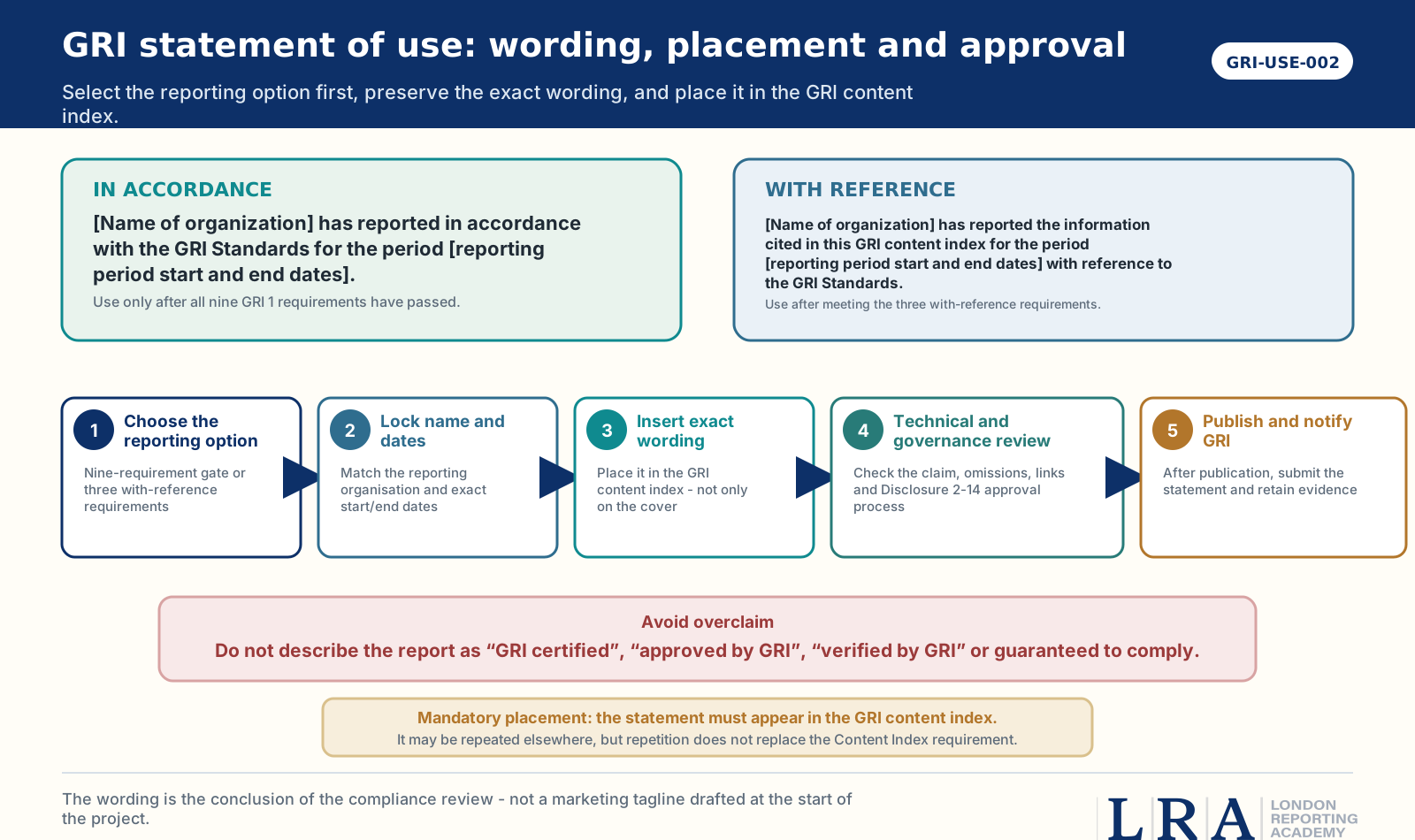
These patterns deliberately separate the unchangeable claim language from the organisation-specific fields. They are drafting controls, not substitutes for reading the official statement in GRI 1. The technical reviewer should compare the final sentence character by character with the current official source, especially after a template carry-forward or translation.
Rule
IN-ACCORDANCE PATTERN
Insert the reporting organisation’s approved name, then the mandated core phrase “has reported in accordance with the GRI Standards”, followed by the reporting period’s start and end dates. Confirm the final complete sentence directly against current GRI 1 Requirement 8 before release.
Rule
WITH-REFERENCE PATTERN
Insert the reporting organisation’s approved name, state that it has reported the information identified in its GRI content index for the named start and end dates, and close with the mandated phrase “with reference to the GRI Standards”. Confirm the final complete sentence directly against the current with-reference section of GRI 1.
In practice
Field-by-field drafting controls
| Field | Required control | Common failure |
|---|---|---|
| Organisation name | Use the approved reporting name that corresponds to the organisation described under GRI 2-1 and the entities included under GRI 2-2. If a group brand and legal parent differ, explain the relationship elsewhere and use a consistent name in the statement and index. | Copying the legal parent name into a report that actually covers a narrower or broader reporting group. |
| Reporting option | Use “in accordance” only after all nine requirements pass; use “with reference” only after its three requirements pass. | Selecting the claim at project kick-off and then adjusting disclosures to fit the marketing promise. |
| Reporting period | Insert explicit start and end dates and reconcile them to GRI 2-3, the report title and the data period. Explain metric-specific periods elsewhere where needed. | Using only “FY2026”, using publication dates, or carrying forward prior-year dates. |
| GRI terminology | Use “GRI Standards” and the correct statement language. Keep assurance and any GRI service description separate. | Using “GRI Guidelines”, “GRI framework”, “GRI compliant”, “GRI rating” or a former Core/Comprehensive concept. |
| Content-index placement | Place the statement inside the GRI content index. A repeat on the cover, methodology page or website can be supplementary. | Placing the statement only in the chairman’s message, report back cover or website metadata. |
| Language versions | Use an authorised translation where available or a technically reviewed translation that preserves the claim. Keep organisation, dates and reporting option consistent across languages. | One language says in accordance while another says aligned or with reference. |
| Version lock | Tie the statement to the final content-index version and final published links. | The report is revised after approval but the claim and index are not rechecked. |
In practice
Placement: mandatory location and useful repetition
| Location | Status | Use |
|---|---|---|
| GRI content index | Mandatory | The statement must appear here because the content index identifies the reporting option, standards, disclosures, locations and omissions. |
| Basis of preparation or reporting methodology | Optional repeat | Can explain the claim, scope, reporting period, standards used, limitations and governance. Must not change the wording or imply a broader claim. |
| Report cover or inside cover | Optional and high risk | A concise repeat may help readers, but only after approval. Avoid logo-like treatment that suggests certification. |
| Website publication page | Optional repeat | Useful for discoverability and version control if it links to the final report and content index. |
| Press release, social media or marketing copy | Not a substitute | Use only carefully reviewed factual wording. Do not abbreviate the claim into “GRI certified” or “GRI approved”. |
In practice
Wording that creates an overclaim
| Avoid | Why it is misleading | Safer replacement |
|---|---|---|
| “GRI compliant report” | GRI 1 defines reporting in accordance or with reference; “compliant” is not the prescribed statement and can imply a broad legal or certification status. | Use the relevant GRI statement of use and describe specific standards/disclosures factually. |
| “GRI certified” or “certified according to GRI” | GRI does not certify the organisation’s report or reporting process. | Describe any external assurance separately and accurately; do not attribute certification to GRI. |
| “Approved by GRI” | Notification, report registration or a GRI service is not approval of the report’s content or claim. | State only that the organisation notified or registered the report, if useful, without implying approval. |
| “Verified by GRI” | GRI’s official materials explain that GRI does not verify, check or pass judgement on report quality or the preparation process. | Describe the actual scope of any GRI Report Service and any independent assurance provider’s conclusion separately. |
| “GRI aligned” | The term is ambiguous: it may refer to selected disclosures, a methodology or the full report. | State the reporting option or identify exactly which GRI disclosures or standards were used. |
| “GRI Standards table” or “GRI Index” | Official reporting-support material prefers “GRI content index”, which accurately describes the publication tool. | Use “GRI content index”. |
| “Verified registration” | In the registration system, a verified status concerns authority to submit on behalf of the organisation, not verification of the report. | Say the report was submitted or registered with GRI, without linking that status to report quality. |
In practice
Internal approval workflow
| Gate | Owner | Required evidence — Approval question |
|---|---|---|
| 1. Reporting-option decision | Technical reporting lead | Nine-requirement checklist or with-reference checklist; unresolved findings; claim recommendation. — Which statement, if any, is supported by the final facts? |
| 2. Name and period lock | Group reporting / legal-entity owner | GRI 2-1, 2-2 and 2-3 outputs; legal and trading names; entity list; reporting dates. — Does the statement identify the same organisation and period as the report? |
| 3. Technical wording review | Independent technical reviewer | Current GRI 1 text; final statement; content-index version; omissions; applicable Sector Standards; disclosure map. — Is the wording exact and is the reporting claim earned? |
| 4. Governance and legal review | Appropriate governance body, legal or risk functions according to the organisation’s process | GRI 2-14 disclosure; material-topic approval; legal/privacy issues; assurance wording; public-claim risk. — Has the organisation completed its required approval process, and does the report describe governance accurately? |
| 5. Publisher lock | Publisher / document controller | Final PDF/web files; content index; link test; language versions; file hashes or final-release record. — Is the approved statement present in the mandatory location and unchanged across final files? |
| 6. Publication close-out | Reporting owner | Published URLs, notification/registration submission, confirmation and archived release set. — Was GRI notified after publication, and can the organisation reproduce what was submitted? |
Caution
DO NOT OVERSTATE GRI 2-14
GRI 2-14 requires the organisation to report whether the highest governance body is responsible for reviewing and approving the reported information, including material topics, and to explain if it is not. GRI 3 guidance recommends that the highest governance body review and approve the list of material topics. The article’s approval workflow is good control practice; it should be tailored to the organisation’s actual governance rather than described as a universal requirement that the board sign every page.
Hypothetical example: the wrong claim in a nearly final report
Registration does not validate the claim, and the cover wording is not an acceptable substitute for the statement in the content index. The technical reviewer blocks the in-accordance wording. The organisation either completes the missing requirements and inserts the correct statement, or assesses the with-reference option and revises the cover, methodology, index and marketing copy consistently. Any independent assurance conclusion is described in its own section with the assurer, scope and level of assurance, not attributed to GRI.
Hypothetical scenario
HYPOTHETICAL SCENARIO
Westmoor Infrastructure’s draft annual report states on the cover that it is “GRI certified and fully compliant”. The GRI content index contains no statement of use. One material topic lacks Disclosure 3-3, the applicable Sector Standard has not been reviewed and two GRI 2 disclosures are missing. A consultant has also submitted the report to GRI’s registration system.
Illustrative only. It shows how the decision is made, not wording that can be copied or relied on.
In practice
Weak versus stronger statement control
| Control area | Weak practice | Stronger practice |
|---|---|---|
| Drafting timing | Marketing writes the statement at project start. | Technical team proposes the claim only after the requirements checklist is substantially complete. |
| Source control | Uses a statement copied from an old report or website. | Checks the final sentence against the current official GRI 1 text and current reporting option. |
| Scope | Names the parent but does not reconcile the entities covered. | Locks the reporting organisation and ties the name to GRI 2-1 and 2-2 evidence. |
| Period | Uses “2026 reporting year”. | Uses explicit start and end dates consistent with GRI 2-3. |
| Placement | Appears only on the report cover. | Appears in the GRI content index; any repeat is controlled and identical in meaning. |
| Approval | One author approves their own claim. | Separate preparer, technical reviewer and publication controller sign the final version. |
| Close-out | No record of notification or published version. | Archives final links, release files and GRI notification/registration confirmation. |
In practice
Common mistakes and corrections
| Mistake | Risk | Correction |
|---|---|---|
| Changing small words in the statement | A seemingly minor edit can alter the defined reporting claim. | Use a locked approved sentence and compare it to current GRI 1. |
| Mixing “in accordance” and “with reference” in different locations | Readers cannot identify the actual reporting option; translations may conflict. | Use one approved option across the index, report, website and derivative content. |
| Using the statement before material topics are approved | The claim may be based on a provisional scope that changes late in the process. | Approve material topics and complete the disclosure map before statement sign-off. |
| Treating external assurance as GRI approval | Assurance and the GRI reporting claim have different scopes and responsible parties. | Describe the assurance conclusion and GRI statement separately. |
| Copying the previous year’s name and dates | Creates a factual inconsistency even where the rest of the report is correct. | Use controlled fields populated from the final entity and reporting-period registers. |
| Failing to reapprove after a late edit | A removed disclosure or broken link can invalidate the earlier claim review. | Trigger re-review for any change to material topics, omissions, index, statement or publication links. |
Rule
MYTH VERSUS REALITY
Myth: “Once GRI registers the report, the in-accordance claim is verified.” Reality: registration or notification fulfils the organisation’s reporting step; it does not mean GRI has approved, certified or checked the report. Responsibility for the claim remains with the reporting organisation and its stakeholders, and any assurance conclusion has its own defined scope.
Final publication check
The reporting option is supported by the completed GRI 1 checklist.
The organisation name matches the reporting organisation and entity scope.
The start and end dates match GRI 2-3 and the report title.
The final wording has been checked against current GRI 1, not a prior-year template.
The statement appears in the GRI content index.
Any optional repeat has the same meaning and does not use certification-style design or language.
The report does not describe itself as GRI compliant, certified, approved, rated or verified by GRI.
Any independent assurance and any GRI Report Service are described separately and within their actual scope.
All language versions, website text and press materials use the approved reporting option.
Late edits to disclosures, omissions or links have triggered re-review.
Published files and links have been archived, and GRI notification or registration is assigned for post-publication completion.
Self-check
- Where must the GRI statement of use appear?
- What is the eligibility difference between in accordance and with reference?
- Why can “verified by GRI” be misleading even if the report was submitted to GRI?
- Which three fields must be reconciled before the sentence is locked?
Questions
Questions people ask
What is the correct GRI statement of use?
The GRI statement of use must match the reporting option the organisation has actually earned, identify the reporting organisation, include the start and end dates of the reporting period, and appear in the GRI content index. Insert the reporting organisation’s approved name, then the mandated core phrase “has reported in accordance with the GRI Standards”, followed by the reporting period’s start and end dates.
Where should the GRI statement appear?
The GRI statement of use must match the reporting option the organisation has actually earned, identify the reporting organisation, include the start and end dates of the reporting period, and appear in the GRI content index. For reporting in accordance, the statement is available only after all nine GRI 1 requirements have passed.
What is the difference between in accordance and with reference?
For reporting in accordance, the statement is available only after all nine GRI 1 requirements have passed. For reporting with reference, it is available only after the separate three requirements have passed.
Can a report say GRI compliant or GRI certified?
“In accordance” is a defined GRI reporting claim. “With reference” is a different reporting option for selected GRI information or where the nine in-accordance requirements are not all met. Expressions such as “GRI compliant”, “GRI certified”, “approved by GRI” or “verified by GRI” can imply a status that the GRI Standards and GRI reporting-support services do not provide.
Does GRI registration verify the report?
Myth: “Once GRI registers the report, the in-accordance claim is verified.” Reality: registration or notification fulfils the organisation’s reporting step; it does not mean GRI has approved, certified or checked the report. Responsibility for the claim remains with the reporting organisation and its stakeholders, and any assurance conclusion has its own defined scope.
In practice
Related standards and practical connections
| Relationship | Reference | Practical connection |
|---|---|---|
| Primary | GRI 1, Requirement 8 | In-accordance statement and mandatory content-index placement. |
| Primary | GRI 1, with-reference section | With-reference statement, content index and notification. |
| Supporting | GRI 1, Requirements 1-7 and 9 | Eligibility gate that supports the statement. |
| Supporting | GRI 2-1, 2-2 and 2-3 | Organisation name, entity scope and reporting period. |
| Governance | GRI 2-14 and GRI 3 material-topic approval guidance | Accurate disclosure of review and approval responsibilities. |
| Publication | GRI Report Registration FAQs and Report Services Methodology | Notification, registration and avoidance of verification or certification overclaims. |
Sources
Primary sources
- GRI 1: Foundation 2021 — Requirement 8 and the reporting-with-reference section
- GRI 1: Foundation 2021 — all nine in-accordance requirements and all three with-reference requirements
- GRI 2: General Disclosures 2021 — Disclosures 2-1, 2-2 and 2-3
- GRI 2: General Disclosures 2021 — Disclosure 2-14 on review and approval of reported information
- GRI Standards Report Registration System FAQs — official GRI FAQs on submission, timing and the meaning of registration status
- GRI Report Services Methodology 2026 — section 1.2 and section 1.6 on verification, certification and inappropriate wording
Framework references
Disclosures this page affects
Take it with you
The checklists as a working spreadsheet
Every checklist and table on this page, with empty status, owner and evidence columns for your team to fill in and keep.
✓ Knowledge Hub AI Assistant · Human-in-the-loop

Ask about this guide
It answers from this page, and reaches into the linked disclosure cards when your question is about the standard itself.
Go deeper · GRI
Certified GRI Standards Training
This page settles one disclosure. The GRI Standards Certified Training — two live days, taken as a bundle with an ESRS course — walks the whole cycle: material topics, datapoints, evidence, the Content Index and assurance readiness, with exercises on your own data.
Available as two live training days online or on-site in London, bundled with an ESRS course.