Short answer
The answer, before the reasoning
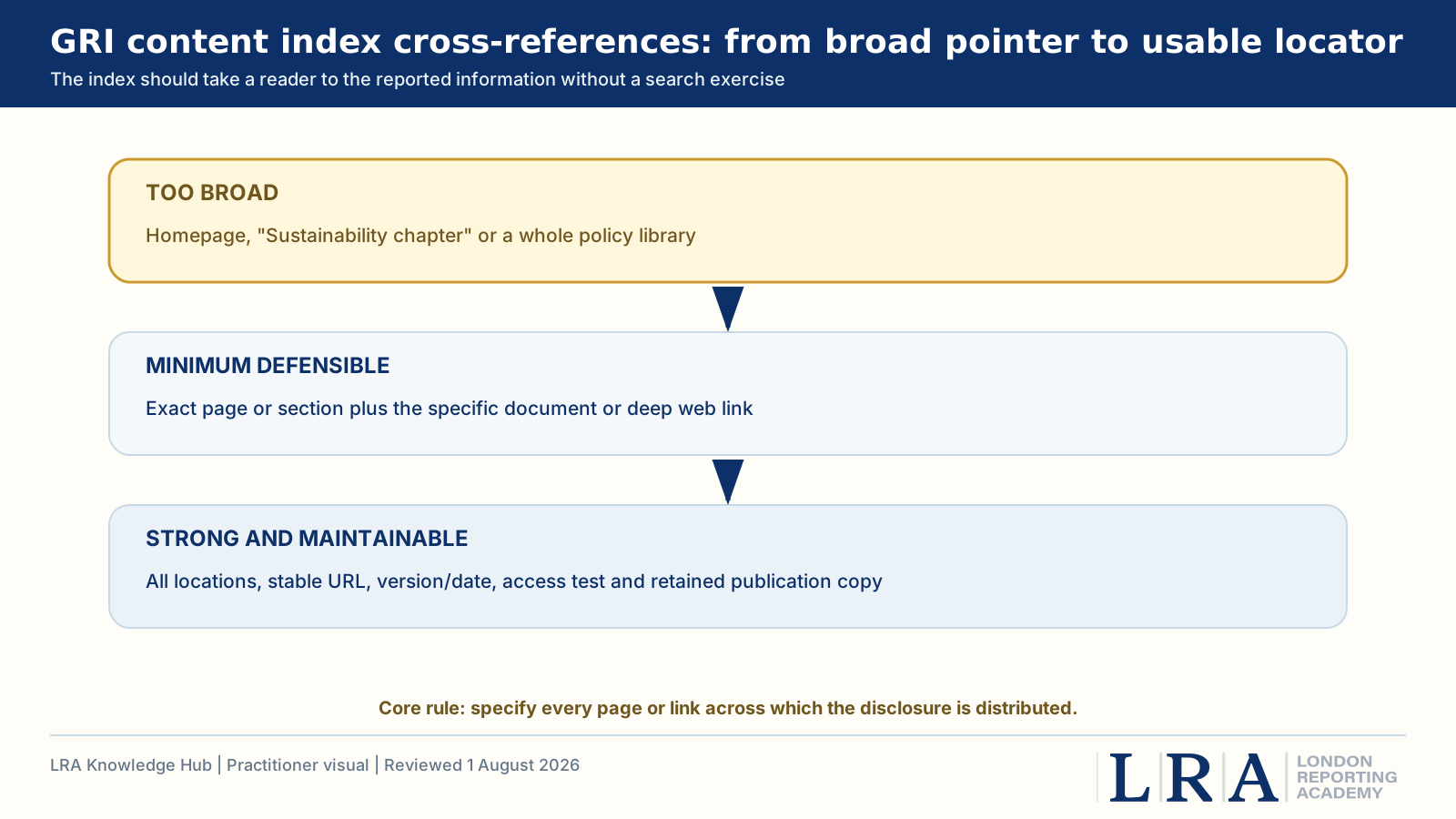
The GRI content index should take the reader to the reported information, not merely to the document that might contain it. GRI 1 requires specific page numbers or links for each reported disclosure, and all page numbers or links when the information is spread across several locations.
A homepage, a broad chapter title or an entire policy library is normally too imprecise. For web content, use a stable deep link and, as publication practice, retain the version or dated snapshot that supports the reporting period. A paywall or inaccessible document is not expressly prohibited by GRI 1, but it is difficult to reconcile with the index's purpose of helping information users access the reported information.
Rule
GRI-IDX-003
GRI Content Index Cross-References: How Precise Must Page and Web Links Be? Practical rules for pages, sections, URLs, policies, data books, multi-document reporting and link maintenance
In practice
Type
| Type | Tier | Audience — Current context |
|---|---|---|
| How-to / publication control guide | Tier 3 - Deep Guide | Content-index owners, report editors, web teams, consultants and reviewers — GRI 1: Foundation 2021 content-index requirements checked to 1 August 2026 |
Why location precision matters
The content index is the navigation layer for GRI reporting. It shows what was reported, which Standard or source was used and where the information can be found. When the reference is too broad, the reader must reverse-engineer the report and cannot easily test whether a disclosure is complete.
Precision is also a control. It exposes duplication, missing requirements, broken web pages and inconsistencies between the final report and the content index before publication.
Quick orientation
Quick orientation
- Applies to
- PDF reports, annual reports, web reports, policy libraries, ESG data books, prior-year publications and multi-document reporting packages.
- Primary decision
- Can a reasonable reader reach every part of the reported disclosure directly and without guessing?
- Key source
- GRI 1 Requirement 7 and Appendices 1 and 2 - Location guidance.
- Common confusion
- Assuming that naming the document or chapter is enough even when the disclosure occupies only one paragraph or several separate locations.
The formal GRI rule
For each reported disclosure, the content index includes the location where the information can be found.
The location is expressed as specific page numbers or links in a report, document or website.
When the information is distributed across multiple pages or web pages, every relevant page number and link is specified.
Information may be published across one or more locations and in electronic or paper-based formats.
If previously reported information has not changed, the organisation can republish it or refer to the earlier information in the content index.
A standalone report that does not contain the content index must provide a link or reference to the index.
What GRI 1 does not prescribe
A single mandatory URL format or website platform.
A universal rule that every reference must include both a page number and a section title.
A technical archive format for dynamic web content.
A specific link-check frequency after publication.
An express ban on paywalled, login-protected or internally restricted sources; however, access limitations can defeat the practical purpose of the index.
In practice
Reference rules by publication type
| Location type | Minimum reference | Stronger practice — Typical failure |
|---|---|---|
| Paginated PDF report | Exact page or page range for every part of the disclosure. | Add section heading and identify the specific requirement when several requirements are split. — Annual Report, Sustainability section. |
| HTML report | Deep link to the exact page or anchored section. | Use stable slugs, section IDs and a publication-date or version marker. — Corporate homepage or generic sustainability landing page. |
| Policy document | Policy title, exact page/section and accessible link. | State policy version and approval date; retain the published copy used for the reporting period. — Policies page containing many documents. |
| ESG data book | Named table or sheet plus page/tab and stable link. | Specify units, period and boundary where the same metric appears in several tables. — Data book, environmental metrics. |
| Multi-document disclosure | Every page and link containing required information. | Allocate each requirement to a location in an internal cross-reference matrix. — One reference to the main report when the metric is only in a separate data annex. |
| Prior-period information | Exact prior report page or link. | Confirm it remains unchanged, publicly accessible and clearly identified as the source for the current index. — See last year's report. |
| Third-party or regulatory filing | Exact public document and location. | Retain a copy and identify the filing date or version. — Link to a search portal with no document identifier. |
In practice
Good and bad examples
| Disclosure situation | Bad reference | Better reference |
|---|---|---|
| One narrative requirement in a long annual report | Annual Report 2025. | Annual Report 2025, p. 72, "Human-rights due diligence". |
| Metric and methodology are separated | ESG Data Book. | ESG Data Book 2025, pp. 18-19 for the metric; Methodology Note, section 4.2 for boundary and calculation. |
| Web disclosure with several sub-pages | www.example.com/sustainability | Deep links to the governance page, data table and methodology page, all listed in the same content-index row. |
| Unchanged policy from prior year | Policy unchanged. | Human Rights Policy, version 3, section 2, public link; unchanged during the 2025 reporting period. |
| Dynamic dashboard | Live ESG dashboard. | Dashboard deep link plus reporting-period filter instructions, extraction date and retained 2025 publication snapshot. |
| Password-protected supplier portal | Supplier portal. | Public summary or report page containing the required information; restricted evidence remains in the internal evidence pack. |
How to handle dynamic web content
GRI 1 does not define a web-archiving method. The following controls are implementation practice designed to preserve verifiability and access when web pages change after publication:
Use a stable deep link rather than a navigation path that depends on menus or search.
Display the reporting period or last-updated date on the page.
Retain a PDF, HTML capture or controlled export of the version approved for publication.
Record the publication date, URL, content owner and archive location in the evidence pack.
Avoid linking to a dashboard default view that automatically rolls forward to the latest year.
Test the link in a private browser session and on mobile, without internal credentials.
When a page is replaced, maintain a redirect or update the content index and change log.
Paywalls, logins and inaccessible documents
The Standard's location guidance is framed around helping information users access the reported information. A reference that only employees, subscribers or selected counterparties can open may not meet that practical objective. Where the underlying evidence must remain restricted, publish the required disclosure in an accessible report or summary and retain the restricted record as support rather than as the public location.
Hypothetical case: one disclosure across four locations
A hypothetical bank reports a material topic across its annual report, a web policy, a data book and a methodology note. The first draft of the content index says only 'Sustainability section'. The reviewer maps each disclosure requirement: governance to annual-report pages 64-65, policy to the named web page, metrics to Data Book table S4, and method and limitations to Methodology Note section 3. The content-index row lists all four locations. The bank also archives the web page and tests every link after the final files go live.
In practice
Cross-reference production workflow
| Step | Action | Owner / input — Output / control |
|---|---|---|
| 1 | Create a requirement-to-location matrix before final pagination. | Technical author + disclosure checklist. — Every requirement has a proposed location. |
| 2 | Freeze document versions and page numbering. | Report editor + web owner. — Controlled publication files. |
| 3 | Insert exact pages, section anchors and deep links. | Content-index owner. — Complete index rows. |
| 4 | Test all locations as an external user. | Independent reviewer. — Link-test log and corrected references. |
| 5 | Reconcile final files after publication. | Publisher + content-index owner. — Live-file confirmation and archive copy. |
| 6 | Monitor links and redirects. | Web owner + content owner. — Periodic exception report and change log. |
Common mistakes
Using a homepage because it is stable, even though it does not contain the disclosure.
Listing one page when the method, metric and limitation are on three different pages.
Linking to a document library rather than the specific policy or report.
Using internal file paths, SharePoint links or portals that external users cannot access.
Linking to a live dashboard that no longer preserves the reported period.
Changing web content after publication without retaining the approved version.
Testing links before publication but not after URLs, redirects and permissions go live.
Copying last year's content index without rechecking page numbers and access.
Myth
A section title is enough because readers can use the document search function.
Reality
GRI 1 calls for specific page numbers or links. A broad chapter reference shifts the navigation burden to the reader and may hide that required information is missing or split across locations.
Readiness
Link-maintenance checklist
- Every reported disclosure has at least one exact page or deep link.
- Every distributed disclosure lists all locations.
- The linked document title, version and reporting period are clear.
- The location opens without internal credentials or a subscription, or an accessible public alternative is supplied.
- Dynamic pages preserve the reporting-period view or have a retained publication snapshot.
- Links have been tested after publication from outside the organisation network.
- Redirects and archived prior-period sources remain functional.
- The content owner and web owner are assigned to monitor changes.
- The final index is reconciled to the final PDF, HTML and data-book versions.
- Broken-link corrections trigger an update record rather than silent replacement.
Self-check
- Could a first-time reader reach every required item in under one minute?
- Would the reference still work if the site menu, search engine or dashboard default changed?
- Does the link show the same reporting period and version that the organisation approved?
- Is any supporting source accessible only to internal users or paying subscribers?
Questions
Questions people ask
Must a GRI content index include page numbers?
The GRI content index should take the reader to the reported information, not merely to the document that might contain it. GRI 1 requires specific page numbers or links for each reported disclosure, and all page numbers or links when the information is spread across several locations.
Can a content index link to a website?
The GRI content index should take the reader to the reported information, not merely to the document that might contain it. GRI 1 requires specific page numbers or links for each reported disclosure, and all page numbers or links when the information is spread across several locations.
Is a homepage link sufficient?
GRI 1 requires specific page numbers or links for each reported disclosure, and all page numbers or links when the information is spread across several locations. A homepage, a broad chapter title or an entire policy library is normally too imprecise.
How should a disclosure across several documents be referenced?
The GRI content index should take the reader to the reported information, not merely to the document that might contain it. GRI 1 requires specific page numbers or links for each reported disclosure, and all page numbers or links when the information is spread across several locations.
Can a GRI index link to a paywalled document?
For web content, use a stable deep link and, as publication practice, retain the version or dated snapshot that supports the reporting period. A paywall or inaccessible document is not expressly prohibited by GRI 1, but it is difficult to reconcile with the index's purpose of helping information users access the reported information.
In practice
Related standards and next learning steps
| Relation | Reference | Why it matters |
|---|---|---|
| Direct | GRI 1 Requirement 7 | Requires the location for every reported disclosure. |
| Direct | GRI 1 Appendices 1 and 2 - Location guidance | Defines specific pages/links and multi-location treatment. |
| Supporting | GRI 1 Clarity, Timeliness and Verifiability principles | Supports accessible, current and reviewable references. |
| Prerequisite | Partial GRI Disclosures | Clarifies whether the referenced information is complete. |
| Evidence | GRI Evidence Pack | Retains publication versions, link tests and source records. |
Sources
Primary sources
Take it with you
The checklists as a working spreadsheet
Every checklist and table on this page, with empty status, owner and evidence columns for your team to fill in and keep.
✓ Knowledge Hub AI Assistant · Human-in-the-loop

Ask about this guide
It answers from this page, and reaches into the linked disclosure cards when your question is about the standard itself.
Go deeper · GRI
Certified GRI Standards Training
This page settles one disclosure. The GRI Standards Certified Training — two live days, taken as a bundle with an ESRS course — walks the whole cycle: material topics, datapoints, evidence, the Content Index and assurance readiness, with exercises on your own data.
Available as two live training days online or on-site in London, bundled with an ESRS course.