Short answer
The answer, before the reasoning
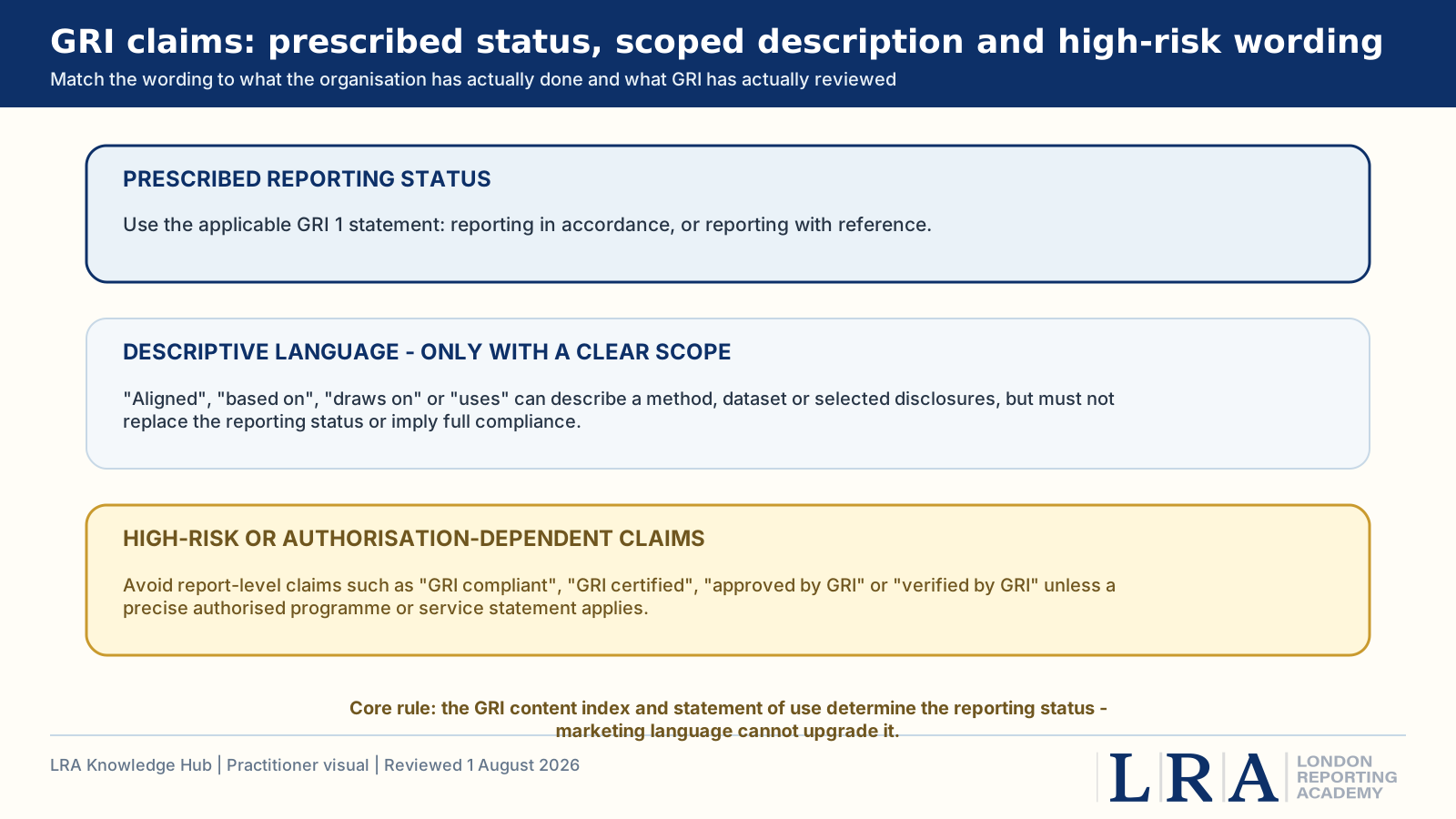
For a report, the safest and most accurate wording is the reporting status defined by GRI 1: either the organisation has reported in accordance with the GRI Standards, or it has reported selected information with reference to the GRI Standards. 'GRI compliant' is not the prescribed reporting status and can imply a broader conclusion than the evidence supports.
'Aligned with GRI' can be used descriptively only when the object and scope are explicit - for example, a methodology or selected datapoints - and it must not replace the statement of use. Claims that a report, company, consultancy or course is certified, approved or verified by GRI require specific formal authorisation and must be limited to that programme or service.
Rule
GRI-USE-003
Can You Say 'GRI Compliant' or 'Aligned with GRI'? Claims to Use and Avoid A practical wording guide for reports, websites, press releases, tenders and course materials
In practice
Type
| Type | Tier | Audience — Current context |
|---|---|---|
| Expert note / claims guide | Tier 4 - Expert Note | Reporting teams, communications, legal, consultants, tender teams and training providers — GRI 1: Foundation 2021, GRI trademark and report-services materials checked to 1 August 2026 |
Why wording creates real reporting risk
Readers do not treat these words as interchangeable. 'In accordance' signals that the organisation accepts responsibility for meeting all nine GRI 1 requirements. 'With reference' signals selected use. By contrast, 'compliant', 'aligned', 'certified' and 'approved' can be read as a quality judgement, independent verification or institutional endorsement.
The risk is not only technical. A strong marketing phrase can conflict with the GRI content index, an assurance statement, a tender response or the organisation's actual partner status. It can also create expectations that GRI itself reviewed the report when report registration or a limited service did not do so.
Quick orientation
Quick orientation
- Applies to
- Report titles, basis-of-preparation sections, websites, press releases, procurement documents, credentials and course descriptions.
- Primary decision
- What exactly is being claimed: a reporting status, a limited method alignment, a service completion or an authorised partner/certification status?
- Key sources
- GRI 1 reporting-status requirements; GRI trademark and copyright policy; registration FAQ; 2026 Report Services methodology and terms.
- Common confusion
- Assuming that report registration, a Content Index Service or use of selected disclosures allows the organisation to say the report is certified or GRI compliant.
In practice
The claims spectrum
| Expression | Status under GRI 1 | Main reader expectation — Recommended treatment |
|---|---|---|
| In accordance with the GRI Standards | Prescribed report status when all nine requirements are met. | A complete GRI reporting package, including material topics, relevant disclosures, omissions, content index, statement and notification. — Use only with the prescribed statement in the GRI content index and after a final requirements review. |
| With reference to the GRI Standards | Prescribed status for selected use when the three with-reference requirements are met. | The information cited in the content index uses selected GRI Standards or disclosures. — Use the prescribed statement and identify exactly what is reported. Do not imply comprehensive GRI reporting. |
| Aligned with GRI | Not a report status defined by GRI 1. | Often understood as close correspondence or broad consistency. — Name the object, scope, edition and residual differences: for example, a data dictionary aligned with selected disclosure definitions. |
| Based on / draws on / uses GRI | Descriptive wording, not a reporting status. | GRI informed the method or content. — State what was used and what was not. Add a non-claim sentence where readers could infer in-accordance reporting. |
| GRI compliant | Not the prescribed statement in GRI 1. | May imply full compliance, quality review or a certification conclusion. — Avoid as the primary report claim. Replace with the applicable GRI 1 status and a link to the content index. |
| GRI certified / approved / verified | Only meaningful where a specific authorised programme, service mark or permission applies. | GRI has independently assessed and endorsed the report, organisation, product, course or person. — Do not use for a report or service unless the exact formal status exists; reproduce only the authorised mark and accompanying scope statement. |
What the official GRI source base supports
GRI 1 defines two reporting statuses and provides the required statement-of-use structure for each.
An organisation cannot claim reporting in accordance when it has not complied with all nine in-accordance requirements.
Report registration is a notification step; the registration FAQ states that GRI does not judge the quality of the disclosures or the preparation process.
GRI Report Services review defined aspects of the content index or linkage work, but the 2026 methodology states that they do not verify whether the organisation reported in accordance, certify the report or provide external assurance.
GRI trademark materials prohibit wording or use of marks that suggests endorsement, certification or affiliation without the relevant written permission.
What the sources do not support
A generic statement that GRI has approved, rated or verified the whole report.
A claim that completing a Content Index Service guarantees alignment or the reliability of the underlying data.
A claim that a consultancy, software tool, training course or individual is GRI certified merely because it uses GRI terminology.
Using the word aligned without identifying what is aligned, which edition is used and whether the organisation is also making a formal GRI reporting-status claim.
Using a GRI logo, service mark or partner mark outside its permission and placement conditions.
Five questions before approving a public claim
1. Is the sentence claiming a GRI reporting status, or merely describing a method, dataset, disclosure or capability?
2. Does the GRI content index support the same conclusion and use the correct reporting period and organisation name?
3. Has any GRI service, certification or partnership actually been granted, and what exactly is its scope and validity period?
4. Could a reasonable reader interpret the sentence as GRI endorsement, assurance or verification of the underlying information?
5. Can the communications, legal and technical reviewers point to evidence for every part of the claim?
Rule
USE THE PRESCRIBED FORM
The two patterns below are the formal GRI 1 statements. Replace the bracketed fields and use only the statement supported by the completed reporting requirements and GRI content index.
In practice
Official GRI 1 statement-of-use patterns
| Reporting status | Statement pattern |
|---|---|
| In accordance | [Name of organization] has reported in accordance with the GRI Standards for the period [reporting period start and end dates]. |
| With reference | [Name of organization] has reported the information cited in this GRI content index for the period [reporting period start and end dates] with reference to the GRI Standards. |
Technical status
IMPORTANT STATUS NOTE
The patterns below are drafting guidance from London Reporting Academy, not wording approved by GRI. They do not replace the formal statement of use, and any GRI mark or service statement must follow the permission supplied by GRI.
In practice
LRA controlled wording library for other channels
| Channel | Safer wording pattern | Wording to avoid |
|---|---|---|
| Report / content index | Use one of the two official GRI 1 statement patterns above and direct the reader to the GRI content index for the detailed basis. | This is a GRI-compliant or GRI-certified report. |
| Basis of preparation | Selected disclosures and definitions from [named GRI Standards and editions] were used. The publication [does / does not] claim reporting in accordance. | The report is fully aligned with GRI without identifying the tested requirements. |
| Website | Our [year] sustainability information reports [applicable status]; the GRI content index is available at [stable link]. | GRI has verified our sustainability reporting. |
| Press release | The publication includes a GRI content index and uses the GRI Standards to report the organisation's material impacts. | The report has received GRI approval. |
| Tender - reporting capability | We support clients in preparing reports that meet the requirements for reporting in accordance with or with reference to the GRI Standards. | We are a GRI-approved consultancy, unless this precise status exists and is authorised. |
| Tender - experience | Our team has delivered [number] projects using the GRI Standards; named credentials and current partner status are provided separately. | All our consultants are GRI certified, unless each claim is current and evidenced. |
| Course materials | Training on applying the GRI Standards, delivered by [provider and current authorised status, where applicable]. | Official GRI certification course, unless the programme and provider are formally authorised to use that wording. |
| GRI service completion | Use the exact service mark and accompanying scope statement supplied by GRI, in the permitted location. | GRI certified the report or guaranteed that it is in accordance. |
In practice
Weak versus stronger wording
| Situation | Weak / risky | Stronger and more precise |
|---|---|---|
| Selected Topic Standard disclosures | Our ESG report is GRI aligned. | The report uses selected disclosures from GRI 305: Emissions 2016 and reports with reference to the GRI Standards; see the content index for the cited information. |
| Content Index Service completed | GRI approved our report. | The GRI content index completed the named GRI Content Index Service. The service scope is described in the statement accompanying the service mark. |
| Methodology comparison | Our internal methodology is GRI compliant. | The methodology uses the definitions and selected requirements identified in the mapping; differences and exclusions are recorded in the methodology register. |
| Training offer | Become GRI certified through our course. | Complete training on applying the GRI Standards. Any separate GRI professional certification or partner status is described with its official name and conditions. |
Hypothetical case: a service mark becomes a report-level overclaim
A hypothetical manufacturer completes a GRI Content Index Service. Its communications team drafts: 'Our 2025 sustainability report has been certified by GRI.' The technical team objects. The service reviewed defined aspects of the content index, not the reliability of the data, the materiality process or the full in-accordance conclusion. The final communication states that the content index completed the named service and reproduces the scope statement supplied with the mark. The report's own statement of use remains the organisation's responsibility.
In practice
Common mistakes
| Mistake | Why it happens | Risk — Correction |
|---|---|---|
| Using compliant as a synonym for in accordance | Legacy language and generic compliance vocabulary. | The claim may be broader than the GRI 1 requirements review. — Use the formal reporting status and retain a signed requirements checklist. |
| Calling registration verification | The registration system may display a verified submission status. | Readers may think GRI checked the report. — Explain that registration confirms submission authority, not report quality. |
| Treating a service mark as endorsement | The mark is visible and can look like a quality seal. | The service scope is overstated. — Use the mark only as permitted and reproduce the exact accompanying statement. |
| Using aligned without an object | The word sounds flexible and positive. | No one knows whether it refers to definitions, datapoints, process or full reporting. — Name the object, edition, scope, mapping and remaining differences. |
| Extending partner or training status | A provider has one formal relationship with GRI. | The status is applied to unrelated services, courses or individuals. — Use the exact current title and only within the authorised scope and validity period. |
Myth
'Aligned with GRI' is always a safe alternative when the organisation is not ready to say in accordance.
Reality
Aligned is safe only when it is a scoped description. If it is used as an undefined report-level status, readers can still infer broad compliance. State what is aligned, to which edition, how the mapping was tested and which GRI reporting status - if any - is claimed.
Readiness
Publication claim checklist
- The content index and public communications use the same reporting status.
- The organisation name and reporting period match the prescribed statement of use.
- Any aligned, based on or uses claim names its object, scope and edition.
- No wording implies GRI assurance, endorsement, rating or verification of report quality.
- Service, partner, software, course and professional certification claims are separately evidenced.
- The authorised mark, placement and accompanying statement have not been altered.
- Tender and sales teams use the same controlled wording library as the reporting team.
- Legal and technical reviewers have approved the final sentence, not only the report body.
Self-check
- Would a reader understand exactly what the organisation did without opening another document?
- Could the claim survive removal of the logo or service mark, based only on the supporting evidence?
- Is every use of certified, approved or verified tied to a named and current formal programme?
- Does the phrase still remain accurate if the organisation later changes one disclosure or web page?
Questions
Questions people ask
Is GRI compliant an official claim?
For a report, the safest and most accurate wording is the reporting status defined by GRI 1: either the organisation has reported in accordance with the GRI Standards, or it has reported selected information with reference to the GRI Standards. By contrast, 'compliant', 'aligned', 'certified' and 'approved' can be read as a quality judgement, independent verification or institutional endorsement.
Can a company say aligned with GRI?
'Aligned with GRI' can be used descriptively only when the object and scope are explicit - for example, a methodology or selected datapoints - and it must not replace the statement of use. Aligned is safe only when it is a scoped description. If it is used as an undefined report-level status, readers can still infer broad compliance.
Does GRI certify sustainability reports?
Report registration is a notification step; the registration FAQ states that GRI does not judge the quality of the disclosures or the preparation process. GRI Report Services review defined aspects of the content index or linkage work, but the 2026 methodology states that they do not verify whether the organisation reported in accordance, certify the report or provide external assurance.
What can be said after a GRI Content Index Service?
The service reviewed defined aspects of the content index, not the reliability of the data, the materiality process or the full in-accordance conclusion. The final communication states that the content index completed the named service and reproduces the scope statement supplied with the mark.
Can a course be called GRI certified?
Claims that a report, company, consultancy or course is certified, approved or verified by GRI require specific formal authorisation and must be limited to that programme or service. Complete training on applying the GRI Standards. Any separate GRI professional certification or partner status is described with its official name and conditions.
In practice
Related standards and next learning steps
| Relation | Reference | Why it matters |
|---|---|---|
| Direct | GRI 1: Foundation 2021 - reporting in accordance and with reference | Defines the only formal report statuses and statement-of-use conditions. |
| Direct | GRI trademark and copyright policy | Sets boundaries for marks, endorsement and certification implications. |
| Supporting | GRI Report Services methodology and terms 2026 | Defines the review scope and approved service statement. |
| Prerequisite | GRI Statement of Use: Correct Wording, Placement and Approval | Explains the formal statement and internal approval workflow. |
| Next step | Partial GRI Disclosures | Tests whether missing information is consistent with the selected reporting status. |
Sources
Primary sources
Take it with you
The checklists as a working spreadsheet
Every checklist and table on this page, with empty status, owner and evidence columns for your team to fill in and keep.
✓ Knowledge Hub AI Assistant · Human-in-the-loop

Ask about this guide
It answers from this page, and reaches into the linked disclosure cards when your question is about the standard itself.
Go deeper · GRI
Certified GRI Standards Training
This page settles one disclosure. The GRI Standards Certified Training — two live days, taken as a bundle with an ESRS course — walks the whole cycle: material topics, datapoints, evidence, the Content Index and assurance readiness, with exercises on your own data.
Available as two live training days online or on-site in London, bundled with an ESRS course.