
The UK texts are published
UK SRS S1 and S2 were issued in February 2026 with UK amendments to the ISSB standards. The standards are final; who applies them is decided separately.

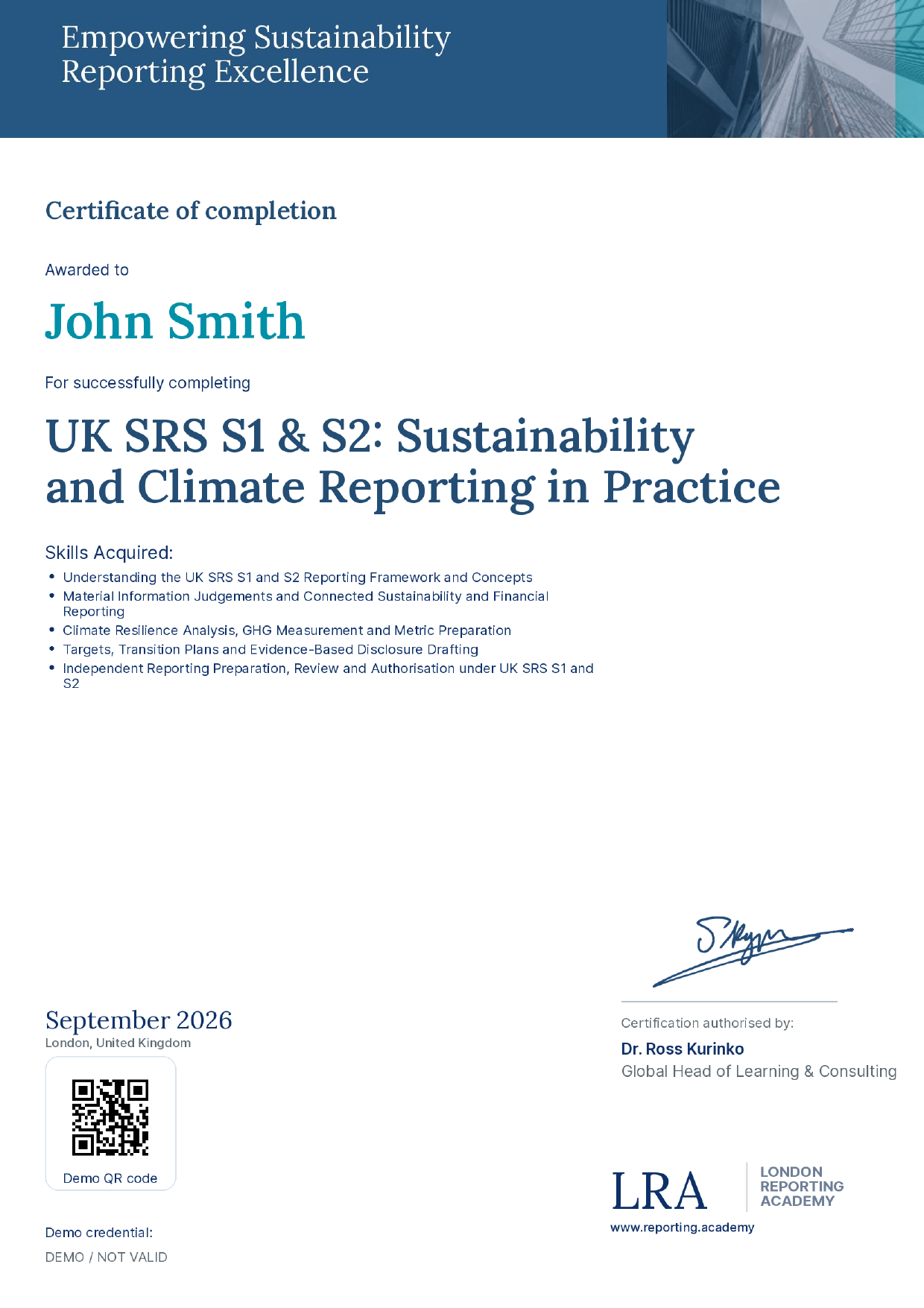
The UK now has its own sustainability reporting standards. UK SRS S1 and UK SRS S2 were issued in February 2026, and the first UK reporting cycle is being prepared right now. This course takes you through that cycle end to end on one continuing case — from the reporting purpose and the requirements map to an authorised, released report — and teaches the UK amendments that make these texts behave differently from IFRS S1 & S2 as issued by the ISSB. Practitioner-led by Dr Ross Kurinko, human-in-the-loop on every learning route.
UK SRS S1 and S2 are the UK-issued sustainability reporting standards published in February 2026. They are built on the ISSB texts, and they are not identical to them. This course is a complete, practitioner-built path through a first cycle under the UK texts — built on 15+ years of ESG-reporting practice and delivered inside the AI-powered LRA Study Studio, with real human support on every route.
UK SRS S1 and S2 were issued in February 2026 with UK amendments to the ISSB standards. The standards are final; who applies them is decided separately.
PS26/19, published on 30 September 2026, puts UK SRS S1 and S2 — Scope 3 included — on a comply or explain basis for in-scope listed companies from 2027 accounting periods, with time-limited reliefs.
Private companies have no timetable, and a live consultation on corporate reporting. Investors, lenders and customers do not wait for one before asking.
Purpose, requirements map, judgements, evidence, drafting, review and release. That is the work this course does with you, on one continuing case, from start to authorised release.
Taught from the UK-issued S1 and S2 of February 2026, with the UK amendments worked through rather than mentioned: the removed effective date, climate-first reporting without a time limit, the Scope 3 provision, the SASB and GICS changes, and the removal of the relief that let a first report be published later than the financial statements.
Alderwick Industrial Group runs from Module 01 to Module 14 — a group with subsidiaries, two operating sites, a December year end and a planned release date. Its facts arrive module by module, the way they do in a real cycle, and the work you produce accumulates into one file.
Designed by Dr Ross Kurinko — GRI and ISSB-IFRS S1 & S2 Certified Global Trainer, PhD, University of Cambridge, 15+ years on FTSE 100 and Fortune Global 500 disclosures — and delivered by seasoned ESG and financial-reporting practitioners. Not third-party content licensors.
The UK application landscape is moving. Lesson 0.10 states the position with its date and its sources — the FCA's final listing rules and the Technical Note still under consultation, the Companies Act consultation, the assurance position and transition plans — and teaches you to reconfirm before you rely on any of it.
Same curriculum, different cadences and audiences. Pick what fits your role, your schedule and your budget. Across every route — including Guided Flex — you can hand the AI thread to a real human. Never AI-only.
The Investor Relations Society's response to the FCA's CP26/5 consultation estimated that around three-quarters of the data points are new or more demanding than under TCFD. Four areas absorb most of that effort.
The UK texts are built on the ISSB standards with deliberate changes. These are the ones that change what a preparer does.
The UK texts carry no effective date of their own. Application is a matter for UK regulators — final FCA comply or explain rules for in-scope listed companies from 2027 accounting periods, and an open policy question for everyone else.
The FCA's final rules do not require third-party assurance of UK SRS disclosures; in-scope listed companies must say whether they obtained it. The course builds the evidence file that makes a disclosure reviewable, and never describes it as an assurance engagement.
S2 does not require a company to have a transition plan. It requires information about a plan the company has, including its key assumptions and dependencies. The FCA's final rules ask the relevant listed companies to say whether they have published one — not to produce one.
There is no equivalence mechanism between the European standards and the ISSB Standards. A UK SRS report is not a CSRD report, and the course does not imply otherwise.
Flexible learning through the AI-powered LRA Study Studio, with structured assessments and specialist UK reporting professionals available to answer your questions through the platform.
Everything in Guided Flex, plus scheduled live online lectures in a shared group, led by Dr Ross Kurinko, with cohort-based progression and peer discussion of the judgements a first UK cycle actually turns on.
Everything in Guided Flex, plus direct mentor sessions with Dr Ross Kurinko or a senior LRA mentor (subject to mentor availability), personalised guidance and line-by-line review of your UK SRS disclosure drafts.
Everything in 1:1 Expert Mentorship, plus your existing working documents are reviewed alongside the mentor sessions — requirements map · GHG inventory and method notes · scenario and resilience work · draft S1 and S2 disclosures. Mentor + practitioner-consultant in one engagement, working with your real cycle via email, file-share and scheduled mentor sessions under NDA. Studio platform stays standard — your documents are not uploaded to the platform; we work them as files.
Bespoke UK SRS programmes for finance, sustainability, risk and internal audit teams, and for advisory and audit practices building a UK SRS service line. Delivered online, on-site, in London, or as a hybrid programme. Price on request.
UK SRS is the UK-issued version of the ISSB standards. If you also report, or advise, in other adopting jurisdictions, the Certified IFRS S1 & S2 (ISSB) Applied course covers the global baseline as the ISSB issued it. Complete this course on an engaged route and Alumni Club pricing applies to it.
Best for: finance and reporting people fitting a first UK cycle around the day job.
Best for: people who want to hear how other UK reporters are making the same judgements.
Best for: anyone preparing a first UK SRS report against a board-approved timetable.
Best for: reporting teams preparing together — and firms building a UK SRS service line.
Alderwick Industrial Group — a parent with two wholly owned subsidiaries, two operating sites, a December year end and a planned joint release with the financial statements. Its facts arrive module by module, and your outputs accumulate into one reporting file rather than fifteen disconnected exercises.
Assignment 1 follows Module 04 and sets Briarfield Technical Group, an independent fictional company: you establish a defensible reporting approach (four to five hours). Assignment 2 follows Module 13 and sets Dunmere Services Group: you take the evidence through to linked disclosures (five to seven hours). You request each brief in your Homework Workspace, work offline and upload your response; a person reviews it and either accepts it or returns it with targeted revision required. There are no marks or points.
Twelve situational questions per module, each with an instructor explanation of why the other answers fail. They test the decision, not the definition.
An opening film sets the practical problem for each module and a closing film consolidates the result, presented by Dr Ross Kurinko. The detailed text carries the learning; the films make sure you know what it was for.
Async support from the LRA team on Guided Flex; live online sessions led by Dr Ross Kurinko on Live Cohort; private sessions with Dr Ross Kurinko or a senior LRA mentor, subject to mentor availability, on 1:1 Expert Mentorship; a trainer on Corporate routes. The form of contact varies; the human presence stays.
A frontier-model AI Tutor is pinned to every page — translate, simplify, exemplify, ask a follow-up — and weak topics surface into a focused revision plan. The judgement calls stay with you and your mentor.
You approve what is published and carry the consequences. Get to working depth fast — what the standards require, which reliefs the UK text allows and what using them costs in compliance wording, and the ability to challenge and sign off the work without drafting it yourself.
In most companies this lands on finance. Leave with a reporting project you can run the way you run a year end: a requirements index, owners, a calendar built backwards from the release date, review gates and an evidence file.
You own the source data and the scenario work. Learn exactly which figure each disclosure wants, on which boundary, and how to evidence it so nobody re-derives it next year.
You need a repeatable method across clients, and a clear view of where UK SRS departs from the ISSB texts. The course gives you both, with the paragraph references behind them.
Module 00 starts with reading a report and navigating the standards, before any drafting. Business literacy is enough to begin; the two human-reviewed assignments give you applied work to show.
GRI and ISSB-IFRS S1 & S2 Certified Global Trainer, PhD, University of Cambridge, 15+ years on FTSE 100 and Fortune Global 500 disclosures. Not a third-party content licence.
Requirements and disclosure index · risk and opportunity register · materiality judgement log · basis-of-preparation note · scenario passports · GHG calculation pack · metric and target passports · evidence index · release record.
A one-page memo of every UK departure from the ISSB texts, with the paragraph references and what each one changes for a preparer.
Lesson 0.10 states the UK application landscape with its sources — the FCA's final rules as at 30 September 2026 — and teaches you to reconfirm rather than rely on a course slide.
Weak topics auto-surface into a focused revision plan — gaps close before they show in your real report.
Both assignments are reviewed by a person on every route — the LRA team on Guided Flex, Live Cohort and Corporate Programme, your mentor on 1:1 Expert Mentorship — and on 1:1 Expert Mentorship your mentor also reviews your disclosure drafts line by line, on top of the AI feedback layer.
Distinguished expert with 15+ years in sustainability, ESG, integrated ESG communications and corporate reporting. PhD, University of Cambridge · GRI and ISSB-IFRS S1 & S2 Certified Global Trainer · Strategic ESG Advisor on IFRS S1 & S2, GRI and ESRS.
Throughout his career, he has been instrumental in establishing ESG governance frameworks and comprehensive disclosure systems — notably building one from scratch for one of Europe's largest railway companies — and has guided over 20 prominent businesses and educated hundreds of professionals across FTSE 100 and Fortune Global 500 disclosures.
Once a year, hybrid event (London + online): case studies from peer alumni, expert panels on emerging frameworks, and structured networking. Free attendance for Club members.
Small-group calls with Dr. Kurinko and 6–12 alumni — we work through your real reports under NDA, compare approaches, debug edge cases. The kind of conversation reporting professionals can't get anywhere else.
60-minute Zoom Q&A every month — open to Club members. Bring a specific question from your current reporting cycle, get a direct, practitioner-grade answer.
A private workspace where alumni from every cohort exchange tips, share intel on new regulations, and ask peer questions. The kind of network you'd otherwise need to attend a year of conferences to build.
30% off any LRA course, any format, any standalone — including the five new courses launching by end of 2026 and every LRA course after that. Stack credentials across the LRA portfolio at member pricing.
Four weeks of early access before every public launch — plus a vote on which frameworks LRA covers next. Alumni shape the curriculum.
Short, member-only video briefings on what's actually changing — ESRS amendments, IFRS S1/S2 updates, SB 253 enforcement, CSRD waves. Built so you stay current without doomscrolling LinkedIn.
LRA quietly maintains relationships with corporate ESG teams and consultancies. When they ask for trained reporters, Club members go on the shortlist. Featured Alumni Spotlight on LRA channels every quarter.
Routes that unlock the Club: Live Cohort · 1:1 Expert Mentorship · Applied Practice.
Guided Flex doesn't unlock Club membership — that's deliberate. The Club is designed for learners who chose an engaged format: live time, mentorship or applied work. It's a long-term commitment from LRA, so we reserve it for learners who made an equivalent commitment.
 Skills England
We specialise in ESG Disclosure and Sustainability Reporting training, mapped to Skills England ST0934 and ST0748, with practical coverage of GRI, ISSB/IFRS S1/S2, ESRS/CSRD, data controls, materiality, assurance readiness and anti-greenwashing.
100 published guides apply this framework to real reporting decisions.
How to structure the disclosure so readers understand its basis, material conclusions, financial connections and claim.
Which statements are UK SRS S2 requirements, which are guidance and which depend on future policy.
How to create a complete, controlled register that connects sustainability matters to the entity’s prospects.
Which package files and related guides belong to this toolkit?
Reporting outside the UK too? The Certified IFRS S1 & S2 (ISSB) Applied course teaches the global baseline as the ISSB issued it. The two courses are complementary — this one is the UK-issued text with its amendments — and Alumni Club pricing applies to the second course when you complete this one on an engaged route.
Flexible payment. Need to spread the cost? Instalment plans are available — email lra@reporting.academy and we'll set one up for your enrolment. Self-funded learners and groups of three or more from the same organisation can request a 20% discount (the two don't stack). And you're covered by a 14-day cancellation right: a full refund within 14 days of purchase if you haven't yet entered the Study Studio.
Add your details and a short note — we'll take it from there.
Add your contact details before we send you to secure Stripe Checkout.
Course Adviser
I'm here to help you find the right course — and our team is one click away.