Short answer
The answer, before the reasoning
UK SRS S2 requires location-based Scope 2 greenhouse gas emissions. An entity also provides information about contractual instruments where that information is necessary to understand its Scope 2 emissions.
PPAs, supplier products, RECs, I-REC(E)s and supplier-specific factors can therefore support additional contractual or market-based information, but they do not replace the location-based figure. Renewable-electricity claims need evidence of consumption, instrument ownership, market and vintage matching, cancellation or retirement, supplier factors and no overlapping claim. The report should distinguish the gross location-based inventory from contractual attributes and any market-based Scope 2 information.
UK SRS S2 makes the location-based figure the required core and contractual information an explanatory layer.
At a glance
1. The required core: location-based Scope 2
Paragraph 29(a)(v) requires location-based Scope 2 emissions. The location-based method reflects the average emissions intensity of grids or other geographic energy systems where consumption occurs. It links metered purchased electricity, steam, heat or cooling to a location-representative factor. Renewable procurement does not remove this required presentation.
2. The explanatory layer: contractual instruments
UK SRS S2 also requires information about contractual instruments where necessary to inform users’ understanding. Paragraph B31 describes contractual instruments broadly, including contracts for energy purchases and unbundled energy-attribute claims. The Standard permits market-based Scope 2 information as part of this explanation where it is useful.
3. Build the location-based calculation first
Reconcile purchased electricity, steam, heat and cooling by site and meter.
Confirm reporting period, units and treatment of estimated meter reads.
Select location-representative grid or energy-system factors and record edition and geography.
Apply GWP and conversion controls consistently.
Aggregate by reporting entity and prepare the required disaggregation between the accounting group and other investees.
Perform variance analysis and independent recalculation.
4. Then build the contractual-instrument register
For each instrument, record the consuming entity and site, counterparty, contract or certificate ID, instrument type, technology, generation period or vintage, market boundary, volume, ownership, transfer rights, cancellation or retirement evidence, supplier factor and any residual-mix treatment. Link the instrument to the exact electricity consumption population.
The control sequence should be traceable from consumption to the public claim.
5. RECs and I-REC(E)s
Energy attribute certificates can support a market-based calculation or a renewable-electricity statement where the scheme, ownership and claim rules are satisfied. The certificate file should show unique identifiers, technology, generation location, vintage, quantity, account holder, transfer and retirement. The entity should confirm that the same attributes are not retained by the generator, resold by an intermediary or claimed by another buyer.
6. PPAs and supplier products
A PPA can contain energy, price and attribute components. The entity must identify which rights are transferred and who owns the energy attributes. A financial or virtual PPA may have different physical-delivery and attribute characteristics from an onsite or sleeved arrangement. Supplier products similarly require evidence of the supplier factor, underlying attributes and residual mix—not merely a marketing label.
7. Prevent double counting
Double counting can arise when the same MWh or attribute is claimed by multiple parties, when certificates overlap with a supplier product, when a generator retains a claim after transferring attributes, or when a buyer claims both a PPA and separate certificates for the same volume. Contract, registry, procurement and GHG teams should reconcile a unique instrument population to the consumption population and public claims.
8. Renewable electricity claims versus Scope 2 numbers
A statement such as “100% renewable electricity purchased” is not the same as “zero Scope 2 emissions”. The location-based figure reflects grid emissions. A market-based figure reflects qualifying contractual instruments and factors. A procurement claim can describe contractual coverage. The report should state which claim is being made, its boundary and period, and the evidence and limitations.
9. Hypothetical multi-country example
10. Illustrative disclosure
The figures are illustrative only. A real disclosure needs the instrument rules, factors, residual mix, market boundaries, ownership and retirement evidence.
11. Common mistakes
Omitting location-based Scope 2 because a market-based figure is available.
Calling all PPAs “physical renewable electricity” without examining delivery and attribute rights.
Using certificates without retirement or cancellation evidence.
Matching a certificate to consumption in the wrong market or period.
Claiming the same volume through a supplier product and separate certificate.
Using a supplier-specific factor without understanding residual-mix and attribute treatment.
Netting renewable attributes against Scope 1 or Scope 3.
Making “zero emissions” or “100% renewable” claims without boundary and limitation wording.
12. Scope 2 evidence checklist
Site and meter population reconciled.
Location-based factors current and geographically appropriate.
Required location-based tCO2e calculated and reviewed.
Contractual instruments linked to exact consumption populations.
PPA and supplier-product attribute ownership confirmed.
Certificate serials, vintages, markets and retirement recorded.
Residual mix and supplier factors documented where relevant.
Overlapping instruments and claims tested.
Market-based information clearly separated from location-based reporting.
Renewable claims approved by GHG, procurement, legal and reporting owners.
Sources, status and limitation
UK SRS S2 establishes the required location-based presentation and relevant contractual information. The GHG Protocol Scope 2 Guidance provides implementation methodology and quality criteria. Scheme-specific rules, contract law and claim requirements should be checked for each instrument and market.
Quick orientation
Quick orientation
- Applies to
- Energy, procurement, GHG, reporting and legal teams using renewable electricity contracts or attributes.
- Primary decision
- How to report the required location-based number and add credible contractual or market-based information.
- Key sources
- UK SRS S2 paragraph 29(a)(v) and B30-B31; GHG Protocol Scope 2 Guidance.
- Common confusion
- Treating a PPA or certificate as permission to replace location-based Scope 2 with a lower market-based figure.
In practice
Instrument
| Instrument | What it can evidence | What it does not prove by itself |
|---|---|---|
| Power purchase agreement | Contractual price, volume, term and potentially associated energy attributes. | That attributes belong to the buyer, were retired, match consumption or replace location-based emissions. |
| Supplier green tariff / product | Supplier commitment and product-specific factor or attributes. | That the factor meets quality criteria or that attributes are exclusive. |
| REC / I-REC(E) / energy attribute certificate | Specified energy attributes with serial, vintage and market information. | Physical delivery of renewable electricity to the consuming site or automatic additionality. |
| Supplier-specific emission factor | A factor associated with the contracted supply. | That all underlying attributes are valid, residual mix is addressed or double counting is prevented. |
Rule
CONTROL TEST
For each claimed MWh, answer: who generated it, who owned the attribute, whether it was transferred, whether it was cancelled or retired, which market and period it matches, and whether any other party can make the same exclusive claim.
In practice
Claim
| Claim | Minimum clarification | Evidence |
|---|---|---|
| Location-based Scope 2 | Geographic factor, consumption boundary and gross tCO2e. | Meter data, factor source and calculation. |
| Market-based Scope 2 | Method, instruments, factors, residual mix and coverage. | Instrument register, supplier factors and retirement. |
| Renewable electricity procurement | Percentage / MWh, entities/sites, period and instrument type. | Contracts, certificates and volume reconciliation. |
| Avoided emissions / additionality claim | Separate methodology and counterfactual; not netted from gross inventory. | Project analysis and claim review. |
Hypothetical scenario
HYPOTHETICAL EXAMPLE
A retailer consumes 120,000 MWh across the UK, Poland and the UAE. It calculates location-based Scope 2 using country- or grid-representative factors. UK sites are covered by a sleeved PPA with transferred certificates; Polish sites use retired guarantees of origin; UAE sites use I-REC(E)s. The group presents the required location-based amount and separate market-based information. It reports renewable procurement coverage by market, identifies unmatched consumption and avoids claiming that location-based emissions are zero. Illustrative scenario only.
Illustrative only. It shows how the decision is made, not wording that can be copied or relied on.
Hypothetical scenario
ILLUSTRATIVE WORDING — ADAPT TO FACTS
“The Group’s location-based Scope 2 emissions were 48,200 tCO2e. Contractual instruments covered 86% of electricity consumption and comprised a UK sleeved PPA, supplier products and retired energy-attribute certificates in specified markets. The Group’s market-based Scope 2 emissions were 9,700 tCO2e. Instruments were matched to consumption by reporting period and market; 14% of consumption was not covered by qualifying contractual instruments. Location-based emissions are presented irrespective of contractual coverage.”
Illustrative only. It shows how the decision is made, not wording that can be copied or relied on.
Questions
Questions people ask
Is location-based Scope 2 mandatory?
Paragraph 29(a)(v) requires location-based Scope 2 emissions. The location-based method reflects the average emissions intensity of grids or other geographic energy systems where consumption occurs.
Can market-based Scope 2 replace it?
UK SRS S2 requires location-based Scope 2 greenhouse gas emissions. An entity also provides information about contractual instruments where that information is necessary to understand its Scope 2 emissions. PPAs, supplier products, RECs, I-REC(E)s and supplier-specific factors can therefore support additional contractual or market-based information, but they do not replace the location-based figure.
What evidence is needed for RECs or I-RECs?
An entity also provides information about contractual instruments where that information is necessary to understand its Scope 2 emissions. PPAs, supplier products, RECs, I-REC(E)s and supplier-specific factors can therefore support additional contractual or market-based information, but they do not replace the location-based figure. Renewable-electricity claims need evidence of consumption, instrument ownership, market and vintage matching, cancellation or retirement, supplier factors and no overlapping claim.
How can double counting be prevented?
Double counting can arise when the same MWh or attribute is claimed by multiple parties, when certificates overlap with a supplier product, when a generator retains a claim after transferring attributes, or when a buyer claims both a PPA and separate certificates for the same volume. Contract, registry, procurement and GHG teams should reconcile a unique instrument population to the consumption population and public claims.
Take it with you
The checklists as a working spreadsheet
Every checklist and table on this page, with empty status, owner and evidence columns for your team to fill in and keep.
✓ Knowledge Hub AI Assistant · Human-in-the-loop

Ask about this guide
It answers from this page, and reaches into the linked disclosure cards when your question is about the standard itself.
Go deeper · UK SRS S2
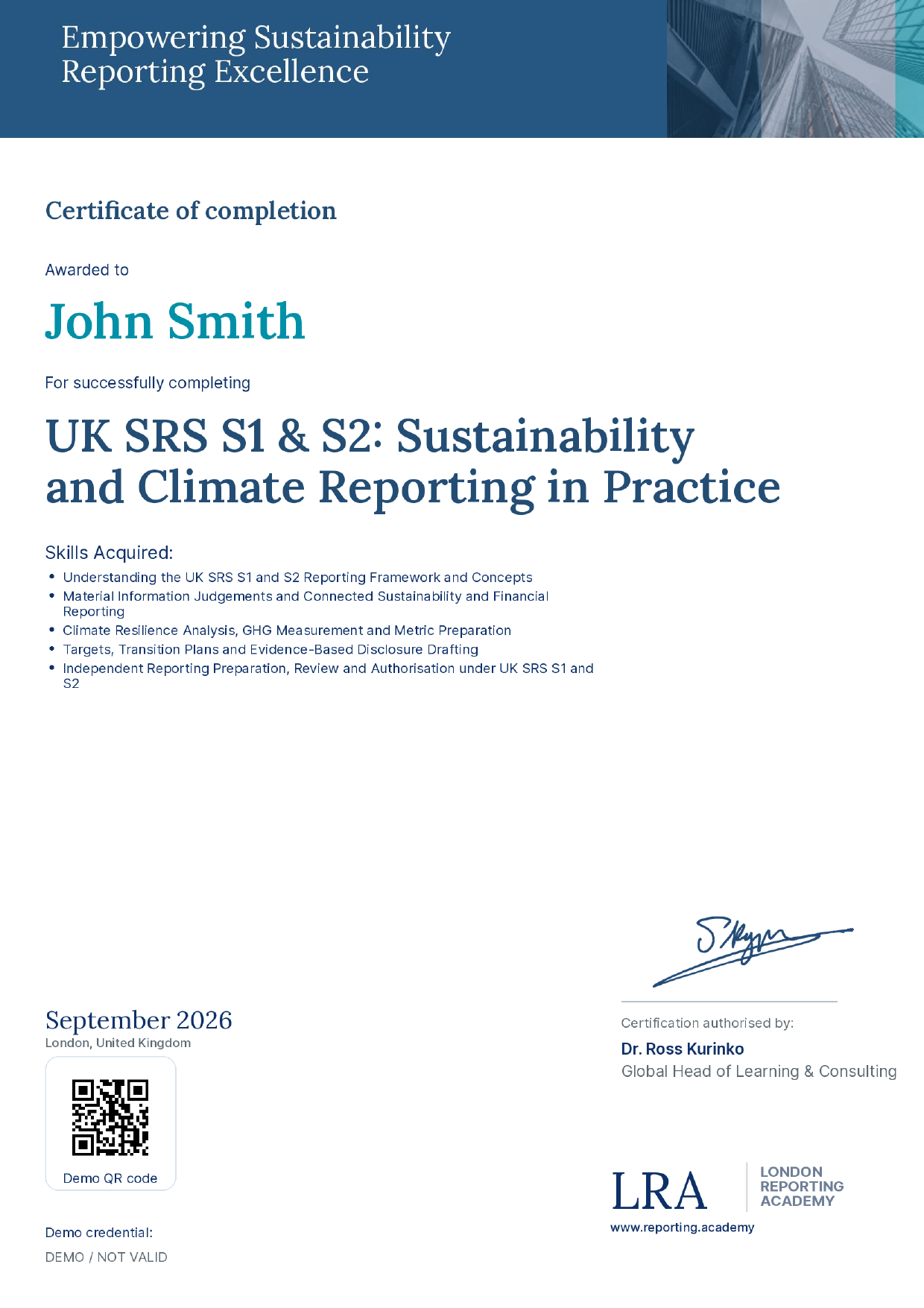
UK SRS S1 & S2: Sustainability and Climate Reporting in Practice
This page settles one requirement. The UK SRS S1 & S2 course takes a first UK reporting cycle end to end — the UK amendments, financial effects, scenario analysis, emissions and an authorised release — on one continuing case, with two assignments reviewed by a person.
Available as Guided Flex, Live Cohort, 1:1 Expert Mentorship or Corporate Programme.