Short answer
The answer, before the reasoning
There is no general rule that every voluntary UK SRS S1 report must already be digitally tagged and filed under a dedicated UK sustainability taxonomy. Even so, companies should prepare for digital reporting early.
The most sensible approach is to treat digital reporting as a structured-data discipline: define the report architecture, map disclosures to a taxonomy where possible, create controlled extensions when necessary, manage versions carefully and ensure that machine-readable outputs remain consistent with the human-readable report.
Why digital readiness matters
Sustainability reporting is moving towards greater comparability, searchability and automated consumption. Investors, analysts, lenders and data platforms increasingly want structured information rather than only narrative PDFs. If the UK adopts more formal filing routes over time, organisations that have already built a taxonomy-minded reporting process will face less disruption.
Digital readiness also improves internal quality. Tagging forces the company to define what each disclosure actually is, how it relates to other disclosures and whether the same metric is being described consistently across documents.
Current position versus future expectations
At the time of writing, UK SRS S1 is available for voluntary use and, under the FCA's final PS26/19 rules, applies on a comply or explain basis to listed issuers in UKLR categories 6, 14, 15, 16 and 22 for accounting periods beginning on or after 1 January 2027. There is no universal digital filing obligation specific to the standard itself; listed issuers should check the final rule instrument for any filing or format requirements. However, digital reporting should be considered in light of possible future developments such as:
future UK filing requirements for sustainability-related disclosures;
adaptation of existing digital reporting infrastructures;
taxonomy development aligned with or informed by the IFRS Sustainability Disclosure Taxonomy;
investor demand for structured datasets even before any mandatory filing route exists.
Companies should therefore distinguish between **current obligations** and **future-readiness design**. The absence of a current mandate is not a reason to ignore digital structure.
Taxonomy basis: why the IFRS Sustainability Disclosure Taxonomy matters
UK SRS S1 is connected conceptually to the ISSB framework family. In digital-reporting discussions, the IFRS Sustainability Disclosure Taxonomy is therefore a natural starting point. It can help companies think about:
standard tags for common disclosures;
definition consistency;
relationships between text blocks, amounts, percentages, dates and dimensions;
extension discipline where an entity-specific concept is required.
This does not mean a company can assume one-for-one UK adoption in every detail. Jurisdictional choices, timing and future UK-specific decisions may alter the filing architecture. But the IFRS taxonomy mindset is highly relevant for preparation.
What should be tagged?
A practical tagging model may include:
narrative text blocks for sections such as governance or strategy;
numeric metrics and ratios;
target values and dates;
dimensions such as business segment, geography or scope classification where relevant;
accounting-policy-style disclosures about methodologies, boundaries and estimates.
Not every line of text needs atomic tagging on day one. Many organisations begin with a combination of text-block tagging and selected detailed tags for key metrics.
Entity-specific extensions
Sustainability disclosures often contain company-specific concepts. Extensions may therefore be necessary. Good practice is to create an extension only when:
no existing taxonomy element captures the meaning adequately;
the extension has a clear label and definition;
the extension is anchored appropriately to a broader concept where the taxonomy architecture expects it.
Poor practice is to create excessive extensions simply because the base taxonomy is not fully understood. Too many unnecessary extensions reduce comparability.
Version control and change management
Digital reporting introduces a further layer of control. The company should maintain:
the taxonomy version used;
a tag-mapping register;
records of extension creation and approval;
✓ Knowledge Hub AI Assistant · Human-in-the-loop

Ask about this guide
It answers from this page, and reaches into the linked disclosure cards when your question is about the standard itself.
Go deeper · UK SRS S1
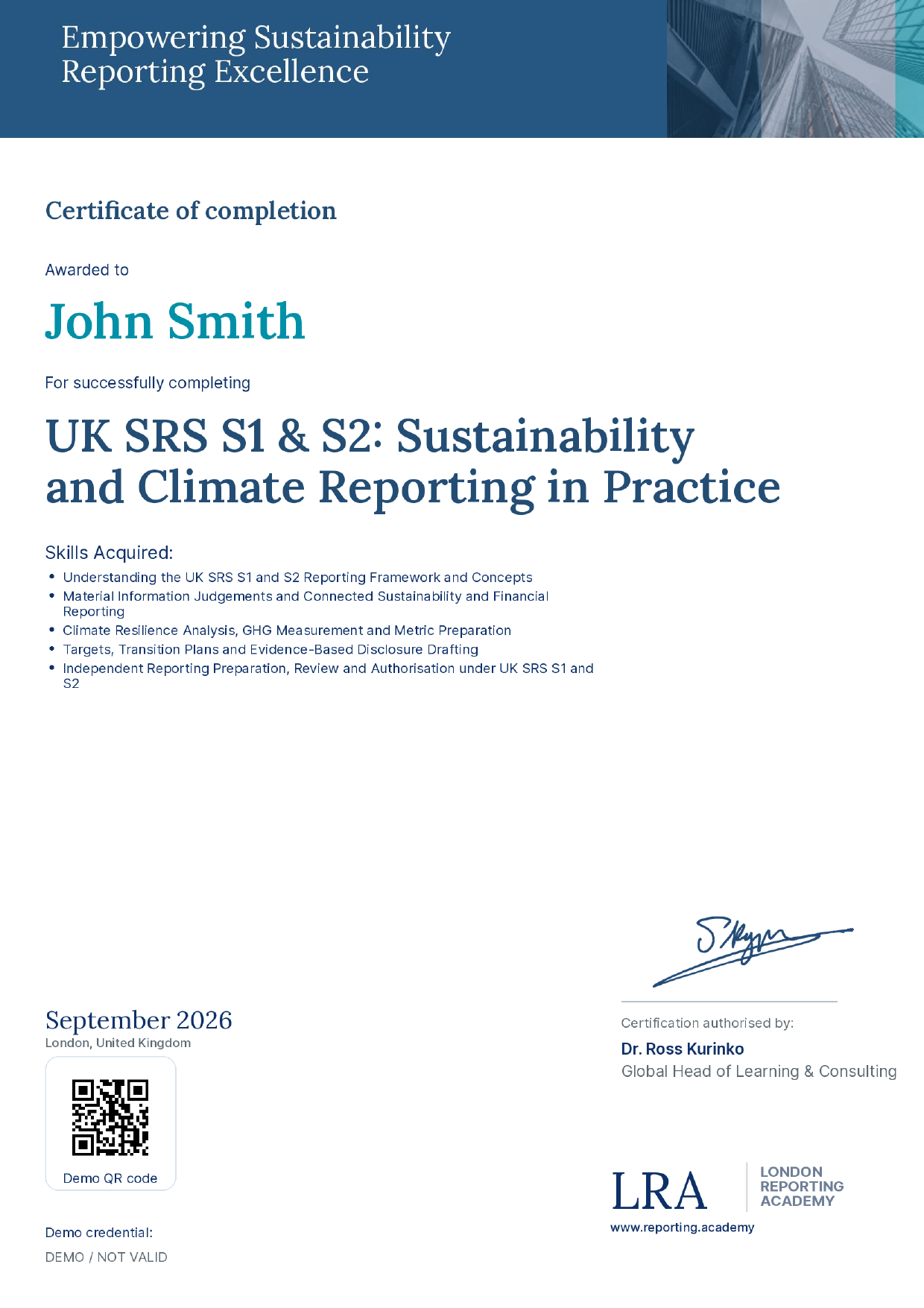
UK SRS S1 & S2: Sustainability and Climate Reporting in Practice
This page settles one requirement. The UK SRS S1 & S2 course takes a first UK reporting cycle end to end — the UK amendments, financial effects, scenario analysis, emissions and an authorised release — on one continuing case, with two assignments reviewed by a person.
Available as Guided Flex, Live Cohort, 1:1 Expert Mentorship or Corporate Programme.