Short answer
The answer, before the reasoning
UK SRS S1 does not itself amend the Companies Act or create a mandatory reporting population. It supplies a final technical standard that any entity may use voluntarily.
A future Companies Act route would need separate legislation or regulations to define the companies and groups in scope, commencement, placement in the annual report, reliefs, assurance, filing and enforcement. References to economically significant companies describe a policy direction under consideration, not an enacted threshold or current legal category for UK SRS reporting.
Prepared in British English as a practitioner Knowledge Card Package: answer, explanation, application, evidence, connections and publishing layer.
Rule
Standard and regulatory context
Final UK SRS S1 and S2 were published in February 2026 for voluntary use. The government has discussed a future Companies Act route for economically significant non-listed companies, but final statutory scope, thresholds, effective dates and implementation mechanics were not enacted on the review date. For listed issuers, the FCA published its final rules in PS26/19 on 30 September 2026; they apply only to issuers in UKLR categories 6, 14, 15, 16 and 22. No Companies Act requirement or timetable exists yet for other companies: the Modernising Corporate Reporting consultation (7 September 2026, closing 30 November 2026) proposes no thresholds and no commencement dates.
Why this matters
Teams can make two opposite errors. Some treat publication of a final standard as if every large UK company already has a statutory duty to use it. Others wait for legislation before building any systems, even though lenders, owners and customers may already need decision-useful sustainability information.
The practical solution is to manage three separate layers: the technical content of UK SRS, the future legal instrument that could mandate or modify its use, and the entity-specific assessment of scope and reporting basis. This prevents a proposal from being presented as law and allows readiness work to continue without inventing obligations.
In practice
Quick orientation
| Field | Practical answer |
|---|---|
| Current status | UK SRS S1 and S2 are final and available for voluntary use by any entity. |
| Current Companies Act duty | Existing strategic report, section 172, NFSIS and climate requirements continue to apply according to their own scope. |
| Future route | Government policy work may use the Companies Act for economically significant non-listed companies. Final requirements must be consulted on and enacted. |
| Key decision | Separate voluntary adoption today from any future statutory claim for a defined reporting period. |
| Main control | Maintain a regulatory watch register and reperform the applicability assessment when final instruments are issued. |
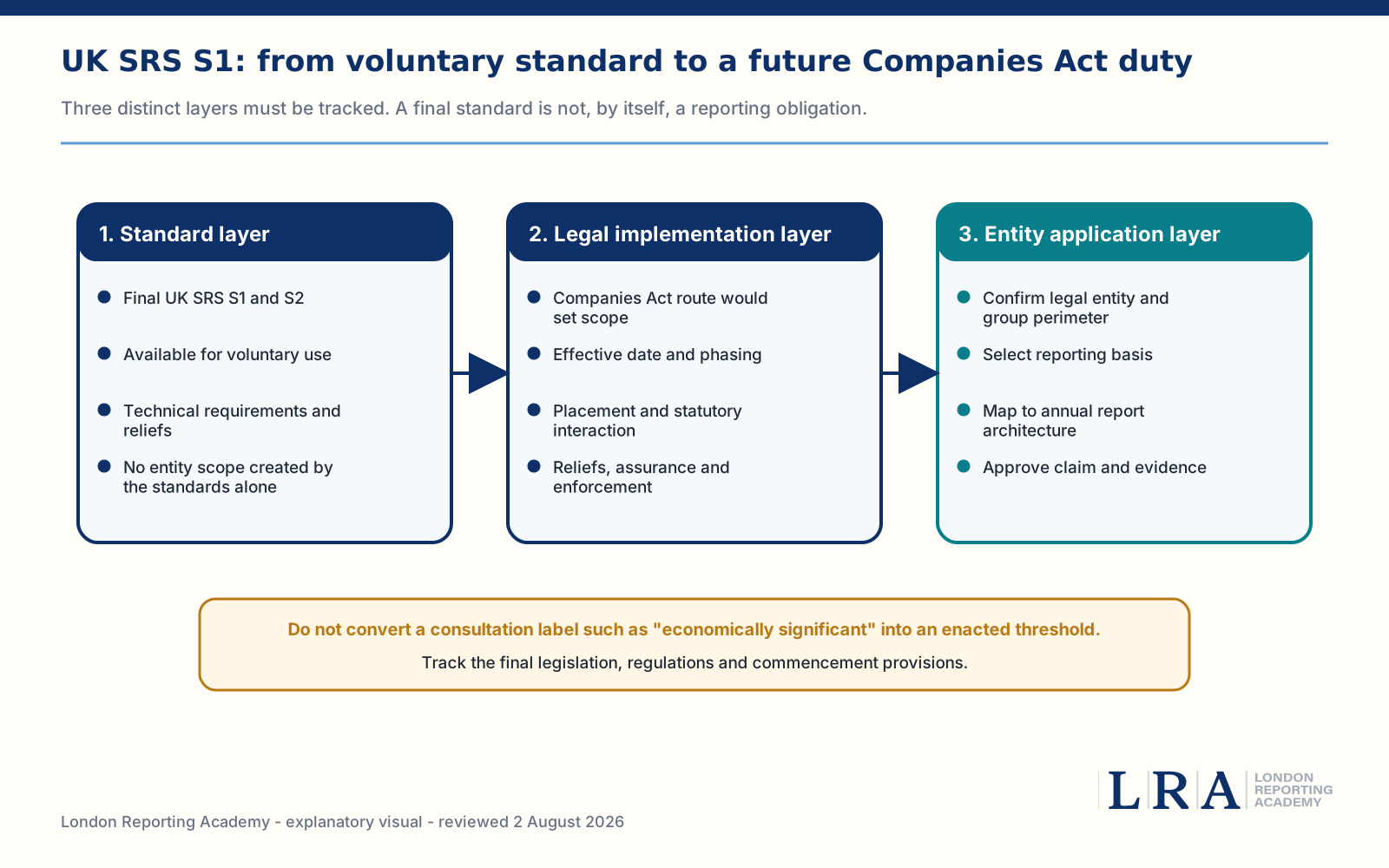
1. The standard and the legal route answer different questions
The standard layer answers: what information is useful to primary users about sustainability-related risks and opportunities that could reasonably be expected to affect the entity’s prospects? It sets concepts, four core content pillars, connected information, location, timing, comparatives, judgements and compliance requirements.
The legal implementation layer answers: which legal entities must report, for which periods, in which document, with what reliefs, oversight and consequences? UK SRS S1 expressly anticipates that law, FCA rules or another authority may determine how some application provisions are used.
The entity application layer answers: what does the final instrument mean for this company or group? That requires an evidence-based scoping memo, rather than reliance on a press release, consultation question or peer assumption.
2. What "economically significant" means at this stage
The government has used the expression economically significant companies when describing the possible future reporting population. The 2025 consultation asked for views on the merits, benefits, costs and readiness of economically significant private companies reporting against UK SRS. The February 2026 response summarised those views but did not enact a numerical definition for the future duty.
A reporting team should therefore avoid importing a threshold from another Companies Act regime, a consultation example, a lender policy or a foreign jurisdiction. A final route could use turnover, balance sheet total, employees, listing status, public-interest characteristics, group tests or a combination. Until the legal text exists, those possibilities remain planning scenarios.
Caution
Do not say
"All economically significant UK companies must report under UK SRS from 2027." No final Companies Act scope or commencement supports that statement on the review date.
In practice
3. How a future Companies Act route could interact with UK SRS
| Implementation question | Possible legal function | Current position |
|---|---|---|
| Entity and group scope | Define company categories, consolidated reporting and exemptions | Not created by UK SRS S1 itself |
| Reporting period and phasing | Set commencement, cohorts and transitional dates | Future decision; do not infer from the FCA's PS26/19 listing rules |
| Required reporting basis | Mandate full UK SRS, a subset, comply or explain or another basis | Future decision |
| Annual report location | Connect UK SRS information with the strategic report, NFSIS or another statement | Current S1 allows GPFR locations subject to law and clear identification |
| Reliefs and comparatives | Permit, limit or remove standard reliefs | Future law may control application |
| Assurance and filing | Set assurance, filing format, digital tagging and oversight | Separate policy and legislative decisions |
| Liability and enforcement | Set directors responsibilities, regulator powers and sanctions | Cannot be derived from voluntary use |
4. A defensible regulatory watch process
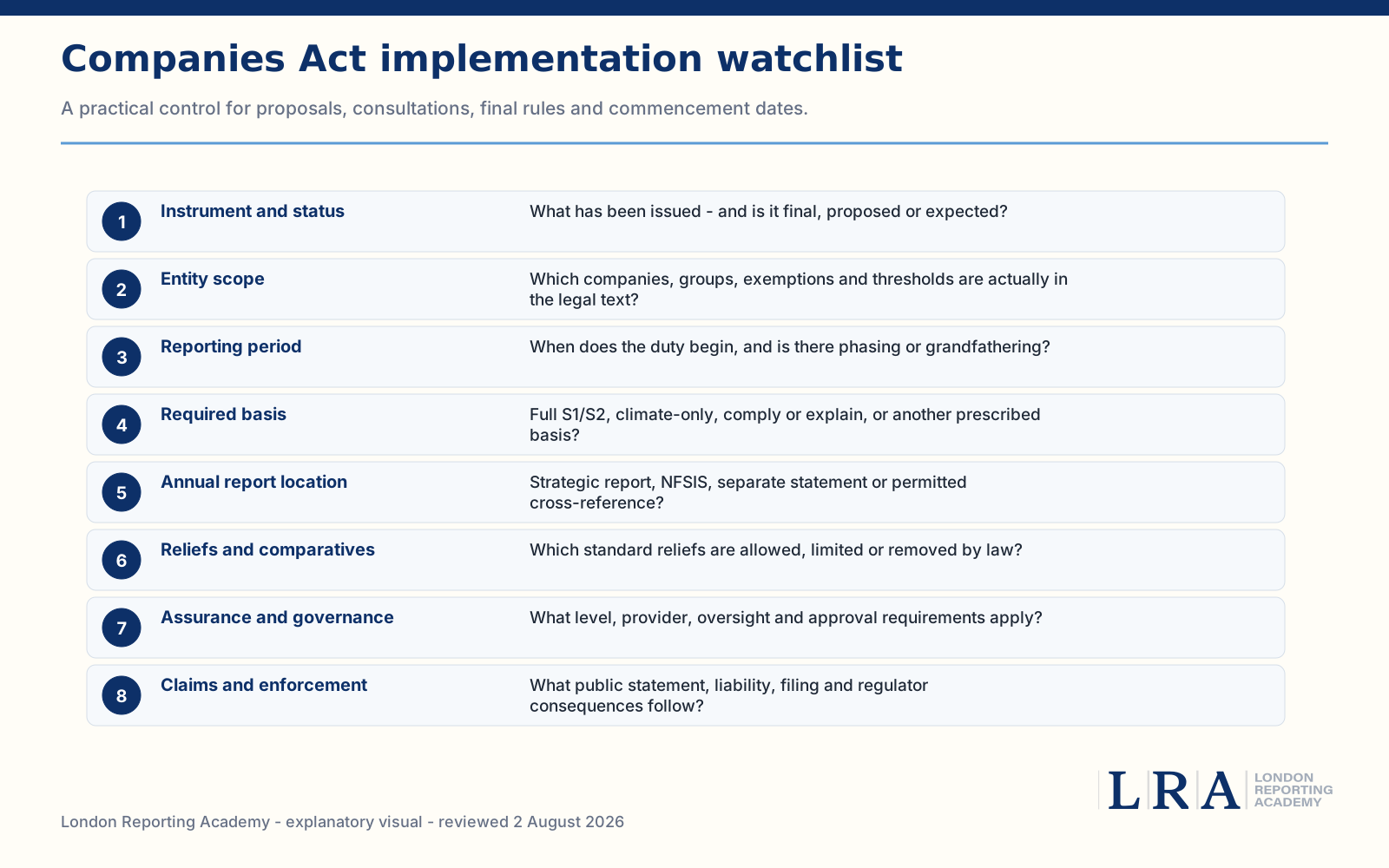
Treat the future route as a controlled legal-change project. The register should distinguish an announcement, consultation, government response, final statutory instrument, commencement provision, regulator rule and non-mandatory guidance.
1. Record the instrument. Capture title, issuing authority, publication date, status, link and responsible legal owner.
2. Extract the exact scope test. Record entity type, group rules, thresholds, exemptions and reference period.
3. Map technical consequences. Note the required UK SRS basis, reliefs, comparatives, location, assurance and claim wording.
4. Assess operational lead time. Identify data, systems, finance linkage, governance and assurance work that must begin before the first reporting period.
5. Approve the conclusion. Legal, company secretariat, finance and reporting owners should sign the scoping memo and retain the source version.
6. Set update triggers. Reopen the memo when final law, FRC guidance, FCA rules or Companies House filing requirements change.
5. What companies can prepare before legislation is final
Readiness does not require pretending that a duty already exists. A company can map its reporting entity, business model and value chain; identify priority sustainability-related risks and opportunities; connect them to strategy and financial planning; define metrics; establish evidence and controls; and prototype annual report architecture.
The safest approach is to label the work correctly. A voluntary UK SRS-based pilot, a gap assessment and a future-readiness programme are not the same as a statutory Companies Act sustainability statement. The board paper should state the intended use, reporting basis, limitations and decision triggers.
Hypothetical example
This decision separates preparation from overclaim. The group uses UK SRS S1 to build a risk-and-opportunity register, finance linkages and controls. Its public wording says that the group is preparing with reference to the final standards on a voluntary basis and will reassess its reporting basis when final UK requirements are issued.
Evidence retained
Current source pack and legal status memo
Board paper approving the voluntary programme
Scenario-based scope analysis, clearly marked non-final
Data and control roadmap
Update trigger linked to final Companies Act consultation and legislation
Hypothetical scenario
Illustrative scenario - adapt to the entity’s facts
A privately owned UK group has 4,500 employees and substantial turnover. Management assumes that the phrase "economically significant" places the group in a mandatory 2027 cohort. The legal team checks the current position and finds final voluntary standards, policy intent and ongoing modernisation work, but no enacted Companies Act UK SRS scope or commencement. The board approves a voluntary readiness programme and a watch register, but does not approve a statutory compliance statement.
Illustrative only. It shows how the decision is made, not wording that can be copied or relied on.
In practice
Weak versus stronger approach
| Weak approach | Why it fails | Stronger approach |
|---|---|---|
| "UK SRS is now mandatory for large private companies." | Confuses endorsement with legal implementation. | "UK SRS is available voluntarily; the government is considering a future Companies Act route for certain non-listed companies." |
| Uses an unverified turnover threshold for "economically significant". | Invents an applicability test. | Maintains planning scenarios but waits for the final legal definition before making a scope conclusion. |
| Copies FCA 2027 dates into a private-company timetable. | The FCA's PS26/19 rules apply only to specified listing categories. | Uses entity-specific readiness dates and separately tracks any future Companies Act commencement. |
| Stops all preparation until legislation is passed. | Creates avoidable data and governance delay. | Builds reusable capability while labelling the work as voluntary readiness. |
In practice
Common mistakes and corrections
| Mistake | Risk created | Correction |
|---|---|---|
| Treating final UK SRS as self-executing company law | False mandatory claim and incorrect board advice. | Document the separate standard, legal implementation and entity application layers. |
| Assuming "economically significant" already has a UK SRS threshold | Incorrect scope and wasted project expenditure. | Use a provisional scenario only; repeat the test against final legislation. |
| Applying the FCA's PS26/19 rules to all UK companies | Imports listing-category rules into an unrelated population. | Apply PS26/19 only to issuers in UKLR categories 6, 14, 15, 16 and 22; use it elsewhere only as general readiness context. |
| Ignoring current Companies Act reporting while waiting for UK SRS | Existing strategic report, NFSIS or climate duties may be missed. | Maintain a current-law compliance matrix alongside the future UK SRS watchlist. |
| Assuming all voluntary reliefs will remain available when mandated | The future law or regulator may limit or condition them. | Tag each relief as subject to the final implementation instrument. |
Myth
Once a government publishes a final reporting standard, companies automatically have to comply with it.
Reality
A final standard can be technically complete and voluntarily usable without creating a statutory reporting duty. The duty arises only through the applicable law or regulatory rule, which also determines scope, timing and consequences.
Readiness
Practical review checklist
- The source register identifies whether each document is final, proposed, consultative or guidance.
- The applicability memo does not use an invented definition of economically significant.
- Current Companies Act obligations are assessed separately from future UK SRS implementation.
- The FCA's PS26/19 listing rules are not applied to private or unlisted companies without a relevant rule.
- Readiness work has a clearly stated voluntary purpose and reporting basis.
- Reliefs, comparatives, placement, assurance and claims are marked for final-law confirmation.
- Legal, finance, company secretariat and reporting owners have approved the current conclusion.
- A named owner and update trigger exist for the next consultation, final legislation and commencement.
In practice
Related requirements and implementation mapping
| Instrument / reference | Relationship | Use in this article |
|---|---|---|
| UK SRS S1 paragraphs 1-2, 60-63, 72-73B and Appendix E | Direct | Technical objective, location, compliance and regulatory control over application provisions. |
| GOV.UK UK SRS guidance | Direct status | Final standards available voluntarily; separate government and FCA implementation work. |
| Government consultation response, Chapter 3 | Policy context | Feedback on potential mandatory reporting by economically significant private companies. |
| Companies Act 2006 Part 15 | Current law | Existing annual report and strategic report duties; not replaced by voluntary UK SRS. |
| FCA PS26/19 | Comparison only | Final listed-company rules (30 September 2026), following the CP26/5 consultation; not the Companies Act route for private companies. |
| Modernising Corporate Reporting programme | Update trigger | Potential simplification and future statutory architecture. |
Frequently asked questions
Is UK SRS S1 mandatory for private companies now?
No. The final standards are available for voluntary use. A future Companies Act route would require separate legal implementation.
Does "economically significant" mean a company above a fixed turnover threshold?
Not for UK SRS implementation on the review date. The final legal instrument must define the population and any thresholds.
Can a private company start using UK SRS before legislation?
Yes, voluntarily. It should describe the reporting basis accurately and avoid implying a statutory duty or full compliance unless the relevant requirements have been met.
Does the FCA's PS26/19 policy statement determine private-company scope?
No. PS26/19 applies only to issuers in UKLR categories 6, 14, 15, 16 and 22. A private-company Companies Act route is a separate government process.
Sources
Primary sources
- UK SRS S1 General Requirements for Disclosure of Sustainability-related Financial Information, February 2026
- UK Sustainability Reporting Standards - GOV.UK guidance - Official confirmation that final UK SRS S1 and S2 are available for voluntary use and that mandatory routes are considered separately
- Government response to the consultation on UK Sustainability Reporting Standards, February 2026 - Official endorsement decision, consultation feedback on private companies and explanation of future implementation issues
- UK Regulatory Initiatives Grid, May 2026 - Official planning context linking FCA rules for listed companies and the future Companies Act route for economically significant non-listed companies
- FRC Guidance on the Strategic Report - publication page - Official status, 2026 revision context and notice that further updates may follow the Modernising Corporate Reporting programme
- Companies Act 2006, section 414C - contents and purpose of the strategic report - Primary legislation for the strategic report purpose and core content
- FCA PS26/19: Aligning listed issuers' sustainability disclosures with international standards (final rules, 30 September 2026)
- Modernising Corporate Reporting consultation (7 September 2026; closes 30 November 2026)
Take it with you
The checklists as a working spreadsheet
Every checklist and table on this page, with empty status, owner and evidence columns for your team to fill in and keep.
✓ Knowledge Hub AI Assistant · Human-in-the-loop

Ask about this guide
It answers from this page, and reaches into the linked disclosure cards when your question is about the standard itself.
Go deeper · UK SRS S1
UK SRS S1 & S2: Sustainability and Climate Reporting in Practice
This page settles one requirement. The UK SRS S1 & S2 course takes a first UK reporting cycle end to end — the UK amendments, financial effects, scenario analysis, emissions and an authorised release — on one continuing case, with two assignments reviewed by a person.
Available as Guided Flex, Live Cohort, 1:1 Expert Mentorship or Corporate Programme.