Short answer
The answer, before the reasoning
UK SRS S1 did not become generally mandatory when the government published the final standard; it remains available for voluntary use by any entity. For listed issuers in UKLR categories 6, 14, 15, 16 and 22, the FCA's final rules in PS26/19 (30 September 2026) apply UK SRS S1 and S2 on a comply or explain basis for accounting periods beginning on or after 1 January 2027, with a two-year climate-first relief for non-climate S1 information in periods beginning in 2027 and 2028.
Comply or explain is not an unqualified mandate, and an explanation does not by itself support an S1 compliance statement. For other companies there is no Companies Act requirement or timetable: the Modernising Corporate Reporting consultation (7 September 2026, closing 30 November 2026) proposes no thresholds and no commencement dates.
In practice
Keep four questions separate
| Question | Answer at 30 September 2026 |
|---|---|
| Can an entity use UK SRS S1 voluntarily? | Yes. The final standard is available for voluntary use by any entity. |
| Must every UK company prepare a UK SRS S1 report? | No. Publication of the standard did not create a general reporting obligation. |
| Do sustainability or climate duties already exist? | Yes. FCA TCFD-aligned rules for periods beginning before 2027, Companies Act and LLP climate rules, and sector requirements apply to specified entities. |
| Does UK SRS S1 apply to listed companies? | Yes, for UKLR categories 6, 14, 15, 16 and 22: the FCA's final PS26/19 rules apply it on a comply or explain basis from accounting periods beginning on or after 1 January 2027. A Companies Act route for other companies has no timetable. |
The standard itself: voluntary
The Department for Business and Trade published final UK SRS S1 and UK SRS S2 on 25 February 2026. The government's guidance states that both standards are available for voluntary use by any entity that chooses to apply them.
Voluntary use can serve several purposes:
preparing early for the FCA's 2027 listing rules or a possible Companies Act requirement;
meeting investor, lender, customer or parent-group expectations;
creating a consistent investor-focused reporting basis across sustainability topics;
connecting existing climate, risk, strategy and financial reporting;
developing controls and evidence before assurance expectations increase; and
supporting a dual UK SRS and IFRS Sustainability Disclosure Standards assessment.
The reporting basis must be clear. An entity might:
1. prepare disclosures that fully comply with UK SRS S1 and make the explicit and unreserved statement required by paragraph 72;
2. apply only selected S1 concepts without making a compliance claim;
3. use the climate-only provision in paragraph E3 and disclose that fact, without asserting UK SRS S1 compliance; or
4. use S1 as a readiness benchmark for the FCA rules or a future Companies Act route.
These are not interchangeable positions. The claim, reliefs and applicable legal route should be approved before drafting begins.
FCA rules: TCFD until 2027, then UK SRS on comply or explain
The FCA currently requires specified listed companies to make TCFD-aligned climate-related disclosures or explain relevant non-disclosure under the applicable UK Listing Rules. Those rules continue for accounting periods beginning before 1 January 2027, unless an issuer voluntarily adopts UK SRS under the FCA's early-adoption provisions.
From periods beginning on or after 1 January 2027, the FCA's final rules in PS26/19 apply UK SRS S1 and S2 on a comply or explain basis to issuers in UKLR categories 6, 14, 15, 16 and 22. Existing TCFD reporting has already established governance, strategy, risk-management and metrics-and-targets reporting for climate, but it did not require the complete investor-focused assessment of non-climate sustainability-related risks and opportunities that UK SRS S1 requires.
An in-scope listed issuer should therefore run two workstreams until its first UK SRS period:
continue to satisfy the TCFD-aligned rule for periods beginning before 1 January 2027; and
prepare a controlled TCFD-to-UK-SRS gap assessment covering S1 foundations, S2 climate detail, non-climate risks and opportunities, financial effects, industry information, controls and claims.
The issuer should not stop current TCFD reporting early merely because the final rules have been published.
Existing Companies Act and LLP climate duties
The 2022 company and LLP regulations require climate-related financial disclosures from specified large UK entities. The detailed scope includes categories such as certain traded, banking and insurance entities, AIM companies with more than 500 employees, and other large companies or LLPs meeting the relevant employee and turnover tests.
These duties are separate from a complete UK SRS S1 mandate. They focus on climate-related financial disclosure and have their own statutory scope, content and report-location requirements. A company may choose to use UK SRS S2, together with the relevant S1 foundations, to support its climate reporting, but it must still test the Companies Act or LLP requirements independently.
For a legal applicability decision, use the legislation and current government guidance rather than a summary threshold alone. Group exemptions, parent reporting, entity category, employee counts, turnover and report location can change the result.
What the FCA's final rules require
The FCA published its final rules in PS26/19 on 30 September 2026, following its CP26/5 consultation, which closed on 20 March 2026. The rules apply to accounting periods beginning on or after 1 January 2027, with first reporting in 2028, and bring UK SRS S1 and S2 into the listing rules on a comply or explain basis, climate disclosures and Scope 3 included.
Treatment by listing category
A company's precise obligations depend on its listing category and reporting period, so check the made rules (FCA 2026/56) for the issuer's own category.
In practice
| Listing category | UK SRS treatment under PS26/19 |
|---|---|
| Commercial companies, non-equity shares and non-voting equity shares, and transition categories | UK SRS S1 and S2 on a comply or explain basis, including climate disclosures and Scope 3; transition-plan and assurance statements. |
| Secondary listing and depositary receipts categories | In scope: UK SRS S1 and S2 on a comply or explain basis and the assurance statement; the transition-plan statement does not apply. |
| Closed-ended funds, open-ended investment companies, shell companies, debt and debt-like securities, securitised derivatives, warrants, options and miscellaneous securities | Outside these listing rules. |
What comply or explain means for S1
Under the final rules, in-scope issuers either report the material sustainability-related information required by UK SRS S1 or explain where they do not. For S1, the rule distinguishes an issuer that has identified relevant sustainability-related risks or opportunities but has not fully disclosed them from one that has identified none.
This is not the same as saying that every S1 datapoint is optional. The rule creates a regulatory obligation to provide the disclosure or the explanation it specifies, and the explanation needs to be clear about what has not been provided and why.
The standard-level compliance statement remains a separate test. Neither an explanation nor a transitional relief automatically entitles the issuer to an explicit and unreserved UK SRS compliance statement under S1 72, 73A and 73B. Regulatory compliance with a comply or explain rule should therefore not be described automatically as complete compliance with UK SRS S1. The FCA's proposed Technical Note 803.1 on explanations and compliance statements is open for comment until 28 October 2026.
Transitional relief for wider S1 reporting
For accounting periods beginning in 2027 and 2028, PS26/19 allows a two-year climate-first relief for non-climate S1 information. The issuer states the relief and the corresponding transitional provision in the annual financial report; no separate explanation of the relieved matter is required while the relief applies. The timetable is:
Final UK SRS S1 itself does not specify a fixed duration for paragraph E3. Paragraph E5 and paragraph 73B make its availability subject to UK law or regulations where application is required. The two-year limit is therefore an FCA rule for listed issuers, not a general feature that every voluntary reporter must follow. A reporter that uses E3 cannot assert compliance with UK SRS S1 (paragraph 73A).
In practice
| Accounting period begins | S1 position for in-scope categories under PS26/19 |
|---|---|
| Before 1 January 2027 | Existing TCFD-aligned rules continue, or the issuer voluntarily adopts UK SRS under the FCA's early-adoption provisions. |
| 1 January 2027 to 31 December 2027 | UK SRS rules apply on a comply or explain basis; first year of the climate-first relief for non-climate S1 information. |
| 1 January 2028 to 31 December 2028 | Second year of the climate-first relief, with its use stated. |
| On or after 1 January 2029 | Relief expired; S1 remains on a comply or explain basis, not an unqualified mandatory-disclosure rule. |
Future Companies Act route
The government response to the UK SRS consultation placed future company-law decisions within the Modernising Corporate Reporting programme. Its consultation, published on 7 September 2026 and closing on 30 November 2026, says the government will consider how UK SRS should be reflected in the Companies Act in the light of responses, with a government response due within six months.
As at 30 September 2026:
no general Companies Act requirement to report against UK SRS S1 has been enacted;
the consultation proposes no thresholds and no commencement dates for private-company application;
assurance of UK SRS is not proposed for private companies at a first stage; and
current climate-related company and LLP duties remain relevant unless and until legislation changes them.
A future Companies Act route may differ materially from the FCA route. It could use different thresholds, exemptions, phased requirements, claims and assurance arrangements. Private companies should not assume that the FCA's listing rules will simply be copied into company law.
Step 1 - Is the entity currently subject to a reporting rule?
Check the FCA Handbook, Companies Act and LLP regulations, sector rules, pension requirements and contractual obligations. Continue to comply with the current rule for the relevant accounting period.
Step 2 - Is the entity in a listing category covered by PS26/19?
If yes, plan for comply or explain reporting from the first accounting period beginning on or after 1 January 2027, and track the Technical Note 803.1 consultation as an update trigger.
Step 3 - Is the entity a large non-listed company or LLP?
Check current company-law climate scope. Monitor the Modernising Corporate Reporting programme separately; do not assume a complete S1 mandate exists.
Step 4 - Is the entity choosing voluntary UK SRS use?
Define the reason, reporting period, location, materiality process, S2 interaction, relief use and intended claim. Voluntary application can start at any time, but it must still follow the standard's requirements if a compliance claim is made.
Step 5 - Is a UK SRS compliance statement planned?
Test every applicable requirement. A regulatory explanation, selective alignment statement or use of the S1 climate-only provision does not by itself support an explicit UK SRS S1 compliance claim.
In practice
Illustrative entity pathways
| Entity | Current position | Sensible next step |
|---|---|---|
| UK commercial listed company | TCFD-aligned rule until 2027 periods, then UK SRS S1 and S2 on a comply or explain basis under PS26/19; may also be within company-law climate scope. | Maintain current compliance, map the PS26/19 requirements and build non-climate S1 readiness. |
| AIM company with more than 500 employees | May be within current company-law climate requirements; not within the FCA's UK SRS listing rules, which cover UKLR categories only. | Confirm statutory scope and use S1/S2 voluntarily where useful; monitor Companies Act reform. |
| Large private UK group | May be within current company-law climate rules but no general S1 mandate. | Conduct a proportionate S1 gap assessment and monitor MCR scope proposals. |
| UK subsidiary of an overseas parent | UK SRS may be voluntary locally while group reporting follows IFRS S1/S2 or another jurisdictional standard. | Map group data to UK legal requirements and avoid assuming the parent claim covers the UK entity. |
| Small unlisted company outside current thresholds | No general UK SRS duty solely because the standards exist. | Use selected S1 concepts only where investor, lender, customer or strategic value justifies the cost. |
In practice
Common status mistakes
| Mistake | Why it is wrong | Correction |
|---|---|---|
| “The government issued UK SRS, so all large companies must use it.” | Issuance for voluntary use did not create a general mandate. | Identify the separate legal or regulatory instrument that applies. |
| “FCA rules require full UK SRS reports in 2027.” | The rules apply to accounting periods beginning on or after 1 January 2027, so first reports appear in 2028, and they work on a comply or explain basis. | Map the first accounting period and plan disclosures, explanations and reliefs separately. |
| “Current TCFD duties have ended because TCFD disbanded.” | Existing FCA and company-law rules remain legally relevant until amended. | Continue the current rule and plan the transition. |
| “Comply or explain means S1 is optional.” | The final rule requires either the disclosure or the explanation it specifies. | Design an evidence-based explanation process as well as data collection. |
| “Using the climate-only provision gives S1 compliance.” | Paragraph 73A prohibits the UK SRS S1 claim when E3 is used. | Disclose the provision and distinguish any S2 claim. |
| “The future Companies Act route will match the FCA rules.” | Government scope and legislation are separate policy decisions. | Maintain separate regulatory workstreams and update triggers. |
Update triggers to monitor
Outcome of the Technical Note 803.1 consultation (open until 28 October 2026) and any later FCA guidance on explanations and compliance statements.
Any amendment to the PS26/19 rules or their commencement.
First-period relief and explanation decisions, recorded against the final rules.
The interaction between the climate-first relief, the S1 climate-only provision and comparatives.
The Modernising Corporate Reporting consultation (closing 30 November 2026), the government response and any Companies Act legislation.
Changes to TCFD-aligned FCA or company-law climate rules.
Any UK SRS amendment, official implementation guidance or regulator statement on compliance claims.
Future assurance registration or mandatory assurance requirements.
Board-level readiness questions
Which current legal and regulatory duties apply to the entity and group?
Which UKLR category, if any, brings the entity within PS26/19?
Is the project voluntary, preparation for the FCA rules or intended to support a compliance claim?
What non-climate risks and opportunities are likely to be material to primary users?
What data, finance and control gaps would prevent reporting from 2027?
Does the annual-report timetable support same-time sustainability and financial reporting?
Which decisions must be revisited after the Technical Note 803.1 consultation or the MCR consultation?
Sources
Primary sources
- DBT UK SRS guidance
- UK SRS S1
- FCA PS26/19: Aligning listed issuers' sustainability disclosures with international standards (final rules, 30 September 2026)
- FCA sustainability reporting requirements
- Companies climate guidance
- DBT consultation response
- Regulatory Initiatives Grid, May 2026
- FCA Primary Market Bulletin 66 (30 September 2026): proposed Technical Note 803.1, open for comment until 28 October 2026
- Modernising Corporate Reporting consultation (published 7 September 2026; closes 30 November 2026)
Take it with you
The checklists as a working spreadsheet
Every checklist and table on this page, with empty status, owner and evidence columns for your team to fill in and keep.
✓ Knowledge Hub AI Assistant · Human-in-the-loop

Ask about this guide
It answers from this page, and reaches into the linked disclosure cards when your question is about the standard itself.
Go deeper · UK SRS S1
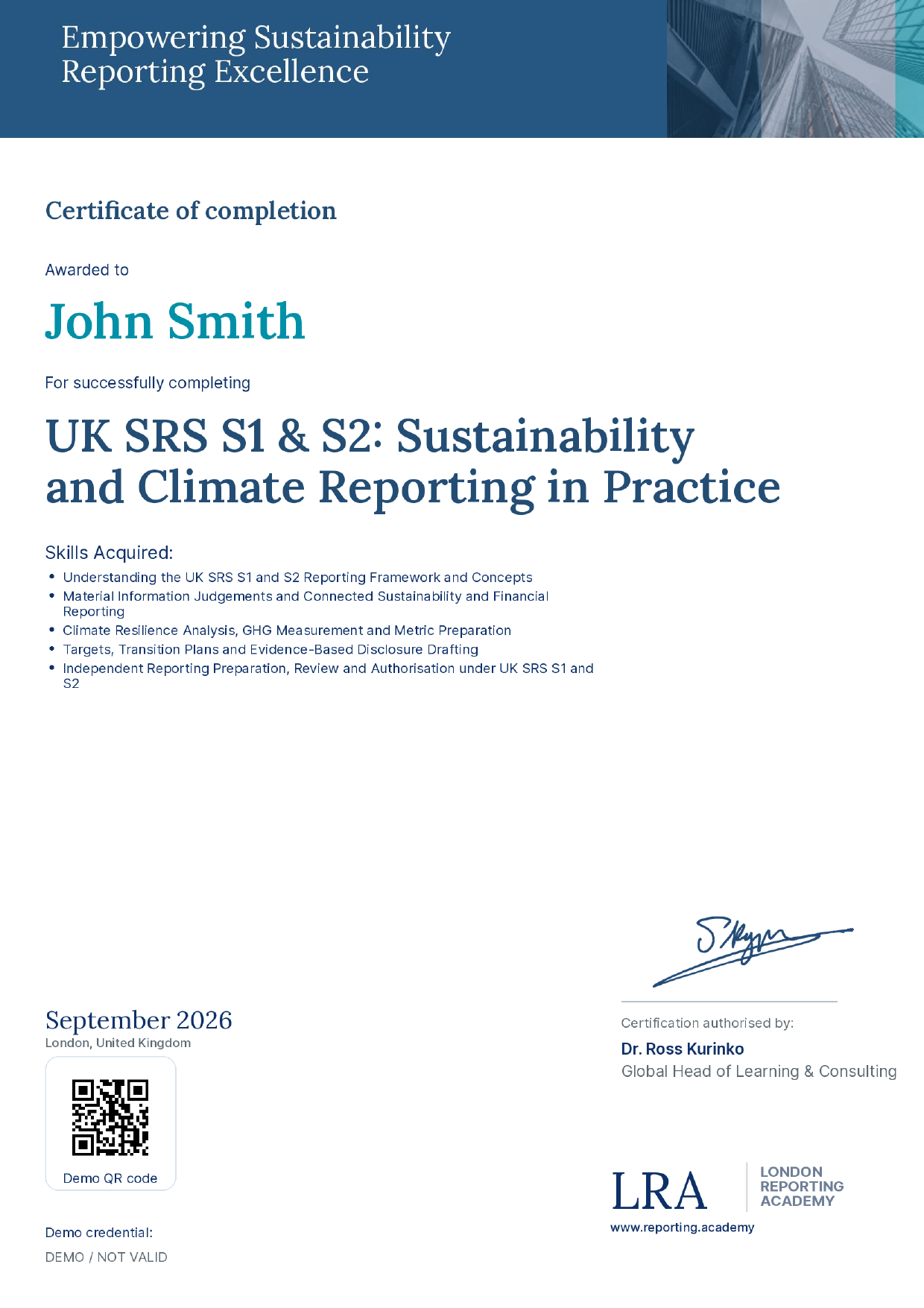
UK SRS S1 & S2: Sustainability and Climate Reporting in Practice
This page settles one requirement. The UK SRS S1 & S2 course takes a first UK reporting cycle end to end — the UK amendments, financial effects, scenario analysis, emissions and an authorised release — on one continuing case, with two assignments reviewed by a person.
Available as Guided Flex, Live Cohort, 1:1 Expert Mentorship or Corporate Programme.