Short answer
The answer, before the reasoning
A company can integrate UK SRS S1 information with its Strategic Report by building one connected narrative around the business model, strategy, principal risks, section 172 considerations, sustainability-related risks and opportunities, financial effects and performance metrics. The two frameworks overlap but are not interchangeable.
The report should preserve each objective, use precise cross-references, align boundaries and assumptions with the financial statements, and remove duplication that obscures material information.
Prepared in British English as a practitioner Knowledge Card Package: answer, explanation, application, evidence, connections and publishing layer.
Rule
Standard and regulatory context
UK SRS S1 permits sustainability-related financial disclosures in a strategic report when it forms part of the entity’s general purpose financial reports, subject to applicable law and clear identification. Existing Companies Act Strategic Report requirements continue to apply.
Why this matters
A separate sustainability chapter can become detached from the business model, financial planning and principal risks. At the other extreme, scattering sustainability information across the annual report can make the UK SRS disclosures impossible to identify or assess.
Integration works when the annual report has a controlled architecture. It should tell one coherent story, but retain a clear trail from each UK SRS requirement to the published location, supporting evidence and approval. The result is connected reporting, not the collapse of different legal tests into a single generic narrative.
In practice
Quick orientation
| Field | Practical answer |
|---|---|
| Natural location | UK SRS S1 recognises the strategic report as a possible location when it is part of the general purpose financial reports. |
| Shared narrative | Business model, strategy, risks, KPIs and future prospects can support both reporting streams. |
| Different lens | Section 172 and broader stakeholder reporting do not replace the UK SRS primary-user and prospects objective. |
| Cross-reference rule | References must be precise, accessible, simultaneous and must not obscure material UK SRS information. |
| Main output | An annual-report architecture and disclosure matrix linking legal requirement, UK SRS requirement, location, evidence and owner. |
1. Start with the objectives, not the chapter titles
The Strategic Report is intended to help members assess how directors have performed their section 172 duty and to provide a fair review of the company’s business, including development, performance, position, principal risks and - for relevant companies - further sustainability information.
UK SRS S1 is designed to provide primary users of general purpose financial reports with material information about sustainability-related risks and opportunities that could reasonably be expected to affect cash flows, access to finance or cost of capital over the short, medium or long term.
These objectives can reinforce one another, but neither should be silently substituted for the other. An employee-engagement narrative may be important to a section 172 account; UK SRS S1 additionally requires the entity to determine whether a workforce risk or opportunity affects prospects and what material information primary users need.
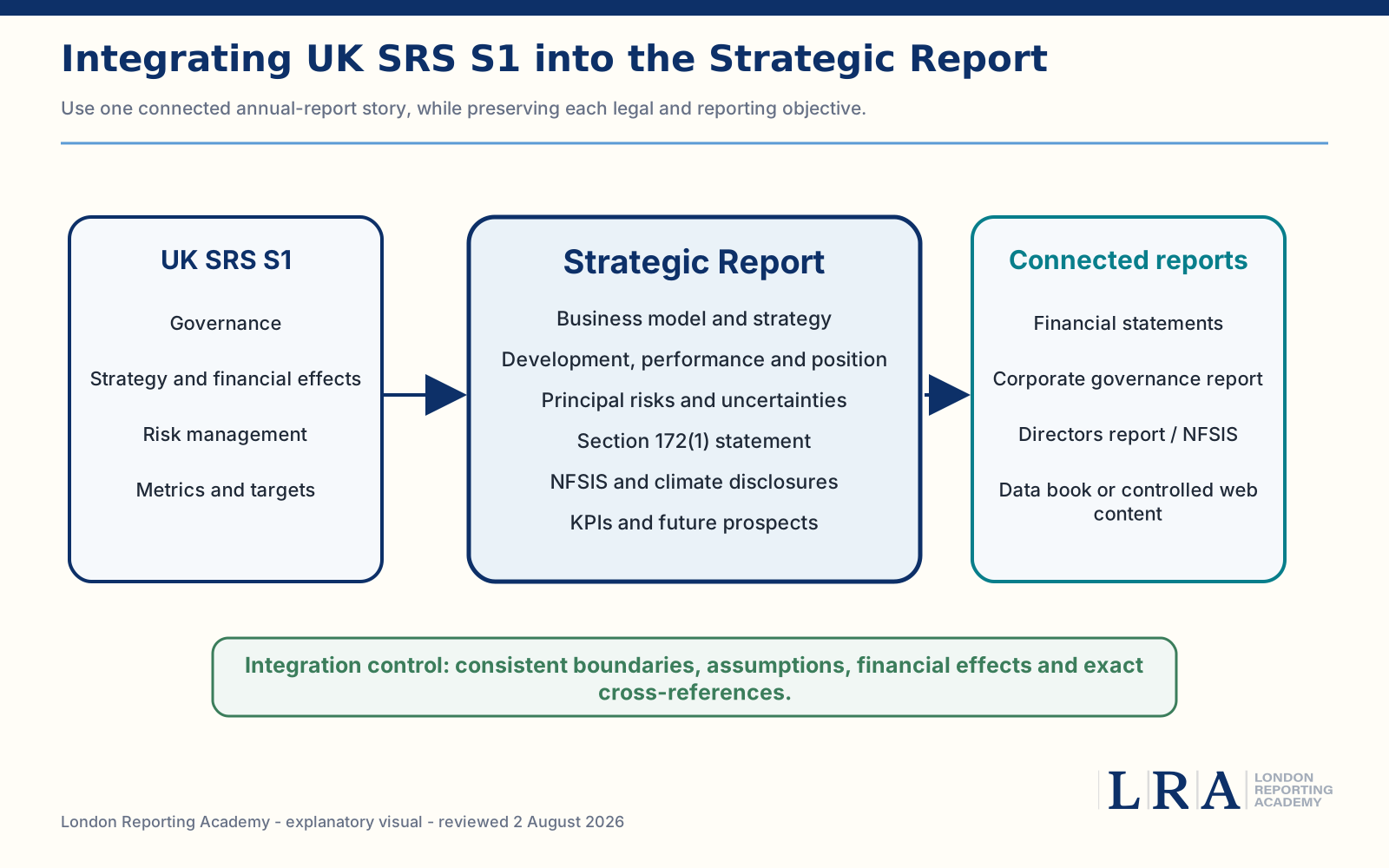
2. Map the connected annual-report story
In practice
| Strategic Report element | UK SRS S1 connection | Integration control |
|---|---|---|
| Business model | Dependencies on resources and relationships; locations in the value chain where SROs arise | Use the same entity-specific description and explain changes in boundary or portfolio. |
| Strategy and objectives | Responses to SROs, resource allocation, current and anticipated financial effects, resilience | Tie actions and capital deployment to approved plans and financial assumptions. |
| Principal risks and uncertainties | Risk-management processes and material sustainability-related risks | Do not assume every SRO is a principal risk or every principal risk is an SRO; reconcile the universes. |
| Section 172 and stakeholders | Evidence about relationships, dependencies and possible risk drivers | Keep the directors-duty narrative distinct from the primary-user materiality conclusion. |
| KPIs and performance review | Metrics and targets used to monitor SROs and progress | Align definitions, period, boundary, methodology and restatements. |
| Future prospects and viability | Resilience, decision points and effects over time | Use consistent time horizons or explain differences. |
3. Connect sustainability information to financial effects
The strongest integration point is the pathway from a sustainability-related risk or opportunity to the entity’s financial position, financial performance and cash flows. Drafting should show the affected business model component, strategic response, resource allocation, current effect and anticipated effect.
Finance should own or review the connection to revenue, operating cost, capital expenditure, asset lives and impairment indicators, provisions, working capital, cash flows, borrowing terms and access to finance. The sustainability narrative and financial statements do not have to use identical measurement bases, but data and assumptions should be consistent to the extent possible and differences should be explainable.
A report becomes less useful when it describes ambitious sustainability programmes but omits their capital requirements, financing dependencies, decision points or limitations. It also becomes misleading when a narrative predicts material financial effects that are absent from forecasts and board papers without explanation.
Rule
Finance connection test
For each material SRO, ask: which line item, cash-flow driver, financing decision or strategic resource allocation is affected; over what time horizon; on what evidence; and who approved the assumption?
4. Design cross-references that survive review
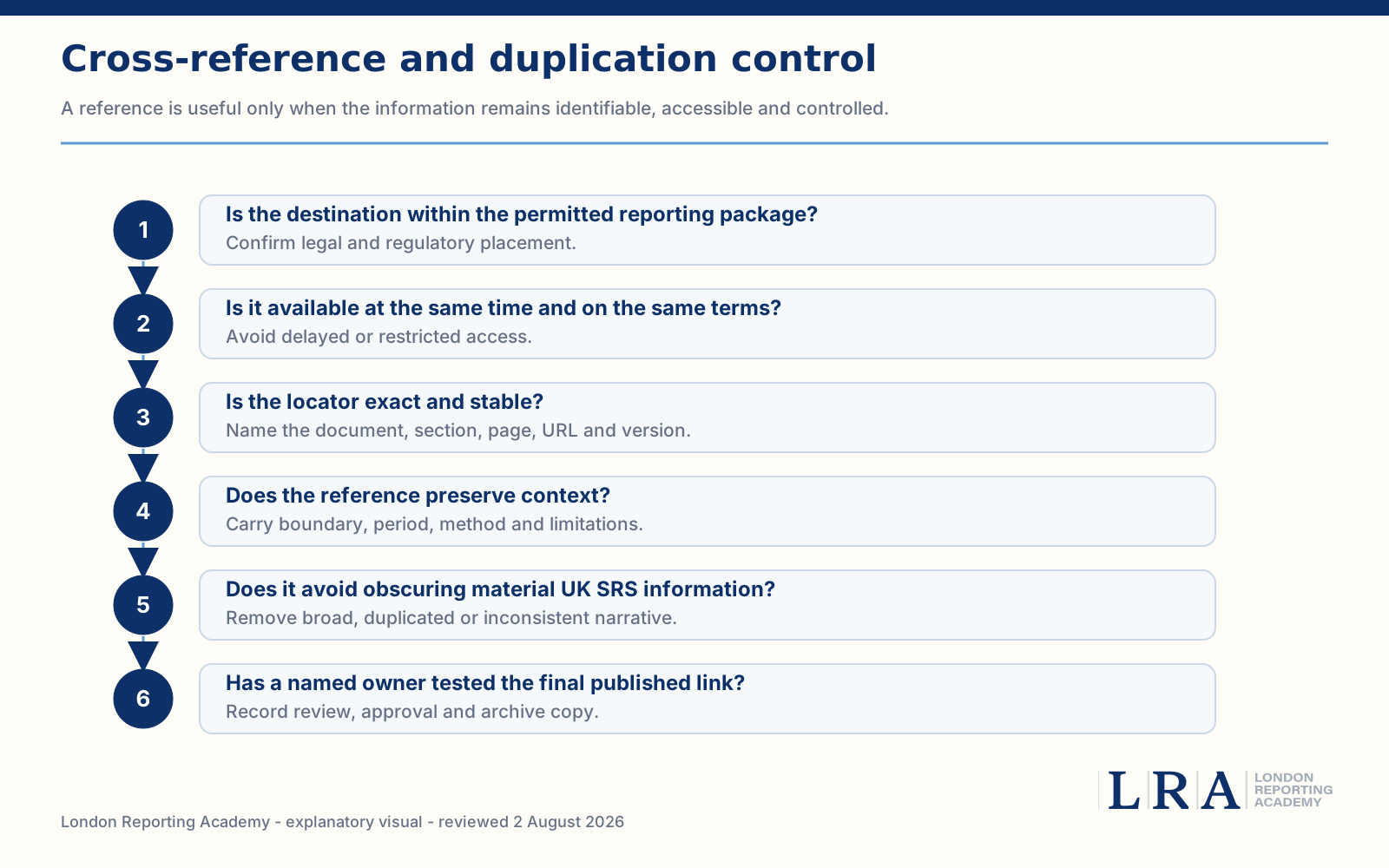
UK SRS S1 permits cross-reference to another report published by the entity when the relevant conditions are met. The control should operate at disclosure level, not merely at chapter level.
1. Confirm the permitted reporting package. A web page outside the annual-report package may not satisfy the legal or UK SRS location and timing conditions.
2. Publish simultaneously and on the same terms. A delayed data book or access-controlled portal weakens the reference.
3. Use an exact locator. Identify the document title, version, section, page and stable link rather than a home page or broad chapter.
4. Preserve the full context. Boundary, period, method, comparatives, limitations and assurance scope must remain visible.
5. Prevent obscuring. Do not surround a short material disclosure with repetitive corporate narrative serving a different objective.
6. Test the final files. The publisher and technical reviewer should open every link, verify the destination and retain an archive copy.
In practice
5. Use a duplication and reconciliation matrix
| Information item | Primary home | Cross-reference from — Reconciliation control |
|---|---|---|
| Business model | Strategic Report business model section | UK SRS strategy and NFSIS index — One approved description and group perimeter. |
| Governance oversight | Corporate governance / UK SRS governance section | Strategic Report summary — Terms of reference, cadence and board evidence agree. |
| Principal sustainability risk | Principal risks section | UK SRS risk and strategy disclosures — Risk description, time horizon and mitigation reconcile. |
| Financial effect | UK SRS strategy / financial effects | Financial review and statements — Line items, forecasts and assumptions are finance-reviewed. |
| KPI or target | Performance tables / data book | UK SRS metrics and strategic performance review — Definition, period, boundary and assurance scope agree. |
| Section 172 stakeholder decision | Section 172(1) statement | Relevant SRO or business-model narrative — Do not restate the board-duty narrative as UK SRS materiality evidence without assessment. |
Hypothetical example
The reporting team creates a disclosure matrix and chooses the Strategic Report as the main narrative architecture. It retains a concise principal-risk disclosure, expands the UK SRS strategy section with financial effects and resource allocation, and cross-references the workforce evidence from the section 172 discussion. Finance reconciles assumptions; the company secretary confirms legal placement; the publisher tests exact links.
Evidence retained
Approved annual-report architecture
Requirement-to-location matrix
Boundary and time-horizon reconciliation
Finance sign-off on financial effects
Cross-reference test log and archived final files
Hypothetical scenario
Illustrative scenario - adapt to the entity’s facts
A listed manufacturer identifies energy-price exposure and workforce skills as material sustainability-related risks. Its draft annual report contains an energy section in the sustainability chapter, a principal risk in the Strategic Report, a capital expenditure statement in the financial review and a workforce discussion in the section 172(1) statement. Each section was drafted separately and uses different time horizons and boundaries.
Illustrative only. It shows how the decision is made, not wording that can be copied or relied on.
In practice
Weak versus stronger approach
| Weak approach | Why it fails | Stronger approach |
|---|---|---|
| Repeats the same climate risk in four sections. | Creates clutter and inconsistent wording. | Selects one primary disclosure and uses precise contextual cross-references. |
| Treats the section 172 statement as the UK SRS materiality assessment. | Different objectives and users are conflated. | Uses stakeholder and board evidence as inputs, then performs the UK SRS prospects and material-information test. |
| States that strategy is resilient without decision points or financial capacity. | Creates an unsupported conclusion. | Explains vulnerabilities, responses, funding, limitations and scenario-analysis results. |
| Links to a corporate sustainability home page. | The destination is broad, dynamic and not controlled. | Links to a stable, versioned section available with the annual report. |
In practice
Common mistakes and corrections
| Mistake | Risk created | Correction |
|---|---|---|
| Writing a stand-alone ESG chapter after the Strategic Report is complete | Sustainability risks are disconnected from strategy and finance. | Design the disclosure architecture before drafting and assign one owner per connected narrative. |
| Assuming principal risks and UK SRS SROs are identical | Opportunities, longer-horizon risks or non-principal material information may be lost. | Maintain both universes and document the reconciliation logic. |
| Using broad cross-references | Users cannot locate or assess the required information. | Use exact document, section, page, URL and version references. |
| Allowing different teams to define the same metric differently | Contradiction between strategic, sustainability and financial narrative. | Use a controlled data dictionary and one approved calculation file. |
| Presenting stakeholder matters only as positive engagement stories | Severe impacts, dependencies and risk drivers may be obscured. | Balance outcomes, concerns, trade-offs, gaps and financial implications. |
Myth
Putting UK SRS disclosures in the Strategic Report automatically makes the annual report integrated.
Reality
Integration depends on connected information, consistent assumptions, controlled cross-references and a clear distinction between legal and UK SRS objectives. Physical proximity alone does not create coherence.
Readiness
Practical review checklist
- The annual-report architecture identifies the primary home for each material disclosure.
- Business model, strategy, principal risks and UK SRS SROs have been reconciled.
- Section 172 and stakeholder information are used as evidence without replacing the UK SRS materiality test.
- Current and anticipated financial effects have finance ownership and identifiable line-item pathways.
- Metric definitions, periods, boundaries and methods agree across all report components.
- Cross-references are exact, stable, simultaneous and available on the same terms.
- Material UK SRS information remains clearly identifiable and is not obscured by broader narrative.
- The board paper records the final architecture, material judgements, limitations and approval.
In practice
Related requirements and implementation mapping
| Instrument / reference | Relationship | Use in this article |
|---|---|---|
| Companies Act 2006 sections 414C and 414CZA | Direct current law | Strategic Report purpose, business review and section 172(1) statement. |
| FRC Guidance on the Strategic Report 2026 | Implementation guidance | Cohesive story, materiality, business model, strategy, risks, KPIs and cross-references. |
| UK SRS S1 paragraphs 21-25 | Direct | Connected information and four core content pillars. |
| UK SRS S1 paragraphs 28-42 | Direct | Strategy, resource allocation, financial effects and resilience. |
| UK SRS S1 paragraphs 60-63 and B45-B47 | Direct | Location, clear identification and cross-reference conditions. |
| Related financial statements | Connected information | Consistent data, assumptions, presentation currency and line-item pathways. |
Frequently asked questions
Must UK SRS S1 information sit in a separate sustainability report?
No. UK SRS S1 recognises the Strategic Report as a possible location when it is part of the general purpose financial reports and applicable conditions are met.
Can the same principal risk disclosure satisfy UK SRS S1?
It may support the UK SRS disclosure, but only after the entity tests the complete UK SRS information need, including strategy, financial effects, risk process, metrics and material information.
Is section 172 stakeholder reporting the same as UK SRS primary-user reporting?
No. They can share evidence, but the legal duty and reporting objective are different.
Can a data book be used by cross-reference?
Potentially, if the applicable legal and UK SRS conditions are met, it is available at the same time and on the same terms, the locator is precise and material information is not obscured.
Sources
Primary sources
- UK SRS S1 General Requirements for Disclosure of Sustainability-related Financial Information, February 2026
- Companies Act 2006, section 414C - contents and purpose of the strategic report - Primary legislation for the strategic report purpose and core content
- Companies Act 2006, section 172 - duty to promote the success of the company - Primary legislation for the directors duty and stakeholder matters reflected in the section 172(1) statement
- Companies Act 2006, section 414CZA - section 172(1) statement - Primary legislation for the section 172(1) statement
- FRC Guidance on the Strategic Report, February 2026 - Non-mandatory guidance on current Companies Act strategic reporting, NFSIS, section 172, communication, materiality and cross-references
- FRC Sustainability Reporting Developments - Frequently Asked Questions, February 2026 - Official high-level comparison of UK SRS with existing UK non-financial and climate reporting requirements
Take it with you
The checklists as a working spreadsheet
Every checklist and table on this page, with empty status, owner and evidence columns for your team to fill in and keep.
✓ Knowledge Hub AI Assistant · Human-in-the-loop

Ask about this guide
It answers from this page, and reaches into the linked disclosure cards when your question is about the standard itself.
Go deeper · UK SRS S1
UK SRS S1 & S2: Sustainability and Climate Reporting in Practice
This page settles one requirement. The UK SRS S1 & S2 course takes a first UK reporting cycle end to end — the UK amendments, financial effects, scenario analysis, emissions and an authorised release — on one continuing case, with two assignments reviewed by a person.
Available as Guided Flex, Live Cohort, 1:1 Expert Mentorship or Corporate Programme.