Short answer
The answer, before the reasoning
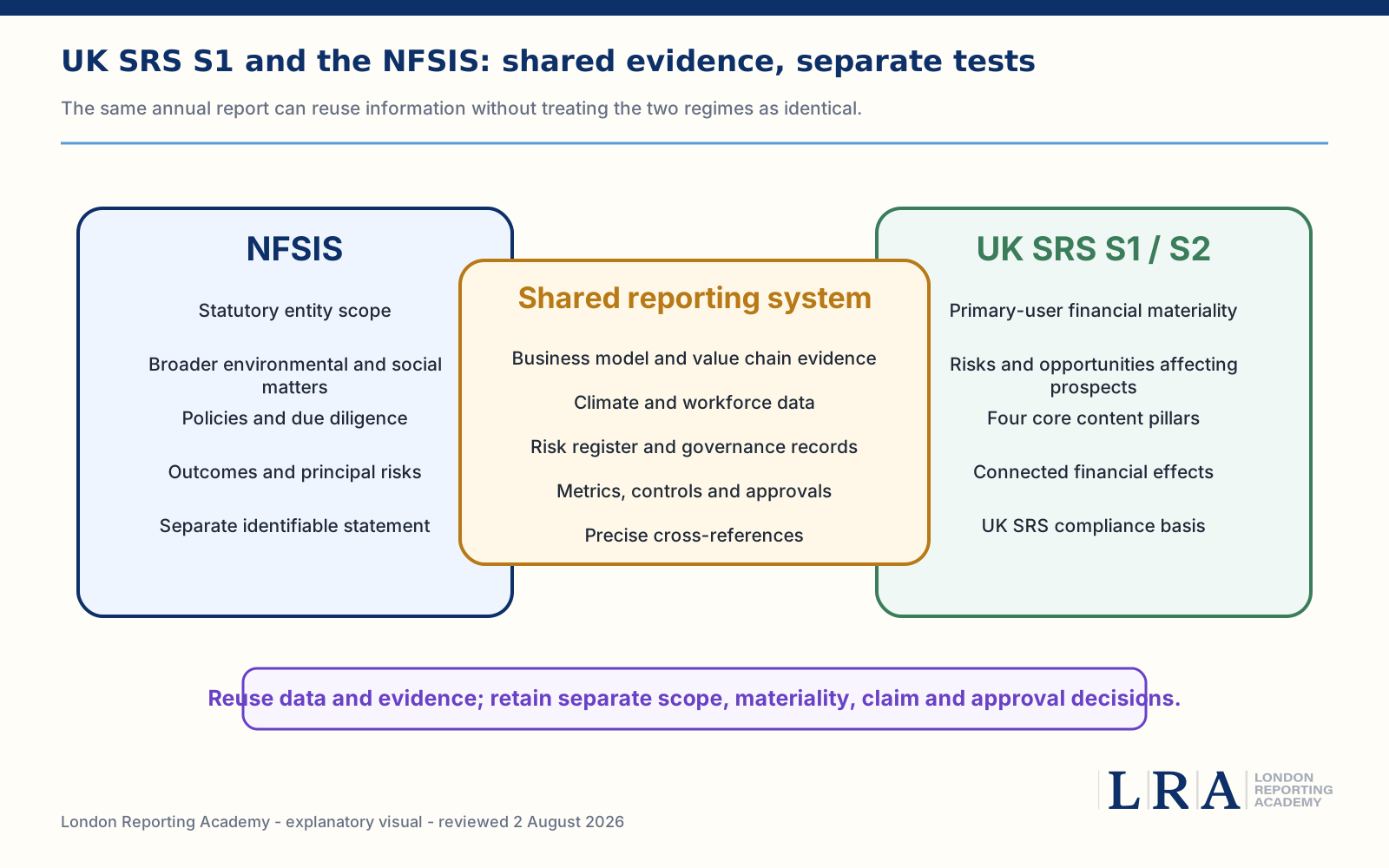
One controlled reporting system can support both the NFSIS and UK SRS: the organisation can reuse business-model descriptions, policy and due-diligence records, risk evidence, climate data, KPIs, governance records and source calculations. It must still perform separate scope, materiality and disclosure tests.
The NFSIS is a statutory, separately identifiable statement with a broader set of prescribed matters for entities in scope; UK SRS focuses on material sustainability-related risks and opportunities affecting prospects and has its own compliance basis.
Prepared in British English as a practitioner Knowledge Card Package: answer, explanation, application, evidence, connections and publishing layer.
Rule
Standard and regulatory context
The NFSIS is a current Companies Act statement for specified companies and groups. It covers environmental, employee, social, human-rights, anti-corruption and anti-bribery matters, together with policies, due diligence, outcomes, principal risks and KPIs. UK SRS S1 and S2 have a different primary-user objective and are voluntary unless separately mandated. The FCA's final rules in PS26/19 (30 September 2026) apply them on a comply or explain basis to issuers in UKLR categories 6, 14, 15, 16 and 22 for accounting periods beginning on or after 1 January 2027.
Why this matters
The practical overlap is substantial. Companies already preparing an NFSIS often possess much of the evidence needed to identify sustainability-related risks and opportunities: policies, value-chain due diligence, incidents, employee data, climate analysis, principal risks and performance indicators.
The danger is treating topic overlap as legal equivalence. A disclosure can be necessary for the NFSIS even when the company concludes it is not material under UK SRS. Conversely, a financing or technology-related sustainability opportunity might be material under UK SRS but not clearly captured by a narrow NFSIS drafting process. A combined project therefore needs shared inputs and separate decision records.
In practice
Quick orientation
| Field | Practical answer |
|---|---|
| NFSIS status | Current statutory statement for specified companies and groups under Companies Act sections 414CA and 414CB. |
| UK SRS status | Final voluntary standards unless a separate law or rule mandates them. |
| Main overlap | Business model, policies, due diligence, risks, climate information, KPIs, governance and evidence. |
| Main separation | Entity scope, prescribed matters, materiality objective, statement identification, compliance claim and reliefs. |
| Efficient model | One evidence layer, two requirement matrices, controlled cross-references and separate approvals. |
1. Understand the current NFSIS architecture
The NFSIS forms part of the Strategic Report for entities within the relevant Companies Act scope. The precise population must be checked against current legislation and the FRC scoping tables. The requirements differ across public-interest entities, certain traded, banking and insurance companies, AIM companies and high-turnover companies, and some companies may be subject only to specified climate-related elements.
For a full NFSIS, the statement addresses environmental matters, employees, social matters, respect for human rights, and anti-corruption and anti-bribery. It includes a brief business-model description; policies and due-diligence processes; policy outcomes; principal risks connected with operations and, where relevant and proportionate, business relationships, products or services; management of those risks; and relevant non-financial KPIs.
The NFSIS must be separately identifiable. Information can sit elsewhere in the Strategic Report and be incorporated through clear cross-references, allowing an index-like statement rather than unnecessary repetition.
2. Compare the reporting objectives before mapping disclosures
In practice
| Dimension | NFSIS | UK SRS S1 / S2 |
|---|---|---|
| Legal basis | Companies Act statutory requirement for entities in scope | Technical standards; voluntary unless separately mandated |
| Primary purpose | Report prescribed non-financial and sustainability matters within the Strategic Report | Provide material information to primary users about SROs affecting prospects |
| Topic coverage | Specified environmental and social matters, policies, due diligence, outcomes, risks and KPIs | All material sustainability-related risks and opportunities; climate requirements in S2 |
| Materiality / selection | Companies Act wording and current strategic-report materiality principles, subject to items required regardless of materiality | Omission, misstatement or obscuring test for primary-user decisions |
| Boundary | Statutory company or group statement according to Companies Act scope | Same reporting entity as related financial statements, plus relevant value-chain information |
| Statement / claim | Separately identifiable NFSIS within Strategic Report | UK SRS reporting basis and, only if justified, explicit compliance statement |
3. Information that can usually be reused
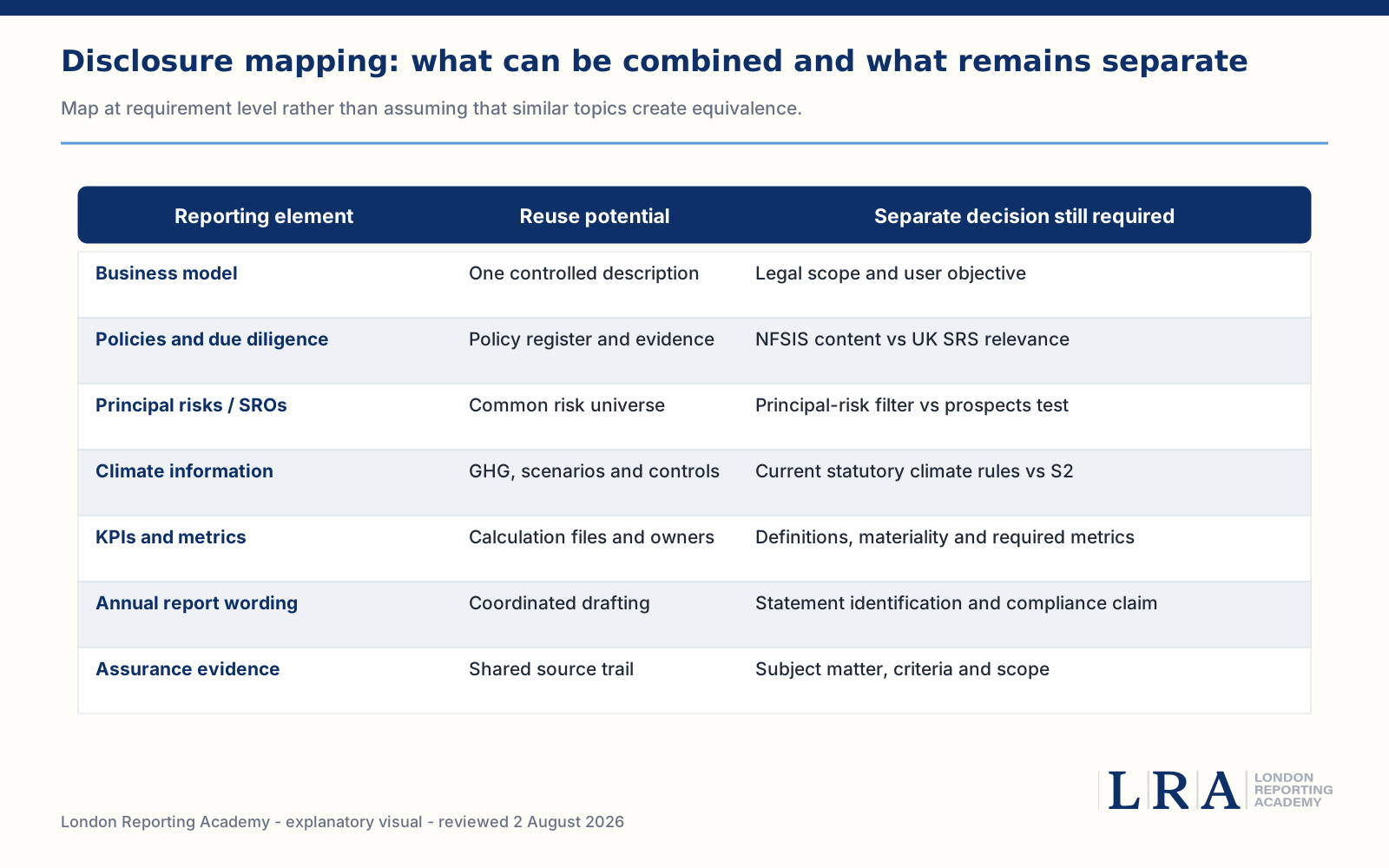
Reuse is strongest at the source, evidence and calculation level. The output wording may still need to be adjusted for the purpose and requirement.
Business model and value chain. Use one approved description of activities, markets, resources, relationships, subsidiaries and significant changes.
Policy and due-diligence register. Retain policy owner, approval date, scope, implementation process, grievance information, actions, outcomes and limitations.
Risk and opportunity universe. Start from one evidence base, then apply the principal-risk, NFSIS and UK SRS selection tests separately.
Climate data. Reuse controlled GHG, energy, scenario and transition evidence, while mapping current Companies Act climate requirements and UK SRS S2 separately.
Workforce, social and human-rights data. Reuse definitions, populations, incidents and trend evidence, but determine which information is required or material in each output.
Governance and controls. Use the same board papers, terms of reference, data-owner confirmations, calculation reviews, legal review and publication archive.
4. Decisions that must remain separate
A single master questionnaire is not enough. The organisation should record, for every disclosure item, the legal or standard source, entity population, period, decision criterion, published location and claim consequence.
Particular care is needed where the NFSIS asks for policies or outcomes on a prescribed matter but UK SRS materiality is not established. The organisation should not remove the NFSIS information merely because an SRO is not material under UK SRS. The opposite also applies: a UK SRS material opportunity or financial effect may need disclosure even when it is not a central NFSIS matter.
In practice
5. A practical disclosure mapping
| Reporting area | Possible common content | NFSIS-specific control — UK SRS-specific control |
|---|---|---|
| Business model | Activities, markets, resources, relationships and group changes | Meets statutory description and statement scope — Connects dependencies and value-chain locations to SROs |
| Policies and due diligence | Policy register, processes, grievance and monitoring evidence | Covers prescribed matters and explains absent policies where required — Discloses material information relevant to governance, strategy or risk management |
| Outcomes and actions | Performance, incidents, corrective actions and limitations | Explains policy outcomes — Connects response effectiveness to material SROs and prospects |
| Risks | Risk register, causes, affected operations and mitigation | Identifies principal risks connected to specified matters — Covers material risks and opportunities, time horizons and financial effects |
| Metrics / KPIs | Definitions, source data, calculations, owner and trend | Relevant non-financial KPIs — Applicable and entity-used metrics, targets and progress |
| Climate | GHG, energy, scenarios, resilience and transition actions | Current statutory climate disclosures for relevant entities — UK SRS S2 plus climate-relevant S1 requirements |
| Publication | Strategic Report architecture and cross-references | Separately identifiable NFSIS — Clearly identifiable UK SRS information and accurate reporting-basis claim |
6. Future simplification: prepare, but do not pre-empt
The FRC expects further changes to its Strategic Report guidance following the government’s Modernising Corporate Reporting programme. Future Companies Act reform could simplify, replace or reorganise parts of the current non-financial reporting architecture and could create a route for UK SRS reporting. The Modernising Corporate Reporting consultation (7 September 2026, closing 30 November 2026) proposes replacing the strategic report's topic-by-topic requirements with baseline narrative disclosures, but sections 414CA and 414CB stay in place until their post-implementation review concludes (expected spring 2027), and it proposes no thresholds and no commencement dates for private-company application of UK SRS.
That direction supports building a modular data and evidence system now. It does not justify describing the NFSIS as abolished, replaced or legally merged with UK SRS. Until final law takes effect, the current NFSIS must be assessed and reported according to its existing scope.
Rule
Version-control rule
Keep a current-law NFSIS matrix and a future-state UK SRS implementation matrix. Merge data fields where useful, not legal conclusions.
Hypothetical example
The group creates one evidence register and one controlled business-model description. It then maps each item to the current NFSIS requirement and the relevant UK SRS disclosure objective. NFSIS-specific policy and due-diligence information remains visible even when it is not material under UK SRS. The UK SRS section adds primary-user materiality, financial effects, four-pillar connections and a carefully reviewed voluntary reporting-basis statement. The unsupported alignment claim is removed.
Evidence retained
Companies Act and FRC scoping memo
NFSIS requirement matrix
UK SRS materiality and disclosure matrix
Shared policy, data and evidence register
Cross-reference and claim approval log
Hypothetical scenario
Illustrative scenario - adapt to the entity’s facts
A banking group prepares a full NFSIS and voluntarily pilots UK SRS S1 and S2. Its anti-bribery policy, human-rights due diligence, climate data and principal-risk evidence are stored in different folders. The first draft copies the same policy narrative into both statements and claims that the NFSIS is "fully aligned with UK SRS".
Illustrative only. It shows how the decision is made, not wording that can be copied or relied on.
In practice
Weak versus stronger approach
| Weak approach | Why it fails | Stronger approach |
|---|---|---|
| Uses one "ESG disclosure checklist" for both regimes. | Hides different scope, materiality and claim consequences. | Uses one evidence inventory feeding two controlled requirement matrices. |
| Removes an NFSIS matter because it is immaterial under UK SRS. | Applies the wrong information filter to a statutory statement. | Checks the Companies Act requirement independently and reports or explains as required. |
| Repeats full policy narratives in both sections. | Creates clutter and inconsistency. | Keeps the NFSIS separately identifiable and uses precise cross-references to one controlled narrative. |
| Says the NFSIS is "UK SRS compliant". | The statutory statement and UK SRS claim are different. | Describes each reporting basis separately and makes a UK SRS compliance statement only after a complete assessment. |
In practice
Common mistakes and corrections
| Mistake | Risk created | Correction |
|---|---|---|
| Assuming similar environmental and social topics make the regimes equivalent | Missing disclosures and an unsupported public claim. | Map objectives, scope, required content and materiality separately. |
| Using the financial-statement consolidation boundary without checking NFSIS scope | Wrong entity or group statement. | Prepare a current Companies Act scoping memo and reconcile it to the UK SRS reporting entity. |
| Treating due-diligence evidence as a complete UK SRS disclosure | Governance, strategy, financial effects and metrics may be absent. | Use due diligence as evidence and complete the relevant UK SRS four-pillar analysis. |
| Hiding the NFSIS in a general sustainability chapter | The statement is not separately identifiable. | Use a clear NFSIS heading and specific cross-references to the underlying information. |
| Assuming future simplification has already removed current duties | Current Companies Act non-compliance. | Apply current law until final amendments and commencement provisions take effect. |
Myth
A company that prepares a good NFSIS has automatically completed UK SRS S1.
Reality
The NFSIS can provide valuable data and evidence, but UK SRS requires a separate assessment of sustainability-related risks and opportunities, material information, connected financial effects, four-pillar disclosures and the reporting basis.
Readiness
Practical review checklist
- The current NFSIS scope and group boundary have been confirmed under the Companies Act.
- The NFSIS is separately identifiable in the Strategic Report.
- One source register supports business model, policies, due diligence, risks, metrics and climate data.
- NFSIS and UK SRS decisions are recorded in separate columns or matrices.
- Items required by current law are not removed solely because they are immaterial under UK SRS.
- Material UK SRS opportunities and financial effects are not lost because they fall outside a traditional NFSIS topic list.
- Cross-references are precise and do not obscure either statement.
- The public wording does not claim equivalence, replacement or compliance without a documented basis.
In practice
Related requirements and implementation mapping
| Instrument / reference | Relationship | Use in this article |
|---|---|---|
| Companies Act 2006 sections 414CA-414CB | Direct current law | NFSIS scope and required content. |
| FRC Strategic Report Guidance 2026, section 11 | Implementation guidance | Statement identification, group treatment, prescribed matters, policies, due diligence, outcomes, risks, KPIs and cross-references. |
| UK SRS S1 paragraphs 1-25 | Direct comparison | Primary-user objective, scope, materiality, connected information and core content. |
| UK SRS S1 paragraphs 60-63 | Direct | Location, co-location with other requirements and clear identification. |
| UK SRS S2 | Climate comparison | Climate disclosures that may reuse current statutory climate data but require separate mapping. |
| Modernising Corporate Reporting programme | Future-state trigger | Possible simplification; no current replacement unless enacted. |
Frequently asked questions
Is the NFSIS the same as a UK SRS sustainability statement?
No. It is a Companies Act statement with its own scope and content. UK SRS has a different reporting objective and compliance basis.
Can NFSIS information be cross-referenced into UK SRS disclosures?
Potentially, when the UK SRS location and cross-reference conditions are met and the referenced information fully addresses the material information need.
Can one data set support both?
Yes. Definitions, calculations and evidence can often be reused, but reporting boundaries, materiality and wording must be controlled separately.
Has the NFSIS been replaced by UK SRS?
No on the review date. Future simplification is a policy and legislative matter, not a current legal result.
Sources
Primary sources
- Companies Act 2006, section 414CA - non-financial and sustainability information statement - Primary legislation for current NFSIS scoping provisions
- Companies Act 2006, section 414CB - content of non-financial and sustainability information statement - Primary legislation for current NFSIS content
- FRC Guidance on the Strategic Report, February 2026 - Non-mandatory guidance on current Companies Act strategic reporting, NFSIS, section 172, communication, materiality and cross-references
- FRC Sustainability Reporting Developments - Frequently Asked Questions, February 2026 - Official high-level comparison of UK SRS with existing UK non-financial and climate reporting requirements
- UK SRS S1 General Requirements for Disclosure of Sustainability-related Financial Information, February 2026
- FRC Guidance on the Strategic Report - publication page - Official status, 2026 revision context and notice that further updates may follow the Modernising Corporate Reporting programme
- FCA PS26/19: Aligning listed issuers' sustainability disclosures with international standards (final rules, 30 September 2026)
- Modernising Corporate Reporting consultation (7 September 2026; closes 30 November 2026)
Take it with you
The checklists as a working spreadsheet
Every checklist and table on this page, with empty status, owner and evidence columns for your team to fill in and keep.
✓ Knowledge Hub AI Assistant · Human-in-the-loop

Ask about this guide
It answers from this page, and reaches into the linked disclosure cards when your question is about the standard itself.
Go deeper · UK SRS S1
UK SRS S1 & S2: Sustainability and Climate Reporting in Practice
This page settles one requirement. The UK SRS S1 & S2 course takes a first UK reporting cycle end to end — the UK amendments, financial effects, scenario analysis, emissions and an authorised release — on one continuing case, with two assignments reviewed by a person.
Available as Guided Flex, Live Cohort, 1:1 Expert Mentorship or Corporate Programme.