Short answer
The answer, before the reasoning
An explicit and unreserved UK SRS S1 compliance statement is only available when the entity’s sustainability-related financial disclosures comply with all applicable UK Sustainability Reporting Standards requirements. Legal-prohibition and commercially sensitive opportunity exemptions do not, by themselves, prevent a compliance statement.
The UK SRS S1 climate-only relief is different: if paragraph E3 is used, the entity may not assert compliance with UK SRS S1 and must disclose that use instead. Local FCA, Companies Act or other UK rules may further affect scope, timing and wording; under the FCA's final PS26/19 rules, neither a relief nor an explanation automatically supports an explicit and unreserved compliance statement.
Design block
Functional visual created for London Reporting Academy.
Why this question matters
Compliance wording is not a decorative footer. It is the reader’s signal that the disclosure package has been prepared against a complete set of requirements, not simply influenced by UK SRS language. A weak statement can overstate maturity, create assurance findings and expose the organisation to greenwashing or investor-communication risk.
UK SRS S1 is close to IFRS S1, but a UK claim still requires a UK-specific analysis. The final UK standard changed important areas such as SASB references, climate-only relief, publication timing and the interaction with local UK rules. Therefore, the claim decision should sit in the same approval process as the basis of preparation, relief register, cross-reference map and board sign-off.
Quick orientation
Quick orientation
- Applies to
- Entities preparing voluntary UK SRS S1 disclosures, listed issuers preparing for the FCA's final PS26/19 listing rules, and groups considering a dual UK SRS / IFRS S1 claim.
- Primary decision
- Can the report make an explicit and unreserved statement of compliance with UK SRS S1?
- Core source anchor
- UK SRS S1 paragraphs 72-73B and Appendix E paragraphs E1-E5.
- Common confusion
- Treating all reliefs as claim-neutral or assuming that an IFRS S1 statement automatically works for UK SRS S1.
The claim gate in one sentence
The governing test is complete compliance. UK SRS S1 paragraph 72 requires an explicit and unreserved statement only where the sustainability-related financial disclosures comply with all requirements of UK Sustainability Reporting Standards, and it prohibits describing disclosures as complying unless all requirements are met.
Decision 1 - determine the reporting basis
First identify whether the entity is using UK SRS voluntarily, preparing for FCA listing-rule reporting under PS26/19 (comply or explain for accounting periods beginning on or after 1 January 2027), responding to investor or lender expectations, or reporting under a future Companies Act or other UK requirement. This matters because UK SRS S1 itself allows voluntary application, but paragraph 73B and Appendix E make clear that use of parts of the Standard may be subject to rules, requirements, regulations or legislation made by the Companies Act 2006, the FCA or another UK regulatory or government entity.
A voluntary report can generally choose whether to report against UK SRS S1 at all. A regulated report cannot rely on the standard text alone if local rules narrow, extend, phase or condition the requirements. The basis of preparation should therefore name both the standard and the applicable reporting route.
Decision 2 - test all requirements, not only the four pillars
A compliance statement is not earned by presenting headings for governance, strategy, risk management and metrics and targets. The complete test includes conceptual foundations, materiality, reporting entity, connected information, sources of guidance, location, timing, comparatives, judgements, measurement uncertainty, errors and applicable transition provisions.
The reviewer should ask whether the disclosures identify material sustainability-related risks and opportunities that could reasonably be expected to affect prospects, whether the disclosures relate to the same reporting entity as the financial statements, and whether data and assumptions are consistent with the related financial statements to the extent possible. A four-pillar narrative without a finance and control trail is a reporting draft, not a compliance conclusion.
In practice
Decision 3 - classify every relief used
| Relief or omission situation | Effect on UK SRS S1 claim | Control action |
|---|---|---|
| Law or regulation prohibits disclosure, or commercially sensitive opportunity information is withheld under the standard | Does not by itself prevent a compliance statement. | Document the basis, evidence, approval and wording. |
| UK SRS S1 paragraph E3 climate-only relief | Prevents asserting compliance with UK SRS S1; use must be disclosed instead. | Use separate wording and avoid “prepared in accordance with UK SRS S1”. |
| UK SRS S2 transition reliefs for climate disclosures | May still permit a UK SRS S2 claim if requirements for disclosure of relief use are met. | Track separately from the S1 claim and disclose alongside the S2 statement. |
| FCA comply or explain position under the PS26/19 final rules | A relief is not an explanation, and neither automatically supports an explicit and unreserved UK SRS compliance statement (S1 paragraphs 72, 73A and 73B). | State each relief and explanation; treat the FCA's proposed Technical Note 803.1 on explanations and compliance statements, open for comment until 28 October 2026, as guidance under consultation, not final guidance. |
Decision 4 - control cross-references and report placement
UK SRS S1 permits required information to be included by cross-reference to another report only when the cross-reference conditions are satisfied. In practice, the disclosure owner should confirm that the referenced information is available on the same terms, at the same time, and is clearly identifiable. If the annual report points to a sustainability report, website or appendix that is later, incomplete or unstable, the claim can become vulnerable.
For UK companies, the Strategic Report is often the natural home for connected financial narrative, but the architecture should follow the applicable reporting route. The safe control is a disclosure matrix that maps each requirement to a page, section, cross-reference, evidence owner and approval status.
Decision 5 - draft the statement with a hierarchy
Illustrative wording should be adapted to the entity’s facts and reviewed legally and technically. A full claim might read: “The sustainability-related financial disclosures for the year ended [date] have been prepared in accordance with UK Sustainability Reporting Standards.” A more precise version can add the standards used, the reporting boundary and the location of the disclosures.
If the entity uses the climate-only relief, the wording should not imply compliance with UK SRS S1. A safer structure is: “The entity has applied the UK SRS S1 paragraph E3 provision to disclose information exclusively about climate-related risks and opportunities. The entity therefore does not make an explicit and unreserved statement of compliance with UK SRS S1. The use of this provision is disclosed here for transparency.”
If the entity also wants an IFRS S1 or IFRS S2 claim, do not combine the statements until a separate IFRS gap assessment has been completed. Differences in UK wording, especially the UK “may refer to and consider” approach to SASB, removal of the IFRS delayed-publication relief and the UK climate-only limitation, can affect whether an IFRS statement is supportable.
In practice
Common mistakes
| Mistake | Why it is risky | Practical fix |
|---|---|---|
| Using “UK SRS-aligned” and “UK SRS compliant” interchangeably | Alignment can describe direction of travel; compliance implies a complete requirements test. | Define a claims vocabulary and approve every claim centrally. |
| Assuming a climate-only first report can still claim UK SRS S1 compliance | UK SRS S1 paragraph 73A expressly prevents the S1 claim when paragraph E3 is used. | Use a relief disclosure and, if supportable, a separate S2 statement. |
| Copying IFRS S1 boilerplate | UK amendments may change the claim consequence. | Run a UK amendment and dual-claim matrix before drafting. |
| Relying on cross-references to late or unstable documents | Required information may not be available as part of the same reporting package. | Use a cross-reference control log with publication timing checks. |
| Ignoring final or future local rules | The FCA's PS26/19 rules set scope, timing and transition conditions for listed issuers; any future Companies Act requirements may differ. | Maintain a regulatory watch list and check final wording against the applicable rules and any later FCA guidance. |
Readiness
Practical checklist before approval
- Confirm the reporting basis: voluntary, FCA, Companies Act or another route.
- Map every S1 requirement to a disclosure, cross-reference or approved relief.
- Separate legal/commercial sensitivity reliefs from climate-only E3 relief.
- Confirm whether UK SRS S2 is also applied and whether S2 reliefs are used.
- Check timing: sustainability-related financial disclosures are reported at the same time as related financial statements.
- Confirm that sources of guidance used, including any SASB topics or metrics, are identified.
- Review dual IFRS wording against IFRS S1/S2, not only UK SRS.
- Obtain finance, legal, company secretarial and board/committee sign-off.
Related standards and indicators
Primary: UK SRS S1 paragraphs 72-73B; Appendix E paragraphs E1-E5.
Supporting: UK SRS S1 paragraphs 20-24 on reporting entity and connected information; paragraphs 54-59 on sources of guidance; paragraphs 60-64 on location and timing.
Comparison: IFRS S1 and IFRS S2 compliance wording and transition reliefs; FCA PS26/19 final listing-rule reporting, which followed the CP26/5 consultation; FCA proposed Technical Note 803.1 on explanations and compliance statements, open for comment until 28 October 2026.
Questions
Questions people ask
Can a climate-only UK SRS report claim S1 compliance?
Legal-prohibition and commercially sensitive opportunity exemptions do not, by themselves, prevent a compliance statement. The UK SRS S1 climate-only relief is different: if paragraph E3 is used, the entity may not assert compliance with UK SRS S1 and must disclose that use instead.
What reliefs do not prevent a UK SRS claim?
Legal-prohibition and commercially sensitive opportunity exemptions do not, by themselves, prevent a compliance statement. The UK SRS S1 climate-only relief is different: if paragraph E3 is used, the entity may not assert compliance with UK SRS S1 and must disclose that use instead.
Can a UK SRS report also claim IFRS S1 compliance?
If the entity also wants an IFRS S1 or IFRS S2 claim, do not combine the statements until a separate IFRS gap assessment has been completed. Differences in UK wording, especially the UK “may refer to and consider” approach to SASB, removal of the IFRS delayed-publication relief and the UK climate-only limitation, can affect whether an IFRS statement is supportable.
Sources
Primary sources
- UK SRS S1, February 2026
- UK SRS S2, February 2026
- DBT UK SRS guidance
- DBT consultation response
- FCA PS26/19: Aligning listed issuers' sustainability disclosures with international standards (final rules, 30 September 2026)
- FCA Primary Market Bulletin 66 (30 September 2026): proposed Technical Note 803.1, open for comment until 28 October 2026
Take it with you
The checklists as a working spreadsheet
Every checklist and table on this page, with empty status, owner and evidence columns for your team to fill in and keep.
✓ Knowledge Hub AI Assistant · Human-in-the-loop

Ask about this guide
It answers from this page, and reaches into the linked disclosure cards when your question is about the standard itself.
Go deeper · UK SRS S1
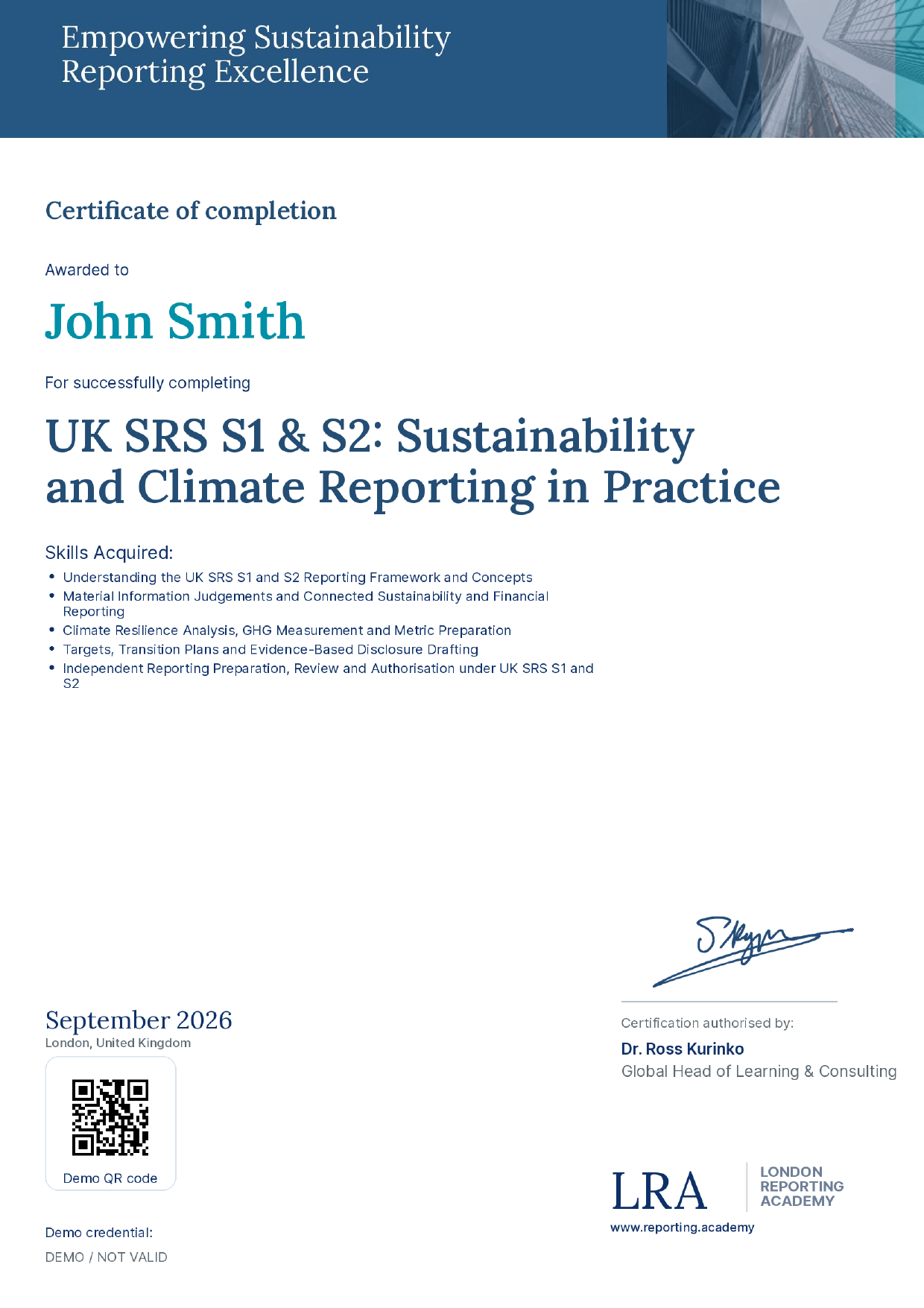
UK SRS S1 & S2: Sustainability and Climate Reporting in Practice
This page settles one requirement. The UK SRS S1 & S2 course takes a first UK reporting cycle end to end — the UK amendments, financial effects, scenario analysis, emissions and an authorised release — on one continuing case, with two assignments reviewed by a person.
Available as Guided Flex, Live Cohort, 1:1 Expert Mentorship or Corporate Programme.