Short answer
The answer, before the reasoning
The Climate Law applies broadly to 'Sources' in the UAE, including free zones. A Source is defined by legal-person or individual-enterprise status and by operations or activities that release greenhouse gases.
That broad perimeter is not the same as an automatic Article 6 filing duty. A group should assess each UAE legal person and operating unit, identify the emissions-generating activity, determine the competent authority and separately document any Article 6 designation evidence.
ANSWER · EXPLAIN · APPLY · EVIDENCE · CONNECT · PUBLISH
Quick orientation
Quick orientation
- Applies to
- UAE public and private legal persons, individual enterprises and free-zone operations that release greenhouse gases.
- Primary decision
- Which legal person or operating unit is the Source, and whether the reporting point is entity, facility, operator or another authority-defined unit.
- Key source
- Articles 1, 3 and 6 of Federal Decree-Law No. (11) of 2024.
- Common confusion
- Assuming either that every group company is automatically covered or that a holding company alone absorbs all subsidiary duties.
In this guide
The Source concept is activity-based, but not boundary-free
A four-layer corporate applicability analysis
Public and private entities
Free zones
Branches and permanent establishments
Holdings, investment companies and group structures
Facilities and operators
A boundary map template
Hypothetical example: headquarters, branch and facilities
Weak versus stronger applicability memo
Common mistakes
Applicability checklist
The Source concept is activity-based, but not boundary-free
The law does not start with a conventional sustainability-reporting boundary. It starts with the defined term Source: public and private legal persons and individual enterprises whose operations or activities result in greenhouse gases being released into the atmosphere. Article 3 then applies the law to all Sources in the State, including free zones.
Three elements must therefore be visible in the applicability file: the person or enterprise, the UAE operation or activity, and the emissions consequence. A company registration alone does not describe the emitting activity. Conversely, an emitting boiler or vehicle is not itself a legal person, although a competent authority may regulate the facility or operator as the practical reporting point.
Figure 1. The broad Source perimeter and the narrower Article 6 determination are related but not identical.
A four-layer corporate applicability analysis
Legal-person layer: identify the UAE incorporated entities, government bodies, individual enterprises and any legally relevant branch registrations.
Operating layer: map facilities, leased sites, fleets, equipment, processes, waste activities and other operations that may release greenhouse gases.
Authority layer: identify the emirate, free-zone, sector, permit and environmental authorities connected with each operation.
Duty layer: record whether Article 6 determination evidence exists and which instructions define boundary, methods, gases, period, deadline and verification.
Public and private entities
The definition is deliberately broad. It can capture government and state-owned entities, private companies and individual enterprises. The law does not state a general exemption based on turnover, employee count, listing status, ownership nationality or sector. Those characteristics can still matter under an implementing scheme, but they should not be presented as exclusions from the Article 3 Source perimeter without authority support.
Free zones
Article 3 expressly includes free zones. A free-zone licence is therefore not a general exemption. The correct analysis identifies the free-zone legal entity, its emitting operations, its facilities and the relevant competent authority or free-zone environmental arrangements. A group should also check whether an emirate scheme or permit condition applies to the facility even where the corporate headquarters is licensed elsewhere.
Branches and permanent establishments
A branch may not have a separate legal personality from its foreign or UAE parent. That does not mean its UAE activities can be ignored. The applicability file should record the branch's legal status, licensing authority, operator, assets, staff, permits and emission-generating operations. The practical reporting point may be the parent legal person, the branch registration, a facility operator or another unit specified by the competent authority.
Holdings, investment companies and group structures
A pure holding company with no emitting operations may have a different Source analysis from its operating subsidiaries. Ownership of an emitting subsidiary is not the same as the holding company itself operating the facility. Nevertheless, the holding company may coordinate group data, approve policies or receive consolidated requests. The compliance file should avoid using consolidated ESG reporting as proof that the legal duty sits only at parent level.
Figure 2. Corporate applicability map for groups, subsidiaries, branches and facilities.
In practice
| Corporate unit | Source assessment question | Common control point |
|---|---|---|
| UAE holding company | Does it have operations or activities that release GHGs, rather than only ownership interests? | Separate legal-duty assessment from group coordination. |
| Operating subsidiary | Which activities, facilities and permits generate emissions? | Document legal entity, operator and competent authority. |
| Joint venture / associate | Who operates or controls the emitting facility, and what does the authority instrument specify? | Do not assume financial-accounting consolidation determines the legal duty. |
| Branch | What is the branch legal status and who is the regulated operator? | Retain licence, permits and authority correspondence. |
| Leased facility | Who has operational control and responsibility for fuel, equipment, maintenance and reporting? | Review lease and permit terms; avoid boundary assumptions. |
| Free-zone company | Which free-zone and emirate authorities are relevant? | Free-zone location is included, not exempt. |
Facilities and operators
Although the federal definition refers to persons and enterprises, implementation can be facility-centred. The EAD facility-level MRV scheme, for example, assigns responsibility to the operator and uses operational control, covered sectors and an emissions threshold. This is a local implementation example, not a universal federal definition. It demonstrates why the corporate file must connect legal entity, facility, operator and scheme instructions.
In practice
A boundary map template
| Field | What to record |
|---|---|
| Legal person / enterprise | Registered name, licence number, legal form and ownership. |
| Location | Emirate, mainland/free zone, address and facility identifier. |
| Operation / activity | Products, processes, combustion, vehicles, fugitive sources, waste and other GHG-generating activities. |
| Operator / control | Owner, lessee, delegated operator and operational decision rights. |
| Authority | MOCCAE, competent emirate authority, free-zone regulator, sector regulator and permit issuer. |
| Source conclusion | Yes / no / unclear, with facts and legal reasoning. |
| Article 6 evidence | Notice, list, resolution, permit condition, sector instruction, portal registration or none found. |
| Duty parameters | Boundary, gases, methods, reporting period, deadline, verification and retention. |
| Owner / review | Legal owner, data owner, approver and next review date. |
In practice
Hypothetical example: headquarters, branch and facilities
| Element | Illustrative analysis |
|---|---|
| Context | A foreign group has a Dubai free-zone subsidiary providing professional services, an Abu Dhabi industrial subsidiary with two facilities, and a Ras Al Khaimah branch operating a quarry. |
| Assessment | The group identifies three legal/registration units and five operating locations. All units use electricity and vehicles; the industrial facilities and quarry have direct fuel and process emissions. |
| Designation evidence | The Abu Dhabi facilities receive EAD scheme instructions. The group finds no equivalent formal notice for the Dubai office or quarry in the sources reviewed, but keeps both in the legal-status watch. |
| Decision | The Abu Dhabi operator builds the scheme-specific report. The Dubai and RAK units maintain source registers and data readiness without claiming an authority filing obligation that has not been evidenced. |
| Governance | Group sustainability coordinates methodology; each legal entity retains its own applicability decision and evidence. |
In practice
Weak versus stronger applicability memo
| Weak wording | Stronger wording |
|---|---|
| "The group is under the threshold and therefore outside the law." | "Each UAE legal person and facility was screened against the Article 1 Source definition. No general Article 3 emissions threshold was used. Scheme-specific thresholds are recorded separately." |
| "The parent reports for all companies." | "The parent coordinates data. Legal responsibility and reporting point are assessed for each entity, facility and authority instrument." |
| "Free-zone companies are not regulated by mainland laws." | "Article 3 expressly includes free zones; the applicable competent authority and local scheme were identified for each operation." |
| "No direct notice means the company is exempt." | "No Article 6 determination evidence was located as at the review date. The conclusion is conditional and subject to update triggers." |
Common mistakes
Using the financial consolidation perimeter as the only legal boundary.
Treating purchased electricity as proof that every office has the same Article 6 duty as an industrial facility.
Ignoring free-zone entities or branches because they are managed centrally.
Applying an Abu Dhabi facility threshold to operations in another emirate without authority support.
Recording only the conclusion and not the facts, sources, assumptions and reviewer approval.
Failing to revisit the map after acquisitions, disposals, new permits, new facilities or regulator communications.
Record the UAE legal person or operating unit, the emissions-generating activity, the competent authority and any evidence that the source has been designated under Article 6. Where designation applies, retain the instructions that set the boundary, methods, gases, reporting period, deadline and verification requirements.
Questions
Questions people ask
Which organisations are within the UAE Climate Law, and how should a group assess corporate applicability?
The Climate Law applies broadly to 'Sources' in the UAE, including free zones. A Source is defined by legal-person or individual-enterprise status and by operations or activities that release greenhouse gases.
What evidence is required?
Record the UAE legal person or operating unit, the emissions-generating activity, the competent authority and any evidence that the source has been designated under Article 6. Where designation applies, retain the instructions that set the boundary, methods, gases, reporting period, deadline and verification requirements.
Which authority instructions change the answer?
Authority layer: identify the emirate, free-zone, sector, permit and environmental authorities connected with each operation. Duty layer: record whether Article 6 determination evidence exists and which instructions define boundary, methods, gases, period, deadline and verification.
Sources
Primary sources
- Federal Decree-Law No. (11) of 2024 On the Reduction of Climate Change Effects
- Official English download of Federal Decree-Law No. (11) of 2024
- Cabinet Resolution No. (67) of 2024 Concerning the National Register for Carbon Credits
- Environment Agency - Abu Dhabi Facility-Level MRV portal
- EAD Facility-Level MRV workshop presentation, 12 March 2026
- UAE Net Zero 2050 Strategy - Official UAE Platform
- National Climate Change Plan of the United Arab Emirates 2017-2050
Take it with you
The checklists as a working spreadsheet
Every checklist and table on this page, with empty status, owner and evidence columns for your team to fill in and keep.
✓ Knowledge Hub AI Assistant · Human-in-the-loop

Ask about this guide
It answers from this page, and reaches into the linked disclosure cards when your question is about the standard itself.
Go deeper · UAE FDL 11 / 2024
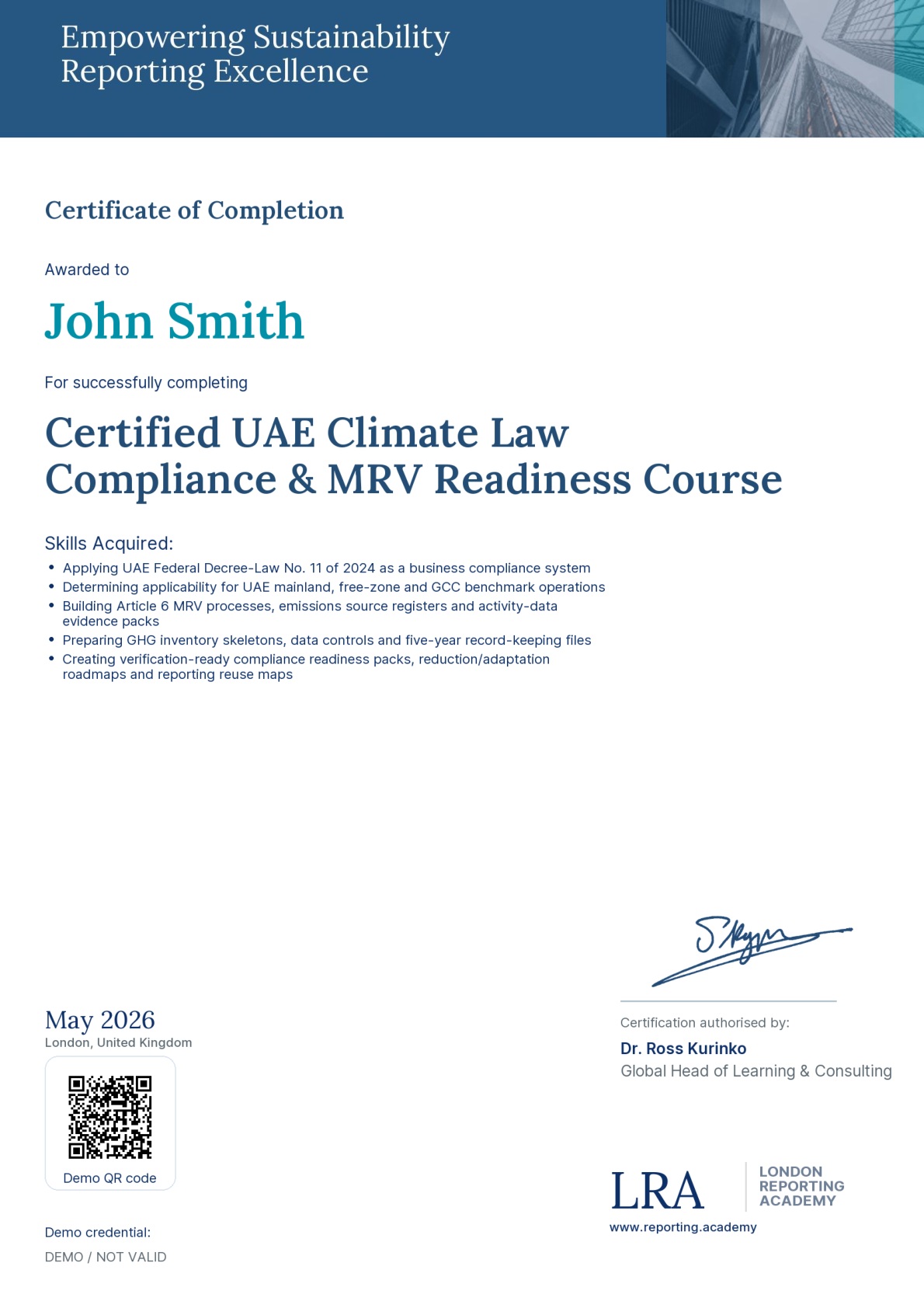
UAE Climate Law Compliance & MRV Readiness
This page settles one requirement. The UAE Climate Law course builds the whole MRV system — measurement, reduction plans, verification and adaptation reporting — on a realistic UAE case or your own organisation.
Available as Guided Flex, Live Cohort, 1:1 Expert Mentorship or Corporate Programme.