Short answer
The answer, before the reasoning
A UAE climate-law source register should be a controlled obligation map, not merely a folder of PDFs. Each record should identify the legal source, issuing authority, authoritative language, status, effective date, scope, designation trigger, method or form, reporting period, deadline, portal or contact, required evidence, owner, reviewer and update trigger.
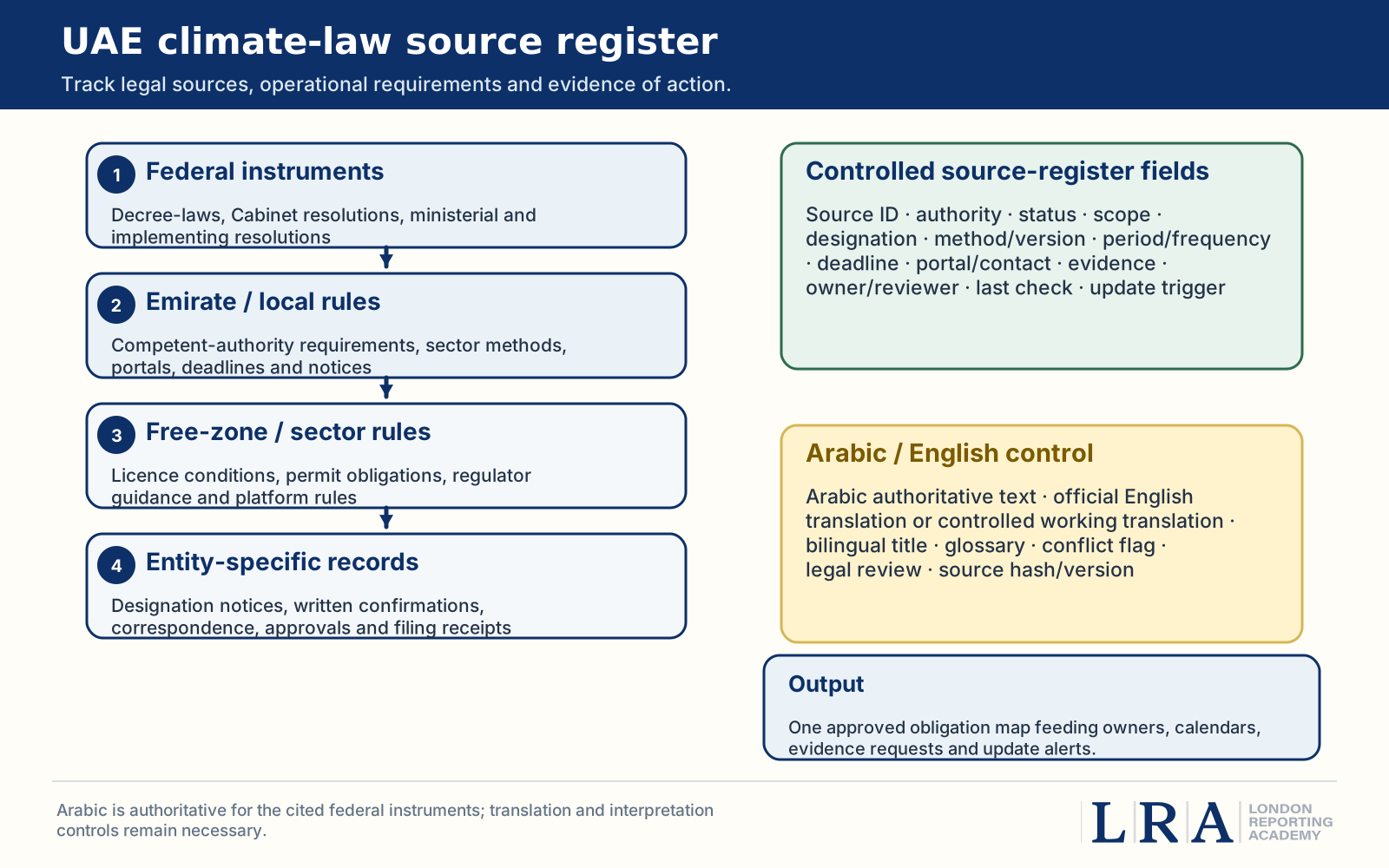
Federal instruments should be linked to emirate, free-zone, sector and entity-specific requirements rather than assumed to replace them. Because the Arabic text is authoritative for the cited federal instruments, the register should retain the Arabic source, a controlled English translation, the translation provenance and a conflict-escalation rule. Authority correspondence, designation notices and written confirmations should be registered with the same discipline as published legislation.
Technical status
Publication status
This document is an educational and implementation-oriented draft. It is not UAE legal advice, a Ministry decision, a registry approval, an assurance conclusion or a project validation. Confirm the Arabic legal text, current implementing instruments, regulator correspondence and the facts of the relevant entity or project before publication or implementation.
Quick orientation
Quick orientation
- Applies to
- Organisations operating across emirates, free zones, regulated sectors or several legal entities, and any company receiving climate-related notices, designations, portal instructions or authority correspondence.
- Primary decision
- How to create one controlled register that links legal sources to operational requirements, owners, deadlines, evidence and update triggers.
- Key sources
- Federal Decree-Law No. 11 of 2024; Cabinet Resolution No. 67 of 2024; official UAE legislation pages and future federal, emirate and free-zone instruments.
- Common confusion
- Treating one federal law as a complete operating manual, relying on an English summary without checking the authoritative Arabic, or storing obligations in emails rather than a controlled register.
Technical status
UAE legal and implementation status gate
Federal Decree-Law No. 11 of 2024 entered into force on 30 May 2025. Cabinet Resolution No. 67 of 2024 entered into force on 28 December 2024. The Arabic text is authoritative. The legal instruments delegate important operational matters - including implementing resolutions, the Registry working regulation, fees, approved verification agencies, methods, portal procedures and some perimeter questions - to the Ministry or other authorities. The official sources reviewed for this package did not provide a complete public operating manual covering every company scenario. Confirm current federal, emirate, free-zone and entity-specific requirements in writing before relying on a filing, threshold, credit or governance conclusion.
Why a source register is a compliance control
UAE climate regulation is deliberately multi-level. Federal Decree-Law No. 11 defines the national framework and recognises the Ministry, entities concerned and competent authorities, including local authorities in each emirate and free zones. It also provides for implementing resolutions. Cabinet Resolution No. 67 creates a separate threshold-based carbon-registry regime and delegates its working regulation, fees, approved verification agencies and executive resolutions. A company may also receive local methods, sector instructions, permit conditions or a designation notice.
A PDF library does not answer the operating questions: Which legal entity or facility is covered? Which authority expects the submission? Which method and form apply? Is the source final, effective, superseded or only proposed? What evidence must be retained? Who must act, and by when? The source register converts legal material into a controlled implementation system while preserving the original source and uncertainty.
In practice
The four source layers
| Layer | Typical sources | Register treatment |
|---|---|---|
| Federal framework | Federal decree-laws, Cabinet resolutions and amendments. | Record the official identifier, Arabic source, official English access, issue/effective dates, scope, key articles and delegated matters. |
| Federal implementation | Ministerial resolutions, MOCCAE forms, portal rules, approved methods, fee decisions, verifier lists and SCA rules. | Link each instrument to the parent law or resolution and mark the operational requirement it activates or changes. |
| Emirate / local / free-zone | Competent-authority rules, permits, circulars, sector methods, local portals and inspection requirements. | Map the requirement to the relevant licence, facility, entity, sector and local authority. Do not assume federal and local requirements are interchangeable. |
| Entity-specific | Designation notices, information requests, meeting minutes, written clarifications, portal confirmations and enforcement correspondence. | Give the record a unique ID, preserve the exact communication and track actions, approvals and reliance limits. |
In practice
Recommended source-register fields
| Field group | Minimum fields | Why it matters |
|---|---|---|
| Identity and provenance | Source ID; Arabic title; controlled English title; instrument type; number/year; issuing authority; official URL; Official Gazette or document reference; file hash/version. | Prevents confusion between similar instruments, summaries and unofficial copies. |
| Status and time | Issued date; publication date; effective date; transition/regularisation period; status: proposed, issued, effective, amended, superseded, withdrawn, unknown. | Separates a current obligation from a future or historical source. |
| Scope and applicability | Jurisdiction; emirate/free zone; sector; legal entity; facility; activity; source definition; designation/notice status; threshold; exclusions and assumptions. | Shows who or what is covered and where specialist judgement remains. |
| Operational requirement | Obligation category; action; frequency; reporting period; deadline; method/version; form; units; portal; signatory; verifier/assurance requirement; retention period. | Turns legal text into a usable calendar and data request. |
| Authority interface | Authority and department; named contact if appropriate; communication channel; correspondence ID; meeting date; question; written response; reliance limitation. | Prevents verbal guidance from becoming an undocumented company rule. |
| Evidence and controls | Evidence required; owner; preparer; reviewer; approver; control reference; filing receipt; location; access class; retention and cybersecurity requirement. | Links the obligation to proof of compliance. |
| Monitoring | Last checked; checked by; next review; update trigger; source change detected; implementation impact; linked task or issue; closure evidence. | Creates a maintainable review queue. |
Arabic and English control
The official UAE legislation pages state that the Arabic text is authoritative. English is essential for multinational teams, but it should be treated as a controlled working translation rather than the final arbiter where wording is disputed. The register should therefore preserve both language records and make the translation decision visible.
In practice
| Control | Recommended practice | Escalation trigger |
|---|---|---|
| Authoritative text | Retain the official Arabic PDF/page and its identifier. Do not replace it with a downloaded English summary. | Arabic source unavailable, corrupted or inconsistent with the recorded version. |
| English version | Record whether it is an official translation, official portal rendering, controlled legal translation or internal working translation. | Material difference affects scope, threshold, duty, deadline, penalty or approval. |
| Bilingual glossary | Control recurring terms such as Ministry, competent authority, source, entity, emissions inventory, carbon retirement and verification. | Different teams use terms in a way that changes accountability or boundary. |
| Translation review | Name the translator/reviewer, date and source version; retain comments on ambiguous phrases. | A filing, contract or public claim relies on the disputed wording. |
| Conflict rule | Pause the implementation conclusion, consult UAE counsel or the authority and retain the resolution. | Arabic and English readings lead to different legal outcomes. |
Caution
Do not translate the uncertainty away
Where the source does not specify a perimeter, deadline, method or portal rule, the English register must show “not specified / delegated / confirmation required”. A polished translation is not a substitute for missing implementing guidance.
In practice
Status taxonomy for the register
| Status | Meaning | Operational treatment |
|---|---|---|
| Proposed / draft | Not yet final or legally effective. | Monitor; do not build a compliance claim on it. Prepare scenarios if material. |
| Issued - not effective | Final instrument exists but application starts later. | Create implementation tasks and confirm transition provisions. |
| Effective | Current source, subject to scope and any designation condition. | Link to active owners, controls, calendar and evidence. |
| Effective - operational detail pending | Parent duty exists but a method, portal, fee, list or implementing rule is delegated or unavailable. | Prepare defensible readiness steps; seek written confirmation; do not invent the missing detail. |
| Entity-specific confirmed | Written notice, approval or clarification applies to the organisation. | Treat as a controlled obligation record with restricted access if needed. |
| Superseded / historical | No longer current but relevant for prior periods or decisions. | Retain for audit trail and link to the replacement. |
| Unverified secondary interpretation | Law-firm note, vendor page or market commentary. | Use only as a discovery lead until checked against primary sources. |
From legal source to operating requirement
1. Capture the official source and authoritative language before extracting any obligation.
2. Classify the issuing authority, legal level, status, effective date and relationship to parent instruments.
3. Extract each distinct requirement or delegated matter into a separate obligation record.
4. Map the record to the relevant legal entities, facilities, activities, licences, sectors and jurisdictions.
5. Identify the method, form, period, deadline, portal, verifier, signatory and evidence - or flag that the source does not specify them.
6. Assign preparer, reviewer, approver and control references; create implementation tasks.
7. Obtain written authority or legal confirmation for material ambiguity and attach it to the record.
8. Monitor update triggers and propagate changes to the reporting calendar, data dictionary, procedures and training.
Worked register example
The third column is illustrative. A local notice should never be invented from a general federal requirement; it should be entered only when the company has the actual source or written authority confirmation.
In practice
| Field | Federal law record | Carbon Registry record — Hypothetical local notice |
|---|---|---|
| Source / authority | Federal Decree-Law No. 11 of 2024 / UAE federal level. | Cabinet Resolution No. 67 of 2024 / UAE Cabinet, MOCCAE and SCA roles. — Competent-authority circular / local authority. |
| Scope | Sources in the State, including free zones; Article 6 duties attach to sources determined by authorities. | High emitters at or above 0.5 million tCO2e Scope 1+2; voluntary participants; platforms. — Named facilities in one emirate. |
| Operational detail | Standards, forms and electronic system depend on Ministry/authority implementation. | Working regulation, fees, approved verifier list and executive resolutions are delegated. — Circular states a method, filing window and portal. |
| Control | Track designation status and implementing instruments. | Maintain threshold views and written perimeter confirmation. — Link exact circular and portal receipt to facility owner. |
Current emirate example: Abu Dhabi facility-level MRV
The Environment Agency - Abu Dhabi facility-level MRV materials illustrate why the source register must keep federal and local layers separate. The 2026 workshop material describes a facility-level point of regulation for specified covered sectors, a current 25,000 tCO2e threshold, registration and annual reporting through the EAD portal and a phased independent-verification timetable. These parameters do not replace the 0.5 million tCO2e federal Registry test and should not be generalised to other emirates or sectors.
In practice
| Register field | Federal carbon Registry | Abu Dhabi facility MRV example |
|---|---|---|
| Point of regulation | Entity/participant under Cabinet Resolution 67, with unresolved group-perimeter questions in some structures. | Facility level in covered sectors under EAD implementation materials. |
| Threshold | 0.5 million tCO2e annually, Scope 1 and Scope 2, for the federal high-emitter category. | 25,000 tCO2e for covered facilities under the current EAD materials. |
| Authority and portal | MOCCAE/Registry and other roles defined by Resolution 67; current working rules must be confirmed. | Environment Agency - Abu Dhabi and facilitymrv.ead.ae. |
| Control conclusion | Keep as a separate legal source and applicability test. | Do not use the local facility threshold as the federal Registry threshold or vice versa. |
Authority correspondence as a legal source record
A regulator call or meeting may be operationally important but is weaker than a published instrument or written response. Record the question asked, facts presented, participants, date, exact answer, whether the authority confirmed the answer in writing, conditions, reliance limits and follow-up. Where the conclusion affects registration, perimeter, deadline, penalties or a public claim, seek a written response or legal opinion.
In practice
Common mistakes
| Mistake | Why it creates risk | Correction |
|---|---|---|
| One row per document | A single instrument can contain several obligations, conditions, delegated matters and dates. | Use a source table plus separate requirement-level records linked by source ID. |
| English-only register | A disputed translation can change the legal conclusion, while Arabic is authoritative. | Retain the Arabic source and controlled translation metadata. |
| Secondary summaries treated as law | Commentary may simplify designation, scope, deadlines or operational status. | Use secondary material only to discover primary sources and questions. |
| No distinction between published and entity-specific requirements | A company may miss a designation notice or wrongly generalise its own correspondence. | Classify correspondence separately and restrict its applicability. |
| Unknown fields silently completed | The register creates false certainty about methods, fees, portals or perimeters. | Use explicit gap statuses and a confirmation owner. |
| Register disconnected from operations | Legal updates do not change data requests, calendars or controls. | Create linked implementation tasks and change-control evidence. |
Myth
Once Federal Decree-Law No. 11 is in the register, the company has captured all UAE climate requirements.
Reality
The federal law is the framework. The operating requirement may also depend on Cabinet or ministerial resolutions, an emirate or free-zone authority, sector rules, a designation notice, a method, a portal instruction and written correspondence.
Self-check
- Can the team show which source creates each active data request and deadline?
- Which three register records rely on an English interpretation that has not been checked against Arabic?
- What happens operationally when a source status changes from “pending” to “effective”?
Sources
Primary sources
Take it with you
The checklists as a working spreadsheet
Every checklist and table on this page, with empty status, owner and evidence columns for your team to fill in and keep.
✓ Knowledge Hub AI Assistant · Human-in-the-loop

Ask about this guide
It answers from this page, and reaches into the linked disclosure cards when your question is about the standard itself.
Go deeper · UAE FDL 11 / 2024
UAE Climate Law Compliance & MRV Readiness
This page settles one requirement. The UAE Climate Law course builds the whole MRV system — measurement, reduction plans, verification and adaptation reporting — on a realistic UAE case or your own organisation.
Available as Guided Flex, Live Cohort, 1:1 Expert Mentorship or Corporate Programme.