Short answer
The answer, before the reasoning
Federal Decree-Law No. (11) of 2024 creates a binding federal climate framework across the UAE, including free zones. It applies broadly to greenhouse-gas-emitting 'Sources', but the specific Article 6 measurement, reporting and verification duties attach to Sources determined by the Ministry of Climate Change and Environment and the competent authority.
Businesses should therefore do two things in parallel: maintain a controlled applicability and designation file, and build an MRV-ready emissions system that can be aligned quickly to the current authority instructions.
ANSWER · EXPLAIN · APPLY · EVIDENCE · CONNECT · PUBLISH
Quick orientation
Quick orientation
- Applies to
- Public and private legal persons and individual enterprises whose UAE operations or activities release greenhouse gases, including free-zone operations.
- Primary decision
- Whether the business is a Source, whether Article 6 designation evidence exists, and which authority instructions apply.
- Key source
- Federal Decree-Law No. (11) of 2024, especially Articles 1-8, 10 and 14-18.
- Common confusion
- Treating the law as either a purely voluntary ESG framework or a single national filing form with one universal deadline.
In this guide
Why this law changes the corporate climate conversation
The five objectives of the Decree-Law
Who is a Source - and why that is not the whole answer
What Article 6 requires from a determined Source
Mitigation, adaptation and the wider governance architecture
Carbon mechanisms and the National Register
Enforcement and penalties
Current implementation status
A ten-step readiness sequence
Hypothetical example: a diversified UAE operator
Weak versus stronger corporate response
Common mistakes and myths
Board and management readiness checklist
Why this law changes the corporate climate conversation
The Decree-Law moves climate governance beyond strategy statements. It establishes a statutory framework for managing greenhouse gas emissions, strengthening climate resilience, collecting and sharing climate information, supporting national and international reporting, and enabling enforcement. For a business, the most immediate practical consequence is not a requirement to publish a glossy climate report. It is the need to know where emissions arise, which authority controls the relevant operations, whether the Source has been determined for Article 6 purposes, and whether the underlying data can survive regulatory review.
The law is deliberately framework-based. It allocates responsibilities to the Ministry of Climate Change and Environment (MOCCAE), competent authorities and other entities, while leaving important operational detail - designation criteria, methods, forms, reporting cycles, verification arrangements and reduction measures - to resolutions and authority instructions. That architecture makes update control part of compliance.
Figure 1. The law creates a sequence from federal framework to Source perimeter, Article 6 trigger, MRV and enforcement.
The five objectives of the Decree-Law
Article 2 sets a broad policy and governance purpose. The law is intended to manage emissions in the State so that the UAE contributes effectively to international climate mitigation and climate neutrality; strengthen the ability of ecosystems, economic sectors and society to adapt; support innovation, research, modern technology, private-sector participation and international cooperation; facilitate climate-data exchange; and align national and local climate action with sustainable development, the green and circular economy, economic diversification and global competitiveness.
In practice
| Objective | Corporate implication |
|---|---|
| Manage emissions | Expect more structured emissions measurement, inventories, reduction measures and regulatory data requests. |
| Strengthen adaptation | Climate risks may affect operational planning, infrastructure, continuity, safety and sector-specific resilience measures. |
| Support innovation | Low-carbon technologies, research, clean energy and efficiency can become both compliance tools and investment priorities. |
| Improve data sharing | Data ownership, consistency, retention and authority access become governance matters, not only sustainability-team tasks. |
| Align development and competitiveness | Climate compliance may increasingly interact with permits, financing, procurement and market access. |
Who is a Source - and why that is not the whole answer
Article 1 defines Sources by reference to public and private legal persons and individual enterprises whose operations or activities result in greenhouse gases being released into the atmosphere. Article 3 applies the Decree-Law to all Sources in the State, including free zones. The law does not frame the perimeter as a listed-company, turnover or employee test.
That broad Source perimeter should not be collapsed into the narrower Article 6 trigger. Article 6 addresses Sources determined by MOCCAE and the competent authority, in coordination with the entity concerned. A company may therefore be inside the law's general perimeter while the exact measurement and filing duty still depends on designation and implementing instructions.
What Article 6 requires from a determined Source
Article 6 is titled Measurement, Reporting and Verification. Its core corporate duties are to measure emissions from activities regularly, prepare an emissions inventory, submit periodic reports according to the standards specified by MOCCAE or the competent authority, take measures to reduce emissions in accordance with the relevant resolutions, submit data on emissions and reduction measures - including planned measures and expected reduction results - and retain records of measured emissions quantities for five years from each analysis.
The Decree-Law itself does not prescribe one universal Scope 1, Scope 2 and Scope 3 filing format.
It does not set one reporting period or submission date for every Source.
It does not make a voluntary sustainability report a substitute for the authority's approved form or portal.
Verification requirements and verifier accreditation can be developed through the applicable scheme; they must be checked for the relevant cycle.
Mitigation, adaptation and the wider governance architecture
Article 4 identifies mitigation means such as improving energy efficiency, using clean energy, protecting and enhancing carbon sinks, carbon capture, use and storage, alternatives to high-global-warming-potential substances, carbon offsetting and sustainable waste management, alongside other technologies and measures determined by the authorities. These are not a single mandatory menu for every company. They provide the statutory basis for reduction pathways and future sector instructions.
Article 7 addresses climate-change adaptation plans, while Article 8 covers climate data and science. The law also supports governance through climate action boards or committees, national pathways and targets, Nationally Determined Contributions and international reports. The practical message is that a mature response includes both emissions management and a proportionate screen of physical climate risks, especially where assets, people, logistics, water, cooling, coastal exposure or business continuity are sensitive.
Carbon mechanisms and the National Register
Article 10 provides for incentives and carbon-offsetting mechanisms, including measures that can facilitate offsetting, emissions trading and the use of carbon pricing approaches. Cabinet Resolution No. (67) of 2024 separately regulates the National Register for Carbon Credits and establishes its own concepts, thresholds and procedures. The two instruments are connected but not interchangeable. In particular, the large-emitter threshold in the Cabinet Resolution should not be imported into the Article 3 Source definition or used as the only test for Article 6 applicability.
Enforcement and penalties
Article 15 provides a fine of AED 50,000 to AED 2,000,000 for a Source that violates Article 6(1), without prejudice to a more severe penalty under another law. Article 16 doubles the penalty for a repeated violation within two years of a final conviction. Article 14 provides for employees with judicial-officer capacity, and Article 17 anticipates administrative penalties and a complaints mechanism through a Cabinet resolution.
Current implementation status
The Decree-Law entered into force on 30 May 2025. Article 18 gave Sources subject to its provisions one year to adjust their status in accordance with the law and implementing resolutions, with the possibility of an extension by Cabinet decision on the Minister's proposal. The default period therefore ended on 30 May 2026. In the official sources reviewed for this package, no blanket federal extension was identified.
Implementation is not uniform in public visibility. Abu Dhabi has an operational facility-level MRV scheme administered by the Environment Agency - Abu Dhabi. Its March 2026 materials describe a 25,000 tCO2e threshold, covered macro-sectors, annual reporting, a 31 March deadline with a stated grace period, and staged third-party verification. Those parameters illustrate how Article 6 can be operationalised; they should not be presented as the federal rule for every emirate or sector.
Figure 2. A six-step readiness roadmap for organisations facing designation and implementation uncertainty.
A ten-step readiness sequence
Create a legal-entity and facility map covering mainland, free-zone and branch operations.
Identify activities that release greenhouse gases and document the preliminary Source assessment.
Identify MOCCAE, emirate, free-zone, sector and permit authorities that may be competent.
Search for and retain designation evidence: resolutions, lists, notices, permit conditions, portal instructions and correspondence.
Create a source-stream register and choose a provisional calculation methodology without presenting it as regulator-approved unless it is.
Collect activity data, factors, assumptions, data-owner attestations and supporting records.
Prepare a controlled emissions-inventory skeleton and an exceptions/data-gap log.
Register current and planned reduction measures with expected results and ownership.
Screen climate risks and adaptation dependencies proportionately to the business model and asset profile.
Approve the applicability judgement, MRV readiness status and update calendar through legal, finance, operations and senior management.
In practice
Hypothetical example: a diversified UAE operator
| Element | Illustrative analysis |
|---|---|
| Context | A group has a Dubai free-zone headquarters, an Abu Dhabi manufacturing facility and a logistics branch in Sharjah. |
| Evidence | The manufacturing facility holds an environmental permit, burns natural gas and receives EAD MRV portal communications. The headquarters has leased offices and company vehicles; the branch operates a small warehouse. |
| Decision | The group treats all emitting UAE operations as potentially within the Source perimeter, but records the Abu Dhabi facility as the only operation with current scheme-specific designation evidence. It applies the EAD instructions to that facility and maintains readiness files for the other operations. |
| Limitation | The group does not claim that the EAD threshold or 31 March deadline applies to Dubai or Sharjah. |
| Next step | Legal and sustainability owners monitor federal and local instruments monthly and document any authority clarification. |
In practice
Weak versus stronger corporate response
| Weak response | Stronger response |
|---|---|
| "We are an SME, so the law does not apply." | A documented Source assessment tests the legal person, emitting activities, location and any authority determination; size is not used as the sole exemption. |
| "We published a GRI report, so we comply." | Voluntary reporting data are reused only after comparing boundary, method, form, timing, verification and retention requirements. |
| "30 May 2026 was the national filing date for everyone." | The organisation separates entry into force, Article 18 status adjustment, designation effective date and scheme-specific filing deadline. |
| "No notice means no action." | The organisation does not invent a duty, but it maintains a readiness file, monitors relevant authorities and prepares traceable data. |
Common mistakes and myths
Mistake: importing the 0.5 million tCO2e carbon-register threshold into the Climate Law Source test. Correction: keep the instruments and purposes separate.
Mistake: treating a corporate carbon footprint as automatically compliant MRV. Correction: compare the applicable authority's boundary, gases, methods, forms, verification and deadline.
Mistake: describing all reduction ambitions as legal targets. Correction: distinguish national pathways, authority-set targets, approved corporate targets and unapproved aspirations.
Myth: every company must report Scope 1, 2 and 3 in the same format. Reality: the Decree-Law delegates detailed standards; current schemes can use different points of regulation and emissions coverage.
Myth: the adjustment period suspended the law until 30 May 2026. Reality: the law was already in force; Article 18 provided a period to align status with the law and implementing resolutions.
Questions
Questions people ask
What does the UAE Climate Law require, and what should a business do now?
Federal Decree-Law No. (11) of 2024 creates a binding federal climate framework across the UAE, including free zones. It applies broadly to greenhouse-gas-emitting 'Sources', but the specific Article 6 measurement, reporting and verification duties attach to Sources determined by the Ministry of Climate Change and Environment and the competent authority. Businesses should therefore do two things in parallel: maintain a controlled applicability and designation file, and build an MRV-ready emissions system that can be aligned quickly to the current authority instructions.
What evidence is required?
Search for and retain designation evidence: resolutions, lists, notices, permit conditions, portal instructions and correspondence. Create a source-stream register and choose a provisional calculation methodology without presenting it as regulator-approved unless it is. Collect activity data, factors, assumptions, data-owner attestations and supporting records.
Which authority instructions change the answer?
It allocates responsibilities to the Ministry of Climate Change and Environment (MOCCAE), competent authorities and other entities, while leaving important operational detail - designation criteria, methods, forms, reporting cycles, verification arrangements and reduction measures - to resolutions and authority instructions. That architecture makes update control part of compliance.
Sources
Primary sources
- Federal Decree-Law No. (11) of 2024 On the Reduction of Climate Change Effects
- Official English download of Federal Decree-Law No. (11) of 2024
- Cabinet Resolution No. (67) of 2024 Concerning the National Register for Carbon Credits
- Environment Agency - Abu Dhabi Facility-Level MRV portal
- EAD Facility-Level MRV workshop presentation, 12 March 2026
- UAE Net Zero 2050 Strategy - Official UAE Platform
- National Climate Change Plan of the United Arab Emirates 2017-2050
Take it with you
The checklists as a working spreadsheet
Every checklist and table on this page, with empty status, owner and evidence columns for your team to fill in and keep.
✓ Knowledge Hub AI Assistant · Human-in-the-loop

Ask about this guide
It answers from this page, and reaches into the linked disclosure cards when your question is about the standard itself.
Go deeper · UAE FDL 11 / 2024
UAE Climate Law Compliance & MRV Readiness
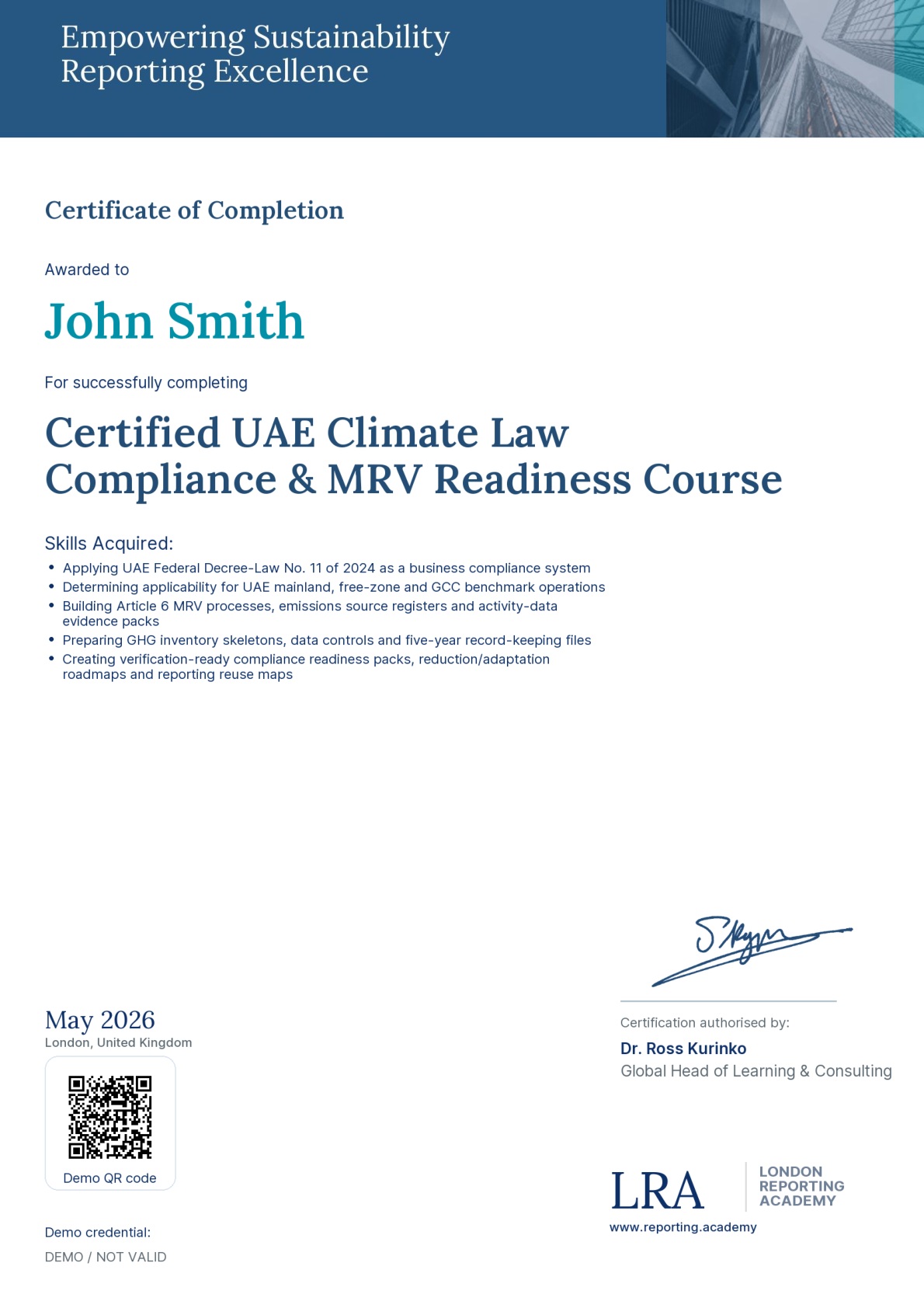
This page settles one requirement. The UAE Climate Law course builds the whole MRV system — measurement, reduction plans, verification and adaptation reporting — on a realistic UAE case or your own organisation.
Available as Guided Flex, Live Cohort, 1:1 Expert Mentorship or Corporate Programme.