Short answer
The answer, before the reasoning
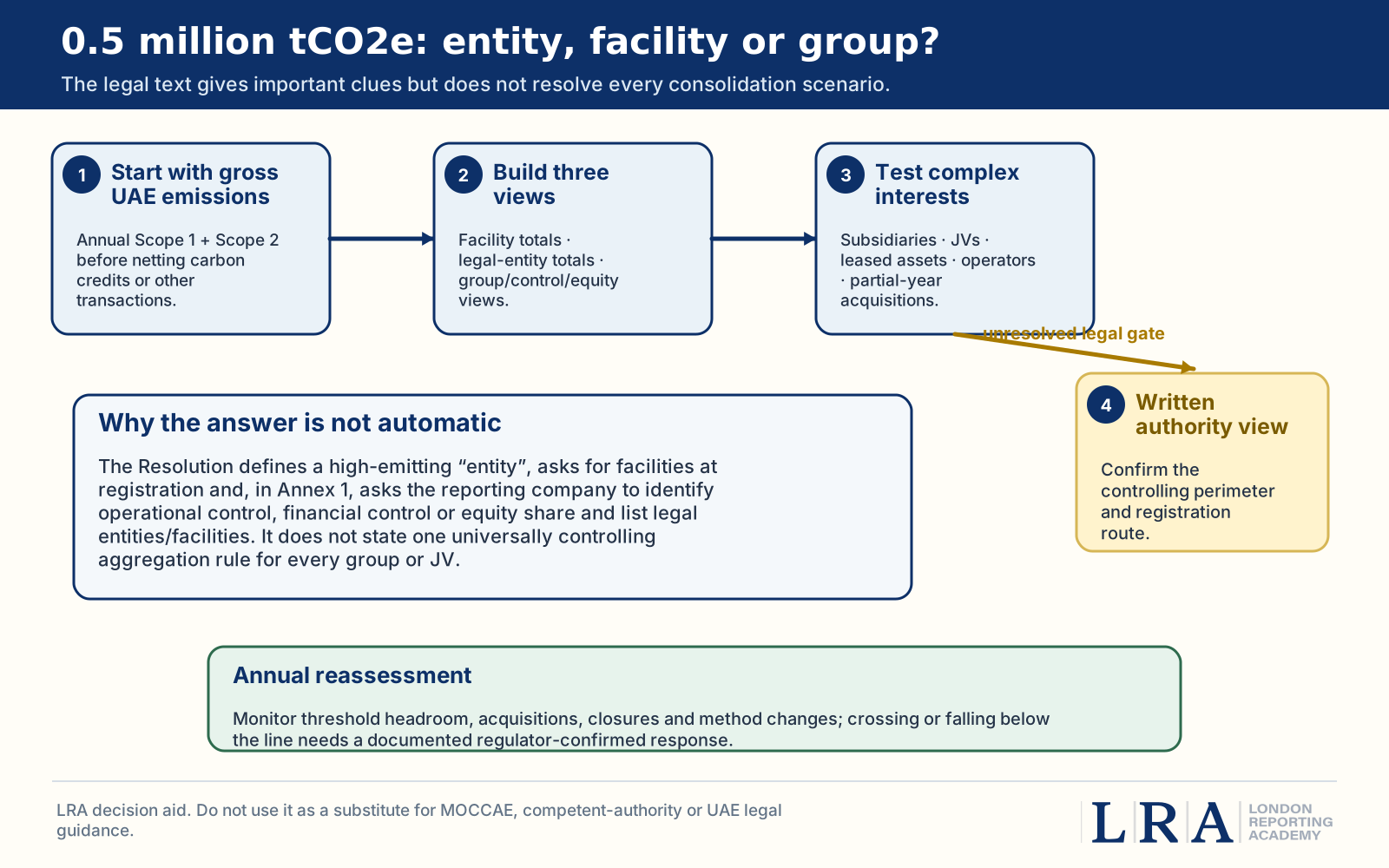
The Resolution does not provide a single unambiguous answer for every corporate structure. It defines an “entity of huge carbon emissions” as an entity with annual emissions in the State at or above 0.5 million tCO2e, and Article 3 applies the test to Scope 1 and Scope 2.
Registration data must include facilities. Annex 1 also asks the reporting company to identify its consolidation approach - operational control, financial control or equity share - and list legal entities or facilities over which it has those interests. These provisions indicate that entity, facility and consolidation facts all matter, but they do not state one universally controlling aggregation rule for groups, JVs or mixed-control structures. Prepare facility, legal-entity and plausible consolidated views, document eliminations and seek written MOCCAE, competent-authority or UAE legal guidance before relying on a threshold conclusion.
Technical status
Publication status
This document is an educational and implementation-oriented draft. It is not UAE legal advice, a Ministry decision, a registry approval, an assurance conclusion or a project validation. Confirm the Arabic legal text, current implementing instruments, regulator correspondence and the facts of the relevant entity or project before publication or implementation.
Quick orientation
Quick orientation
- Applies to
- Organisations with several facilities, legal entities, joint ventures, leased operations or acquisitions whose Scope 1+2 totals may cross 0.5 million tCO2e under one possible perimeter but not another.
- Primary decision
- Which emissions perimeter should be tested against the threshold, what alternative views should be prepared and which questions require written authority or UAE legal confirmation.
- Key sources
- Cabinet Resolution No. 67 of 2024, Articles 1, 3 and 6; Annex 1 organisational limitations and facility/entity fields.
- Common confusion
- Assuming the threshold is obviously per facility, automatically equal to financial consolidation, or a group test using one preferred GHG Protocol boundary.
Technical status
UAE legal and implementation status gate
Federal Decree-Law No. 11 of 2024 entered into force on 30 May 2025. Cabinet Resolution No. 67 of 2024 entered into force on 28 December 2024. The Arabic text is authoritative. The legal instruments delegate important operational matters - including implementing resolutions, the Registry working regulation, fees, approved verification agencies, methods, portal procedures and some perimeter questions - to the Ministry or other authorities. The official sources reviewed for this package did not provide a complete public operating manual covering every company scenario. Confirm current federal, emirate, free-zone and entity-specific requirements in writing before relying on a filing, threshold, credit or governance conclusion.
The legal text gives three important signals
This is a classic legal-and-accounting perimeter problem. The safest response is not to choose the most convenient boundary. It is to build a transparent set of views, identify where they differ and obtain written guidance on the controlling legal test.
In practice
| Signal | What the text says | What it does - and does not - resolve |
|---|---|---|
| Entity threshold | An entity of huge carbon emissions is an entity with annual emissions in the State equal to or above 0.5 million tCO2e; Article 3 specifies Scope 1 and Scope 2. | The applicant is described as an entity, but “entity” is not elaborated for every group, branch, licence or JV scenario. |
| Facility information | Registration requires basic enterprise data including facilities and reduction procedures at each facility. | Facilities must be visible, but the wording does not state that the threshold is always tested separately per facility. |
| Organisational limitations | Annex 1 asks which consolidation method is used: operational control, financial control or equity share; it also asks for legal entities/facilities and additional reports when more than one approach is used. | Several views are contemplated, but the Resolution does not state which one exclusively controls the legal threshold in every case. |
In practice
Build a multi-perimeter threshold workbook
| View | Population and calculation | Purpose |
|---|---|---|
| Facility view | Gross annual Scope 1+2 for each physical facility or operating site, including sources, meters, leased assets and operators. | Shows concentration and supports facility-level information required at registration. |
| Legal-entity view | Aggregate facilities and activities held or operated by each UAE legal person, branch or licence holder; document intercompany energy and duplicate-source eliminations. | Tests the ordinary meaning of an “entity” and supports applicant analysis. |
| Operational-control view | Include operations where the reporting company has authority to introduce and implement operating policies, based on the approved boundary policy. | Reflects one consolidation approach explicitly contemplated by Annex 1. |
| Financial-control view | Include operations financially controlled under the adopted methodology, with documented differences from accounting consolidation. | Reflects another Annex 1 approach and exposes differences. |
| Equity-share view | Recognise emissions in proportion to economic interest, including relevant JVs and associates. | Provides the third Annex 1 approach and identifies shared-ownership exposure. |
| Group diagnostic view | Consolidate plausible UAE group totals across legal entities, with eliminations and a reconciliation to other views. | Assesses the risk that authorities expect a group or parent-controlled interpretation. |
Rule
Gross emissions first
Do not reduce the threshold calculation by carbon credits, retirements or other environmental-attribute transactions unless the authority expressly requires that treatment. Annex 1 presents emissions independently from purchases, sales, transfers and offsets.
Multiple facilities and legal entities
A single legal entity may operate several facilities. In that case, a legal-entity view would normally aggregate those facilities, while the facility schedule preserves the site detail. A group may also have several legal entities, each below the line, whose combined emissions exceed it. The Resolution does not expressly say that the parent must aggregate all subsidiaries solely because they are financially consolidated, nor that each licence is always isolated. Both scenarios should be visible in the workbook and in the legal questions sent to the authority.
Where a free-zone company, mainland company and local subsidiary share operations or utilities, document the contractual operator, legal owner, meter holder, operational control, financial control, equity share and any intercompany transfer. The purpose is to avoid both double counting and boundary shopping.
In practice
Joint ventures, associates and shared operations
| Structure | Threshold questions | Evidence to retain |
|---|---|---|
| Joint operation under operational control | Does the operator report 100%, its equity share or another amount? Is the JV itself the “entity”? | JV agreement, operator rights, permits, source ownership, boundary policy and authority response. |
| Equity-accounted JV without operational control | Is equity share expected because Annex 1 contemplates it, or does the JV register separately? | Ownership records, governance rights, emissions data access, JV reporting and legal advice. |
| Associate / minority interest | Does financial or operational control exist despite minority ownership? Is a proportional view relevant? | Shareholding, veto/control rights, management agreements and consolidation analysis. |
| Leased facility or equipment | Who operates the source and who holds the relevant permit, meter, fuel contract and reporting obligation? | Lease, service agreement, operational-control assessment, invoices and permit conditions. |
| Contract-operated facility | Does the owner, contractor or both have control over emissions-generating activity? | O&M contract, decision rights, data responsibility, source register and double-counting control. |
Annual reassessment and threshold headroom
The legal definition is annual. The organisation should therefore perform a formal year-end assessment and maintain a forecast where emissions are close to the line. A rolling forecast is not itself the statutory test, but it gives time to resolve perimeter, verification and registration questions before the year closes.
In practice
| Trigger | Assessment action | Control response |
|---|---|---|
| Forecast reaches an internal warning band | Update facility and entity data, test all plausible boundaries and review estimates. | Escalate to CFO and Legal; begin authority engagement and registration readiness. |
| Acquisition or start-up | Determine control date, partial-year treatment, source population and whether annualisation is relevant under current guidance. | Create a legal question; do not invent an annualisation rule. |
| Closure or disposal | Confirm cut-off, continuing ownership/control and whether historical or current-year totals remain relevant. | Retain transaction and meter evidence; reassess future participation. |
| Crossing the threshold | Confirm the controlling perimeter, registration timing, MRV and verification obligations. | Seek written authority guidance; do not assume the original six-month regularisation period automatically applies to a new entrant. |
| Falling below the threshold | Assess whether the entity becomes a voluntary participating entity, can exit or has continuing Registry obligations. | Do not deregister or change credit treatment without written confirmation. |
| Method or factor change | Quantify the effect on threshold and prior conclusions; consider baseline/recalculation policy. | Approve the change, document version and notify/consult where material. |
Questions for UAE legal and authority review
1. What legal person, branch, licence holder or undertaking is the relevant “entity” for Article 1 and Article 3?
2. Is the 0.5 million tCO2e threshold tested per legal entity, per facility, per Registry applicant, per corporate group or under a prescribed GHG consolidation method?
3. If a company reports under more than one consolidation approach, which view controls registration and what additional reports are required?
4. How should operational control, financial control and equity share be applied to joint ventures, associates and joint operations?
5. How are leased assets, outsourced operations, contract operators and shared utilities treated?
6. Are foreign operations excluded because the definition refers to emissions annually “in the State”, and how are cross-border group activities presented?
7. How should partial-year acquisitions, disposals, start-ups, closures and mergers be treated?
8. Which Scope 2 method, contractual instruments and emissions factors apply to the legal threshold?
9. Should threshold emissions be restated when the baseline or consolidation method changes?
10. What is the registration deadline for an entity that first crosses the threshold after the Resolution’s original regularisation period?
11. What is the process when an entity falls below the threshold, and do reporting or credit obligations continue?
12. Which authority - MOCCAE, the emirate competent authority, a free-zone authority or another sector authority - should provide the controlling response?
Hypothetical worked example
The example deliberately stops before the legal conclusion. The figures are illustrative; the correct result depends on the authoritative Arabic text, current operating rules, corporate facts and written authority guidance.
Hypothetical scenario
Illustrative scenario - group with mixed perimeters
A UAE parent has three wholly owned legal entities emitting 220,000, 190,000 and 130,000 tCO2e of Scope 1+2. It also has a 40% JV emitting 200,000 tCO2e, operated by the JV partner. Each wholly owned legal entity is below 0.5 million. The group operational-control view totals 540,000 tCO2e; the equity-share view adds 80,000 tCO2e from the JV; the legal-entity views remain below the line. The group does not select a preferred answer. It prepares all views, reconciles the facilities and sends a documented question to MOCCAE and the relevant competent authority asking which entity and consolidation method control registration. Meanwhile it prepares MRV and verification readiness in case registration is required.
Illustrative only. It shows how the decision is made, not wording that can be copied or relied on.
In practice
Threshold assessment evidence pack
| Evidence area | Minimum record |
|---|---|
| Corporate structure | Legal entities, licences, branches, ownership, control rights, JV agreements and organisation chart. |
| Facility population | Facility register, source register, permits, operators, leases, utility arrangements and meter ownership. |
| Boundary policy | Definitions, selected approaches, reasons, treatment of JVs/leases and change control. |
| Emissions calculation | Gross Scope 1+2 workbook, factors, GWP, units, estimates, reconciliations and QA. |
| Multi-view reconciliation | Facility-to-entity-to-control/equity/group bridge and duplicate/elimination logic. |
| Annual assessment | Forecast, year-end conclusion, threshold headroom, triggers and approval. |
| Legal and authority record | Questions, facts provided, advice, written confirmation, limitations and date. |
| Registration response | Readiness plan, submitted documents, account/portal evidence and ongoing obligations. |
In practice
Common mistakes
| Mistake | Why it creates risk | Correction |
|---|---|---|
| Convenient boundary selection | The company chooses the method that keeps it below the threshold without a legal basis. | Prepare all plausible views and obtain an approved controlling conclusion. |
| Facility-only assumption | Facility information is required, but the threshold is defined by reference to an entity. | Retain facility detail and test legal-entity and consolidation views. |
| Automatic accounting consolidation | Financial statements and GHG organisational boundaries can answer different questions. | Document the legal entity and the Annex 1 approaches separately. |
| Including Scope 3 or netting offsets | The legal test is Scope 1+2 and emissions should be assessed before credit transactions. | Maintain separate Scope 3 and offset schedules. |
| Ignoring JVs until verification | Shared operations can change the threshold conclusion and data access needs. | Resolve JV treatment during scope design and contract review. |
| No annual trigger | A prior-year conclusion is carried forward despite growth, acquisitions or method change. | Perform annual and event-driven reassessment. |
Myth
The Annex lists operational control, financial control and equity share, so the company may freely choose whichever method produces the lowest result.
Reality
Annex 1 recognises several reporting approaches and asks for additional information where more than one is used. It does not create a right to boundary-shop for the legal threshold. The controlling perimeter should be supported by the current rules, the facts and written authority or legal guidance.
Self-check
- Which perimeter produces the highest annual result, and why might the authority consider it relevant?
- Can every tonne in the group diagnostic view be traced to one facility and one controlled source record?
- What exact written source supports the final registration conclusion?
Sources
Primary sources
Take it with you
The checklists as a working spreadsheet
Every checklist and table on this page, with empty status, owner and evidence columns for your team to fill in and keep.
✓ Knowledge Hub AI Assistant · Human-in-the-loop

Ask about this guide
It answers from this page, and reaches into the linked disclosure cards when your question is about the standard itself.
Go deeper · UAE FDL 11 / 2024
UAE Climate Law Compliance & MRV Readiness
This page settles one requirement. The UAE Climate Law course builds the whole MRV system — measurement, reduction plans, verification and adaptation reporting — on a realistic UAE case or your own organisation.
Available as Guided Flex, Live Cohort, 1:1 Expert Mentorship or Corporate Programme.