Short answer
The answer, before the reasoning
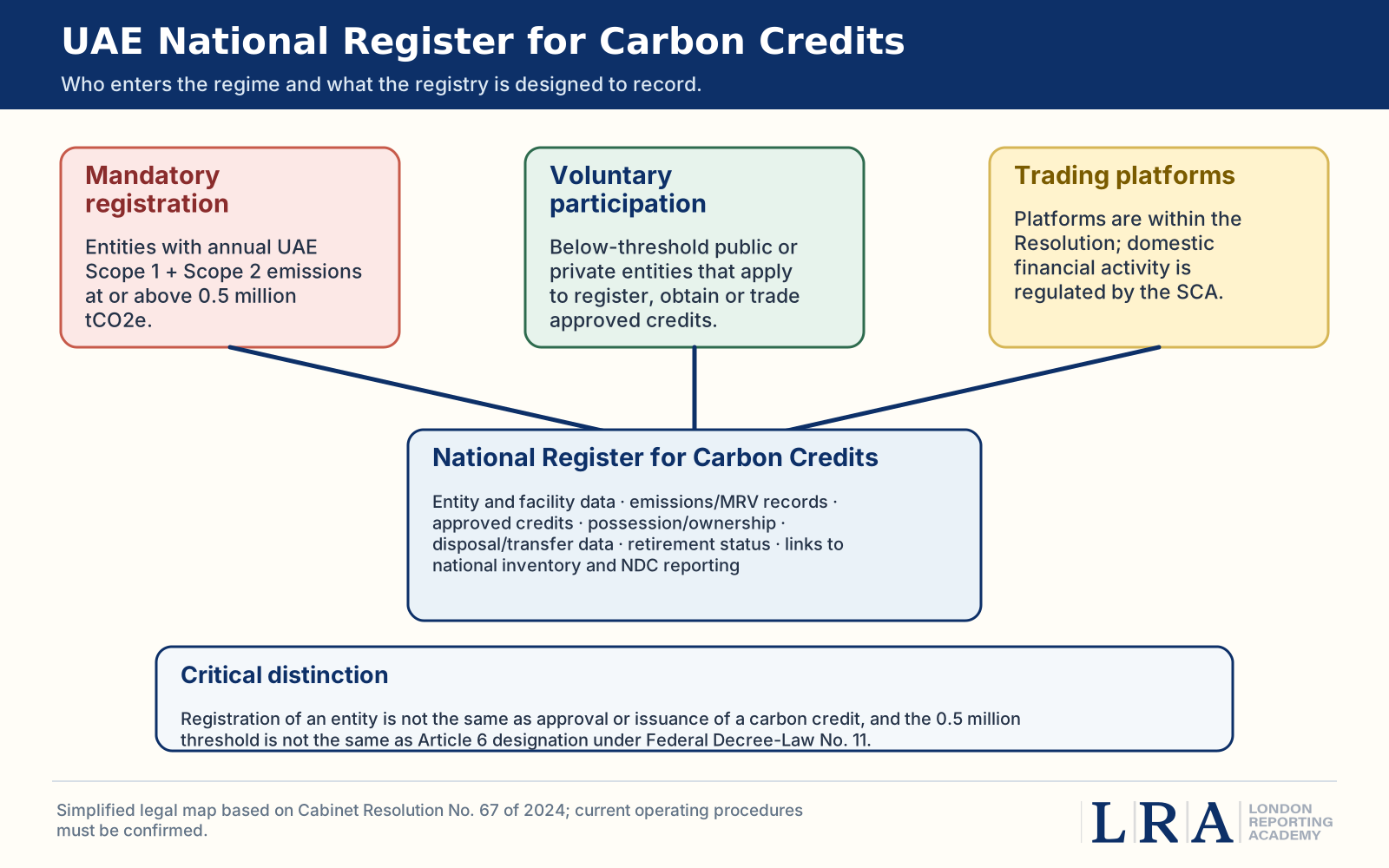
Cabinet Resolution No. 67 of 2024 applies across the UAE, including financial and non-financial free zones, to three categories: entities with annual UAE Scope 1 and Scope 2 emissions at or above 0.5 million tCO2e; below-threshold public or private entities that voluntarily apply to register and obtain or trade approved credits; and carbon-credit trading platforms. High-emitting entities must register.
Voluntary participation is available below the threshold, but registration does not itself create a credit. The Registry is designed to approve credits and record emissions-related information, credit issuance or recognition, possession or ownership, disposal or transfer information and retirement status. It can also support national inventory and NDC reporting. This threshold-based regime is separate from the designation-based Article 6 duties in Federal Decree-Law No. 11 of 2024.
Technical status
Publication status
This document is an educational and implementation-oriented draft. It is not UAE legal advice, a Ministry decision, a registry approval, an assurance conclusion or a project validation. Confirm the Arabic legal text, current implementing instruments, regulator correspondence and the facts of the relevant entity or project before publication or implementation.
Quick orientation
Quick orientation
- Applies to
- Public or private entities assessing mandatory or voluntary participation in the National Register for Carbon Credits, including entities in financial and non-financial free zones.
- Primary decision
- Whether an entity is within mandatory registration, may participate voluntarily or is acting as a trading platform, and which records and approvals are separate.
- Key sources
- Cabinet Resolution No. 67 of 2024, especially Articles 1, 3, 5-11 and 14-17; Federal Decree-Law No. 11 of 2024, Articles 6 and 10.
- Common confusion
- Assuming all UAE businesses must register, treating entity registration as automatic credit issuance, or using the Registry threshold as the Article 6 designation test under the Federal Decree-Law.
Technical status
UAE legal and implementation status gate
Federal Decree-Law No. 11 of 2024 entered into force on 30 May 2025. Cabinet Resolution No. 67 of 2024 entered into force on 28 December 2024. The Arabic text is authoritative. The legal instruments delegate important operational matters - including implementing resolutions, the Registry working regulation, fees, approved verification agencies, methods, portal procedures and some perimeter questions - to the Ministry or other authorities. The official sources reviewed for this package did not provide a complete public operating manual covering every company scenario. Confirm current federal, emirate, free-zone and entity-specific requirements in writing before relying on a filing, threshold, credit or governance conclusion.
Three categories are within the Resolution
The Resolution applies in the State, including financial and non-financial free zones. The threshold is expressed annually and by reference to Scope 1 and Scope 2. It is not expressed as a Scope 3 test and should not be reduced by purchased carbon credits or offset transactions. Annex 1 separates reported emissions from transactions involving greenhouse-gas allowances or offsets.
In practice
| Category | Legal position | Core consequence |
|---|---|---|
| Entities of huge carbon emissions | Public or private entities with annual emissions in the State equal to or above 0.5 million metric tonnes CO2e. Article 3 refers to Scope 1 and Scope 2. | Mandatory registration and the MRV, annual reporting and verification requirements in the Resolution. |
| Participating entities | Below-threshold public or private entities that voluntarily apply to register and obtain or trade carbon credits. | Voluntary entry, but once participating they must meet the registration and credit-approval requirements applied by Article 6. |
| Carbon-credit trading platforms | Platforms facilitating trading are expressly within scope. | Domestic platform financial activity is subject to SCA regulation and supervision. |
Entity registration and credit approval are separate gates
A high-emitting entity’s registration establishes the entity within the Registry regime. Article 6 requires a valid commercial or industrial licence, basic enterprise data including facilities and reduction procedures at each facility, and any other documents requested by the Ministry. That does not mean the entity has received carbon credits.
Approval of a carbon credit is a further decision. The Resolution requires Article 6-consistent reduction features, information on activities and reduction or removal procedures, updated emissions data in the national MRV system, an approved reduction certificate, payment of applicable fees and I-REC-related statements intended to avoid double enumeration. Verified credits are then approved and recognised for relevant reduction or removal projects. Operational details remain dependent on the Registry working regulation and executive rules.
In practice
| Gate | What it establishes | Evidence examples |
|---|---|---|
| Applicability / threshold | Whether registration is mandatory, potentially voluntary or outside the specified categories. | Scope 1+2 calculation, boundary policy, facility/entity map, legal analysis and authority correspondence. |
| Entity registration | The legal person or participating entity is registered and linked to its facilities and basic data. | Licence, enterprise details, facilities, reduction procedures, account documents and approvals. |
| MRV and annual reporting | The entity maintains the emissions information required by the Resolution. | Inventory, annual report, source records, method, verification statement and submission receipt. |
| Project / credit approval | A specific verified reduction or removal is accepted as a carbon credit under applicable rules. | Project statement, methodology, monitoring, verification certificate, fees and double-counting evidence. |
| Transaction / retirement | Ownership or use of the approved credit changes and the Registry is updated. | Disposal statement, quantity, counterparty, price where required, platform record and retirement evidence. |
In practice
What the Registry is designed to record
| Record family | Legal signals in the instruments | Practical register fields |
|---|---|---|
| Entity and facility information | The Registry applies to high emitters and participating entities; registration includes enterprise data and facilities. | Legal name, licence, identifiers, facility list, authority, contacts, status and reduction procedures. |
| Emissions and MRV information | The law’s definition refers to emissions; Resolution 67 requires MRV, annual reports and updated data in the national MRV system. | Reporting period, Scope 1/2 totals, boundary, method, baseline, verifier, status, submission and data-quality notes. |
| Credit approval and project link | The Ministry establishes the Registry to approve credits; Article 6 lists approval evidence. | Credit/project ID, methodology, vintage, quantity, certificate, verifier, approval date, validity and conditions. |
| Possession / ownership | The Resolution defines the Registry as recording issuance and possession; SCA rules cover ownership transfer on platforms. | Account holder, current owner, serial/identifier, quantity and status. |
| Disposal / transfer | Article 11 requires a disposal statement with quantity, buyer or approved entity and selling price to update data. | Transfer date, from/to accounts, quantity, price where applicable, platform and approval evidence. |
| Retirement / expiry | The Registry documents retirement; expired or retired credits cannot be used for reduction objectives. | Retirement date, beneficiary/use, quantity, reason, claim reference, cancellation/expiry status. |
| National and international reporting links | The Registry may support the national inventory, NDC reporting, compliance carbon markets and Article 6 processes. | Corresponding-adjustment or authorisation status where relevant, NDC treatment and reporting references. |
Caution
Do not infer a live portal field from a legal concept
The legal instruments describe functions and required information, but the official sources reviewed for this package did not provide a complete current public operating manual for every account, workflow or screen. Use the working regulation and current authority instructions when available.
How the Registry relates to Federal Decree-Law No. 11
Federal Decree-Law No. 11 provides the broader climate-law framework. Article 10 states that the Ministry shall establish and manage the National Carbon Credit Registry. Article 6, however, imposes MRV and reduction duties on “sources determined by the Ministry and the competent authority, in coordination with the entity concerned”. That is a designation-based mechanism.
Resolution 67 uses a different threshold-based scope for the National Register. A company should therefore maintain two separate decision records: one for Article 6 designation or authority requirements under the Decree-Law, and another for Resolution 67 threshold or voluntary participation. The same inventory can support both, but the legal triggers are not interchangeable.
In practice
| Question | Federal Decree-Law No. 11 | Cabinet Resolution No. 67 |
|---|---|---|
| Who is potentially covered? | “Sources” in the State, including free zones; specific Article 6 duties attach to sources determined by authorities. | High emitters at/above the threshold, voluntary participating entities and trading platforms. |
| Primary mechanism | National mitigation, MRV, adaptation, data, incentives and enforcement framework. | Threshold-based Registry, MRV and carbon-credit approval/trading framework. |
| Registry link | Article 10 requires the Ministry to establish and manage it. | Provides detailed scope, registration, approval, trading, disposal and penalties. |
| Corporate control | Track designation, implementing resolutions and authority instructions. | Track threshold, voluntary participation, operating rules and transactions. |
Registration workflow
1. Determine the relevant UAE legal entity or entities, facilities and annual Scope 1+2 perimeter; document unresolved group or JV questions.
2. Classify the organisation as potentially mandatory, potentially voluntary or a trading-platform participant; obtain legal/authority confirmation where material.
3. Prepare licence and enterprise data, facility information, reduction procedures and other requested documents.
4. Establish the MRV system, annual report, baseline, methods, controls and approved verification route required by the Resolution.
5. Complete the current Registry registration procedure under the Ministry’s working rules and retain account, approval and submission evidence.
6. For a credit project, complete the separate project, methodology, monitoring, verification, fee and double-counting approval requirements.
7. Control subsequent ownership, transfer, disposal, retirement, expiry and public claims against the Registry record.
8. Reassess annually and after acquisitions, closures, method changes or revised thresholds; confirm exit or re-entry treatment in writing.
Hypothetical scenario
Illustrative scenario
Entity A operates a large UAE industrial facility and reports 620,000 tCO2e of annual Scope 1+2 emissions under the perimeter confirmed for the Registry. Registration is mandatory. Entity B, a smaller district-cooling operator at 85,000 tCO2e, develops a verified efficiency project and wants to sell approved credits; it considers voluntary participation. A separate exchange operator falls within the trading-platform category and requires the relevant SCA and Ministry rules. Entity A’s registration does not create credits, and Entity B cannot sell a reduction merely because its inventory improved: the project and credit still need the required methodology, evidence, verification and Registry approval.
Illustrative only. It shows how the decision is made, not wording that can be copied or relied on.
In practice
Common mistakes
| Mistake | Why it creates risk | Correction |
|---|---|---|
| Treating all companies as mandatory registrants | The Resolution distinguishes high emitters, voluntary participants and platforms. | Perform and document the scope test; do not generalise one entity’s status to the whole market. |
| Including Scope 3 in the legal threshold | Article 3 identifies Scope 1 and Scope 2 for the 0.5 million test. | Keep Scope 3 screening separate unless current authority guidance changes the test. |
| Netting credits against emissions | The threshold concerns emissions; Annex 1 separates emissions from transactions and offsets. | Calculate gross Scope 1+2 before credit use unless the authority expressly directs otherwise. |
| Equating registration with issuance | Entity registration, MRV, project verification and credit approval are distinct. | Use separate status fields and approvals for each gate. |
| Assuming retired credits remain usable | Retired and expired credits cannot be used for reduction objectives. | Lock retired/expired units and link claims to retirement evidence. |
| Using the threshold as Article 6 designation | The Decree-Law uses a separate authority-determination mechanism. | Maintain separate legal tests and correspondence. |
Myth
Once a company is registered, every tonne it reduces becomes a UAE carbon credit.
Reality
Registration places the entity within the Registry regime. A specific reduction or removal must separately meet the applicable methodology, monitoring, verification, fee, double-counting and Registry-approval requirements before it is an approved credit.
Self-check
- Can the team distinguish the registration status of the entity from the approval status of each credit?
- Which Registry records support the exact wording of the organisation’s public carbon claim?
- What written evidence supports the chosen relationship between Article 6 designation and Resolution 67 scope?
Sources
Primary sources
Take it with you
The checklists as a working spreadsheet
Every checklist and table on this page, with empty status, owner and evidence columns for your team to fill in and keep.
✓ Knowledge Hub AI Assistant · Human-in-the-loop

Ask about this guide
It answers from this page, and reaches into the linked disclosure cards when your question is about the standard itself.
Go deeper · UAE FDL 11 / 2024
UAE Climate Law Compliance & MRV Readiness
This page settles one requirement. The UAE Climate Law course builds the whole MRV system — measurement, reduction plans, verification and adaptation reporting — on a realistic UAE case or your own organisation.
Available as Guided Flex, Live Cohort, 1:1 Expert Mentorship or Corporate Programme.