Short answer
The answer, before the reasoning
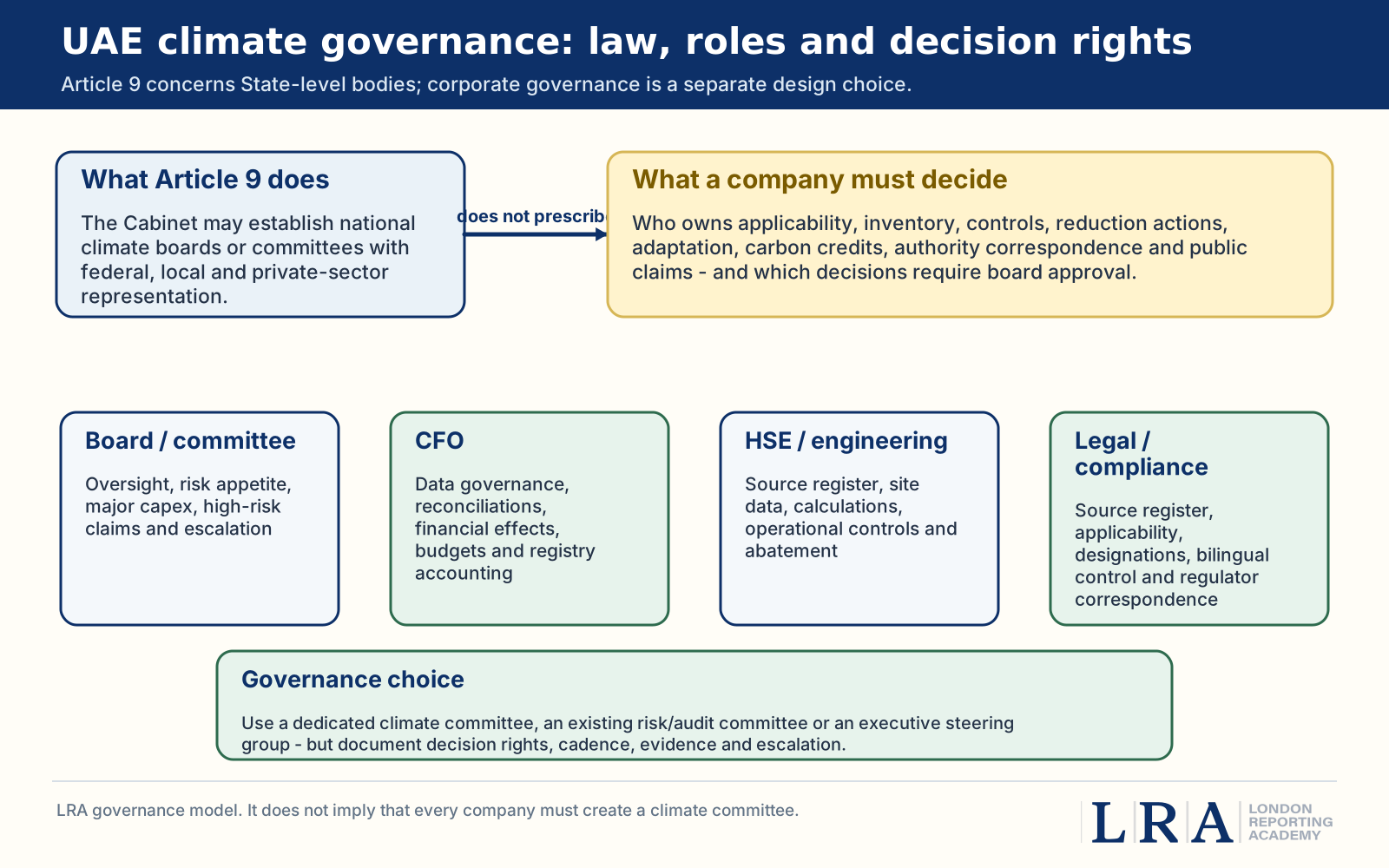
Article 9 does not require every company to create a climate committee. It allows the UAE Cabinet to establish climate-action boards or committees at State level, with federal, local and private-sector representation.
A company must instead build governance that is proportionate to its legal exposure, emissions profile, facilities, jurisdictions, data complexity and climate decisions. The board or highest governance body should oversee material compliance, risk, targets, major expenditure and public claims; the CFO should govern data, controls and financial consequences; HSE and engineering should own source-level evidence and operational action; and Legal should control applicability, bilingual sources, authority correspondence and legal claims. A dedicated climate committee is one possible structure, not a universal statutory requirement.
Technical status
Publication status
This document is an educational and implementation-oriented draft. It is not UAE legal advice, a Ministry decision, a registry approval, an assurance conclusion or a project validation. Confirm the Arabic legal text, current implementing instruments, regulator correspondence and the facts of the relevant entity or project before publication or implementation.
Quick orientation
Quick orientation
- Applies to
- UAE organisations designing governance for emissions reporting, climate plans, adaptation, carbon-credit decisions or authority engagement under Federal Decree-Law No. 11 of 2024 and related instruments.
- Primary decision
- How to allocate climate-law ownership and decision rights, and whether a dedicated corporate climate committee is proportionate.
- Key sources
- Federal Decree-Law No. 11 of 2024, particularly Articles 6, 7, 9, 10, 14-19; Cabinet Resolution No. 67 of 2024, particularly Articles 4-6 and 16-17.
- Common confusion
- Reading Article 9 as a requirement for every company to create a climate committee, or assigning all accountability to a sustainability or HSE team.
Technical status
UAE legal and implementation status gate
Federal Decree-Law No. 11 of 2024 entered into force on 30 May 2025. Cabinet Resolution No. 67 of 2024 entered into force on 28 December 2024. The Arabic text is authoritative. The legal instruments delegate important operational matters - including implementing resolutions, the Registry working regulation, fees, approved verification agencies, methods, portal procedures and some perimeter questions - to the Ministry or other authorities. The official sources reviewed for this package did not provide a complete public operating manual covering every company scenario. Confirm current federal, emirate, free-zone and entity-specific requirements in writing before relying on a filing, threshold, credit or governance conclusion.
Why Article 9 is often misread
The phrase “climate action boards or committees” sounds like a corporate-governance instruction when read out of context. It is not. Article 9 says that the Cabinet may establish boards or committees composed of representatives of federal and local government entities and the private sector. Their role is to follow up and evaluate climate-change policies at State level and propose measures under the resolution establishing them. The provision is enabling and national in character.
The corporate question is different: how should an organisation organise itself so that applicable notices, emissions data, reduction measures, adaptation work, carbon-credit decisions and public statements are prepared, challenged and approved? The Decree-Law does not prescribe one company organogram. Governance therefore needs a fact-based design rather than an invented “mandatory climate committee” rule.
What the law requires - and what it does not prescribe
In practice
| Legal point | Source-grounded conclusion | Corporate implication |
|---|---|---|
| Article 9 | The Cabinet may establish State-level boards or committees. | Monitor whether an establishment resolution creates a relevant interface or request; do not treat Article 9 alone as a corporate committee mandate. |
| Article 6 | Sources determined by the Ministry and competent authority may have measurement, reporting, data-submission, reduction and record-retention duties. | Assign owners for applicability, inventory, reporting, reduction actions, records and authority access. |
| Articles 7-8 | Authorities develop adaptation plans and require climate data and studies. | Allocate physical-risk, asset, business-continuity and data-response responsibilities. |
| Article 10 | The Ministry and competent authorities may use incentives, carbon-offsetting mechanisms and climate-performance indicators; the Ministry establishes and manages the Registry. | Create decision rights for carbon-credit use, project claims, capital allocation and registry activity. |
| Governance form | No universal company climate committee, RACI, signatory matrix or meeting frequency is prescribed in the cited federal text. | Use a proportionate model and document why it is fit for the organisation. |
A proportionate corporate governance model
A useful model has three levels. First, the board or a delegated board committee oversees material climate-law exposure, major risk and claims. Second, an executive sponsor - often the CFO, chief risk officer, chief operating officer or general counsel - is accountable for the integrated programme. Third, technical and functional owners prepare the inventory, controls, plans, submissions and evidence. The titles can vary; the decision rights should not.
In practice
| Role | Core responsibilities | Decisions that should not be taken alone |
|---|---|---|
| Board / highest governance body | Approve governance design, risk appetite, material targets and plans, significant capital allocation, major carbon-credit strategy, serious breaches and high-risk public claims. | Technical methodology, facility estimates or legal interpretation without specialist advice. |
| Existing board risk/audit/sustainability committee | Provide deeper challenge, monitor controls and assurance, review significant judgements and recommend approval to the board. | Assume executive responsibility for collecting data or operating controls. |
| CFO / finance | Own reporting calendar, data governance, reconciliations, financial effects, budgets, capex, provisions, credit accounting and management representation. | Define operational sources or legal applicability without HSE/engineering and Legal. |
| HSE / engineering / operations | Maintain source and facility registers, activity data, metering and maintenance evidence, operational calculations, reduction actions, adaptation measures and site explanations. | Approve legal claims, group perimeter or public offset claims alone. |
| Legal / compliance | Maintain the legal source register, test scope and designation, control Arabic/English sources, manage regulator correspondence, legal privilege, contracts, claims and escalation. | Validate emissions calculations or operational effectiveness without technical owners. |
| Sustainability / climate programme lead | Coordinate workstreams, translate requirements into tasks, maintain the disclosure and action matrix, prepare status reporting and connect owners. | Become the sole owner of source data, compliance or board decisions. |
| Internal audit / independent review | Test governance, controls, evidence and remediation independently of preparation. | Prepare the same control evidence it later evaluates. |
In practice
RACI for the main UAE climate-law decisions
| Decision / activity | Board or committee | CFO — HSE / operations — Legal / compliance — Climate lead |
|---|---|---|
| Applicable authorities, legal sources and designation status | I / C | C — C — A/R — R |
| Inventory boundary, methodology and material estimates | I; approve high-risk judgement | A — R — C — R |
| Annual inventory close, reconciliations and evidence pack | I | A — R — C — R |
| Reduction plan, targets, capex and delivery tracking | A for material plan | C / finance gate — R — C — R |
| Adaptation and business-continuity actions | A for material plan | C — R — C — R |
| 0.5 million tCO2e threshold and registry response | I / A if material | R — R — A for legal conclusion — R |
| Carbon-credit project, purchase, transfer, retirement and claim | A for material strategy / claim | R — R — A for legal/contract gate — R |
| Filing, authority response and public statement | Approve or clearly delegate | A for data — R for technical content — A for legal wording — R |
| Breach, material error or regulator notice | A for response oversight | R — R — A/R — R |
Rule
RACI limitation
This is an LRA implementation model, not a prescribed statutory RACI. Replace role titles and approval levels with the organisation’s actual delegation of authority, regulated-sector rules and legal advice.
Does the company need a dedicated climate committee?
A dedicated committee is useful when climate work crosses several legal entities, emirates, free zones or operating divisions; the organisation is near or above the Registry threshold; the inventory contains material estimates; reduction or adaptation decisions require significant capital; carbon credits create financial, legal and reputational exposure; or existing committees do not have enough time or technical depth. It can also provide a stable forum for resolving boundary, methodology and authority questions.
A new committee may be unnecessary where an existing board risk or audit committee already has an appropriate mandate and an executive steering group can coordinate delivery. A smaller organisation may use a named executive owner and a documented monthly review. The test is not whether a committee exists; it is whether decisions are made by the right people, on time, with evidence and escalation.
In practice
| Governance option | Works well when | Minimum control |
|---|---|---|
| Dedicated board climate/sustainability committee | Climate exposure, capital decisions and public claims are strategically significant and require frequent board-level attention. | Board-approved charter, reserved matters, competency plan, minutes and link to audit/risk oversight. |
| Existing audit/risk committee | The main challenge is compliance, internal control, assurance, estimates and reporting reliability. | Explicit climate remit, technical briefings and time allocated for climate matters. |
| Management climate steering committee | Cross-functional delivery is complex but board oversight can remain within an existing committee. | Executive sponsor, decision log, escalation thresholds and regular board reporting. |
| Named executive owner without committee | The organisation is smaller or less complex and decisions are limited. | Documented responsibilities, calendar, deputy, review evidence and event-driven escalation. |
In practice
Reporting cadence and decision calendar
| Cadence | Purpose | Evidence retained |
|---|---|---|
| Weekly during mobilisation or filing close | Resolve source gaps, boundary questions, late evidence and regulator requests. | Action tracker, issue log, decision notes and updated critical path. |
| Monthly operational review | Review inventory completeness, estimates, data quality, reduction actions and adaptation incidents. | Dashboard, exceptions, reconciliations, remediation and owner confirmations. |
| Quarterly steering review | Challenge legal status, threshold headroom, plan delivery, capex, credit activity and external claims. | Steering minutes, judgement log, legal updates and approved actions. |
| Semi-annual or scheduled board review | Approve strategy, material targets, major expenditure, significant judgements and governance changes. | Board paper, minutes, approval record and matters reserved. |
| Event-driven escalation | Respond to a regulator notice, threshold crossing, acquisition, serious data error, verifier finding, incident or public-claim risk. | Escalation record, impact assessment, legal advice and correction plan. |
Hypothetical worked example
The example is not a model organogram. Its teaching point is that an existing committee can be used where its mandate, competence, decision rights and evidence are strengthened. The group does not cite Article 9 as the reason for its structure.
Hypothetical scenario
Illustrative scenario - diversified industrial group
A UAE group operates a quarry, a cement plant, a logistics company and a free-zone trading entity. The board already has an Audit and Risk Committee. Rather than create a second board committee, the group expands that committee’s terms of reference and forms a monthly management climate steering group chaired by the CFO. HSE owns facility inventories and abatement actions; Legal owns the source register, free-zone correspondence and perimeter questions; Finance owns reconciliations and capex; the climate lead maintains the consolidated action and evidence matrix. The board approves the boundary policy, a material kiln-efficiency programme and any external carbon-neutrality claim. A threshold uncertainty is escalated for written authority guidance.
Illustrative only. It shows how the decision is made, not wording that can be copied or relied on.
In practice
Evidence that governance is operating
| Evidence category | Examples | Review question |
|---|---|---|
| Mandate and authority | Board resolution, committee charter, delegation of authority, RACI and reserved-matters schedule. | Can each material decision be traced to an authorised approver? |
| Competence | Training records, specialist appointments, technical briefings and conflict-of-interest declarations. | Did decision-makers understand the legal and technical question? |
| Decision process | Agendas, papers, minutes, decision log, dissent/challenge and action owners. | Is there evidence of challenge rather than passive receipt? |
| Data and control oversight | Control dashboard, reconciliations, estimates, issue log, assurance findings and management representation. | Did governance see significant gaps before release? |
| Regulator interface | Designation notices, questions, submissions, portal receipts, meeting notes and written confirmations. | Are verbal interpretations confirmed and retained? |
| Claims and publication | Legal review, technical substantiation, approval record and archived final files. | Could a reader mistake a limited claim for broader compliance? |
In practice
Common mistakes
| Mistake | Why it creates risk | Correction |
|---|---|---|
| Turning Article 9 into a company mandate | It creates a false legal claim and distracts from actual governance design. | Describe Article 9 accurately and document the organisation’s proportionate governance choice separately. |
| Making sustainability the sole accountable owner | The team may coordinate but cannot control legal interpretation, source systems, operations, finance and board approval alone. | Assign accountable functional owners and preserve preparation-review separation. |
| Showing the board only the final report | Material assumptions, missing data and claims are too late to challenge. | Use staged decision gates for scope, method, estimates, plans, assurance and release. |
| Committee without decision rights | Meetings produce discussion but no approved judgements or remediation. | Define reserved matters, quorum, escalation thresholds, records and action closure. |
| No event-driven escalation | Acquisitions, threshold changes, incidents or verifier findings can bypass the routine calendar. | Create specific triggers and named recipients. |
Myth
Federal Decree-Law No. 11 requires every company to create a climate committee.
Reality
Article 9 permits the Cabinet to establish State-level climate-action boards or committees. A company should choose and document a proportionate governance structure; a dedicated committee is optional unless another applicable instrument or authority requires it.
Self-check
- Which three climate-law decisions are reserved to the board, and where is that authority documented?
- Who can stop a filing or public claim when evidence is incomplete?
- Would a regulator or assurer be able to reconstruct the decision process from retained records?
Sources
Primary sources
Take it with you
The checklists as a working spreadsheet
Every checklist and table on this page, with empty status, owner and evidence columns for your team to fill in and keep.
✓ Knowledge Hub AI Assistant · Human-in-the-loop

Ask about this guide
It answers from this page, and reaches into the linked disclosure cards when your question is about the standard itself.
Go deeper · UAE FDL 11 / 2024
UAE Climate Law Compliance & MRV Readiness
This page settles one requirement. The UAE Climate Law course builds the whole MRV system — measurement, reduction plans, verification and adaptation reporting — on a realistic UAE case or your own organisation.
Available as Guided Flex, Live Cohort, 1:1 Expert Mentorship or Corporate Programme.