Short answer
The answer, before the reasoning
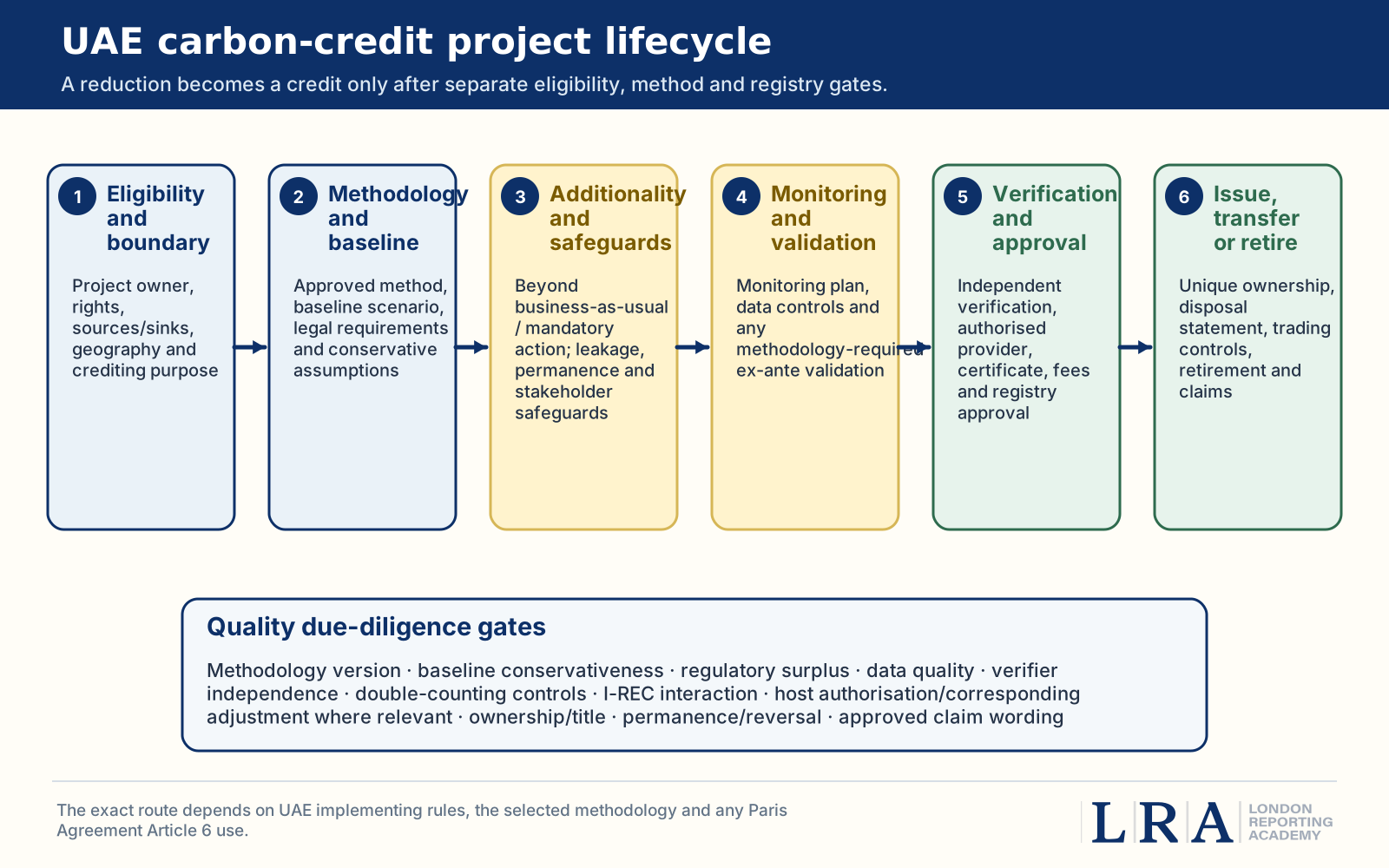
A UAE carbon-credit project should pass a series of separate gates: establish legal eligibility and title; define the project boundary; select the current approved methodology; set a defensible baseline; demonstrate the required additionality or regulatory-surplus tests; operate a controlled monitoring plan; complete any methodology-required validation; obtain independent verification from an authorised or accredited provider; secure Registry approval and any issuance record; and control transfer, ownership, retirement and public claims. Cabinet Resolution No. 67 sets important approval and verification conditions, but it does not itself provide one complete methodology for every project.
The Registry working rules, approved methods, fees, verifier list, Paris Agreement authorisation and corresponding-adjustment treatment must therefore be confirmed for the specific route.
Technical status
Publication status
This document is an educational and implementation-oriented draft. It is not UAE legal advice, a Ministry decision, a registry approval, an assurance conclusion or a project validation. Confirm the Arabic legal text, current implementing instruments, regulator correspondence and the facts of the relevant entity or project before publication or implementation.
Quick orientation
Quick orientation
- Applies to
- UAE organisations developing, purchasing, financing, approving, transferring or retiring carbon credits under the National Register or a Paris Agreement Article 6 route.
- Primary decision
- How to separate project eligibility, methodology, baseline, additionality, monitoring, validation, verification, Registry approval, transfer, retirement and claims - and what evidence is needed at each gate.
- Key sources
- Cabinet Resolution No. 67 of 2024, Federal Decree-Law No. 11 of 2024, the UAE BTR and NDC 3.0, and current UNFCCC Article 6.4 methodology, validation/verification and registry materials.
- Common confusion
- Treating a registered entity, a verified reduction and an issued or usable credit as the same thing; assuming the 2019 inventory baseline is automatically the project baseline; or making an “additional” or “Paris-aligned” claim without methodology, host-authorisation and double-counting evidence.
Technical status
UAE legal and implementation status gate
Federal Decree-Law No. 11 of 2024 entered into force on 30 May 2025. Cabinet Resolution No. 67 of 2024 entered into force on 28 December 2024. The Arabic text is authoritative. The legal instruments delegate important operational matters - including implementing resolutions, the Registry working regulation, fees, approved verification agencies, methods, portal procedures and some perimeter questions - to the Ministry or other authorities. The official sources reviewed for this package did not provide a complete public operating manual covering every company scenario. Confirm current federal, emirate, free-zone and entity-specific requirements in writing before relying on a filing, threshold, credit or governance conclusion.
Start with the legal distinction: entity, project, reduction and credit
These stages should not be collapsed into one marketing statement. A project may be listed but not yet credited; a reduction may be verified but not approved for issuance; and an issued unit may not support a particular Article 6, offset, carbon-neutrality or product claim without further authorisation and retirement evidence.
In practice
| Object | What it means in the workflow | Evidence that should exist |
|---|---|---|
| Registered entity | A high-emitting or voluntary participating entity has entered the National Register process and supplied the required enterprise and facility information. | Account or registration evidence, licence, facilities, authorised persons, submitted information and regulator correspondence. |
| Registered or approved project/activity | A defined activity has been accepted under the applicable Registry route, methodology and project documentation rules. | Project identifier, owner, methodology/version, boundary, approval decision and conditions. |
| Monitored reduction or removal | A quantified outcome has been calculated for a monitoring period under an approved method. | Monitoring report, source data, calculations, QA, uncertainty, leakage/reversal treatment and change log. |
| Verified outcome | An independent provider has tested the reported outcome against stated criteria and issued the required certificate or report. | Engagement scope, provider accreditation/authorisation, report, findings, corrections and conclusion. |
| Approved or issued credit | The Registry or competent mechanism has approved and recorded the unit, subject to the applicable rules. | Registry entry, serial or unique identifier where applicable, vintage, quantity, ownership and status. |
| Transferred or retired credit | Ownership or possession has changed, or the unit has been permanently removed from further use for a stated purpose. | Disposal/transfer statement, buyer/seller, price where required, account record, retirement beneficiary/purpose/date and claim approval. |
What Cabinet Resolution No. 67 requires for credit approval
For approval of carbon credits, the Resolution requires consistency with Paris Agreement Article 6, real, measurable, approved and continuous reductions, an absolute value, added value to the national sector target, a statement describing the project or activity, updated MRV information, a certificate from an approved verification agency, payment of fees when established and statements concerning international renewable-energy certificates to avoid double enumeration. Participating entities are subject to the same credit-approval requirements.
Rule
Important source boundary
Those conditions are not a complete project methodology. They do not by themselves define the baseline equation, additionality test, leakage rules, permanence buffer, validation stage, crediting period or safeguards for every technology. Those elements must come from the current Registry working regulation, the approved methodology and, where relevant, the applicable Article 6 standards.
In practice
The end-to-end project lifecycle
| Gate | Core questions | Controlled output |
|---|---|---|
| 1. Legal eligibility and title | Who owns the project, assets, environmental attributes and data? Are permits, land rights, contracts and regulatory obligations clear? Is the chosen crediting route open? | Eligibility memo, rights matrix, permits, ownership/title opinion or review, route and authority contacts. |
| 2. Project boundary | Which sources, sinks, reservoirs, facilities, geographies and periods are included? What is excluded? Could emissions move outside the boundary? | Boundary map, source register, leakage assessment, organisational/operational relationship and change triggers. |
| 3. Methodology selection | Is the method approved for the route, technology, geography and vintage? Is the exact version current? Are tools and parameter hierarchies followed? | Methodology applicability assessment, version lock, deviations/gaps log and technical approval. |
| 4. Baseline setting | What would reasonably occur without the project? What laws, common practice, technical constraints and data determine the baseline? Is it conservative? | Baseline scenario analysis, data sources, assumptions, equations, uncertainty and approval. |
| 5. Additionality / regulatory surplus | Would the activity occur without credit revenue or recognition? Is it already legally required, common practice or fully funded? What exact methodology test applies? | Additionality test, legal-requirement scan, investment/barrier/common-practice evidence and reviewer conclusion. |
| 6. Monitoring plan | Which variables, meters, sampling, factors, QA, calibration, missing-data rules and responsibilities support each tonne? | Approved monitoring plan, data dictionary, meter register, calculation model, evidence register and controls. |
| 7. Validation where required | Does the selected mechanism require ex-ante independent validation of project design, baseline, additionality and monitoring plan? | Validation report, findings and closure. If not required, documented basis for the route. |
| 8. Verification | Is the provider authorised/accredited and independent? What period, sites, methods, materiality and findings are covered? | Verification engagement, report/certificate, corrections, management representation and unresolved limitations. |
| 9. Registry approval / issuance | Has the competent Registry accepted the verified amount and recorded ownership, vintage and status? Are fees and declarations complete? | Approval/issuance notice, Registry record, unique identifiers where applicable, quantity and account reconciliation. |
| 10. Transfer, retirement and claims | Who may sell, buy or retire? Are platform, SCA, disposal, price, authorisation, corresponding-adjustment and claim rules satisfied? | Transfer/disposal statement, contracts, account movements, retirement certificate, claim wording and legal/communications approval. |
Project baseline versus the 2019 inventory baseline
Article 4 of the Resolution uses 2019, or the first subsequent year with emissions data, as the baseline year for entity-level emission reporting and reduction tracking. That reference should not automatically be treated as the counterfactual baseline for every credit project. A project baseline is normally the scenario and calculation defined by the selected methodology: it may use historical data, projected activity, benchmark values, regulatory requirements or another approved approach.
In practice
| Baseline concept | Purpose | Do not confuse it with |
|---|---|---|
| Entity inventory baseline year | Provides a reference year for the entity’s emissions and reduction reporting under the Resolution. | The counterfactual scenario for one project or one crediting period. |
| Project baseline scenario | Estimates emissions or removals that would occur without the project under the approved methodology. | A simple copy of the company’s 2019 Scope 1+2 total. |
| Crediting baseline / parameter set | Determines credited reductions for a monitoring period and may be updated or reassessed under the method. | A corporate target baseline or NDC target year. |
| Claim baseline | Supports a public statement about performance against a defined reference point. | Evidence that the underlying units are additional, issued, owned and retired. |
How to test additionality without overclaiming
The Resolution speaks of real, measurable, approved and continuous reductions and added value to the national sector target. The UAE BTR describes additionality and other quality principles in the intended Article 6 architecture. The exact additionality test for a project must still come from the applicable methodology and route. An organisation should not invent a generic “not in budget” test or assume that a commercially attractive project cannot be additional.
In practice
| Test area | Questions to evidence | Typical records |
|---|---|---|
| Legal or regulatory surplus | Is the activity already required by law, permit, licence, court order or binding contract? If partially required, what incremental activity is credited? | Legal register, permits, compliance plan, regulator correspondence and legal review. |
| Investment analysis | Would the project be financially attractive without credit revenue or recognition under the methodology’s test? | Approved model, capex/opex, revenue assumptions, financing terms, sensitivities and investment decision record. |
| Barrier analysis | Are there credible technological, institutional, financial or market barriers recognised by the methodology? | Technical studies, financing rejections, supplier evidence, organisational decisions and mitigation plan. |
| Common practice | Is the activity already common in the relevant sector/geography, and how does the project differ? | Market/sector evidence, comparable facilities, adoption rates, technology and regulatory context. |
| Prior consideration / timing | Was the carbon-credit route considered before the project became irreversible, where the methodology requires it? | Board papers, project approvals, contracts, registration dates and chronology. |
| National contribution | How does the activity add value to the applicable national sector target and avoid undermining NDC accounting? | Sector mapping, Ministry/authority approval, NDC linkage and authorisation/corresponding-adjustment record where relevant. |
Validation and verification are different
Cabinet Resolution No. 67 expressly requires a certificate from an approved verification agency for credit approval and provides for a future authorised-provider list. It does not, in the text reviewed, impose a separate ex-ante validation stage on every domestic project. Validation should therefore be described as required where the current Registry rules, approved methodology or Article 6 route requires it.
In practice
| Review stage | Primary question | Timing and evidence |
|---|---|---|
| Validation | Is the proposed project design, methodology application, baseline, additionality and monitoring plan acceptable before or at registration? | Usually ex ante where required by the selected mechanism; validation report, findings and design corrections. |
| Verification | Did the monitored reduction or removal occur and was it quantified correctly for the stated period and criteria? | Ex post for a monitoring period; source testing, recalculation, site work, findings and verification conclusion/certificate. |
| Registry approval | Does the competent Registry accept the project/unit and record the approved quantity and status? | After required submissions and reviews; Registry decision and account record. |
Monitoring, data quality and calculation controls
Create a project data dictionary linking every monitored parameter to unit, frequency, meter, source system, owner, evidence and calculation use.
Lock methodology, tool, emission-factor, GWP and parameter versions; assess every change before applying it.
Control meter calibration, maintenance, sampling, laboratory results, missing data, estimates and substitutions.
Reconcile project data to facility operations, fuel/energy balances, production, invoices and the entity GHG inventory where relevant.
Record uncertainty and materiality, and distinguish measured, calculated and estimated data.
Maintain a project change log for equipment, boundary, ownership, regulation, baseline, monitoring plan and methodology updates.
Retain evidence for leakage, reversals or permanence where the technology or methodology requires them.
Separate preparer, technical reviewer, management approver and independent verifier roles.
In practice
Quality due diligence before purchase, finance or retirement
| Quality area | Due-diligence question | Red flag |
|---|---|---|
| Legal rights and title | Does the seller own the environmental attribute and have authority to transfer it? | Overlapping claims by project owner, landlord, operator, financier, utility or government. |
| Registry and serial status | Is the unit recorded, active, unique and held in the seller’s account? | Spreadsheet certificate without direct Registry evidence. |
| Methodology and version | Was the current approved method applied correctly for the project and vintage? | Expired, inapplicable or silently changed methodology. |
| Baseline | Is the counterfactual supported, conservative and consistent with current law and operations? | Baseline ignores mandatory action, planned investment or obvious efficiency trend. |
| Additionality | Does the method-specific test pass with contemporaneous evidence? | Boilerplate claim without investment, barrier, common-practice or legal analysis. |
| Quantification and data | Can the verified tonnes be traced to controlled inputs, calculations and monitoring evidence? | Unreconciled estimates, missing meters or unexplained factors. |
| Verifier competence and independence | Is the provider authorised/accredited for the route and free of conflicts? | Consultant designed the project and issued the assurance-like conclusion without safeguards. |
| Double counting and attributes | Are other certificates, renewable attributes, subsidies, inventories or claims identified and controlled? | Same MWh or reduction supports I-REC, corporate inventory and credit claim without clear treatment. |
| Article 6 authorisation | For an ITMO or corresponding-adjustment claim, is host authorisation and accounting treatment documented? | “Paris aligned” or “Article 6 credit” label without current authorisation record. |
| Permanence, leakage and safeguards | Are reversal risk, leakage and environmental/social safeguards managed? | No monitoring or remedy route after issuance. |
| Transfer and retirement | Is the exact quantity transferred and retired for the named beneficiary and purpose? | Credit remains tradable or retirement purpose differs from the public claim. |
| Claims and communication | Does the wording match the unit type, vintage, use, authorisation and retirement evidence? | Unqualified “carbon neutral”, “offset” or “nationally approved” statement. |
Hypothetical worked example
This is an illustrative teaching scenario. It does not conclude that waste-heat recovery is additional or creditable in a real case; the result depends on the approved methodology, law, project facts, Registry rules and competent-authority decisions.
Hypothetical scenario
Illustrative scenario - industrial waste-heat recovery
A UAE manufacturer plans to recover kiln waste heat and generate electricity for on-site use. The project team initially proposes 2019 electricity purchases as the crediting baseline and states that the project is additional because it was not in the previous budget. Technical and legal review finds that the applicable methodology requires a project-specific baseline based on expected grid electricity and operating conditions, a regulatory scan, a common-practice assessment and defined monitoring parameters. The company creates a boundary map, tests whether energy-efficiency permit conditions already require any part of the project, documents the investment decision, locks the methodology version, installs calibrated meters and obtains the required validation and verification for the chosen route. It does not describe credits as issued until the Registry has approved and recorded them, and it does not make an Article 6 or corresponding-adjustment claim without the relevant authorisation evidence.
Illustrative only. It shows how the decision is made, not wording that can be copied or relied on.
In practice
Weak versus stronger project wording
| Weak wording | Why it is risky | Stronger, fact-dependent pattern |
|---|---|---|
| “The project is registered and has generated 50,000 additional UAE carbon credits.” | Registration, verified reductions and issued credits may be different stages; “additional” and “UAE carbon credits” need a defined basis. | “For the monitoring period [date-date], [provider] verified [quantity] tCO2e against [method/version]. The National Register recorded/approved [quantity and status] on [date]. Additionality was assessed using [test]. The units were [held/transferred/retired] in account [reference].” |
| “The credits are Paris aligned.” | The statement may imply Article 6 authorisation, corresponding adjustments or a recognised mechanism without evidence. | “The project follows [specified mechanism/method]. Any Article 6 authorisation, corresponding-adjustment status and permitted claim are described separately with the relevant decision references.” |
| “Our purchase offsets emissions.” | Ownership, retirement, scope, period, unit quality and claim rules are not shown. | “The organisation retired [quantity/type/vintage] for [beneficiary and purpose] on [date]. The retirement does not change the gross emissions inventory; the related claim is limited to [precise statement].” |
In practice
Common mistakes
| Mistake | Why it creates risk | Correction |
|---|---|---|
| Treating registration as issuance | A listed entity or project may not yet have approved units. | Use separate status fields and require direct Registry evidence for issuance or approval. |
| Using 2019 as every project baseline | The Resolution’s entity reporting baseline and a methodology counterfactual serve different purposes. | Apply the approved project methodology and document the relationship to corporate baselines. |
| Generic additionality statement | “Not previously planned” rarely proves the methodology test. | Retain contemporaneous legal, investment, barrier, common-practice and timing evidence as applicable. |
| Verification-only procurement | Verification may test quantified outcomes but not cure title, authorisation, methodology or claim gaps. | Perform legal, Registry, methodology and claims due diligence in addition to technical review. |
| Double counting attributes | The same energy or reduction can be claimed through multiple instruments or inventories. | Maintain an attribute register and document I-REC, credit, inventory, transfer and retirement treatment. |
| Uncontrolled public claims | Marketing language can exceed the Registry record and retirement evidence. | Use a claims approval matrix with Legal, climate technical and communications sign-off. |
Myth
An independent verification certificate means the project has automatically received high-quality, additional and transferable UAE carbon credits.
Reality
Verification is one gate. Credit approval and use also depend on project eligibility, methodology, baseline, additionality or regulatory-surplus tests, Registry acceptance, title, double-counting controls, validity, transfer/retirement status and any Article 6 authorisation relevant to the claim.
Self-check
- Which document proves that the unit exists in the Registry and is owned by the seller or buyer?
- What exact methodology test supports additionality, and was the evidence created before the project decision became irreversible?
- Could another party make a claim over the same reduction or renewable-energy attribute?
- Does the proposed public statement require an Article 6 authorisation or corresponding adjustment that has not been obtained?
Sources
Primary sources
Take it with you
The checklists as a working spreadsheet
Every checklist and table on this page, with empty status, owner and evidence columns for your team to fill in and keep.
✓ Knowledge Hub AI Assistant · Human-in-the-loop

Ask about this guide
It answers from this page, and reaches into the linked disclosure cards when your question is about the standard itself.
Go deeper · UAE FDL 11 / 2024
UAE Climate Law Compliance & MRV Readiness
This page settles one requirement. The UAE Climate Law course builds the whole MRV system — measurement, reduction plans, verification and adaptation reporting — on a realistic UAE case or your own organisation.
Available as Guided Flex, Live Cohort, 1:1 Expert Mentorship or Corporate Programme.