Short answer
The answer, before the reasoning
A phased TNFD adoption is acceptable when it is transparent. A first-year report does not need to cover every activity, value-chain tier or all 14 recommended disclosures, but it should make clear what is in scope, which nature-related issues have been prioritised, how locations were considered, what evidence supports the disclosed dependencies, impacts, risks and opportunities, and how the organisation plans to expand the depth and breadth of reporting.
The strongest first year usually starts with governance, scope, priority locations, DIRO logic, feasible metrics and a credible progression roadmap.
Quick orientation
Quick orientation
- Applies to
- First-time TNFD reporters, TNFD Adopters, sustainability teams and risk teams designing a first nature disclosure cycle.
- Primary decision
- Which nature-related issues, locations, disclosures and metrics are credible for year one, and what must be placed on the expansion roadmap.
- Key sources
- TNFD Recommendations; TNFD Disclosure Recommendations page; Getting Started guidance; TNFD Adopter FAQs; TNFD 2025 Status Report.
- Common confusion
- “Phased” does not mean vague. It means transparent boundaries, evidence-backed prioritisation and a repeatable expansion cycle.
Why this question matters
Many organisations delay nature reporting because they assume the first TNFD-aligned publication must be complete across the full group and value chain. That creates two risks: either the team waits for perfect data that may take years, or it publishes a polished narrative without explaining the limits of coverage. TNFD’s own adopter FAQs and Getting Started guidance support a more practical path: start with available information, make one or more disclosures where feasible, state the scope clearly and increase ambition over time.
What a phased TNFD adoption should achieve
Year one should establish a controlled reporting system, not simply produce a nature chapter. The report should help users understand which parts of the organisation have been assessed, where the organisation interfaces with nature, which dependencies, impacts, risks and opportunities appear most material, and what remains outside the current boundary.
The TNFD Recommendations include general requirements that are expected to frame any public statement of TNFD alignment. For a phased first year, the most important practical consequence is that scope, location basis, materiality approach, time horizons, integration and stakeholder engagement cannot be hidden in a footnote. They need to be visible near the start of the disclosure.
A proportionate first-year disclosure can still be decision-useful if it explains the decision logic. Readers do not expect a small first-year team to have perfect upstream and downstream data; they do expect a clear boundary, a reason for priority selection, and an honest explanation of data gaps.
Recommended year-one disclosure package
A pragmatic first-year package normally includes five layers. First, state the reporting basis and scope: group entities, business lines, geographies, assets, direct operations and value-chain elements included and excluded. Secondly, describe governance: board oversight, management accountability, escalation and how nature is entering risk and strategy conversations.
Thirdly, disclose priority locations and the interface with nature. This is where nature reporting differs most visibly from generic ESG reporting: the same activity can have different significance depending on biome, water stress, protected-area proximity, ecosystem condition, Indigenous Peoples and Local Communities, and cumulative pressures.
Fourthly, explain the DIRO logic. Dependencies and impacts should not be treated as an appendix to risks; they are the causal foundation for understanding nature-related risks and opportunities. Finally, disclose feasible metrics and limitations, including the method, boundary, assumptions, data quality and next-cycle improvements.
Figure 1. TNFD Phased Adoption Flywheel. Branded LRA visual; illustrative, not an official TNFD diagram.
How to prioritise sectors, locations and value-chain coverage
Start with sectors, products or business lines where nature interfaces are likely to be important. Examples include food and agriculture, forestry, pulp and paper, mining, construction materials, water utilities, beverages, apparel, fishing, aquaculture, marine transportation, biotechnology and pharmaceuticals, and other sectors for which TNFD has published or consulted on sector guidance.
Priority locations should not be selected only by financial size. A small facility in or near a sensitive ecosystem may be more important for nature assessment than a large office asset. A useful first-year test is to ask: where could the organisation’s activity depend on ecosystem services, create material pressure on nature, or face transition, regulatory, market or physical consequences because of nature change?
For value chains, begin with the parts that are plausibly most exposed: key raw materials, high-impact sourcing regions, logistics corridors, waste streams, financed or insured activities, or products associated with land conversion, water abstraction, pollution, invasive species or ecosystem disturbance. If value-chain coverage is partial, say so clearly and explain the expansion plan.
Governance-first disclosures
A first-year TNFD report is often stronger when it leads with governance and process before trying to overstate metrics. Governance disclosure can be credible even while metrics mature: it can describe board oversight, management roles, risk ownership, internal project structure, review gates, data-control responsibilities and how the organisation will decide whether nature-related issues affect strategy, financial planning or risk appetite.
Governance-first does not mean governance-only. The report still needs an assessment basis. But it helps readers see whether the organisation has a repeatable system or a one-off consultancy output. Good governance disclosure also supports the cautious use of limitation language because it can show who owns the gaps and when they will be addressed.
Figure 2. TNFD Year One Disclosure Stack. Branded LRA visual; use with the article caption and source note.
Expansion roadmap: repeat the cycle, do not restart it
A phased approach should become a repeat cycle: scope, assess, disclose, learn, expand and strengthen controls. The roadmap should distinguish actions that expand coverage from actions that improve depth. Coverage expansion might include additional geographies, sites, business lines, suppliers, customers, financed exposures or product groups. Depth improvement might include better location data, more granular metrics, scenario analysis, financial effect analysis, targets, response measures or assurance readiness.
The roadmap should include realistic dependencies: data availability, system changes, supplier engagement, scientific method selection, internal capability, external specialist input and governance approvals. It should also state how the organisation will decide whether a new location, activity or value-chain tier enters the next cycle.
In practice
Practical implementation steps
| Step | Action | Owner / input — Output / control |
|---|---|---|
| 1 | Lock the reporting boundary | Reporting owner + legal/entity data — Document the group, direct operations and value-chain scope for year one. |
| 2 | Select priority sectors and locations | Operations, procurement, risk, sustainability — Record rationale using sector exposure, location sensitivity, business relevance and data feasibility. |
| 3 | Run a focused LEAP assessment | Cross-functional TNFD project team — Create DIRO and location registers with clear evidence status. |
| 4 | Choose feasible disclosures | Reporting team + technical reviewer — Map outputs to TNFD pillars and identify transparent limitations. |
| 5 | Approve progression roadmap | Board/committee or senior management — Approve next-cycle expansion milestones, owners and resources. |
Hypothetical scenario
Illustrative scenario - not model compliance wording
A food ingredients group begins with two high-volume commodity supply chains and three processing sites located in water-stressed basins. It discloses governance, scope, priority-location logic, water dependency and pollution-related impact pathways, selected water and land-use metrics, and the limitation that downstream product-use impacts are not yet assessed. The year-two plan adds supplier traceability and biodiversity-sensitive sourcing regions; year three adds scenario analysis and target-readiness work.
Illustrative only. It shows how the decision is made, not wording that can be copied or relied on.
In practice
Common mistakes and fixes
| Mistake | Why it matters | Fix |
|---|---|---|
| Calling the report “TNFD-aligned” without saying what is in scope | Users cannot understand the coverage or compare progress | Place a clear scope statement at the start and map exclusions to a roadmap. |
| Selecting only the largest revenue units | Nature significance can depend on biome, ecosystem condition and pressure, not only revenue | Use location and nature-interface criteria alongside financial and operational significance. |
| Publishing metrics without method or data-quality notes | Metrics may look precise but be unverifiable | State method, boundary, source system, assumptions, estimates and owner. |
| Treating partial value-chain coverage as immateriality | A missing supplier tier may reflect data immaturity, not lack of relevance | Use “not yet assessed” or “currently outside scope” with remediation actions. |
In practice
Myth versus reality
| Type | Text |
|---|---|
| Myth | A first TNFD report must cover the whole organisation and all value-chain tiers. |
| Reality | TNFD allows organisations to start with part of operations, disclose one or more feasible disclosures and expand over time, provided scope and limitations are clear. |
| Practical consequence | Do not wait for perfect coverage, but do not present a pilot as full-group coverage. |
Readiness
Reader checklist
- Have we stated direct operations and value-chain scope?
- Have we explained why these sectors and locations were prioritised?
- Can every DIRO claim be traced to a location, activity, evidence source and owner?
- Have we distinguished unavailable data from immaterial issues?
- Does the roadmap say what will expand, who owns it and by when?
In practice
Related standards, indicators and next reading
| Related material | Relationship |
|---|---|
| TNFD Explained | Internal Knowledge Hub link candidate; final URL to be set in CMS. |
| TNFD LEAP Approach | Internal Knowledge Hub link candidate; final URL to be set in CMS. |
| TNFD DIROs Explained | Internal Knowledge Hub link candidate; final URL to be set in CMS. |
| TNFD Gap Assessment | Internal Knowledge Hub link candidate; final URL to be set in CMS. |
| TNFD Reporting Checklist and Free LEAP Deliverables Pack | Internal Knowledge Hub link candidate; final URL to be set in CMS. |
Sources
Primary sources
Take it with you
The checklists as a working spreadsheet
Every checklist and table on this page, with empty status, owner and evidence columns for your team to fill in and keep.
✓ Knowledge Hub AI Assistant · Human-in-the-loop

Ask about this guide
It answers from this page, and reaches into the linked disclosure cards when your question is about the standard itself.
Go deeper · TNFD
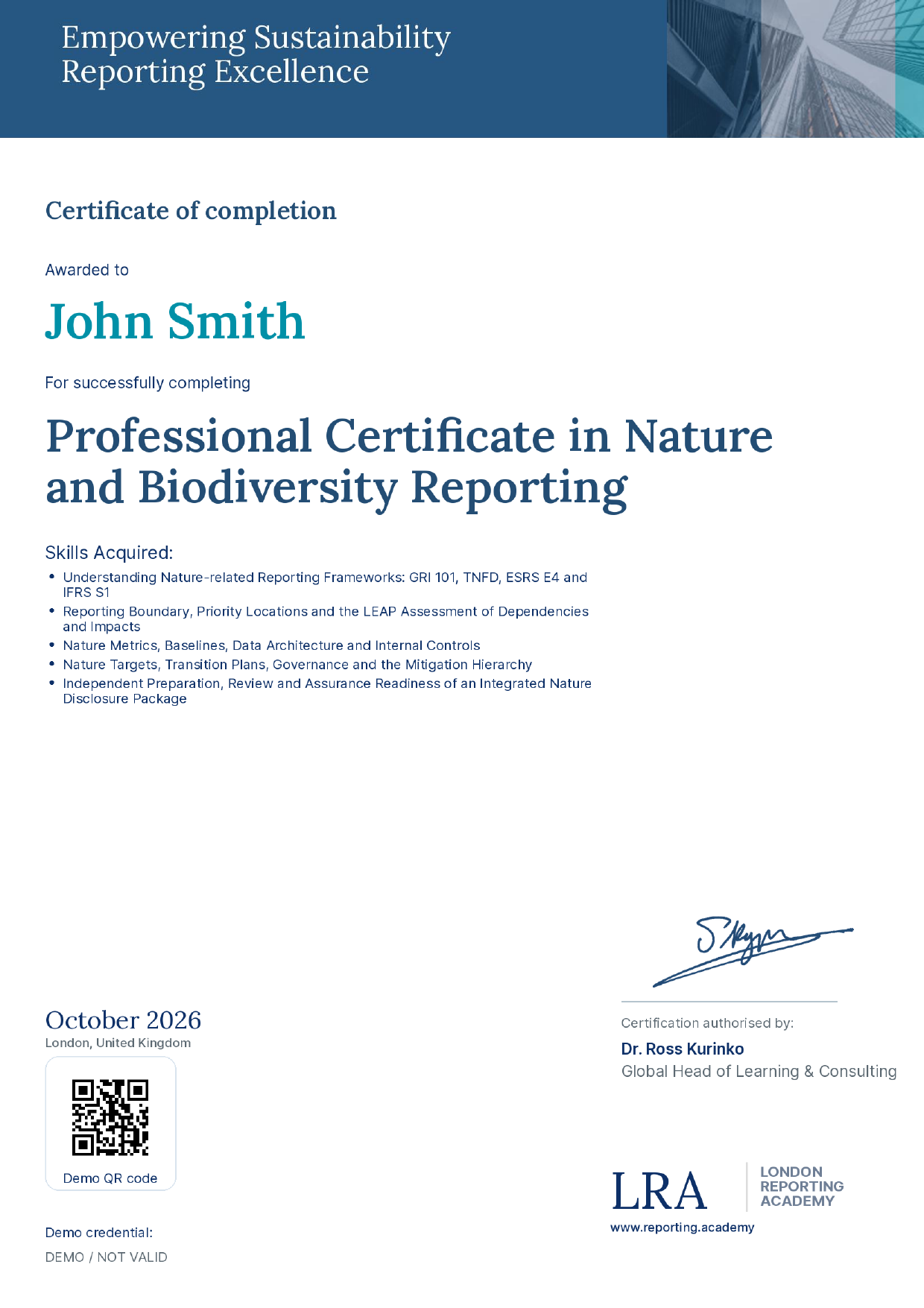
Professional Certificate in Nature and Biodiversity Reporting
TNFD (Taskforce on Nature-related Financial Disclosures) and LEAP, GRI 101: Biodiversity 2024, ESRS E4 and IFRS S1 — from reporting boundary and priority locations to an integrated, assurance-ready nature disclosure package.
Available as Guided Flex, Live Cohort, 1:1 Expert Mentorship or Corporate Programme.