Short answer
The answer, before the reasoning
A credible TNFD-aligned report is built by first defining the reporting objective, materiality approach and assessment scope; then identifying priority interfaces with nature, evaluating dependencies and impacts, assessing risks and opportunities, and translating those findings into the 14 recommended disclosures. LEAP is a useful assessment approach but is not itself a mandatory alignment test.
The report should also apply all six TNFD general requirements across the four pillars, explain boundaries and limitations, use controlled metrics and targets, and retain evidence for each material statement. First-time reporters can adopt the recommendations in phases, provided the scope and expansion plan are transparent.
Technical status
Technical status
The TNFD Recommendations are final voluntary recommendations. LEAP and the getting-started materials are official supporting guidance, not a separate mandatory compliance checklist. This guide uses the source set available on 3 August 2026.
Rule
Limitation
Educational implementation guidance. It does not determine legal applicability, materiality or assurance scope for a particular organisation. “Aligned” should be used only when the published report and supporting evidence justify the claim.
Start with the reporting promise, not the LEAP spreadsheet
Many projects begin by downloading nature datasets and scoring sites. That can create activity without a reporting architecture. The first decision is what the organisation intends to publish, for whom and under which materiality approach. The assessment method, data requests, governance and controls should then be designed to support that promise.
A practical project has three connected layers: an assessment layer that identifies dependencies, impacts, risks and opportunities; a management layer that decides responses, resources, targets and escalation; and a disclosure layer that communicates material information under the four TNFD pillars. Evidence and controls connect all three.
Quick orientation: the complete workflow
Figure 1. A TNFD report connects assessment, management and disclosure through one controlled evidence trail.
In practice
| Stage | Primary decision | Minimum controlled output |
|---|---|---|
| 1. Basis and governance | Why are we reporting and who approves? | Reporting-basis memorandum, RACI, board/management mandate and source register. |
| 2. Scope | Which entities, activities, value-chain segments and time horizons are assessed? | Boundary map, exclusions, expansion plan and data-quality baseline. |
| 3. Locate | Where does the business interface with nature? | Geocoded location register and preliminary priority-location screen. |
| 4. Evaluate | What are the material dependencies and impacts? | Dependency/impact register, causal pathways and evidence. |
| 5. Assess | Which risks and opportunities are material? | DIRO register linked to strategy, risk and financial pathways. |
| 6. Prepare | How will the organisation respond and report? | Actions, metrics, targets, governance decisions and disclosure crosswalk. |
| 7. Draft and control | Does the report answer the 14 disclosures and six general requirements? | Controlled draft, evidence index, review findings and approval record. |
| 8. Publish and improve | What is disclosed now and what expands next? | Final report, alignment statement, limitations, update triggers and next-year plan. |
Step 1 - establish the reporting basis and ownership
Document whether the report is a voluntary TNFD publication, part of an annual report, an investor response, a regulatory preparation exercise or a combined report with GRI, ESRS or IFRS S1. Record the materiality definition, primary users, reporting period, intended claim, source editions and approval route.
Create a cross-functional steering group. Typical owners include the board or a board committee for oversight; an executive sponsor; finance for financial effects and reporting controls; enterprise risk for integration; sustainability for methodology and drafting; operations and procurement for location and value-chain evidence; legal for claims; and internal audit or assurance teams for challenge.
Minimum governance evidence
board or committee mandate and meeting calendar;
management roles and escalation thresholds;
approved reporting objective and materiality approach;
RACI for each disclosure and metric;
source/version register and change-control owner; and
decision log for material judgements, exclusions and claims.
Step 2 - scope the assessment and disclosure perimeter
The scope should be broad enough to identify potentially material issues but proportionate enough to be implemented. Distinguish the initial universe from the population subjected to detailed assessment and from the final disclosure scope.
In practice
| Scope dimension | Questions to answer | Evidence |
|---|---|---|
| Reporting entity | Which entities and activities are covered by the report? | Group chart, financial perimeter and reconciliation. |
| Direct operations | Which assets, sites, projects and activities interface with nature? | Asset register, permits, coordinates and operational data. |
| Upstream value chain | Which commodities, suppliers, geographies and tiers are likely to create dependencies, impacts, risks or opportunities? | Procurement spend/volume, commodity maps, traceability and screening. |
| Downstream value chain | Which products, customers, use phases, disposal routes or financed activities matter? | Sales/product data, portfolio information and lifecycle evidence. |
| Nature realms and biomes | Which land, freshwater, ocean and atmospheric interfaces are relevant? | Geospatial and ecological context. |
| Time horizons | What short, medium and long terms are appropriate? | Asset lives, contracts, strategy cycles and ecological timing. |
| Exclusions | What is not assessed or disclosed, why, and when will it be added? | Approved limitation and expansion plan. |
Step 3 - locate interfaces with nature and identify priority locations
The Locate phase starts with the business footprint and asks where activities and value-chain relationships interface with nature. A site register should contain more than coordinates: it should connect the activity to biome, ecosystem condition, water basin, protected or sensitive-area status, nearby communities and rights holders, relevant direct drivers and data quality.
Priority locations are not simply the sites with the largest revenue or the highest generic biodiversity score. They include locations where material nature-related issues have been identified and locations that are ecologically or socially sensitive. The organisation should document the criteria, thresholds, expert review and aggregation rules used.
Priority-location control points
unique site/activity identifier and coordinates;
geospatial source and extraction date;
direct-operation or value-chain relationship;
sensitive-location criteria and evidence;
material-issue criteria and evidence;
data-quality grade and uncertainty;
review by local operations and relevant specialists; and
link to Strategy D and other location-specific disclosures.
Step 4 - evaluate dependencies and impacts
Dependencies describe the ecosystem services and natural processes on which the organisation relies. Impacts describe changes in the state of nature caused, contributed to or linked to the organisation through activities and business relationships. The analysis should show causal pathways rather than a list of generic nature topics.
Use assessment metrics where they help identify and prioritise issues. TNFD distinguishes assessment metrics from disclosure metrics: not every metric used internally must be disclosed. The metric architecture should record purpose, unit, boundary, method, source, uncertainty, owner and review.
In practice
| Pathway element | Illustrative questions |
|---|---|
| Business activity | What process, product, service, financing or sourcing decision creates the interface? |
| Dependency | Which provisioning, regulating, cultural or supporting ecosystem service is relied upon? |
| Impact driver | Is the pressure land/sea-use change, resource exploitation, climate change, pollution or invasive species? |
| State of nature | What is changing in ecosystem extent, condition, species population or ecological function? |
| Affected people | Which Indigenous Peoples, Local Communities, workers, customers or other stakeholders are affected? |
| Evidence and confidence | What measured, modelled, estimated, expert or stakeholder evidence supports the pathway? |
Step 5 - assess risks and opportunities and create the DIRO register
Dependencies and impacts can create physical, transition and systemic risks as well as opportunities. The Assess phase translates nature interfaces into consequences for the organisation and tests materiality under the chosen approach.
Do not force every impact into a quantified financial effect in the first cycle. A well-supported qualitative pathway and a plan to improve measurement are stronger than invented precision. Conversely, do not omit an investor-relevant risk simply because the corresponding ecological data are imperfect.
In practice
| DIRO field | Minimum content |
|---|---|
| Issue ID and location | Unique link to site, value-chain node or portfolio exposure. |
| Dependency/impact pathway | Causal chain from activity and nature interface to consequence. |
| Risk/opportunity type | Physical, transition, systemic or opportunity category. |
| Time horizon | Short, medium and long-term assessment. |
| Business consequence | Operational, strategic, legal, market, reputational, financing or other consequence. |
| Financial pathway | Revenue, cost, asset value, liability, capex, cash flow, access to finance or cost of capital. |
| Materiality conclusion | Criteria, evidence, uncertainty and approval. |
| Response and controls | Existing and planned actions, owner, resources, indicators and residual exposure. |
Step 6 - prepare responses, metrics and targets
The Prepare phase connects material findings to strategy, risk management, capital allocation, procurement, product design, stakeholder engagement and reporting. Responses should distinguish avoidance, minimisation, restoration, regeneration, transformation and financial risk transfer. Carbon credits or biodiversity credits should not be used to obscure gross impacts or operational performance.
Metrics should include TNFD core global metrics on a comply-or-explain basis where relevant, core sector metrics, and entity-specific metrics necessary to explain material issues. Targets should state baseline, boundary, metric, period, interim milestones, scientific or policy basis, dependencies on external action, governance and performance.
Target evidence checklist
approved target wording and owner;
baseline year and recalculation rule;
geographic and value-chain boundary;
metric definition and methodology;
interim milestones and resources;
dependencies, assumptions and limitations;
performance data and variance analysis; and
consistency with public claims and transition plans.
Step 7 - draft the report against the four pillars and 14 disclosures
Use a disclosure matrix rather than writing from memory. For each recommendation, record applicability, materiality, report location, evidence, owner, reviewer, limitation, cross-reference and final sign-off. Apply the six general requirements across every pillar.
In practice
| Pillar | Drafting focus | Typical evidence |
|---|---|---|
| Governance | Board oversight, management role and human-rights/engagement governance. | Terms of reference, minutes, management papers, policies and engagement records. |
| Strategy | Material DIROs, effects on business model/value chain/strategy/financial planning, resilience and priority locations. | DIRO register, strategy papers, scenarios, financial analysis and location register. |
| Risk and impact management | Identification, assessment, prioritisation, monitoring and integration into enterprise risk. | Methodology, workflows, risk taxonomy, thresholds, controls and monitoring reports. |
| Metrics and targets | Metrics for risks/opportunities and dependencies/impacts, plus targets and performance. | Data dictionary, calculations, factors, source records, target approvals and variance analysis. |
Step 8 - build assurance-ready controls
TNFD does not create a universal assurance mandate, but the credibility of the report depends on evidence and control. Apply finance-grade discipline to material metrics and claims.
controlled definitions, units, boundaries and time periods;
source-data ownership and original evidence;
method, model and geospatial version control;
review of estimates, assumptions and uncertainty;
reconciliation between location, DIRO, action and metric registers;
segregation between preparation, review and approval;
finding, remediation and independent retest;
cross-reference and final-file testing; and
management representations on completeness and known limitations.
A 12-month first reporting cycle
Figure 2. The first reporting cycle sequences governance, LEAP-style assessment, drafting, controls and approval over 12 months.
In practice
| Month | Primary work | Decision gate / deliverable |
|---|---|---|
| 1 | Legal/reporting basis, source pack, executive sponsor and project charter. | Approved objective, claim and governance. |
| 2 | Boundary, entity/activity universe, value-chain screening and data-owner mobilisation. | Scope and data request approved. |
| 3 | Geocoding, nature-interface screening and location-data QA. | Location register v1. |
| 4 | Priority-location criteria, sensitive-location analysis and local validation. | Priority locations approved. |
| 5 | Dependency and impact pathways; engagement planning. | Dependency/impact register v1. |
| 6 | Risk and opportunity assessment, time horizons and materiality. | DIRO register and materiality decisions. |
| 7 | Strategy, financial pathways, response options and scenario scoping. | Management response and finance bridge. |
| 8 | Metrics, targets, methods, baselines and evidence controls. | Metric/target register. |
| 9 | Draft four-pillar disclosures and general-requirement notes. | First controlled draft. |
| 10 | Internal challenge, gap remediation, data finalisation and cross-references. | Review findings and revised draft. |
| 11 | Board/committee review, legal/claims review and optional pre-assurance. | Approval-ready package. |
| 12 | Final approval, publication, evidence archive and next-year expansion plan. | Published report and lessons-learned record. |
Phased adoption without vague disclosure
A first report may start with material direct operations, selected upstream commodities or a defined portfolio segment. The limitation should be specific: what is covered, what is not, why the exclusion exists, what evidence was used and when expansion is planned. “Data are unavailable” is not a complete scope statement.
A useful expansion plan sets dates and owners for additional value-chain tiers, geographies, metrics, scenarios and assurance. It also prevents a pilot from becoming the permanent reporting boundary.
Hypothetical example - food manufacturer
A diversified food manufacturer begins with six processing sites and three high-volume agricultural commodities. It maps sites and sourcing regions, identifies water, soil fertility, pollination and flood-regulation dependencies, and evaluates land-use, water, nutrient and pesticide impacts. The analysis highlights two water-stressed basins and one commodity associated with conversion risk.
The company links these findings to production interruption, input-cost volatility, licence-to-operate risk and opportunities from regenerative sourcing. It publishes the scope, priority locations, material DIROs, current actions and metrics, while explaining that tier-two supplier traceability and quantitative financial effects will be expanded in the next cycle.
Limitation. This is illustrative wording and must not be copied without company-specific evidence and review.
In practice
Weak versus stronger alignment wording
| Weak wording | More defensible wording |
|---|---|
| “Our report is fully TNFD compliant.” | “This report addresses the TNFD Recommendations identified in our disclosure index. We apply the materiality approach, scope and limitations described in the basis of preparation.” |
| “We assessed the whole value chain.” | “The detailed assessment covered direct operations and the specified upstream commodities and regions. Other value-chain segments were screened at sector level and are scheduled for expansion.” |
| “All sites were low risk.” | “No material financial risk was identified at the assessed sites under the stated criteria; sensitive-location and impact findings are reported separately.” |
Common mistakes and fixes
1. Treating a heatmap as LEAP completion
Fix: retain location-specific dependency, impact, risk and opportunity pathways, decisions and evidence.
2. Using one materiality score for impacts and financial effects
Fix: share evidence where appropriate but preserve the criteria and approval trail for each lens.
3. Reporting group totals without natural context
Fix: disaggregate where aggregation would obscure material differences between locations.
4. Publishing actions without performance evidence
Fix: disclose baseline, metric, target, resources, current results, delays and limitations.
5. Copying the 14 headings but omitting the six general requirements
Fix: test materiality, scope, location, integration, time horizons and engagement across every pillar.
6. Making alignment claims before control closure
Fix: use an alignment/claims gate tied to the disclosure matrix, evidence status and approval record.
Readiness
Final publication checklist
- reporting objective, users and materiality approach are explicit;
- assessment and disclosure scope are reconciled and exclusions explained;
- priority locations are supported by controlled geospatial evidence;
- dependencies, impacts, risks and opportunities are connected through documented pathways;
- all 14 recommendations are mapped to report content or a transparent explanation;
- all six general requirements are applied across the four pillars;
- metrics, targets, estimates and models have owners and review evidence;
- stakeholder and rights-holder engagement is evidenced and connected to decisions;
- cross-framework reuse does not create false equivalence;
- claims, cross-references and the final file have been tested;
- board/management approval is documented; and
- update triggers and the next-cycle expansion plan are recorded.
Self-check
- Can the team distinguish the assessment scope, detailed-analysis scope and disclosure scope?
- Can every material DIRO be traced to location, evidence, governance and a disclosure decision?
- Would a reviewer understand how the six general requirements affected each pillar?
- Does the alignment wording remain accurate when limitations and exclusions are read in full?
Selected official sources
SRC-01 · Recommendations of the Taskforce on Nature-related Financial Disclosures - TNFD (Version 1.0, September 2023). https://tnfd.global/wp-content/uploads/2023/08/Recommendations_of_the_Taskforce_on_Nature-related_Financial_Disclosures_September_2023.pdf
SRC-02 · TNFD Disclosure Recommendations webpage - TNFD (Current webpage checked 3 August 2026). https://tnfd.global/recommendations/
SRC-03 · Guidance on the identification and assessment of nature-related issues: the LEAP approach - TNFD (Version 1.1, October 2023; webpage last updated June 2026). https://tnfd.global/publication/additional-guidance-on-assessment-of-nature-related-issues-the-leap-approach/
SRC-04 · Getting started with adoption of the TNFD Recommendations - TNFD (Version 1.0, September 2023; webpage last updated July 2025). https://tnfd.global/publication/getting-started-with-adoption-of-the-tnfd-recommendations/
SRC-17 · Guidance on engagement with Indigenous Peoples, Local Communities and affected stakeholders - TNFD (Official guidance page checked 3 August 2026). https://tnfd.global/publication/guidance-on-engagement-with-indigenous-peoples-local-communities-and-affected-stakeholders/
SRC-18 · TNFD metrics resources - TNFD (Current page checked 3 August 2026). https://tnfd.global/metrics/
Technical status
Publication status: Source-grounded publication-ready draft - human technical sign-off pending. This article is educational material and does not replace the official TNFD, GRI or IFRS sources, legal advice or assurance procedures.
Take it with you
The checklists as a working spreadsheet
Every checklist and table on this page, with empty status, owner and evidence columns for your team to fill in and keep.
✓ Knowledge Hub AI Assistant · Human-in-the-loop

Ask about this guide
It answers from this page, and reaches into the linked disclosure cards when your question is about the standard itself.
Go deeper · TNFD
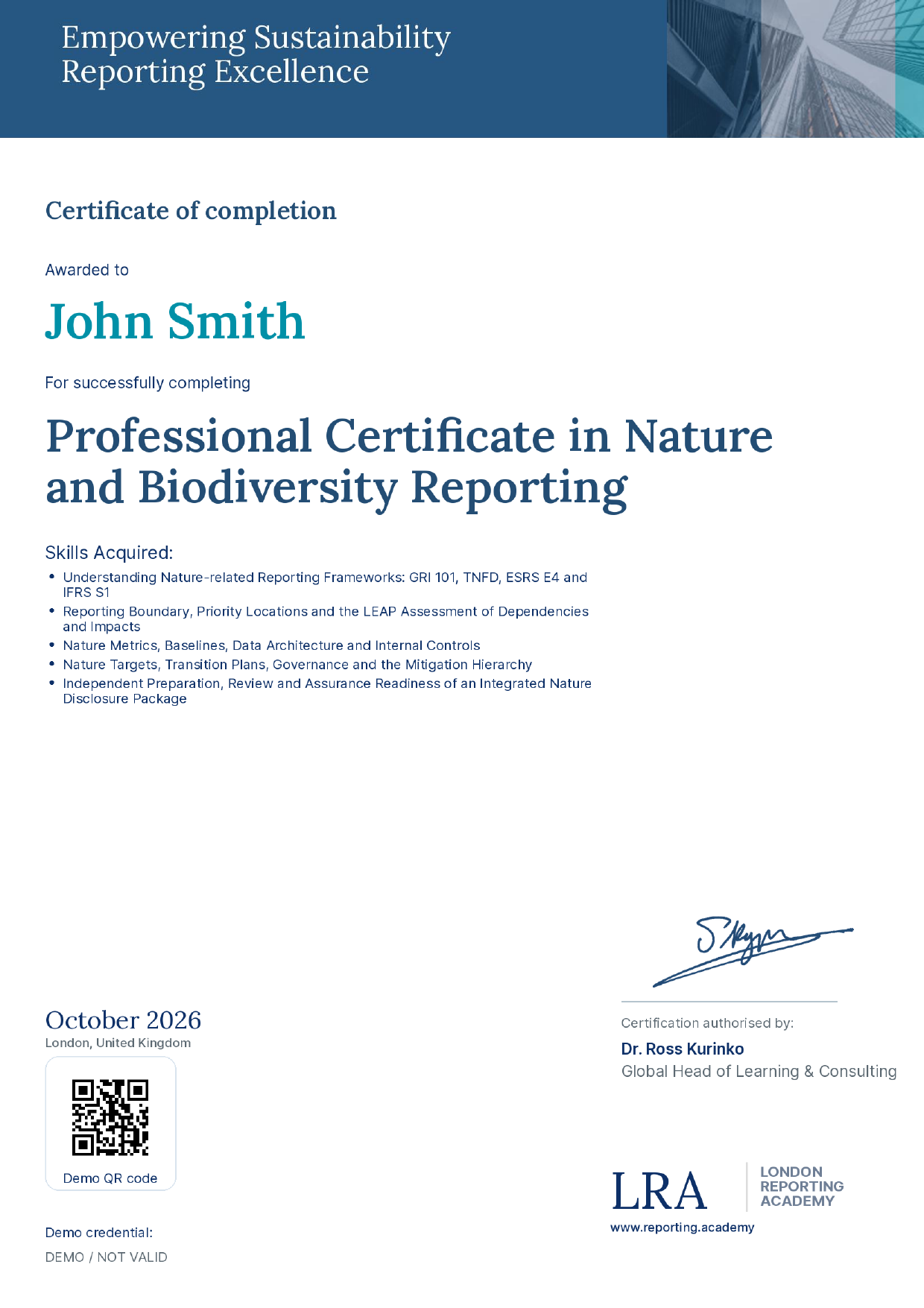
Professional Certificate in Nature and Biodiversity Reporting
TNFD (Taskforce on Nature-related Financial Disclosures) and LEAP, GRI 101: Biodiversity 2024, ESRS E4 and IFRS S1 — from reporting boundary and priority locations to an integrated, assurance-ready nature disclosure package.
Available as Guided Flex, Live Cohort, 1:1 Expert Mentorship or Corporate Programme.