Short answer
The answer, before the reasoning
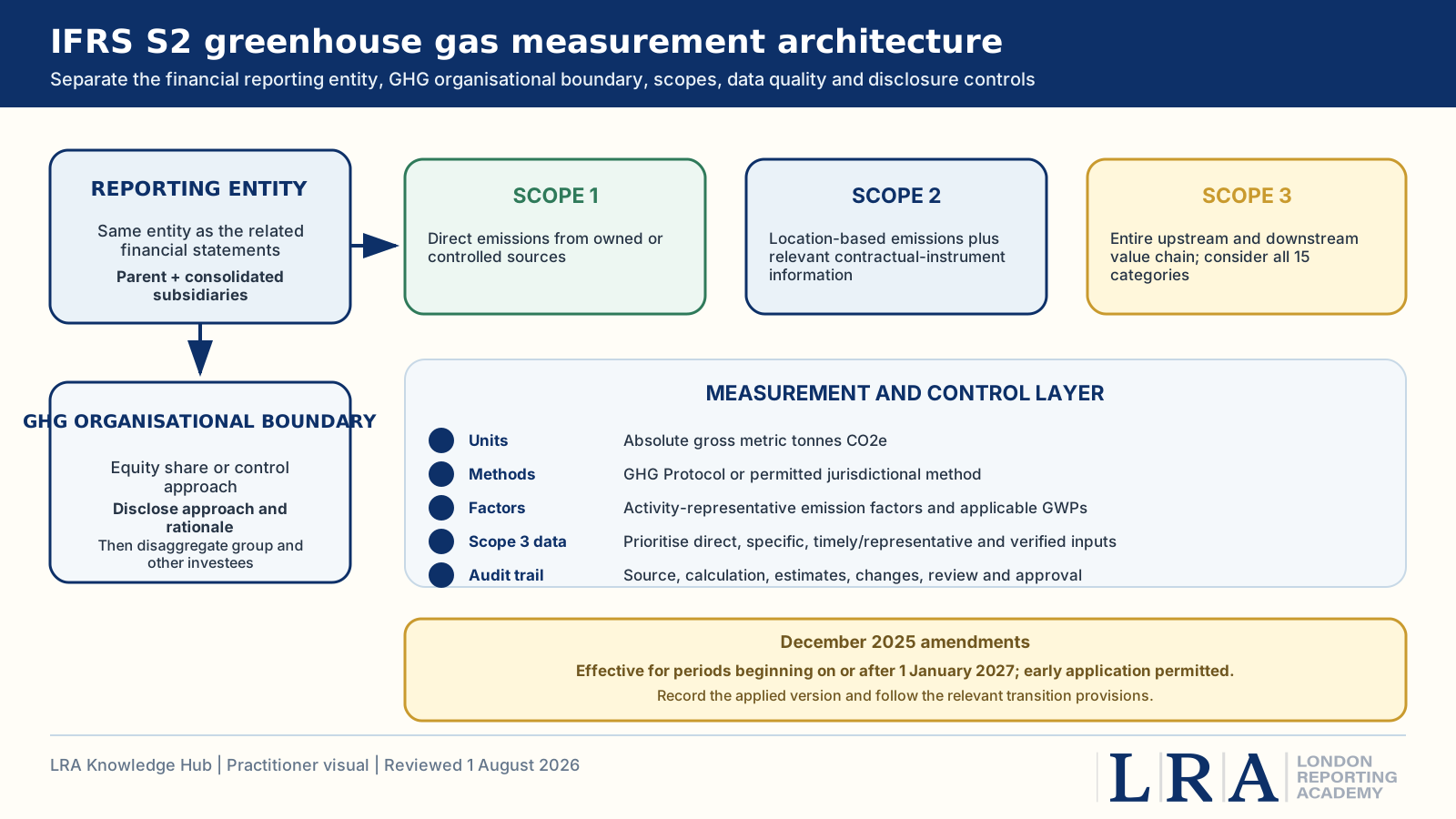
IFRS S2 requires an entity to disclose its absolute gross Scope 1, Scope 2 and Scope 3 greenhouse gas emissions generated during the reporting period, expressed in metric tonnes of CO2 equivalent and subject to materiality. The entity normally measures emissions using the GHG Protocol Corporate Standard, applies an equity-share or control approach, and explains the method, inputs, assumptions and emission factors used.
Scope 1 and Scope 2 emissions are disaggregated between the consolidated accounting group and other investees excluded from financial consolidation. Scope 2 is disclosed on a location-based basis, with information about relevant contractual instruments. For Scope 3, the entity considers the entire upstream and downstream value chain and all 15 categories, discloses the categories included and applies the IFRS S2 data-prioritisation framework. The December 2025 targeted amendments are effective for annual periods beginning on or after 1 January 2027, with early application permitted.
Rule
IFRS-GHG-001
IFRS S2 Scope 1, Scope 2 and Scope 3 Emissions: Complete Measurement Guide Absolute gross emissions, organisational boundaries, contractual instruments, Scope 3 categories, factors and data quality
In practice
Type
| Type | Tier | Audience — Current context |
|---|---|---|
| GHG measurement and disclosure guide | Tier 3 · Deep Guide | Reporting, carbon-accounting, finance, operations, procurement, investments, data, assurance and governance teams — IFRS S2 December 2025 edition and targeted amendments checked to 1 August 2026 |
Start with the disclosure objective, not a carbon-accounting spreadsheet
A GHG inventory for IFRS S2 is not merely an operational carbon dataset. It is investor-focused information about transition-risk exposure and performance. The measurement method, organisational structure, value-chain boundary, contractual energy instruments, estimates and data quality all affect how users interpret the emissions figure. The inventory therefore needs a controlled connection to the reporting entity, financial consolidation, risk and opportunity assessment, targets, financial planning and governance approval.
The same underlying activity data can often support regulatory, voluntary and management inventories, but the final IFRS S2 disclosure must be tested against IFRS S2 definitions, disaggregation and explanatory requirements. A figure calculated for another purpose should not be imported without a boundary and methodology reconciliation.
Quick orientation
Quick orientation
- Applies to
- Entities applying IFRS S2 and preparing material Scope 1, Scope 2 and Scope 3 disclosures.
- Primary decision
- What emissions are within each scope, which entities and value-chain activities are included, how are they measured, and what limitations must be explained?
- Key source
- IFRS S2 paragraph 29(a), application guidance B19-B63A and the December 2025 amendments.
- Common confusion
- Treating the financial-consolidation perimeter as the GHG boundary, or treating a market-based Scope 2 figure as a substitute for the required location-based disclosure.
The required headline disclosures
In practice
| Element | Core IFRS S2 treatment |
|---|---|
| Scope 1 | Absolute gross direct emissions generated during the reporting period. |
| Scope 2 | Absolute gross indirect emissions from purchased or acquired energy, disclosed using a location-based approach. |
| Scope 3 | Absolute gross indirect value-chain emissions, upstream and downstream, after considering all 15 GHG Protocol categories. |
| Unit | Metric tonnes of CO2 equivalent. |
| Gases | The seven greenhouse gases covered by IFRS S2 are measured and converted to CO2 equivalent as applicable. |
| Gross presentation | Emissions are disclosed before offsets, carbon credits or avoided-emissions claims. |
| Method and assumptions | The measurement approach, inputs, assumptions and emission factors are explained. |
| Organisational disaggregation | Scope 1 and Scope 2 are split between the consolidated accounting group and other investees excluded from that group. |
Step 1: reconcile the reporting entity and the GHG organisational boundary
The reporting entity for IFRS sustainability disclosures is the same reporting entity as for the related general purpose financial statements. That does not mean that every GHG emission is classified solely by financial consolidation. The GHG Protocol measurement approach can bring emissions of an associate, joint venture or other investment into Scope 1 and Scope 2 under an equity-share or control approach, or place relevant emissions in Scope 3 when the investee is outside the chosen organisational boundary.
In practice
| Entity relationship | Measurement question | IFRS S2 presentation control |
|---|---|---|
| Parent and consolidated subsidiary | Is the activity within the selected equity-share or control approach? | Include in the appropriate scope and identify Scope 1/2 as attributable to the consolidated accounting group. |
| Associate or joint venture | Does the chosen GHG Protocol approach include its operations in Scope 1/2, or are relevant emissions treated in Scope 3? | Disaggregate Scope 1/2 attributable to investees excluded from the consolidated accounting group. Document ownership and operational-control changes. |
| Unconsolidated controlled operation or structured arrangement | Does the selected control approach capture the operation, and is the accounting treatment different? | Reconcile the GHG boundary to the financial statements and explain the disaggregation. |
| Franchise, outsourced operation or supplier | Is the activity outside the organisational boundary but within the value chain? | Assess the relevant Scope 3 category and minimum category boundary. |
| Customer use or end-of-life activity | Does the product create material downstream emissions? | Assess relevant downstream Scope 3 categories using reasonable and supportable information. |
Rule
CONTROL POINT
Maintain an entity-boundary bridge that lists every subsidiary, associate, joint venture and significant arrangement, its accounting treatment, ownership or control facts, GHG Protocol treatment, scope classification, data owner and change history.
Step 2: choose and disclose the measurement approach
Under the current IFRS S2 requirements, an entity normally measures GHG emissions using the GHG Protocol Corporate Standard. That standard permits an equity-share approach or a control approach. A control approach can be based on financial control or operational control under the GHG Protocol. The IFRS S2 disclosure explains the approach selected, the reasons for the choice and how it relates to the disclosure objective.
A jurisdictional authority or exchange can require a different method for all or part of an entity. The December 2025 amendments clarify that the jurisdictional relief may apply to the affected part while the entity still discloses Scope 1, Scope 2 and Scope 3 for the entity as a whole. A controlled inventory therefore needs a method-by-entity register rather than a single unqualified “GHG Protocol” label.
In practice
| Method register field | What to retain |
|---|---|
| Entity or activity | The part of the group or inventory to which the method applies. |
| Method and version | GHG Protocol Corporate Standard, jurisdictional method or other permitted basis. |
| Measurement approach | Equity share, financial control, operational control or applicable alternative. |
| Reason and disclosure objective | Why the approach faithfully represents the entity’s climate exposure. |
| Effective period | When the method first applies and when any jurisdictional requirement expires or changes. |
| Consistency and change | Prior-year treatment, change rationale, effect on comparability and restatement decision. |
| Approval | Technical owner, finance or sustainability review and governance sign-off. |
Step 3: calculate absolute gross emissions and select factors
IFRS S2 requires absolute gross emissions. Carbon credits, offsets, avoided emissions and removals used in a net target do not reduce the gross Scope 1, Scope 2 or Scope 3 disclosure. They are considered separately in target disclosures where relevant.
Where direct measurement is available, the constituent gases are converted to CO2 equivalent using applicable 100-year global warming potential values. Where emission factors already contain the CO2-equivalent conversion, recalculation is not required. Otherwise, the applicable global warming potential values are used. The factor selected must best represent the activity, including relevant technology and jurisdiction. IFRS S2 does not prescribe one universal emission-factor database.
In practice
| Calculation control | Review question |
|---|---|
| Activity data | Does the quantity represent the correct activity, period, unit, facility, product or value-chain transaction? |
| Emission factor | Does the factor represent the jurisdiction, technology, fuel, transport mode, material or other activity? |
| Gas and GWP treatment | Are constituent gases and CO2-equivalent conversions applied consistently and under the applicable version? |
| Unit conversion | Are energy, mass, distance, currency and production units controlled and independently checked? |
| Completeness | Are missing sites, months, suppliers, products or categories identified rather than silently treated as zero? |
| Estimates | Are estimation methods, proxies, uncertainty, bias and improvement plans recorded? |
| Change control | Are factor updates, acquisitions, disposals and methodological changes reviewed for comparatives and targets? |
Step 4: measure Scope 1 emissions
Scope 1 covers direct emissions from sources within the selected organisational boundary. Typical sources include stationary combustion, mobile combustion, process emissions and fugitive emissions. The inventory should be complete across the relevant entities and operations, but the exact scope classification depends on the measurement approach. An emission from an associate can be Scope 1 for the reporting entity under one approach and Scope 3 under another.
Build a source register by facility, equipment, vehicle, process and refrigerant system.
Reconcile fuel purchases, meter readings, production records, maintenance records and refrigerant movements.
Separate measured, calculated and estimated sources and document the method for each.
Investigate unusual movements against production, weather, outages, acquisitions and asset changes.
Retain evidence for biogenic CO2, methane, nitrous oxide and other relevant gas treatment where applicable.
Reconcile the source register to the organisational-boundary bridge and the Scope 1/2 disaggregation.
Step 5: measure Scope 2 and explain contractual instruments
IFRS S2 requires location-based Scope 2 emissions. This reflects the average emissions intensity of the grids or energy systems where consumption occurs. If the entity has contractual instruments that could inform users’ understanding, it provides information about those instruments. Examples can include energy contracts bundled with generation attributes, renewable energy certificates or other unbundled attribute claims. A market-based Scope 2 figure may be useful additional information, but it does not replace the required location-based figure.
In practice
| Scope 2 dataset | Required control |
|---|---|
| Purchased electricity, steam, heat and cooling | Complete consumption by site and reporting period, with unit conversions and supplier or meter evidence. |
| Location-based factor | Grid or jurisdiction factor that best represents the place and period of consumption. |
| Contractual instruments | Instrument type, quantity, geography, generation period, ownership, cancellation or retirement evidence and any residual mix treatment. |
| Additional market-based figure | Method, instrument eligibility, residual mix, limitations and clear distinction from the location-based disclosure. |
| Renewable-energy claim | Consistency between procurement evidence, Scope 2 explanation, targets, website claims and financial commitments. |
Step 6: consider all 15 Scope 3 categories
IFRS S2 requires the entity to consider its entire upstream and downstream value chain and all 15 categories described in the GHG Protocol Scope 3 Standard. This does not mean that each category will necessarily be included in the final material disclosure. It means the entity must perform a complete category consideration, apply the applicable category boundaries and materiality, and disclose which categories are included.
The category-screening file should document activity presence, applicable minimum boundary, likely magnitude, transition-risk relevance, data availability, exclusions, overlap risks, method and review conclusion. A category is not “not applicable” merely because supplier-specific data are unavailable: estimation using reasonable and supportable information is expected in many cases.
In practice
| Upstream categories | Downstream categories |
|---|---|
| 1 Purchased goods and services | 9 Downstream transportation and distribution |
| 2 Capital goods | 10 Processing of sold products |
| 3 Fuel- and energy-related activities not included in Scope 1 or 2 | 11 Use of sold products |
| 4 Upstream transportation and distribution | 12 End-of-life treatment of sold products |
| 5 Waste generated in operations | 13 Downstream leased assets |
| 6 Business travel | 14 Franchises |
| 7 Employee commuting | 15 Investments |
| 8 Upstream leased assets |
Step 7: apply the IFRS S2 Scope 3 data-prioritisation framework
Scope 3 will often rely on estimates. IFRS S2 therefore focuses not only on the number but on the quality and representativeness of the inputs. The entity uses all reasonable and supportable information available without undue cost or effort and prioritises inputs using four characteristics, with judgement over trade-offs.
The disclosure explains the measurement approach, inputs and assumptions, including the extent to which Scope 3 uses inputs from specific activities and the extent to which inputs are verified. This is a data-quality disclosure, not a requirement to claim that all Scope 3 data are primary or externally assured.
In practice
| Characteristic | Preferred evidence | Typical limitation to disclose |
|---|---|---|
| Direct measurement | Directly monitored emissions where available. | Coverage may be narrow or available only for selected suppliers and facilities. |
| Specific activity data | Primary data from the entity’s own transactions or specific value-chain partners. | Supplier data may use different periods, boundaries or methods. |
| Timely and representative data | Data reflecting the jurisdiction, technology and activity being estimated. | Newer generic data can be less representative than older activity-specific data. |
| Verified data | Internally or externally checked data and calculations. | Verification may be unavailable across distant value-chain tiers without undue cost or effort. |
Financial institutions and Category 15
Entities participating in asset management, commercial banking or insurance activities have additional financed-emissions requirements. The December 2025 amendments permit an entity to limit Category 15 measurement and disclosure to financed emissions and permit specified treatment of derivatives, subject to explanation. Where an entity includes broader Category 15 emissions, it discloses the total Category 15 amount and the financed-emissions subtotal. The amendment and its transition provisions must be applied by the correct effective date and version.
Rule
VERSION GATE
The December 2025 amendments apply for annual reporting periods beginning on or after 1 January 2027, with early application permitted. Reports for earlier periods must identify whether the amendments have been early applied rather than silently using the revised reliefs.
Hypothetical example: diversified manufacturer with an associate
Illustrative scenario; not company data. A manufacturer controls two production subsidiaries and owns 35% of an associate. It chooses the operational-control approach. The parent and subsidiaries are operationally controlled and their direct and purchased-energy emissions are measured in Scope 1 and Scope 2. The associate operates independently, so its relevant emissions are assessed in Scope 3 Category 15 rather than included in the group’s Scope 1 and Scope 2 measurement. The group discloses the location-based Scope 2 total and explains renewable-electricity instruments separately. It screens all 15 Scope 3 categories, with purchased materials, logistics, use of sold products and investments included as material categories.
The evidence pack contains the entity-boundary bridge, operational-control assessment, energy invoices, factor register, Scope 3 category screen, supplier and product assumptions, investment methodology, data-quality profile, calculation review and governance approval. The conclusion could change if the group gains operational control of the associate or changes its measurement approach.
Illustrative disclosure wording
Why it works: the wording identifies the method, approach, unit, three scopes, investee disaggregation, required Scope 2 basis, contractual-instrument layer, Scope 3 category consideration, included categories and data-quality approach. It still requires entity-specific values, assumptions, factor sources, limitations and comparative-change disclosures.
Hypothetical scenario
ILLUSTRATIVE WORDING - ADAPT TO FACTS
“The Group measured greenhouse gas emissions using the GHG Protocol Corporate Standard and the operational-control approach. Absolute gross emissions for the year were disclosed in metric tonnes of CO2 equivalent for Scope 1, Scope 2 and Scope 3. Scope 1 and Scope 2 emissions attributable to the consolidated accounting group are presented separately from emissions attributable to other investees. Scope 2 is reported on a location-based basis; information about electricity attribute instruments is provided separately. The Group considered all 15 Scope 3 categories and included Categories 1, 2, 3, 4, 5, 6, 7, 9, 11, 12 and 15. Scope 3 estimates prioritised activity-specific, representative and verified inputs where available. Material estimation limitations and year-on-year methodology changes are described below.”
Illustrative only. It shows how the decision is made, not wording that can be copied or relied on.
In practice
Weak versus stronger measurement disclosure
| Weak wording | Stronger treatment |
|---|---|
| “Emissions were calculated in line with the GHG Protocol.” | Names the standard version, organisational approach, reason for the choice and any jurisdictional methods applied to part of the group. |
| “Scope 2 is 100% renewable.” | Discloses location-based Scope 2, then separately explains contractual instruments, market-based information and limitations. |
| “Scope 3 data were unavailable.” | Shows the 15-category consideration, estimation methods, data-quality priorities, material limitations and improvement plan. |
| “Associates are outside the boundary.” | Explains whether associates fall in Scope 1/2 under the measurement approach or in relevant Scope 3 categories, and provides the required disaggregation. |
| “Carbon credits reduced total emissions.” | Keeps absolute gross emissions separate and explains carbon credits only in the relevant target or net-emissions context. |
| “The latest emission factors were used.” | Explains which factors were used and why they best represent activity, jurisdiction and technology. |
Common mistakes
Using the consolidated financial perimeter as the GHG organisational boundary without selecting and documenting a GHG Protocol approach.
Failing to disaggregate Scope 1 and Scope 2 between the consolidated accounting group and other investees.
Publishing only a market-based Scope 2 figure or treating renewable certificates as zero physical emissions.
Reducing absolute gross emissions by carbon credits, avoided emissions or offsets.
Screening only the most familiar Scope 3 categories rather than considering all 15 and the entire value chain.
Excluding a category because primary data are unavailable, without attempting reasonable estimation.
Using spend-based factors for material categories without testing activity-specific alternatives or representativeness.
Using the newest factor automatically even when it is less representative of the activity, technology or jurisdiction.
Mixing reporting periods, currencies, energy units, production units or supplier boundaries without reconciliation.
Failing to reassess categories and entities after an acquisition, divestment, supplier change or business-model shift.
Applying the December 2025 reliefs before their effective date without disclosing early application.
Describing all data as verified when only selected inputs or calculations were checked.
Myth
IFRS S2 requires perfect supplier-specific data for every Scope 3 category before Scope 3 can be disclosed.
Reality
IFRS S2 expects estimation in Scope 3. The entity uses reasonable and supportable information without undue cost or effort, prioritises higher-quality and more representative inputs, explains its methods and data characteristics, and discloses material limitations.
Readiness
Measurement and disclosure readiness checklist
- The sustainability reporting entity matches the related financial statements.
- An entity-boundary bridge reconciles subsidiaries, associates, joint ventures and other arrangements to the GHG organisational boundary.
- The GHG Protocol or permitted alternative method and measurement approach are identified, justified and version-controlled.
- Scope 1, Scope 2 and Scope 3 are measured as absolute gross metric tonnes of CO2 equivalent.
- The seven gases, GWP treatment, activity data, unit conversions and factors are controlled.
- Factors best represent the activity, jurisdiction and technology, with source and version retained.
- Scope 1 and Scope 2 are disaggregated between the consolidated accounting group and other investees.
- Location-based Scope 2 is disclosed and relevant contractual instruments are explained separately.
- All 15 Scope 3 categories and the entire upstream and downstream value chain have been considered.
- Included Scope 3 categories, boundaries, methods, estimates and exclusions are documented.
- Scope 3 inputs have been assessed against direct measurement, specific activity, timeliness/representativeness and verification characteristics.
- The extent of activity-specific and verified Scope 3 inputs can be explained.
- Acquisitions, disposals, significant value-chain changes and methodology changes trigger reassessment.
- Financed-emissions and Category 15 requirements have been assessed where relevant.
- The applicable IFRS S2 version and any early application of the December 2025 amendments are clear.
- Calculations, narrative, targets, website claims and financial planning have passed cross-functional review and governance approval.
The GHG treatment of an associate or joint venture depends on the selected equity-share or control approach, not solely on financial consolidation. Its emissions may enter Scope 1 and Scope 2 under that approach or be assessed in Scope 3 when the investee sits outside the organisational boundary; the treatment and disaggregation should be documented.
The December 2025 amendments made targeted changes to IFRS S2's GHG requirements, including jurisdictional method and GWP reliefs, Category 15 and financed-emissions presentation, derivatives and excluded activities, and industry classification. They apply for annual periods beginning on or after 1 January 2027, with early application permitted.
Self-check
- Could another reviewer reproduce each scope total from controlled activity data, factors and assumptions?
- Can the team explain why each associate or joint venture is in Scope 1/2 or Scope 3 under the selected measurement approach?
- Does the Scope 2 disclosure lead with the location-based amount and keep contractual instruments clearly separate?
- Has every Scope 3 category been considered, including categories ultimately excluded from the material disclosure?
Questions
Questions people ask
Does IFRS S2 require all three scopes?
IFRS S2 requires an entity to disclose its absolute gross Scope 1, Scope 2 and Scope 3 greenhouse gas emissions generated during the reporting period, expressed in metric tonnes of CO2 equivalent and subject to materiality. The entity normally measures emissions using the GHG Protocol Corporate Standard, applies an equity-share or control approach, and explains the method, inputs, assumptions and emission factors used.
How are associates and joint ventures treated?
The GHG treatment of an associate or joint venture depends on the selected equity-share or control approach, not solely on financial consolidation. Its emissions may enter Scope 1 and Scope 2 under that approach or be assessed in Scope 3 when the investee sits outside the organisational boundary; the treatment and disaggregation should be documented.
Is location-based Scope 2 mandatory?
IFRS S2 requires location-based Scope 2 emissions. This reflects the average emissions intensity of the grids or energy systems where consumption occurs.
Must all 15 Scope 3 categories be included?
IFRS S2 requires the entity to consider its entire upstream and downstream value chain and all 15 categories described in the GHG Protocol Scope 3 Standard. This does not mean that each category will necessarily be included in the final material disclosure.
What changed in December 2025?
The December 2025 amendments made targeted changes to IFRS S2's GHG requirements, including jurisdictional method and GWP reliefs, Category 15 and financed-emissions presentation, derivatives and excluded activities, and industry classification. They apply for annual periods beginning on or after 1 January 2027, with early application permitted.
In practice
Related requirements and next steps
| Relation | Reference | Why it matters |
|---|---|---|
| Direct | IFRS S2 paragraph 29(a) | Core GHG emissions disclosures, methods, disaggregation, Scope 2 and Scope 3 information. |
| Direct | IFRS S2 B19-B63A | Measurement, factors, boundaries, Scope 3 framework and financed emissions. |
| Transition | December 2025 amendments | Reliefs and clarifications effective from 1 January 2027, with early application permitted. |
| Supporting | IFRS S2 paragraphs 33-36 | Targets, gross versus net targets and carbon-credit information. |
| Supporting | IFRS S1 materiality and connected information | Materiality, aggregation, estimates, judgements and connection to financial reporting. |
Sources
Primary sources
- IFRS S2 Climate-related Disclosures, including December 2025 amendments
- Amendments to Greenhouse Gas Emissions Disclosures (December 2025)
- Greenhouse Gas Emissions Disclosure requirements applying IFRS S2 - educational material (May 2025)
- Greenhouse Gas Protocol: A Corporate Accounting and Reporting Standard, Revised Edition
- GHG Protocol Scope 2 Guidance
- GHG Protocol Corporate Value Chain (Scope 3) Accounting and Reporting Standard
- Amendments to Greenhouse Gas Emissions Disclosures project page
Framework references
Disclosures this page affects
Take it with you
The checklists as a working spreadsheet
Every checklist and table on this page, with empty status, owner and evidence columns for your team to fill in and keep.
✓ Knowledge Hub AI Assistant · Human-in-the-loop

Ask about this guide
It answers from this page, and reaches into the linked disclosure cards when your question is about the standard itself.
Go deeper · IFRS S1 / S2
Certified IFRS S1 & S2 (ISSB) Applied Sustainability Reporting
This page settles one requirement. The IFRS S1 & S2 course walks the whole ISSB workflow — governance, strategy, risk management, metrics and targets — with drafting exercises on your own data.