Short answer
The answer, before the reasoning
IFRS S2 requires climate-related scenario analysis to assess climate resilience, but it does not require every entity to start with complex financial modelling. The approach must be commensurate with the entity’s circumstances.
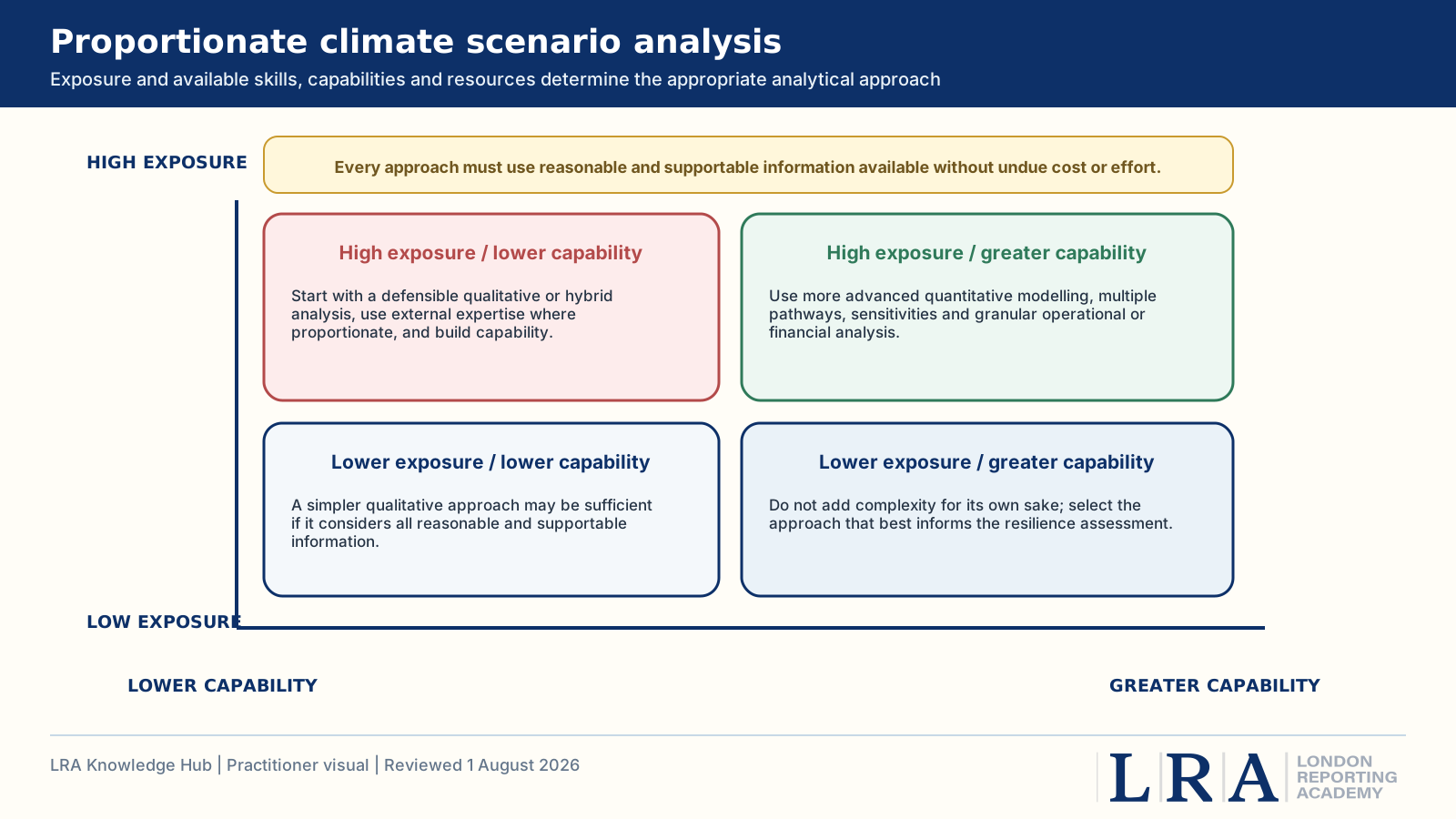
The entity assesses its exposure to climate-related risks and opportunities and the skills, capabilities and resources available, then selects a qualitative, quantitative or combined method that considers all reasonable and supportable information available without undue cost or effort. Higher exposure and greater capability generally call for more sophisticated analysis. The scenario analysis may align with a multi-year strategic planning cycle, but the resilience assessment and its results must be updated at every reporting date.
Rule
IFRS-SCN-001
IFRS S2 Scenario Analysis: A Proportionate Approach to Climate Resilience Skills, capabilities, resources, reasonable information, scenarios, assumptions, time horizons and a first-year pathway
In practice
Type
| Type | Tier | Audience — Current context |
|---|---|---|
| Scenario-analysis implementation guide | Tier 3 · Deep Guide | Reporting, finance, risk, strategy, climate, modelling and assurance teams — IFRS S2 paragraph 22, B1-B18 and March 2026 IFRS Foundation factsheet checked to 1 August 2026 |
The requirement is mandatory; the sophistication is proportionate
A first-time reporter cannot satisfy IFRS S2 by stating that scenario analysis is “not yet mature” and omitting the resilience assessment. Equally, the Standard does not require a new reporter with limited exposure and capability to commission a complex bespoke model merely to appear sophisticated. The required outcome is a decision-useful assessment of climate resilience supported by an approach that fits the entity’s circumstances.
Proportionality is not a permanent exemption. Scenario analysis is an iterative practice. As exposure, data, skills and resources develop, the approach is expected to strengthen. An entity with high climate exposure and access to the necessary capabilities is required to use a more advanced quantitative approach.
Quick orientation
Quick orientation
- Applies to
- All entities applying IFRS S2 that assess the climate resilience of their strategy and business model.
- Primary decision
- What scenario-analysis approach is commensurate with the entity’s exposure and available skills, capabilities and resources?
- Key requirements
- IFRS S2 paragraph 22 and application guidance B1-B18.
- Common confusion
- Assuming either that scenario analysis must always be a sophisticated model or that a qualitative narrative can always be used indefinitely.
Two factors determine the proportionate approach
In practice
| Factor | Assessment questions | Implication |
|---|---|---|
| Exposure to climate-related risks and opportunities | How severe, widespread, uncertain and decision-relevant are the identified physical and transition risks and opportunities? Which assets, locations, value-chain stages and time horizons are affected? | Greater exposure increases the benefit and likely need for more quantitative or technically sophisticated analysis. |
| Skills, capabilities and resources | What internal and external expertise, data, systems, modelling capability, budget and time are available? What could reasonably be developed or obtained? | Limited capability can support a simpler initial approach, but resources available to the entity and expected capability growth must be considered. |
Rule
REASONABLE AND SUPPORTABLE INFORMATION
The chosen approach must enable the entity to consider all reasonable and supportable information available at the reporting date without undue cost or effort. A simpler method is not permission to ignore available information that could change the resilience conclusion.
In practice
A practical analytical spectrum
| Approach | What it can include | When it may be proportionate — Key limitations to disclose |
|---|---|---|
| Qualitative scenario narratives | Structured descriptions of contrasting physical and transition pathways, exposures, response options and strategic implications. | Lower exposure or early capability, provided the narratives use relevant evidence and challenge the strategy. — Limited quantification, uncertainty, scope exclusions and planned capability development. |
| Hybrid analysis | Qualitative narratives combined with selected quantitative sensitivities, asset screening, carbon-price tests, demand shifts or operating assumptions. | Moderate or uneven exposure, or a first-year entity with data for the most material drivers. — Why selected variables were quantified, where proxies were used and what remains qualitative. |
| Advanced quantitative analysis | Multiple internally consistent scenarios, asset or portfolio modelling, financial sensitivities, system dynamics and probabilistic or pathway analysis. | High exposure and access to sufficient skills, capabilities and resources. — Model risk, assumptions, scenario limitations, uncertainty ranges and non-modelled effects. |
Selecting scenarios and inputs
Use one or more scenarios with a reasonable and supportable basis. Public, freely available international or regional scenarios from authoritative sources can be used.
Consider whether the selected set represents a diverse range of climate-related scenarios rather than minor variations of one central case.
Consider physical-risk and transition-risk dimensions relevant to the identified exposures.
Include, among the scenarios used, a scenario aligned with the latest international agreement on climate change, and explain its relevance to the resilience assessment.
Align time horizons with the entity’s definitions, strategic planning, asset lives and financial planning, while recognising that climate effects can extend beyond the normal budget cycle.
Define the operational scope: relevant locations, business units, assets, products, suppliers, customers or portfolios.
Retain the source, version and date for scenarios, variables and external data, and identify internally developed inputs separately.
In practice
Key assumptions to control
| Assumption family | Examples | Review control |
|---|---|---|
| Policy | Carbon prices, emissions standards, permitting, subsidies, trade measures and legal enforcement. | Reconcile to the jurisdictions and sectors actually relevant to the entity. |
| Macroeconomic | Growth, inflation, interest rates, commodity prices, exchange rates and demand. | Avoid incompatible assumptions across finance and climate models. |
| Regional and physical | Weather patterns, water availability, sea-level change, infrastructure, demographics and land use. | Use location-relevant data and state resolution limits. |
| Energy | Energy demand, prices, grid mix, fuel availability and electrification. | Link to operational plans, energy contracts and capital assumptions. |
| Technology | Cost, availability, adoption, performance and infrastructure dependencies. | Challenge unsupported learning curves and deployment timing. |
| Management response | Capex, adaptation, decommissioning, product change, insurance and supply-chain actions. | Distinguish approved actions from aspirational or unfunded responses. |
A practical first-year pathway
The ten steps below are an LRA implementation pathway, not a sequence prescribed by IFRS S2. The required outcome is a proportionate, evidence-based scenario analysis and resilience disclosure.
1. Confirm the reporting entity, governance owner, strategic planning cycle and the purpose of the resilience assessment.
2. Use the climate risk and opportunity register to identify the exposures that should drive scenario selection and analytical scope.
3. Assess exposure and available skills, capabilities and resources, including reasonable access to external expertise.
4. Select a diverse and defensible set of scenarios and define time horizons, locations, business units, assets and value-chain areas in scope.
5. Choose an initial qualitative, hybrid or quantitative method and document why it is commensurate with the entity’s circumstances.
6. Set controlled assumptions for policy, macroeconomics, regional variables, energy, technology and management responses.
7. Analyse vulnerabilities, thresholds, response options, financial-effect channels and implications for strategy and business model.
8. Challenge the results with finance, risk, operations, strategy and relevant technical specialists; record disagreements and uncertainty.
9. Prepare the paragraph 22 disclosures: resilience assessment results, capacity to adapt, uncertainties, scenario inputs, assumptions, timing and scope.
10. Approve a capability-development plan and define the trigger and timetable for more advanced analysis in later cycles.
In practice
How often must the analysis be updated?
| Element | Minimum IFRS S2 position | Practical control |
|---|---|---|
| Scenario analysis | May be performed in line with the strategic planning cycle, including a multi-year cycle such as every three to five years. | Record the analysis date, strategic cycle and triggers for an earlier rerun. |
| Resilience assessment | Must be updated at each reporting date using current insight into climate uncertainty and its implications. | Perform an annual update that considers new risks, assumptions, events, strategy, investments and financial information. |
| Scenario-input disclosure | May remain unchanged in a period when the analysis itself is not rerun, if that accurately reflects the process. | State when the analysis was carried out and explain material changes or lack of change. |
| Significant changes | New acquisitions, divestments, hazards, regulation, technology or strategy may make the prior analysis stale. | Use event-based triggers rather than waiting automatically for the next scheduled cycle. |
In practice
Governance and evidence trail
| Record | What to retain |
|---|---|
| Scope and proportionality paper | Exposure assessment, capabilities, resources, selected analytical level and approval. |
| Scenario register | Scenario names, sources, versions, publication dates, purpose and relevance. |
| Assumption register | Variables, values or narratives, owners, sources, consistency checks and changes. |
| Model or narrative files | Calculations, sensitivity tests, qualitative reasoning, limitations and quality controls. |
| Management-response evidence | Approved plans, capex, financing, adaptation actions, dependencies and decision points. |
| Challenge record | Workshop papers, expert review, finance reconciliation, governance questions and resolutions. |
| Disclosure bridge | Traceability from analysis results to resilience conclusions, financial effects and published wording. |
| Capability roadmap | Planned data, systems, skills and modelling improvements with owners and dates. |
Hypothetical first-year example: freight operator
A hypothetical regional freight operator has high exposure to fuel policy, vehicle technology and extreme heat, but limited internal modelling capability. It uses three structured scenarios: a faster transition with tighter emissions policy and rapid electric-vehicle adoption; a delayed transition with higher later policy shock; and a high-physical-risk pathway with more frequent heat and flood disruption. It adds quantitative sensitivities for fuel cost, vehicle replacement, downtime and selected depot adaptation, while supplier and customer-demand effects remain qualitative.
The approach is proportionate because it concentrates available data on the most decision-relevant drivers, discloses the limitations and produces strategy implications. However, high exposure means the entity cannot treat the hybrid method as a permanent endpoint. Its approved roadmap adds route-level physical modelling, fleet residual-value analysis and more granular demand scenarios over the next two planning cycles.
In practice
Illustrative disclosure anatomy
| Disclosure component | Illustrative content to adapt | Evidence behind it |
|---|---|---|
| Approach | A hybrid scenario analysis was used because the entity has high exposure but is developing quantitative capability. | Proportionality assessment and board approval. |
| Scenarios and sources | Three contrasting transition and physical pathways, including a latest-agreement-aligned scenario, are identified with sources and versions. | Scenario register and source files. |
| Scope and horizons | Depots, owned fleet and material contracted routes were assessed over defined short, medium and long horizons. | Asset and route map, horizon policy and exclusions. |
| Assumptions | Fuel, policy, technology, weather and management-response assumptions are summarised. | Assumption register and finance reconciliation. |
| Results and implications | Key vulnerabilities, decision points, uncertainties, response needs and financial-effect channels are explained. | Analysis output, challenge record and strategy papers. |
| Limitation and roadmap | Non-modelled supplier effects and planned capability improvements are disclosed. | Gap log and capability roadmap. |
Rule
ADAPTATION WARNING
Illustrative disclosure structure is not a compliant template. The scenarios, assumptions, scope, analysis, results and limitations must reflect the reporting entity’s own facts and material information.
In practice
Weak versus stronger analysis
| Weak practice | Stronger practice |
|---|---|
| Uses one generic 1.5°C pathway because peers do. | Explains why each selected scenario is relevant to the entity’s physical and transition exposures. |
| Presents scenario outputs without the assumptions. | Provides material assumptions, sources, scope, time horizons and uncertainty. |
| Calls the analysis qualitative but provides only a climate-trend summary. | Uses contrasting narratives that test vulnerabilities, responses and strategy implications. |
| Runs a complex model disconnected from decisions. | Focuses sophistication on decision-relevant exposures and financial-effect channels. |
| Repeats a three-year-old analysis without annual review. | Updates the resilience assessment annually and reruns the analysis on cycle or trigger. |
| States “insufficient resources” without a plan. | Explains current capability, reasonable external options and an approved development pathway. |
Common mistakes
Treating scenario analysis as a forecast or prediction rather than a structured exploration of plausible futures.
Selecting scenarios before identifying the entity’s material climate exposures and decision needs.
Using temperature labels without describing the policy, technology, physical and economic assumptions that matter.
Assuming a qualitative method requires no evidence, scope or internal consistency.
Using “without undue cost or effort” as a reason to ignore information already available to management.
Confusing limited current capability with an indefinite right not to improve the analysis.
Failing to test management responses, resource constraints, asset flexibility and financial capacity.
Reporting model outputs without implications for strategy, business model and resilience.
Rerunning scenario analysis annually for formality while failing to update the annual resilience conclusion meaningfully.
Myth
IFRS S2 requires every entity to publish a complex multi-scenario financial model from its first reporting year.
Reality
IFRS S2 requires scenario analysis, but the approach is proportionate to exposure and available skills, capabilities and resources. A simpler initial approach can be appropriate, provided it is evidence-based, decision-useful and strengthened as circumstances require.
Readiness
Scenario-analysis readiness checklist
- Climate risks and opportunities have been identified before selecting scenarios.
- Exposure and available skills, capabilities and resources have been assessed and approved.
- The selected approach is explicitly justified as commensurate with the entity’s circumstances.
- All reasonable and supportable information available without undue cost or effort has been considered.
- The scenarios have a reasonable and supportable basis and include a diverse range relevant to the entity.
- A scenario aligned with the latest international agreement on climate change has been considered within the set.
- Scope, horizons, assumptions, data sources, methods and limitations are controlled and traceable.
- Analysis covers physical risks, transition risks and relevant opportunities rather than one dimension only.
- Results identify vulnerabilities, strategic implications, response needs, decision points and uncertainty.
- The resilience assessment is updated at each reporting date, even if the scenario analysis is not rerun annually.
- A capability roadmap is approved where the current approach is simpler than the exposure would ultimately warrant.
In practice
Related requirements and next steps
| Relation | Reference | Why it matters |
|---|---|---|
| Direct | IFRS S2 paragraph 22 | Required resilience information and scenario-analysis disclosures. |
| Direct | IFRS S2 B1-B18 | Proportionality, exposure, skills, inputs, analytical choices and update frequency. |
| Supporting | IFRS S2 paragraphs 10-21 and 25 | Risk population, strategy, financial effects and risk-management inputs. |
| Supporting | IFRS S1 paragraphs 11-23 and 74-82 | Materiality, connected information, judgements and uncertainty. |
| Next step | IFRS S2 Climate Resilience | Convert scenario results into an evidence-based assessment of capacity to adapt. |
Scenario analysis can use qualitative narratives when that approach is commensurate with the entity's exposure and available skills, capabilities and resources. Qualitative analysis should use relevant evidence and explain its scope, assumptions, strategic implications and limitations; contrasting physical and transition pathways and a capability-development plan are useful where relevant to the entity's exposure and expected development of the analysis.
Select scenarios after identifying the climate risks, opportunities and decision needs that should drive the analytical scope. Use a diverse and defensible set covering relevant physical and transition pathways, time horizons, locations, assets and value-chain areas, with controlled assumptions and documented reasons for the selection.
Questions
Questions people ask
Is scenario analysis mandatory?
IFRS S2 requires climate-related scenario analysis to assess climate resilience, but it does not require every entity to start with complex financial modelling. The approach must be commensurate with the entity’s circumstances.
Can it be qualitative?
Scenario analysis can use qualitative narratives when that approach is commensurate with the entity's exposure and available skills, capabilities and resources. Qualitative analysis should use relevant evidence and explain its scope, assumptions, strategic implications and limitations; contrasting physical and transition pathways and a capability-development plan are useful where relevant to the entity's exposure and expected development of the analysis.
How should scenarios be selected?
Select scenarios after identifying the climate risks, opportunities and decision needs that should drive the analytical scope. Use a diverse and defensible set covering relevant physical and transition pathways, time horizons, locations, assets and value-chain areas, with controlled assumptions and documented reasons for the selection.
How often must it be updated?
Higher exposure and greater capability generally call for more sophisticated analysis. The scenario analysis may align with a multi-year strategic planning cycle, but the resilience assessment and its results must be updated at every reporting date.
What should a first-year reporter do?
A first-time reporter cannot satisfy IFRS S2 by stating that scenario analysis is “not yet mature” and omitting the resilience assessment. Equally, the Standard does not require a new reporter with limited exposure and capability to commission a complex bespoke model merely to appear sophisticated.
Sources
Primary sources
Framework references
Disclosures this page affects
Take it with you
The checklists as a working spreadsheet
Every checklist and table on this page, with empty status, owner and evidence columns for your team to fill in and keep.
✓ Knowledge Hub AI Assistant · Human-in-the-loop

Ask about this guide
It answers from this page, and reaches into the linked disclosure cards when your question is about the standard itself.
Go deeper · IFRS S1 / S2
Certified IFRS S1 & S2 (ISSB) Applied Sustainability Reporting
This page settles one requirement. The IFRS S1 & S2 course walks the whole ISSB workflow — governance, strategy, risk management, metrics and targets — with drafting exercises on your own data.