Short answer
The answer, before the reasoning
IFRS S2 requires an entity to identify climate-related physical risks, transition risks and opportunities that could reasonably be expected to affect its prospects, using all reasonable and supportable information available without undue cost or effort. Each identified risk is classified as physical or transition, linked to short-, medium- or long-term horizons and traced to concentrations in the business model and value chain.
The disclosures then explain strategy and resource allocation, current and anticipated financial effects, climate resilience, risk-management processes, metrics and targets. A controlled climate risk and opportunity register is a strong implementation tool, but IFRS S2 does not prescribe a particular register template or scoring method.
Rule
IFRS-CLI-001
IFRS S2 Climate-Related Risks and Opportunities: Complete Guide Physical and transition risks, opportunities, concentrations, strategy, capital deployment, metrics and targets
In practice
Type
| Type | Tier | Audience — Current context |
|---|---|---|
| Climate risk and opportunity deep guide | Tier 3 · Deep Guide | Reporting, finance, risk, strategy, operations, data and assurance teams — IFRS S1 and IFRS S2 requirements and 2025-2026 implementation materials checked to 1 August 2026 |
Why a list of climate topics is not enough
IFRS S2 is designed around connected investor information. A climate item should not appear as an isolated label in a materiality matrix and then disappear from strategy, financial planning or metrics. The entity needs a traceable chain from the climate driver and exposure to the effect on prospects, the location of the concentration, the management response, the financial-effect channel and the performance measures used to monitor the response.
That chain is equally important for opportunities. A new product, efficiency programme or finance instrument is not automatically a climate-related opportunity. The opportunity must be available to the entity and capable of affecting cash flows, access to finance or cost of capital over the short, medium or long term.
Quick orientation
Quick orientation
- Applies to
- Entities identifying, assessing and disclosing climate-related risks and opportunities under IFRS S2.
- Primary decision
- Which physical risks, transition risks and opportunities could reasonably affect the entity’s prospects, where are they concentrated, and how are they managed and measured?
- Key requirements
- IFRS S2 paragraphs 9-25 and 27-37, read with IFRS S1 materiality, connected information, judgements and measurement uncertainty.
- Common confusion
- Treating a climate risk register as the disclosure itself, or reporting generic climate themes without linking them to business model, financial effects and decisions.
In practice
Core concepts
| Concept | Working meaning | Typical evidence |
|---|---|---|
| Physical risk | Risk arising from acute events or chronic shifts associated with climate change. | Hazard data, asset locations, engineering assessments, insurance experience, supplier exposure and operational losses. |
| Transition risk | Risk arising from the transition to a lower-carbon economy, including policy, legal, technology, market and reputational drivers. | Regulation, carbon-price assumptions, technology roadmaps, customer demand, litigation and financing terms. |
| Climate-related opportunity | Potential positive effect arising from climate change or efforts to mitigate and adapt to it. | Demand forecasts, cost curves, product pipeline, efficiency economics, adaptation services and financing access. |
| Effect on prospects | A reasonably expected effect on cash flows, access to finance or cost of capital over the short, medium or long term. | Financial planning, budgets, forecasts, valuations, covenants, credit analysis and capital-allocation papers. |
| Concentration | Where an identified risk or opportunity is concentrated in the business model or value chain. | Geography, facility, asset type, product, customer, supplier, distribution channel or financing portfolio. |
What IFRS S2 requires in the identification stage
Describe the climate-related risks and opportunities that could reasonably be expected to affect the entity’s prospects.
Classify each identified climate-related risk as a physical risk or a transition risk.
Specify the short-, medium- or long-term time horizon over which the effects could reasonably be expected to occur.
Explain how the entity defines those time horizons and how they link to the planning horizons used for strategic decision-making.
Use all reasonable and supportable information available at the reporting date without undue cost or effort, including past events, current conditions and forecasts.
Refer to and consider applicable industry-based disclosure topics in the Industry-based Guidance on Implementing IFRS S2.
Rule
WHAT THE STANDARD DOES NOT PRESCRIBE
IFRS S2 does not prescribe one climate taxonomy, probability scale, heat-map format, monetary threshold, register software or number of risks and opportunities. The method must nevertheless support complete, material and connected disclosures.
In practice
Recommended climate risk and opportunity register
| Register field | Minimum content | Control question |
|---|---|---|
| ID and title | Stable identifier and plain-language description of the driver, exposure and possible effect. | Can the same item be traced across risk, strategy, finance and reporting files? |
| Type | Physical acute, physical chronic, transition, opportunity, or a linked combination. | Is the classification supported rather than chosen for convenience? |
| Source and evidence | Internal records, authoritative external data, industry guidance and expert input. | Is the source current, relevant to the location and retained? |
| Business-model and value-chain location | Entity, facility, asset, product, customer, supplier, portfolio or geography. | Does the concentration reconcile to operational and financial records? |
| Time horizon | Short, medium or long term, using the entity’s defined planning horizons. | Is the horizon linked to asset lives, investment cycles and financial planning? |
| Nature, likelihood and magnitude | Qualitative and quantitative assessment, criteria and uncertainty. | Can a reviewer understand how the item was prioritised? |
| Financial-effect channels | Revenue, costs, assets, liabilities, cash flows, finance access or cost of capital. | Are current and anticipated effects connected to financial planning? |
| Strategic response | Business-model change, mitigation, adaptation, transition action or opportunity capture. | Is there a real decision, not only a general policy statement? |
| Resources and capital deployment | Capex, opex, R&D, financing, workforce or acquisitions/divestments. | Does the response have an owner, budget and timing? |
| Metrics and targets | Cross-industry, industry-based and entity-specific measures, baselines and milestones. | Do the measures monitor the stated risk, opportunity or response? |
| Scenario and resilience link | Scenario, vulnerability, response option and resulting resilience implication. | Does scenario analysis change the assessment or decision? |
| Governance and status | Owner, reviewer, approval, residual risk, review date and change history. | Can the conclusion be reconstructed and challenged? |
Physical risks: acute and chronic
A hazard does not become a material disclosure merely because it appears in a climate dataset. The entity tests the hazard against exposure, vulnerability, time horizon and its potential effect on prospects. The same flood scenario can create a major risk for a single-site manufacturer and a less significant risk for a geographically diversified service group.
In practice
| Risk pattern | Examples | Potential effect channels — Possible responses |
|---|---|---|
| Acute physical | Flood, wildfire, cyclone, heatwave, drought episode or extreme precipitation. | Asset damage, interruption, safety costs, inventory loss, insurance, logistics and supplier failure. — Protection, relocation, redundancy, supplier diversification, emergency plans and insurance strategy. |
| Chronic physical | Rising temperature, sea-level change, water stress, changing precipitation or ecosystem shifts. | Lower productivity, asset-life changes, cooling costs, resource constraints, migration of demand and long-run capex. — Asset redesign, water strategy, site decisions, product adaptation, infrastructure investment and portfolio change. |
In practice
Transition risks and opportunities
| Driver | Risk examples | Opportunity examples |
|---|---|---|
| Policy and legal | Carbon pricing, product standards, permitting restrictions, disclosure liability and litigation. | Lower compliance cost from early transition, advisory services, eligible green finance and market entry. |
| Technology | Asset obsolescence, replacement cost, failed technology bets and infrastructure incompatibility. | Efficiency, electrification, low-carbon processes, digital optimisation and licensing. |
| Market | Demand erosion, input-price shifts, customer substitution and supplier constraints. | New demand, premium products, circular models, lower operating cost and resilient supply. |
| Reputation and finance | Loss of trust, restricted capital, higher insurance or finance cost and workforce effects. | Stronger customer position, improved financing access and reduced risk premium where supported by credible performance. |
Rule
NO AUTOMATIC NETTING
A climate-related opportunity does not cancel a separate transition or physical risk. Report the material information needed to understand both exposures, their timing, uncertainty and management response.
From concentration to strategy and capital deployment
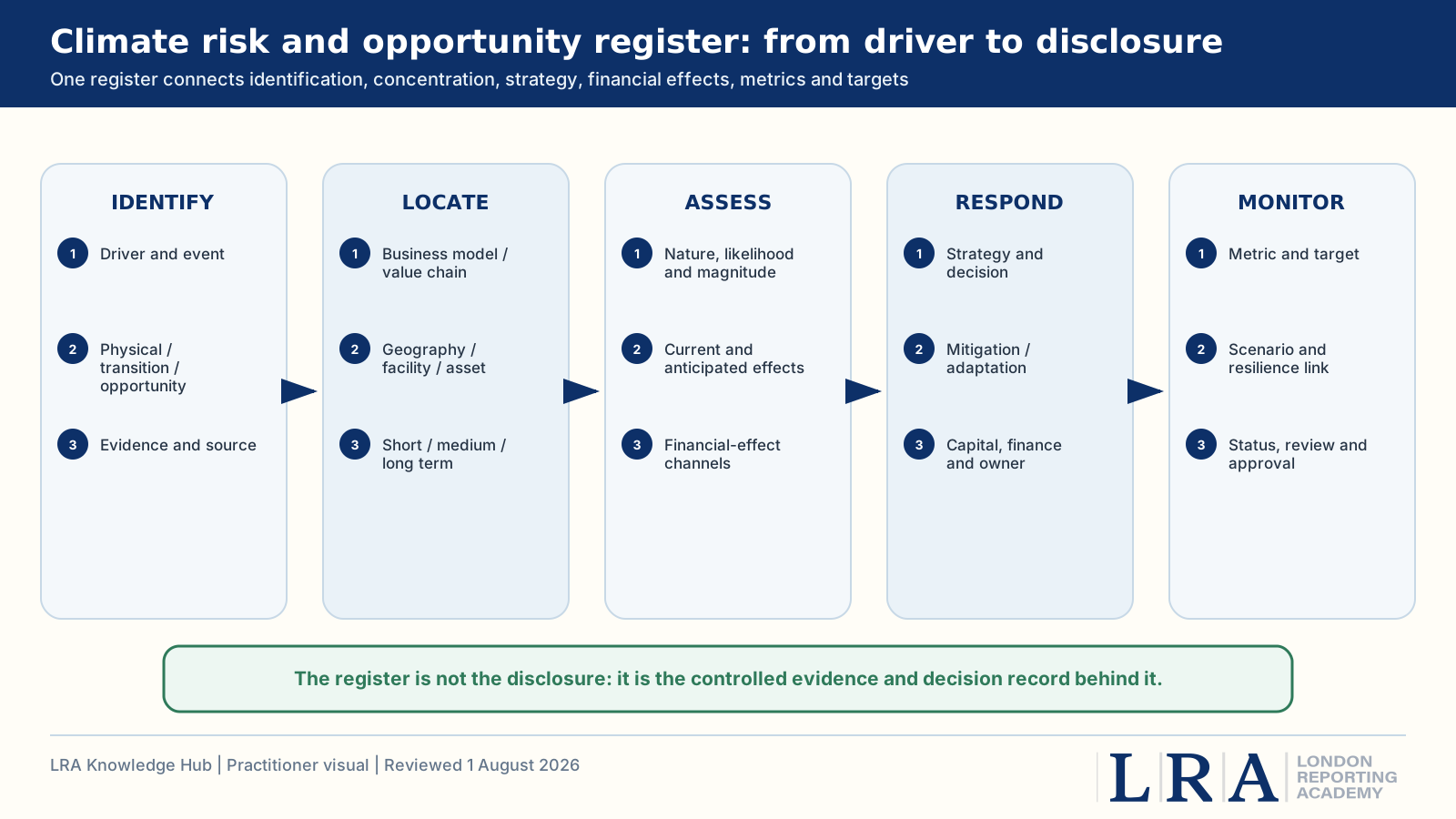
1. Locate each risk or opportunity in the business model and value chain, including the relevant geography, facility, asset type, supplier, customer or portfolio.
2. Identify current and anticipated effects on operations, demand, supply, financing and the related financial statement channels.
3. Record how strategy and decision-making respond, including current and anticipated business-model changes, direct and indirect mitigation or adaptation, and any transition plan.
4. Connect the response to resource allocation: capital expenditure, operating expenditure, research and development, workforce, acquisitions, divestments, financing and partnership activity.
5. Link the register to current and anticipated financial effects and the assumptions used in financial planning.
6. Use scenario analysis to test resilience and update the response, decision points and residual exposure.
7. Select cross-industry, industry-based and entity-specific metrics and targets that monitor the identified items and the effectiveness of the response.
In practice
Metrics and targets should mirror the register
| Register conclusion | Possible IFRS S2 metric connection |
|---|---|
| Material transition-risk exposure | Amount and percentage of assets or business activities vulnerable to transition risks, plus relevant industry-based metrics. |
| Material physical-risk exposure | Amount and percentage of assets or business activities vulnerable to physical risks, with location or asset-type disaggregation where material. |
| Climate-related opportunity | Amount and percentage of assets or business activities aligned with the opportunity, supported by a controlled definition. |
| Strategic response | Capital expenditure, financing or investment deployed towards climate-related risks and opportunities. |
| Carbon-related decision tool | Internal carbon price, how it is used and the price per metric tonne. |
| Management accountability | Whether and how climate considerations affect executive remuneration and the relevant percentage. |
| Performance goal | Target scope, metric, objective, period, baseline, milestones, review process and performance trend. |
Hypothetical case: food and logistics group
A hypothetical food producer owns two processing plants, contracts refrigerated logistics and sources crops from water-stressed regions. It identifies acute flood risk at one plant, chronic heat and water stress in the upstream supply chain, a transition risk from refrigerant regulation, and an opportunity to provide lower-emission product lines to major retailers.
The register locates the flood risk at a specific facility, the water risk in named sourcing regions, and refrigerant exposure in owned and contracted cold-chain assets. Financial-effect channels include interruption, input prices, equipment replacement, insurance and customer revenue. The response includes flood protection, supplier diversification, refrigerant replacement capex and product-development expenditure. Metrics and targets are selected for the relevant exposure and response; the opportunity is not reported as realised revenue until the customer pipeline and economics support that conclusion.
In practice
Weak versus stronger disclosure
| Weak wording | Stronger, evidence-linked wording |
|---|---|
| “Climate change may affect our operations.” | Identifies the physical or transition risk, affected facility or value-chain segment, time horizon and anticipated effect channel. |
| “We see significant opportunities in green products.” | Defines the opportunity, qualifying products or activities, evidence of demand, timing, capital required and uncertainty. |
| “Risks are managed through our enterprise risk framework.” | Explains the climate-specific inputs, assessment criteria, prioritisation, monitoring, integration and changes from the prior period. |
| “We are investing in resilience.” | States the current and planned investment, decision rationale, scope, timing and effect on the identified vulnerability. |
| “The risk is long term.” | Defines the long-term horizon and links it to asset lives, strategic planning and capital allocation. |
Common mistakes
Beginning with a generic list of climate themes instead of the entity’s business model, assets, value chain and prospects.
Treating physical and transition risks as mutually exclusive when one exposure has both drivers.
Listing opportunities without evidence that they are available to the entity or capable of affecting prospects.
Using one horizon definition that is disconnected from strategic planning, asset lives and financial planning.
Reporting a global risk score without explaining material geographic, asset or business-model concentrations.
Describing policies and ambitions without resource allocation, financial-effect channels, metrics or progress.
Using scenario analysis as a separate climate report rather than an input to risk identification and resilience.
Netting opportunities against risks or presenting gross opportunity figures without definitions and controls.
Failing to reconcile the climate register to the financial-effects analysis, targets and related financial statements.
Myth
Once a climate risk register has been approved, IFRS S2 strategy and metrics disclosures can be populated automatically from the risk titles and scores.
Reality
The register is an evidence and decision backbone. Material disclosures still require entity-specific explanations of concentrations, strategy, financial effects, resilience, processes, metrics, targets, uncertainty and connected information.
Readiness
Climate risk and opportunity review checklist
- The population includes physical risks, transition risks and opportunities across the reporting entity and relevant value chain.
- Every identified risk is classified and linked to a defined time horizon.
- Reasonable and supportable internal and external information has been considered without undue cost or effort.
- Applicable industry-based disclosure topics have been reviewed.
- Concentrations are identified by geography, facility, asset, activity, product, supplier, customer or portfolio where material.
- The assessment explains nature, likelihood, magnitude, uncertainty and prioritisation rather than only a colour score.
- Strategy, direct and indirect responses, resource allocation and progress are linked to the identified items.
- Current and anticipated financial-effect channels reconcile to financial planning and related disclosures.
- Scenario analysis and the annual resilience assessment update the register and decision record.
- Metrics and targets monitor the exposure, response and outcome with controlled definitions and boundaries.
- Governance ownership, review, approval, residual exposure and change history are retained.
In practice
Related requirements and next steps
| Relation | Reference | Why it matters |
|---|---|---|
| Direct | IFRS S2 paragraphs 10-14 | Identification, classification, horizons, concentrations and strategy response. |
| Direct | IFRS S2 paragraphs 15-22 | Current and anticipated financial effects and climate resilience. |
| Direct | IFRS S2 paragraphs 25 and 29-37 | Risk-management processes, cross-industry metrics, industry metrics and targets. |
| Supporting | IFRS S1 paragraphs 11-23 and 74-82 | Fair presentation, materiality, connected information, judgements and uncertainty. |
| Next step | IFRS S2 Scenario Analysis | Test the register under a proportionate range of climate futures. |
Physical risks arise from acute events or chronic climate changes affecting assets, operations or the value chain. Transition risks arise from policy, legal, technology, market, reputation or financing changes associated with a lower-carbon economy; each risk is classified and connected to the entity's prospects and time horizons.
An opportunity should be supported by evidence that it is available to the entity and can affect cash flows, access to finance or cost of capital over the relevant time horizon. Record its source, business-model or value-chain location, uncertainty, financial-effect channels, strategic response, resources, metrics, owner and review status.
A climate register should give each risk or opportunity a stable identifier and record its type, evidence, business-model or value-chain location, time horizon, likelihood and magnitude, financial-effect channels, response, resources, metrics, scenario link and governance status. The same item should be traceable across risk, strategy, finance and reporting files.
Locate each risk or opportunity in the relevant geography, facility, asset, supplier, customer, portfolio or other business-model or value-chain concentration. Then explain the current and anticipated effects, strategic response and related resource allocation, including capital expenditure, operating expenditure, research and development, workforce, financing or transactions.
Questions
Questions people ask
What are physical and transition risks?
Physical risks arise from acute events or chronic climate changes affecting assets, operations or the value chain. Transition risks arise from policy, legal, technology, market, reputation or financing changes associated with a lower-carbon economy; each risk is classified and connected to the entity's prospects and time horizons.
How should opportunities be evidenced?
An opportunity should be supported by evidence that it is available to the entity and can affect cash flows, access to finance or cost of capital over the relevant time horizon. Record its source, business-model or value-chain location, uncertainty, financial-effect channels, strategic response, resources, metrics, owner and review status.
What belongs in a climate register?
A climate register should give each risk or opportunity a stable identifier and record its type, evidence, business-model or value-chain location, time horizon, likelihood and magnitude, financial-effect channels, response, resources, metrics, scenario link and governance status. The same item should be traceable across risk, strategy, finance and reporting files.
How are concentrations and capital deployment disclosed?
Locate each risk or opportunity in the relevant geography, facility, asset, supplier, customer, portfolio or other business-model or value-chain concentration. Then explain the current and anticipated effects, strategic response and related resource allocation, including capital expenditure, operating expenditure, research and development, workforce, financing or transactions.
Sources
Primary sources
- IFRS S2 Climate-related Disclosures, including December 2025 amendments
- IFRS S1 General Requirements for Disclosure of Sustainability-related Financial Information
- Disclosing information about an entity's climate-related transition, including transition plans, in accordance with IFRS S2 (June 2025)
- Climate resilience and climate-related scenario analysis requirements in IFRS S2 - factsheet (March 2026)
- Using ISSB Industry-based Guidance when applying ISSB Standards (July 2025)
Framework references
Disclosures this page affects
Take it with you
The checklists as a working spreadsheet
Every checklist and table on this page, with empty status, owner and evidence columns for your team to fill in and keep.
✓ Knowledge Hub AI Assistant · Human-in-the-loop

Ask about this guide
It answers from this page, and reaches into the linked disclosure cards when your question is about the standard itself.
Go deeper · IFRS S1 / S2
Certified IFRS S1 & S2 (ISSB) Applied Sustainability Reporting
This page settles one requirement. The IFRS S1 & S2 course walks the whole ISSB workflow — governance, strategy, risk management, metrics and targets — with drafting exercises on your own data.