Short answer
The answer, before the reasoning
IFRS S1 already requires disclosure of material nature-related risks and opportunities that could reasonably be expected to affect an entity’s prospects. Dependencies on nature and impacts on nature are important because they can create physical, transition, systemic and opportunity pathways to cash flows, access to finance or cost of capital.
The entity applies IFRS S1, refers to and considers relevant SASB disclosure topics and metrics, and may use other permitted sources. TNFD, including the LEAP approach, can provide a practical assessment structure, but it is supporting guidance rather than a substitute for IFRS S1. As at 1 August 2026, the ISSB nature-related Practice Statement remained an exposure-draft project, not a final separate Standard.
Rule
IFRS-NAT-001
Nature-Related Risks Under IFRS S1: How TNFD and SASB Can Support Disclosure From dependencies and impacts to material risks, opportunities, location-specific evidence and entity-specific metrics
In practice
Type
| Type | Tier | Audience — Current context |
|---|---|---|
| Nature-related risk identification and disclosure guide | Tier 4 · Expert Guide | Reporting, finance, risk, strategy, procurement, operations, nature specialists and assurance teams — IFRS S1, TNFD and ISSB nature-project status checked to 1 August 2026 |
Why this question matters
The practical risk is not a lack of terminology. It is that a familiar framework, dataset or metric is treated as a complete reporting conclusion without testing the governing IFRS requirements, materiality, evidence and publication claim.
Quick orientation
Quick orientation
- Applies to
- Entities with material dependencies or impacts involving water, land, ecosystems, biodiversity, pollution, raw materials or nature-related value-chain exposures.
- Primary decision
- Which nature interfaces create risks or opportunities that could affect prospects, and what material information is needed?
- Key sources
- IFRS S1, SASB Standards, CDSB water/biodiversity guidance, TNFD Recommendations and LEAP guidance.
- Common confusion
- Reporting dependencies and impacts as ends in themselves without translating them into investor-relevant risk or opportunity pathways.
Why dependencies and impacts matter under IFRS S1
IFRS S1 explains that sustainability-related risks and opportunities arise from the entity’s interactions with stakeholders, society, the economy and the natural environment across the value chain. The entity both depends on resources and relationships and affects them. Degradation, depletion, preservation or regeneration can therefore change operational continuity, input costs, market access, regulation, reputation, financing or strategic options.
A nature assessment should not stop at “the company uses water” or “the company affects biodiversity”. It should identify the mechanism through which the dependency or impact can affect the entity’s prospects. The same impact can generate different financial pathways depending on location, ecological condition, regulation, stakeholder response and the substitutability of the resource.
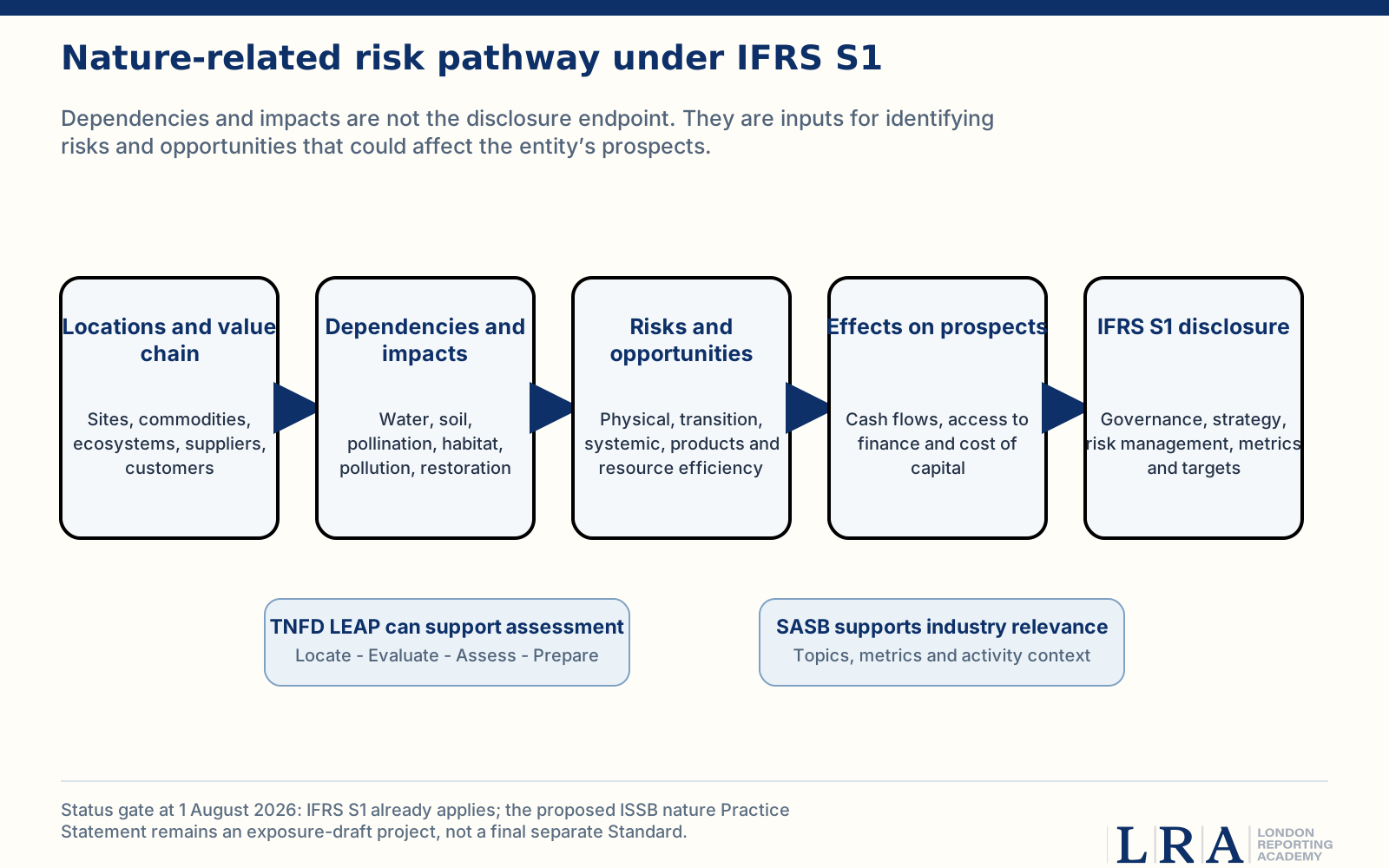
The IFRS S1 identification chain
In practice
| Stage | Question | Evidence |
|---|---|---|
| 1. Map interfaces | Where does the business model and value chain interact with nature? | Sites, commodities, suppliers, products, financing portfolios, geospatial and operational data. |
| 2. Identify dependencies and impacts | Which ecosystem services or natural resources are relied on or affected? | Water, soil, pollination, climate regulation, habitat, land conversion, pollution and restoration evidence. |
| 3. Translate to risks and opportunities | How could those dependencies or impacts create physical, transition, systemic or opportunity pathways? | Risk drivers, regulation, stakeholder evidence, market trends, technology and scenario information. |
| 4. Assess effects on prospects | Could the pathway affect cash flows, access to finance or cost of capital over the short, medium or long term? | Financial planning, asset exposure, procurement, revenue, cost, capex, financing and sensitivity analysis. |
| 5. Identify material information | What information could influence primary-user decisions in the complete report? | Materiality judgement, user needs, magnitude, likelihood, timing and qualitative factors. |
| 6. Disclose and govern | How are governance, strategy, risk management, metrics and targets connected? | Board papers, policies, actions, metrics, assumptions, limitations and approvals. |
In practice
How TNFD LEAP can support the process
| LEAP phase | Useful contribution to IFRS S1 work | Control needed |
|---|---|---|
| Locate | Prioritises business activities and locations where interaction with nature may be important. | Do not assume every priority location produces material IFRS information. |
| Evaluate | Identifies dependencies and impacts, including their drivers and condition. | Use consistent definitions, evidence and value-chain boundaries. |
| Assess | Translates dependencies and impacts into risks and opportunities and prioritises them. | Apply IFRS S1 prospects and materiality tests; retain assumptions and uncertainty. |
| Prepare | Supports strategy, target, metric and disclosure preparation. | Align with IFRS S1 core content, sources, timing and compliance requirements. |
Technical status
STATUS DISTINCTION
TNFD is not a separate route to an IFRS S1 compliance statement. IFRS S1 remains the governing Standard. The ISSB had permitted balloting of an exposure draft of a proposed nature-related Practice Statement by July 2026, with an exposure draft planned for October 2026. It was not a final pronouncement at the source-check date.
Using SASB and other sources proportionately
IFRS S1 requires an entity to refer to and consider the applicability of SASB disclosure topics when identifying sustainability-related risks and opportunities and the associated SASB metrics when identifying information to disclose in the absence of a specific ISSB Standard. This is particularly useful for nature because risks and metrics differ substantially by industry.
The entity may also consider the CDSB water and biodiversity application guidance, other investor-focused standard setters and relevant peers. TNFD can be considered as a practical source where it helps identify or explain information that is relevant and faithfully representative and does not conflict with IFRS S1. The source used, industry applied and significant judgements should be traceable.
In practice
Nature risk and opportunity register fields
| Field | What to record | Review question |
|---|---|---|
| Interface | Entity, activity, location, ecosystem, commodity and value-chain relationship. | Is the geographic and operational context specific enough? |
| Dependency or impact | Resource/service depended on or affected, direction, scale and condition. | Is this an evidenced interaction rather than a generic sector assumption? |
| Risk or opportunity pathway | Physical, transition, systemic or opportunity mechanism. | How does the dependency or impact translate into an entity-level exposure? |
| Time horizon and concentration | Short/medium/long term; location, supplier, customer, asset or portfolio concentration. | Could aggregation conceal a material hotspot? |
| Effect on prospects | Revenue, cost, assets, liabilities, capex, access to finance or cost of capital. | Is the financial pathway plausible and connected to planning? |
| Response | Avoidance, mitigation, adaptation, restoration, substitution, engagement or product opportunity. | Is the response funded, governed and measurable? |
| Metrics and evidence | SASB or entity-specific metrics, baselines, methods, data quality and limitations. | Does the metric measure the risk/opportunity, not merely activity? |
Location, value chain and aggregation
Nature-related information is often location-specific because ecological condition and regulatory or stakeholder context vary across sites. A group-wide total can obscure a material operation in a water-stressed basin or a supplier dependency concentrated in a high-biodiversity area. IFRS S1 does not prescribe a universal geospatial method, but fair presentation and the aggregation requirements can make location or value-chain disaggregation necessary when it is material.
The reporting entity remains the same as the related financial statements. The assessment, however, considers dependencies and impacts throughout the value chain when they give rise to risks or opportunities affecting the reporting entity’s prospects.
Hypothetical example: ingredient sourcing and water stress
A hypothetical beverage producer depends on reliable water supply and agricultural ingredients. A group-wide water-withdrawal number appears stable, but the nature assessment identifies two high-volume sites in stressed basins and a concentrated crop supply chain exposed to soil degradation and pollinator decline.
The entity uses TNFD LEAP to structure location and dependency analysis, refers to relevant SASB topics and metrics, and links the findings to production disruption, input-price volatility, capital expenditure for water efficiency and supplier diversification. The published IFRS S1 disclosure focuses on the material risk pathways, strategic response, financial implications, metrics and limitations rather than reproducing the entire impact inventory.
Hypothetical scenario
ILLUSTRATIVE WORDING - ADAPT TO FACTS
Our highest-priority nature-related exposure arises from water dependency at two production sites and from the concentration of agricultural inputs in regions experiencing soil degradation. We identified these exposures through site and supplier assessment, including location-specific data and relevant industry guidance. The risks could affect production continuity, input costs and planned capital expenditure over the short and medium term. We are expanding basin-level monitoring and supplier diversification; quantitative financial effects remain subject to measurement uncertainty because supplier-level data is incomplete. The board risk committee reviewed the assessment and the related response plan in June 20X6.
Illustrative only. It shows how the decision is made, not wording that can be copied or relied on.
In practice
Weak versus stronger nature disclosure
| Weak disclosure | Stronger disclosure |
|---|---|
| “Biodiversity is important to our company.” | Identifies the dependency or impact, location, risk pathway, time horizon, strategic response and limitation. |
| Lists hectares restored as proof of resilience. | Explains what outcome is expected, how it affects the risk and what evidence supports effectiveness. |
| Reports a global water total only. | Disaggregates material locations and explains basin context and operational concentration. |
| States “aligned with TNFD and IFRS S1”. | Describes TNFD as a supporting assessment method and separately states the IFRS basis of preparation. |
Common mistakes
Treating a biodiversity impact list as a complete IFRS S1 risk and opportunity assessment.
Using TNFD terminology without explaining the connection to the entity’s prospects.
Ignoring location-specific concentrations or value-chain dependencies.
Reporting only negative physical risks and overlooking transition risks and opportunities.
Selecting metrics because they are available rather than because they inform the material risk or opportunity.
Presenting proposed ISSB nature content as issued requirements.
Using a “TNFD aligned” claim as evidence of IFRS S1 compliance.
Readiness
Nature disclosure readiness checklist
- Material activities, locations and value-chain interfaces with nature are mapped.
- Dependencies and impacts are evidenced and translated into risk or opportunity pathways.
- Effects on cash flows, finance or cost of capital are assessed across time horizons.
- SASB topics and metrics have been referred to and considered.
- Use of TNFD, CDSB or other sources is documented and does not conflict with IFRS S1.
- Location-specific information and disaggregation are considered.
- Entity-specific metrics have definitions, methods, assumptions and limitations.
- Governance, strategy, risk management, metrics and targets are connected.
- The status of the ISSB nature project is accurately described and update triggers are active.
In practice
Related requirements and next steps
| Relation | Reference | Why it matters |
|---|---|---|
| Direct | IFRS S1 paragraphs 2-3, 11-18, 54-59 and B2-B12 | Dependencies, impacts, prospects, materiality and sources of guidance. |
| Supporting | SASB Standards and CDSB water/biodiversity guidance | Industry and topic-specific identification and metrics. |
| Supporting | TNFD Recommendations and LEAP guidance | Practical assessment structure and nature-specific concepts. |
| Update | ISSB Nature-related Disclosures project | Status of proposed incremental Practice Statement. |
Questions
Questions people ask
Does IFRS S1 already require nature disclosure?
IFRS S1 already requires disclosure of material nature-related risks and opportunities that could reasonably be expected to affect an entity’s prospects. Dependencies on nature and impacts on nature are important because they can create physical, transition, systemic and opportunity pathways to cash flows, access to finance or cost of capital.
Is TNFD mandatory under IFRS S1?
TNFD is not a separate route to an IFRS S1 compliance statement. IFRS S1 remains the governing Standard. TNFD can be considered as a practical source where it helps identify or explain information that is relevant and faithfully representative and does not conflict with IFRS S1.
How should dependencies and impacts be used?
The reporting entity remains the same as the related financial statements. The assessment, however, considers dependencies and impacts throughout the value chain when they give rise to risks or opportunities affecting the reporting entity’s prospects.
Is there a final ISSB nature Standard?
TNFD, including the LEAP approach, can provide a practical assessment structure, but it is supporting guidance rather than a substitute for IFRS S1. As at 1 August 2026, the ISSB nature-related Practice Statement remained an exposure-draft project, not a final separate Standard.
Sources
Primary sources
- IFRS S1 General Requirements
- ISSB materiality educational material
- ISSB Nature-related Disclosures project and July 2026 update
- ISSB proposed way forward for nature-related disclosures, May 2026
- TNFD Recommendations
- TNFD LEAP approach guidance
- Using ISSB Industry-based Guidance when applying ISSB Standards
Framework references
Disclosures this page affects
Take it with you
The checklists as a working spreadsheet
Every checklist and table on this page, with empty status, owner and evidence columns for your team to fill in and keep.
✓ Knowledge Hub AI Assistant · Human-in-the-loop

Ask about this guide
It answers from this page, and reaches into the linked disclosure cards when your question is about the standard itself.
Go deeper · IFRS S1 / S2
Certified IFRS S1 & S2 (ISSB) Applied Sustainability Reporting
This page settles one requirement. The IFRS S1 & S2 course walks the whole ISSB workflow — governance, strategy, risk management, metrics and targets — with drafting exercises on your own data.