Short answer
The answer, before the reasoning
When no IFRS Sustainability Disclosure Standard specifically applies to a sustainability-related risk or opportunity, IFRS S1 requires the entity to use judgement to identify information that is relevant to primary-user decisions and faithfully represents the risk or opportunity. The entity must refer to and consider applicable SASB metrics.
It may consider CDSB application guidance, other investor-focused standard setters and relevant peer information to the extent permitted, and may consider GRI and ESRS under Appendix C when those sources help meet IFRS S1 and do not conflict with ISSB requirements or obscure material information. If the entity develops a metric, it must explain its definition, type, validation, method, inputs, limitations and assumptions, and identify the sources and significant judgements used.
Rule
IFRS-SRC-001
IFRS S1 Company-Specific Disclosures: What to Do When No Dedicated ISSB Standard Exists Source hierarchy, SASB and CDSB guidance, GRI/ESRS/TNFD considerations, metric design and disclosure of judgement
In practice
Type
| Type | Tier | Audience — Current context |
|---|---|---|
| Company-specific disclosure and source-hierarchy guide | Tier 4 · Expert Guide | Reporting, finance, risk, sustainability, data, legal, investor-relations and assurance teams — IFRS S1 issued text and implementation materials checked to 1 August 2026 |
Why this question matters
The practical risk is not a lack of terminology. It is that a familiar framework, dataset or metric is treated as a complete reporting conclusion without testing the governing IFRS requirements, materiality, evidence and publication claim.
Quick orientation
Quick orientation
- Applies to
- Material sustainability-related risks and opportunities not covered by a dedicated ISSB Standard or not fully addressed by available industry guidance.
- Primary decision
- Which sources and entity-specific information best meet IFRS S1 relevance and faithful-representation objectives?
- Key sources
- IFRS S1 paragraphs 45-59, 72-75, Appendix C and accompanying guidance.
- Common confusion
- Treating the absence of a dedicated Standard as permission to invent arbitrary KPIs or to apply another framework instead of IFRS S1.
The governing rule is IFRS S1 judgement, not framework shopping
The absence of a dedicated ISSB topical Standard does not remove the disclosure obligation. IFRS S1 requires the entity to identify sustainability-related risks and opportunities that could reasonably be expected to affect its prospects and to provide material information about them. The source hierarchy helps the entity identify information; it does not transfer the compliance basis to the external source.
The selected information must be relevant to investor decisions and faithfully represent the risk or opportunity. The entity also applies fair presentation, materiality, aggregation, connected information, reporting-entity, timing, comparative and judgement requirements. A metric can therefore be well known in another framework yet still be unsuitable if its scope, definition or objective does not meet the IFRS S1 information need.
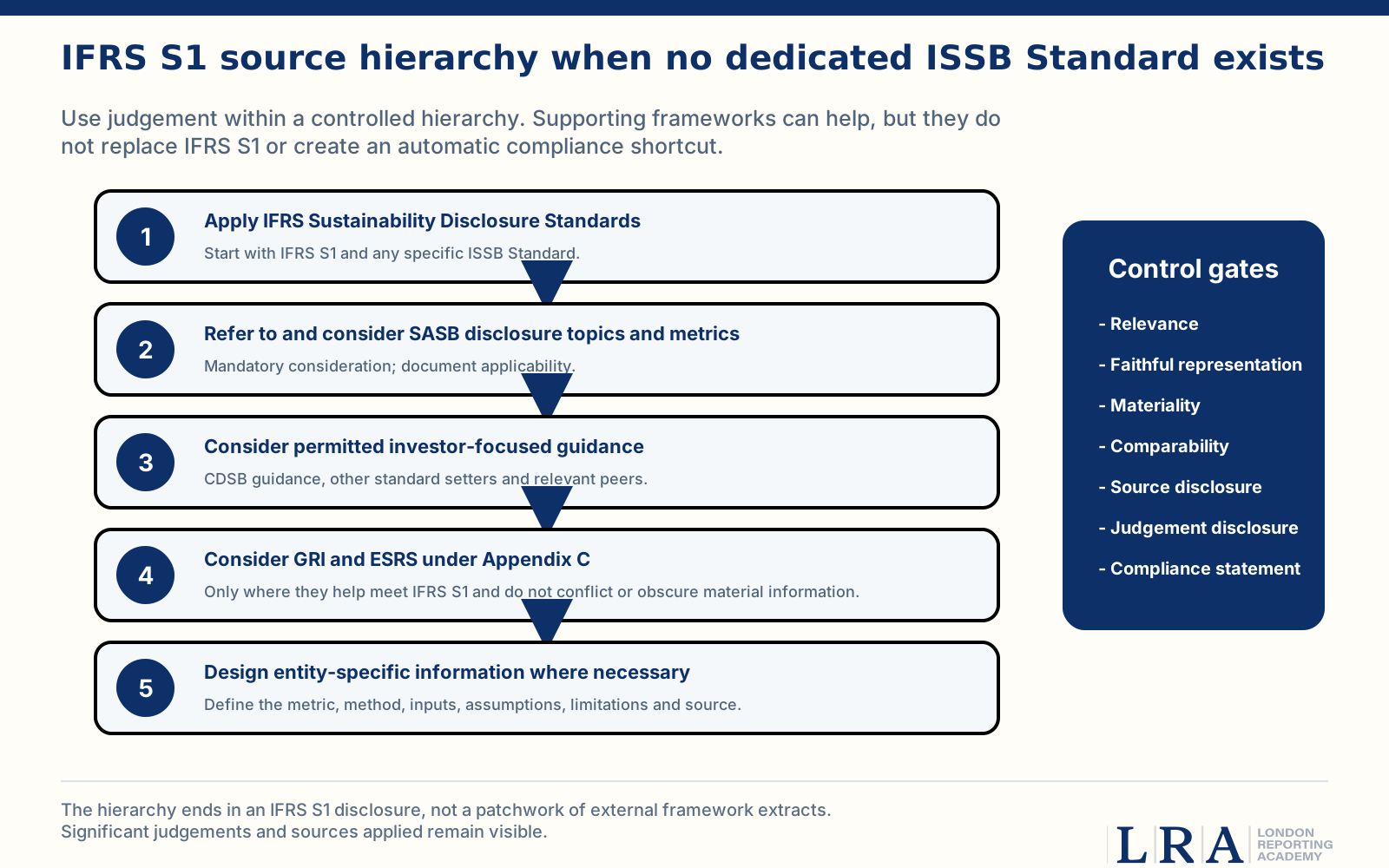
Source hierarchy under IFRS S1
In practice
| Priority | Source and status | How to use it |
|---|---|---|
| 1 | IFRS Sustainability Disclosure Standards - apply | Apply IFRS S1 and any Standard that specifically addresses the risk or opportunity. |
| 2 | SASB disclosure topics and metrics - refer to and consider | Mandatory consideration for identifying risks/opportunities and applicable metrics; the entity can conclude a topic or metric is not applicable. |
| 3 | CDSB water/biodiversity guidance, other investor-focused standard setters and relevant peers - may consider | Use only to the extent permitted and, for disclosure requirements, where they do not conflict with ISSB Standards. |
| 4 | GRI and ESRS under IFRS S1 Appendix C - may consider | Use where they assist the IFRS S1 objective and do not conflict or obscure material ISSB information. |
| 5 | Entity-specific information - develop where necessary | Design narrative or metrics that fill the information gap and meet relevance, faithful representation and qualitative characteristics. |
In practice
Decision logic for a missing topical Standard
| Decision question | Possible conclusion | Documentation |
|---|---|---|
| Is there a specific ISSB Standard? | Apply it together with IFRS S1. | Applicable requirement map. |
| Which SASB industries, topics and metrics fit the actual activities? | Use relevant guidance; record why other topics or metrics are not applicable. | Industry and applicability matrix. |
| Does the information identified meet relevance and faithful representation? | Retain, adapt, disaggregate or reject the candidate information. | Materiality and qualitative-characteristics assessment. |
| Would CDSB, another investor standard setter or peer information help? | Use as a supporting source if permitted and non-conflicting. | Source, version and difference note. |
| Would GRI or ESRS help identify a disclosure? | Use under Appendix C only within the IFRS S1 objective and without obscuring ISSB information. | Appendix C assessment and residual differences. |
| Is material information still missing? | Develop entity-specific narrative or a metric. | Metric definition sheet and governance approval. |
| Are sources and judgements visible? | Disclose sources applied, industries used and significant judgements where required. | Published basis and internal judgement log. |
Using GRI, ESRS and TNFD without changing the reporting objective
IFRS S1 explicitly permits consideration of GRI and ESRS in Appendix C when they help the entity meet the IFRS S1 objective and do not conflict with ISSB Standards. This permission is useful where another framework contains a mature topic-specific disclosure. It does not mean that the entire framework, its materiality lens or its compliance claim is imported into the IFRS disclosure.
TNFD is not named in Appendix C. An entity may consider it through the broader permitted-source logic only when it is an appropriate investor-focused source and helps produce relevant, faithfully representative information without conflict. The entity should document the basis for using TNFD, the specific recommendation or metric considered and any adjustments made for IFRS S1.
In practice
Company-specific metric design sheet
| Field | Required or useful content | Control question |
|---|---|---|
| Metric name and purpose | Clear name and the risk or opportunity it informs. | Would a primary user understand why this metric matters? |
| Definition and source | Definition, any source metric adjusted and the difference from that source. | Is the metric genuinely entity-specific or merely relabelled? |
| Type and unit | Absolute, relative or qualitative; unit and denominator. | Can performance and trend be interpreted consistently? |
| Boundary and period | Entities, sites, value-chain scope, geography and reporting period. | Does the boundary reconcile to the disclosure and financial reporting context? |
| Method and inputs | Formula, systems, factors, transformations and data-quality hierarchy. | Can the number be recalculated and reviewed? |
| Assumptions and limitations | Estimates, proxies, exclusions, uncertainty and sensitivity. | Could a limitation change a primary user’s interpretation? |
| Validation and controls | Third-party validation, internal review, reconciliations and approval. | Is validation described precisely without overstating assurance? |
| Comparatives and change | Prior-period basis, redefinition, replacement or restatement. | Has comparability been preserved or the change explained? |
In practice
Disclosure of sources and significant judgements
| What is disclosed | IFRS S1 basis | Practical drafting point |
|---|---|---|
| Source and metric taken from outside ISSB Standards | Paragraph 49 | Name the source and the metric; do not say merely “industry best practice”. |
| Entity-developed metric information | Paragraph 50 | Explain definition, type, validation, method, inputs, limitations and assumptions. |
| Sources of guidance applied and industries used | Paragraph 59 | Identify specific standards, pronouncements, industry practice and industries applied. |
| Judgements with the most significant effect | Paragraphs 74-75 | Explain decisions on risks/opportunities, sources and material information where significant. |
| Explicit and unreserved compliance statement | Paragraph 72 | Use only when all requirements are met; applying another framework alone is insufficient. |
Hypothetical example: cyber-related workforce capability
A hypothetical payment-services company identifies a sustainability-related opportunity and risk related to maintaining a skilled cyber-security workforce. No dedicated ISSB Human Capital Standard exists. The company refers to relevant SASB topics and metrics but concludes that the available metrics do not fully capture the concentration of critical skills and internal succession coverage.
It develops an entity-specific metric for the percentage of critical cyber roles with an approved successor meeting defined competence criteria. The metric definition identifies the role population, competence assessment, reporting date, exclusions, data owner and validation. The disclosure explains why the metric is relevant to service continuity and growth, identifies the SASB and internal sources used, and describes the significant judgement involved.
Hypothetical scenario
ILLUSTRATIVE WORDING - ADAPT TO FACTS
In preparing disclosures about cyber-workforce capacity, we applied IFRS S1 and referred to the disclosure topics and metrics in the applicable SASB industry guidance. We also considered peer disclosures. Because the available metrics did not fully represent our concentration in critical roles, we developed a metric measuring the proportion of designated cyber-security roles with an approved internal successor who has completed the required competence assessment. The metric covers the reporting entity’s operating companies at 31 December 20X6, excludes temporary vacancies and is reviewed by the chief people officer and chief information security officer. The role designation and competence criteria involve significant judgement and are reviewed annually.
Illustrative only. It shows how the decision is made, not wording that can be copied or relied on.
In practice
Weak versus stronger source use
| Weak approach | Stronger approach |
|---|---|
| “No ISSB Standard exists, so we used GRI instead.” | Applies IFRS S1, explains why specific GRI information was considered and retains ISSB materiality and compliance. |
| A custom KPI is published with no method. | Defines purpose, boundary, formula, inputs, assumptions, limitations, validation and comparatives. |
| Peer practice is treated as a mandatory benchmark. | Uses peers as an input, then tests relevance and faithful representation for the entity. |
| The source hierarchy is described only internally. | Identifies sources and significant judgements in the published disclosures where IFRS S1 requires. |
Common mistakes
Assuming “no dedicated Standard” means “no disclosure requirement”.
Skipping the mandatory SASB refer-and-consider step.
Importing another framework’s materiality conclusion without applying IFRS S1.
Using a peer metric without testing definition, boundary or investor relevance.
Creating a bespoke KPI that cannot be recalculated or compared.
Failing to identify the external source or explain how a metric was adjusted.
Obscuring material ISSB information with a large volume of immaterial framework content.
Making an unreserved compliance statement when ISSB requirements have not been fully applied.
Readiness
Company-specific disclosure checklist
- The risk or opportunity could reasonably be expected to affect the entity’s prospects.
- Any specifically applicable ISSB Standard has been applied.
- Relevant SASB topics and metrics have been referred to and considered.
- Permitted sources are current, investor-relevant and non-conflicting.
- Use of GRI or ESRS satisfies Appendix C conditions and does not obscure material information.
- Entity-specific metrics meet paragraph 50 definition and method disclosures.
- Sources, industries and significant judgements are identified where required.
- Materiality, aggregation, comparatives and connected information have been reviewed.
- The final compliance claim matches the complete basis of preparation.
In practice
Related requirements and next steps
| Relation | Reference | Why it matters |
|---|---|---|
| Direct | IFRS S1 paragraphs 45-59 | Metrics, sources and judgement when no specific Standard applies. |
| Direct | IFRS S1 Appendix C | Conditional use of GRI and ESRS. |
| Direct | IFRS S1 paragraphs 72-75 | Compliance statement and significant judgements. |
| Application | Nature and Human Capital guides | Examples of company-specific application before dedicated Standards exist. |
Questions
Questions people ask
What happens when no ISSB Standard applies?
When no IFRS Sustainability Disclosure Standard specifically applies to a sustainability-related risk or opportunity, IFRS S1 requires the entity to use judgement to identify information that is relevant to primary-user decisions and faithfully represents the risk or opportunity. The entity must refer to and consider applicable SASB metrics. It may consider CDSB application guidance, other investor-focused standard setters and relevant peer information to the extent permitted, and may consider GRI and ESRS under Appendix C when those sources help meet IFRS S1 and do not conflict with ISSB requirements or obscure material information.
Must SASB be used?
The entity must refer to and consider applicable SASB metrics. It may consider CDSB application guidance, other investor-focused standard setters and relevant peer information to the extent permitted, and may consider GRI and ESRS under Appendix C when those sources help meet IFRS S1 and do not conflict with ISSB requirements or obscure material information.
Can GRI or ESRS be used?
It may consider CDSB application guidance, other investor-focused standard setters and relevant peer information to the extent permitted, and may consider GRI and ESRS under Appendix C when those sources help meet IFRS S1 and do not conflict with ISSB requirements or obscure material information. If the entity develops a metric, it must explain its definition, type, validation, method, inputs, limitations and assumptions, and identify the sources and significant judgements used.
What must be disclosed for a company-specific metric?
If the entity develops a metric, it must explain its definition, type, validation, method, inputs, limitations and assumptions, and identify the sources and significant judgements used. The disclosure explains why the metric is relevant to service continuity and growth, identifies the SASB and internal sources used, and describes the significant judgement involved.
Sources
Primary sources
Framework references
Disclosures this page affects
Take it with you
The checklists as a working spreadsheet
Every checklist and table on this page, with empty status, owner and evidence columns for your team to fill in and keep.
✓ Knowledge Hub AI Assistant · Human-in-the-loop

Ask about this guide
It answers from this page, and reaches into the linked disclosure cards when your question is about the standard itself.
Go deeper · IFRS S1 / S2
Certified IFRS S1 & S2 (ISSB) Applied Sustainability Reporting
This page settles one requirement. The IFRS S1 & S2 course walks the whole ISSB workflow — governance, strategy, risk management, metrics and targets — with drafting exercises on your own data.