Short answer
The answer, before the reasoning
IFRS S1 requires an entity to refer to and consider the SASB Standards when identifying sustainability-related risks and opportunities and when identifying information to disclose. IFRS S2 applies the same mandatory refer-and-consider logic to the Industry-based Guidance on Implementing IFRS S2.
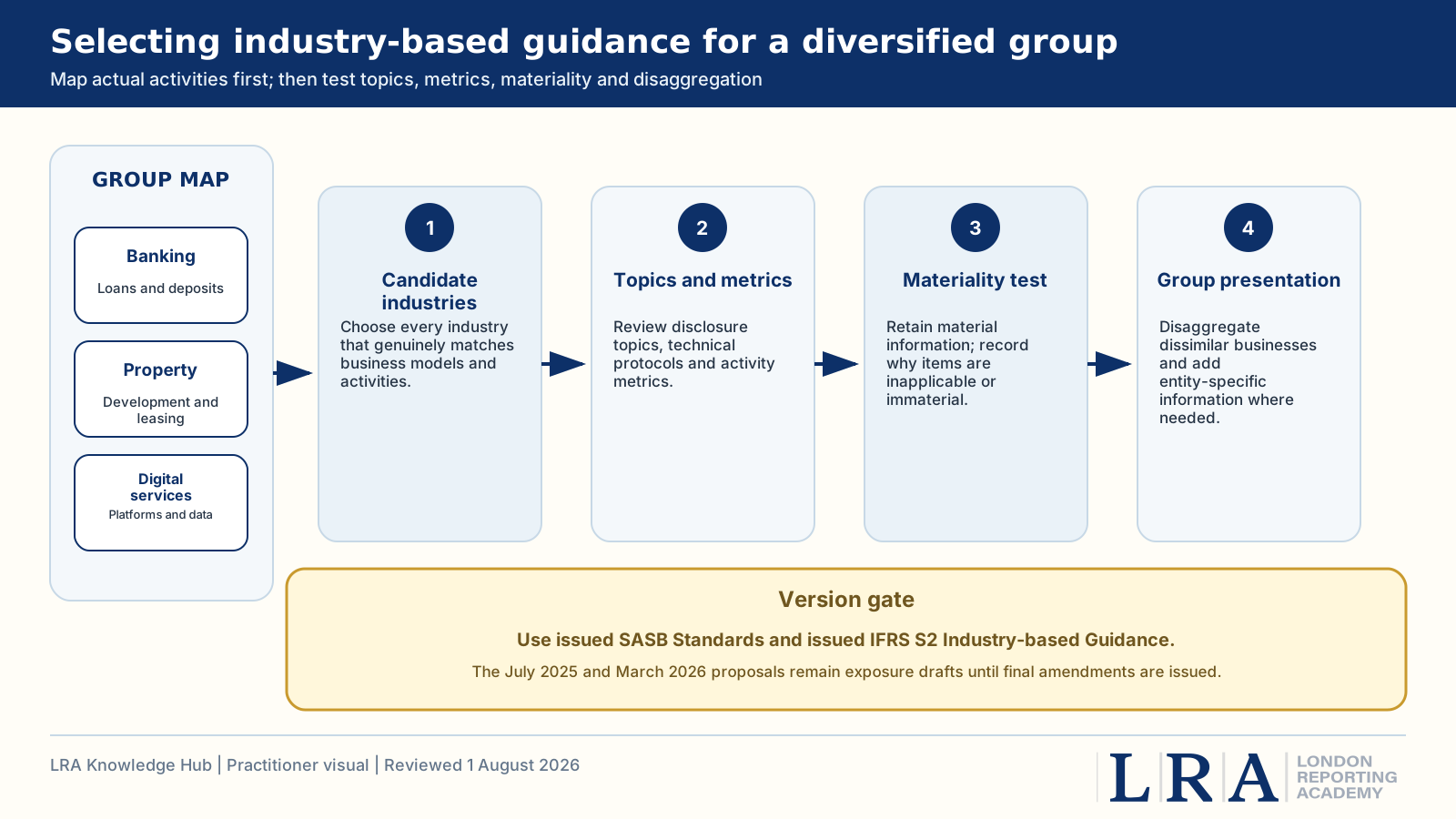
This does not mean that every industry, disclosure topic or metric must be reported. The entity selects the industry or industries that best match its actual business models and activities, considers the associated topics, metrics and activity metrics, then applies entity-specific materiality judgements. Diversified groups may need several industries and disaggregated information. Where guidance is inapplicable, insufficient or would obscure material information, the entity retains the judgement, adds entity-specific information and explains significant judgements when required.
Rule
IFRS-SAS-001
IFRS S1 and S2 Industry-Based Metrics: How to Select Relevant SASB Guidance A practical method for diversified groups, activity metrics, non-applicability and entity-specific information
In practice
Type
| Type | Tier | Audience — Current context |
|---|---|---|
| Industry-based metrics selection guide | Tier 3 · Deep Guide | Reporting, finance, risk, investor-relations, data and assurance teams — IFRS S1, IFRS S2 and issued SASB guidance checked to 1 August 2026; current proposals are separately flagged |
Why this is not a one-code exercise
Industry selection is not solved by copying the legal entity classification, the largest revenue code or the parent company description. A reporting group can operate several business models, expose investors to different sustainability-related drivers and use different operating measures in each part of the group. The purpose of the industry-based guidance is to help identify information that is likely to be useful, not to force the group into one label.
The mandatory action is to refer to and consider the guidance. The final disclosures remain governed by IFRS S1 and IFRS S2, including fair presentation, materiality, aggregation and disaggregation, connected information and the requirement to add information when specifically applicable requirements are insufficient.
Quick orientation
Quick orientation
- Applies to
- Groups selecting SASB Standards under IFRS S1 and IFRS S2 Industry-based Guidance, including entities with several industries or changing business models.
- Primary decision
- Which industries, disclosure topics, metrics and activity metrics are relevant to the reporting entity and to distinct parts of the group?
- Key requirements
- IFRS S1 paragraphs 54-59 and IFRS S2 paragraphs 12, 23, 28 and 32, read with the materiality and aggregation requirements.
- Common confusion
- Treating “refer to and consider” as either optional browsing or automatic application of every metric in one selected SASB Standard.
What “shall refer to and consider” means
“Shall” is mandatory. An entity cannot disregard the relevant industry-based guidance when applying the specified IFRS S1 and IFRS S2 requirements.
The guidance is assessed against the entity’s business model and activities. A topic or metric can be inapplicable to the entity’s circumstances or not material after consideration.
The exercise produces a population of potentially relevant risks, opportunities and information. It does not replace the entity’s materiality judgement.
Industry-based guidance does not override cross-industry IFRS S2 requirements, such as greenhouse gas emissions or the other cross-industry metric categories.
If the industry metrics do not provide enough decision-useful information, IFRS S1 can require additional entity-specific information.
Rule
IMPORTANT DISTINCTION
IFRS S1 does not require the entity to “apply the SASB Standards” as a separate compliance framework. It requires the entity to refer to and consider them as a source of guidance within the IFRS Sustainability Disclosure Standards process. IFRS S2 requires disclosure of industry-based metrics and requires the entity to refer to and consider the associated Industry-based Guidance.
A seven-step selection method
The following sequence is an LRA implementation method, not a prescribed checklist in IFRS S1 or IFRS S2. It is designed to make the required refer-and-consider judgement traceable.
In practice
| Step | Action | Evidence and control |
|---|---|---|
| 1. Fix the reporting entity | Start with the same reporting entity as the related financial statements. List consolidated subsidiaries, business units, operating segments and material value-chain exposures. | Group structure, segment note, management reporting and acquisition or disposal register. |
| 2. Map business models and activities | Describe how each material activity creates cash flows: products, services, customers, assets, technologies, locations and channels. | Business-model map approved by finance and operating management. |
| 3. Identify candidate industries | Select every SASB industry or IFRS S2 industry volume that reasonably matches a material activity. Do not stop at the parent’s primary code. | Industry-selection register with rationale, owner and version. |
| 4. Review topics and metrics | Consider disclosure topics, quantitative or narrative metrics, technical protocols and relevant activity metrics. | Topic-and-metric applicability matrix with exact standard version. |
| 5. Apply materiality | Assess whether the information could reasonably be expected to influence primary-user decisions in the context of the reporting entity. | Materiality conclusion, evidence, assumptions and reviewer challenge. |
| 6. Design presentation | Aggregate similar information and disaggregate information when aggregation would obscure material differences between industries, geographies or business models. | Presentation map reconciled to segment and management information. |
| 7. Add and govern entity-specific information | Add metrics or narrative information where the guidance is insufficient; identify significant judgements and the sources or industries applied where required. | Metric definition sheet, judgement note, governance approval and annual change review. |
Diversified groups and multiple industries
A diversified group can use more than one industry. The July 2025 IFRS Foundation educational material specifically recognises that an entity with activities in several industries may select several industry descriptions and apply metrics only to the relevant parts of the business. This is usually more faithful than forcing dissimilar operations into the largest segment.
In practice
| Group situation | Likely approach | Presentation consequence |
|---|---|---|
| One dominant business with a small ancillary activity | Start with the dominant industry and test whether the ancillary activity creates a separate material risk, opportunity or metric. | A single industry may be sufficient, with an entity-specific metric or separate note where needed. |
| Several material operating segments | Select the relevant industry for each segment or material activity. | Disaggregate metrics when combining them would conceal different drivers, units or performance. |
| New acquisition or disposal | Reassess the industry map and the population of topics and metrics. | Explain changes in sources, methodology, definitions or comparatives when material. |
| Material exposure through customers or the value chain | Consider whether another industry’s guidance helps identify the exposure, even if the entity does not operate in that industry. | Use the guidance as an identification input; do not imply that the entity belongs to that industry. |
| Platform or hybrid business model not neatly described | Use the closest relevant industries, then supplement with entity-specific information. | Explain the judgement and avoid a false sense of completeness from a poor-fit classification. |
Activity metrics and comparability
SASB activity metrics describe the scale of an activity or operation. They are intended to be used with performance metrics to provide operational context, support normalisation and facilitate comparison. Examples can include production volume, number of accounts, floor area, passenger kilometres or assets under management, depending on the industry.
An activity metric is not automatically material simply because it appears in a SASB Standard. The entity considers whether the measure is needed to interpret the related metric, whether its definition matches the business, whether the period and boundary are consistent, and whether an additional or alternative denominator would provide more useful information.
In practice
| Question | Review test |
|---|---|
| Does the metric explain scale? | Would a primary user interpret the performance metric differently without the activity measure? |
| Is the denominator stable? | Does it avoid artificial improvement caused by acquisitions, outsourcing, mix changes or idle capacity? |
| Is it comparable? | Are definitions, units, boundary and period consistent with the technical protocol and prior periods? |
| Is disaggregation needed? | Would one group-wide activity number mix unlike operations or conceal a material concentration? |
| Is an entity-specific measure better? | Does another operational measure more faithfully represent how management monitors the risk or opportunity? |
Entity-specific alternatives and additions
The correct response to a poor-fit metric is not to omit the issue silently. The entity first asks whether the disclosure topic is relevant but the specified metric is inapplicable, whether another metric in the same or another industry is more useful, and whether an entity-specific metric or narrative disclosure is required for fair presentation.
Preserve the underlying risk or opportunity even when the suggested metric is not suitable.
Define the entity-specific metric, unit, boundary, methodology, assumptions, data source and reason for use.
Explain changes to metrics or methodologies when they affect comparability.
Connect the metric to strategy, risk management, targets and financial effects rather than publishing an isolated number.
Avoid replacing an established comparable metric merely because an internal alternative makes performance look better.
Documenting non-applicability
The ISSB Standards do not prescribe a specific documentation file for the refer-and-consider process. However, a systematic process is expected, and documentation is often necessary for governance, internal control, assurance, regulatory review and consistent reassessment. The distinction matters: the register below is recommended implementation practice, not an additional disclosure requirement.
In practice
| Register field | What to retain |
|---|---|
| Industry and version | Exact SASB Standard or IFRS S2 Industry-based Guidance volume and issue date. |
| Business activity mapped | Entity, segment, product, service, geography or value-chain exposure considered. |
| Topic or metric | Identifier, title, unit and technical protocol reviewed. |
| Conclusion | Applicable and material; applicable but not material; metric inapplicable; or guidance insufficient. |
| Rationale and evidence | Facts, management information, risk assessment, peer information and user-needs analysis. |
| Alternative information | Entity-specific metric, another industry metric or narrative disclosure selected. |
| Presentation | Group-wide, segment, geography or other disaggregation. |
| Owner, reviewer and date | Prepared, challenged, approved and scheduled for reassessment. |
Hypothetical example: a group with three business models
A hypothetical listed group operates a commercial bank, a property-development and leasing business, and a digital payments platform. The parent’s legal classification is financial services, but the property segment represents a material share of assets and capital expenditure, while the platform creates distinct data-security, workforce and technology risks.
The group selects relevant guidance for commercial banking, real estate activities and digital-platform activities. It does not aggregate energy intensity, customer metrics or operational scale across the three businesses where the definitions and drivers differ. It uses relevant SASB activity metrics to explain scale, adds an entity-specific metric for platform service availability, and records why several real-estate metrics do not apply to developments sold before occupation. The group discloses the sources and industries applied and identifies the selection of multiple industries as a significant judgement where that information is material.
In practice
Weak versus stronger selection records
| Weak record | Stronger record |
|---|---|
| “Primary industry: Financials. All other SASB Standards not applicable.” | Maps each material business activity, identifies candidate industries and records topic- and metric-level conclusions. |
| “Metric omitted because data is unavailable.” | Separates inapplicability from a data gap, identifies the information need and records a remediation or alternative metric. |
| One group-wide denominator for unlike operations. | Uses activity metrics and disaggregation that preserve comparability and explain scale. |
| A custom KPI replaces the SASB metric without explanation. | Explains why the suggested metric is unsuitable, defines the alternative and preserves relevant comparable information where possible. |
| The 2025 or 2026 exposure draft is used as if final. | Uses issued standards, labels proposals separately and sets an update trigger for final amendments. |
Common mistakes
Selecting one industry solely from revenue, legal registration or a stock-exchange classification.
Assuming every metric in the selected SASB Standard is automatically required and material.
Treating activity metrics as optional decoration rather than testing whether they are needed for interpretation and comparability.
Aggregating dissimilar industries into one number that obscures materially different drivers or performance.
Using “not applicable” to conceal a data gap or an inconvenient result.
Ignoring value-chain or customer-industry exposure that is relevant to identifying risks and opportunities.
Failing to add entity-specific information where the guidance does not capture the business model.
Applying proposed amendments before they are issued without a clear early-adoption or version basis.
Myth
A group chooses one SASB industry, reports every metric in that Standard and has completed the IFRS S1 and IFRS S2 industry-based requirements.
Reality
The group must refer to and consider relevant guidance across its actual activities, apply materiality, disaggregate when needed and add entity-specific information where the guidance is insufficient.
Readiness
Selection and review checklist
- The reporting entity and operating segments reconcile to the financial statements.
- Material business models, activities and value-chain exposures are mapped before selecting industries.
- Every relevant candidate industry has been considered, not only the parent’s main classification.
- Topics, metrics, technical protocols and activity metrics have been reviewed at the correct level.
- Materiality is applied after consideration, with no automatic inclusion or exclusion.
- Aggregation and disaggregation preserve material differences and comparability.
- Entity-specific information fills genuine gaps without discarding useful comparable metrics.
- Non-applicability, alternatives and significant judgements are traceable and approved.
- The package identifies the issued version and separates exposure drafts from current requirements.
- Acquisitions, disposals and changes in business model trigger reassessment.
In practice
Related requirements and next steps
| Relation | Reference | Why it matters |
|---|---|---|
| Direct | IFRS S1 paragraphs 54-59 | Sources of guidance, metrics, identification of sources and significant judgements. |
| Direct | IFRS S2 paragraphs 12, 23, 28 and 32 | Industry-based topics and metrics for climate-related risks and opportunities. |
| Supporting | IFRS S1 paragraphs 11-18 and B13-B37 | Fair presentation, materiality, aggregation and additional information. |
| Supporting | SASB activity metrics and technical protocols | Scale, normalisation, definitions and comparability. |
| Next step | IFRS S2 Climate-Related Risks and Opportunities | Connect selected industry guidance to the risk and opportunity register. |
Document the exact industry guidance and metric reviewed, the mapped business activity, the applicability and materiality conclusion, and the facts and user-needs evidence supporting it. Record any alternative metric or narrative selected, the presentation basis, owner, reviewer, approval date and reassessment trigger.
Questions
Questions people ask
Must every SASB metric be disclosed?
IFRS S1 requires an entity to refer to and consider the SASB Standards when identifying sustainability-related risks and opportunities and when identifying information to disclose. IFRS S2 applies the same mandatory refer-and-consider logic to the Industry-based Guidance on Implementing IFRS S2. This does not mean that every industry, disclosure topic or metric must be reported.
Can a group use several industries?
A diversified group can use more than one industry. The July 2025 IFRS Foundation educational material specifically recognises that an entity with activities in several industries may select several industry descriptions and apply metrics only to the relevant parts of the business.
What are activity metrics?
SASB activity metrics describe the scale of an activity or operation. They are intended to be used with performance metrics to provide operational context, support normalisation and facilitate comparison.
How should non-applicability be documented?
Document the exact industry guidance and metric reviewed, the mapped business activity, the applicability and materiality conclusion, and the facts and user-needs evidence supporting it. Record any alternative metric or narrative selected, the presentation basis, owner, reviewer, approval date and reassessment trigger.
Sources
Primary sources
- IFRS S1 General Requirements for Disclosure of Sustainability-related Financial Information (June 2023)
- IFRS S2 Climate-related Disclosures, including December 2025 amendments
- Using ISSB Industry-based Guidance when applying ISSB Standards (July 2025)
- Using the SASB Standards to meet the requirements in IFRS S1 (February 2024)
- Understanding SASB Standards
- Enhancing the SASB Standards - Phase 1
- Amendments to the IFRS S2 Industry-based Guidance
Framework references
Disclosures this page affects
Take it with you
The checklists as a working spreadsheet
Every checklist and table on this page, with empty status, owner and evidence columns for your team to fill in and keep.
✓ Knowledge Hub AI Assistant · Human-in-the-loop

Ask about this guide
It answers from this page, and reaches into the linked disclosure cards when your question is about the standard itself.
Go deeper · IFRS S1 / S2
Certified IFRS S1 & S2 (ISSB) Applied Sustainability Reporting
This page settles one requirement. The IFRS S1 & S2 course walks the whole ISSB workflow — governance, strategy, risk management, metrics and targets — with drafting exercises on your own data.