Short answer
The answer, before the reasoning
IFRS S1 requires material information about human capital risks and opportunities when workforce-related dependencies, impacts or conditions could reasonably be expected to affect the entity’s prospects. The assessment can cover the entity’s own workforce and workers in the value chain, depending on the business model and exposure.
Relevant areas can include skills, capacity, health and safety, recruitment, retention, labour relations, engagement, working conditions and supplier practices. The entity refers to and considers applicable SASB disclosure topics and metrics and adds entity-specific information where necessary. As at 1 August 2026, the ISSB Human Capital project remained a research project; there was no dedicated final ISSB Human Capital Standard replacing the IFRS S1 judgement process.
Rule
IFRS-HC-001
Human Capital Disclosures Under IFRS S1: Risks, Opportunities and Industry Metrics Workforce dependencies, skills, safety, retention, labour relations, value-chain workers and financial prospects
In practice
Type
| Type | Tier | Audience — Current context |
|---|---|---|
| Human capital risk and metrics guide | Tier 4 · Expert Guide | Reporting, finance, HR, risk, operations, procurement, investor-relations and assurance teams — IFRS S1, SASB and the ISSB Human Capital research project checked to 1 August 2026 |
Why this question matters
The practical risk is not a lack of terminology. It is that a familiar framework, dataset or metric is treated as a complete reporting conclusion without testing the governing IFRS requirements, materiality, evidence and publication claim.
Quick orientation
Quick orientation
- Applies to
- Entities whose strategy and operating model depend materially on workforce skills, safety, availability, engagement, labour relations or value-chain labour.
- Primary decision
- Which workforce matters create risks or opportunities affecting prospects, and which metrics faithfully represent them?
- Key sources
- IFRS S1, applicable SASB Standards and ISSB Human Capital research materials.
- Common confusion
- Publishing a broad HR dashboard without connecting the measures to material risks, opportunities and financial pathways.
Start with the business dependency, not the HR catalogue
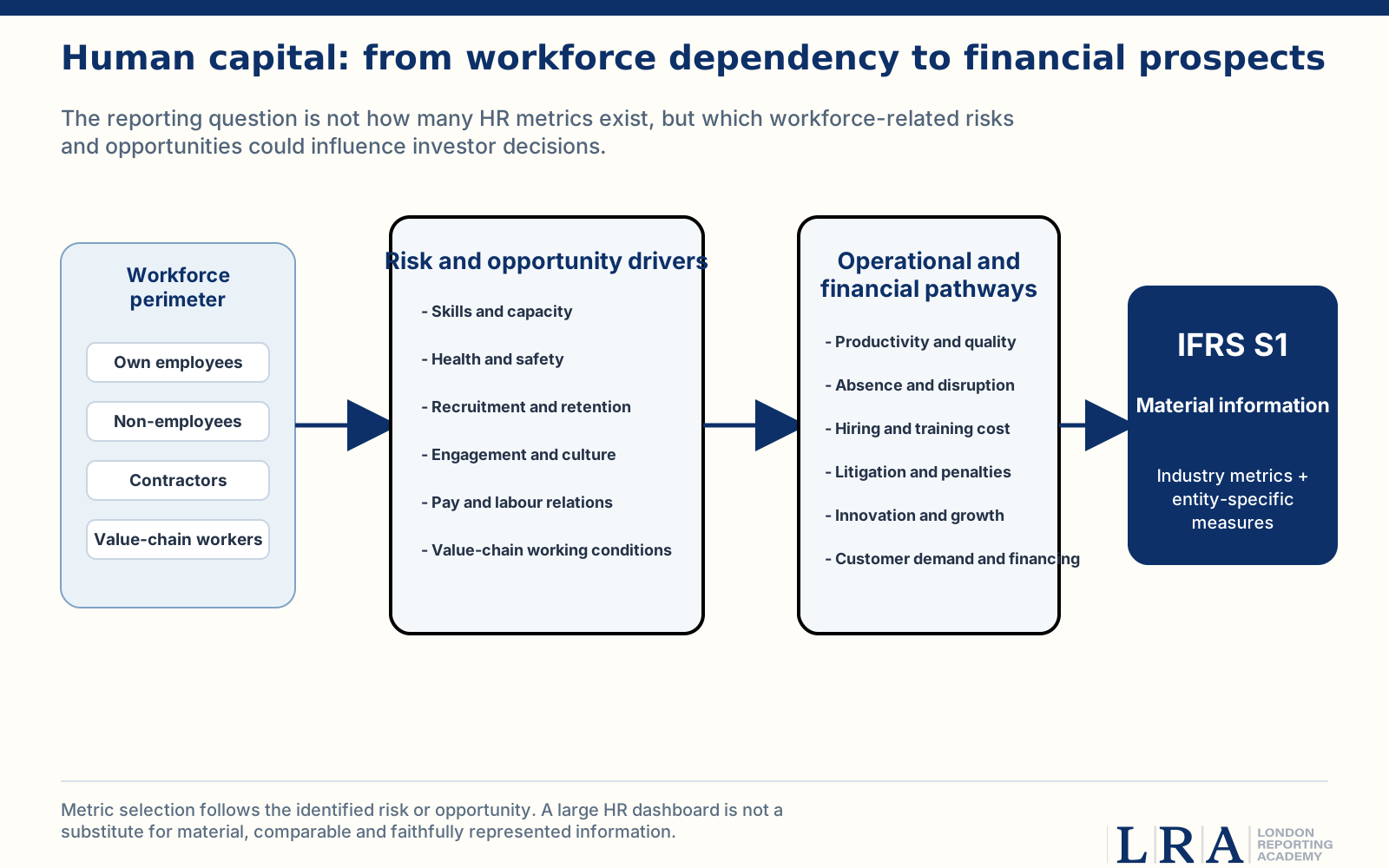
Human capital is a resource and relationship that the entity can depend on and affect. A specialised workforce can be essential to production, safety, innovation, customer service or regulatory permission to operate. Employment and value-chain practices can influence the entity’s ability to attract, develop and retain people, maintain continuity and avoid disruption or liability.
The IFRS S1 question is whether a workforce-related risk or opportunity could reasonably be expected to affect cash flows, access to finance or cost of capital over the short, medium or long term. The answer is entity- and industry-specific. A metric that is central for a hospital, mine or software business may be immaterial or defined differently for another entity.
In practice
Human capital risk and opportunity map
| Area | Potential risk or opportunity | Possible effect on prospects |
|---|---|---|
| Skills and capacity | Critical-skill shortages, ageing workforce, training effectiveness, automation transition or stronger capability. | Output, innovation, project delivery, recruitment and training cost, revenue growth or delay. |
| Health and safety | Fatalities, injuries, occupational illness, psychosocial risk or safer process design. | Disruption, compensation, penalties, insurance, productivity, licence to operate and reputation. |
| Recruitment and retention | Turnover, vacancy duration, employee value proposition, engagement or succession strength. | Hiring cost, lost knowledge, service quality, capacity utilisation and strategic execution. |
| Labour relations | Collective bargaining, disputes, industrial action, restructuring or constructive engagement. | Production interruption, wage cost, restructuring timing, legal exposure and management attention. |
| Pay and working conditions | Wage adequacy, hours, benefits, discrimination, harassment or improved conditions. | Absence, retention, litigation, customer trust, productivity and regulatory exposure. |
| Value-chain workers | Contractor safety, forced/child labour exposure, supplier labour practices or capability-building. | Supply interruption, remediation, contract loss, import restrictions, procurement cost and reputation. |
| Culture and leadership | Misconduct, weak speak-up culture, incentive misalignment or strong innovation culture. | Fraud, legal cost, turnover, control failure, customer outcomes and long-term performance. |
In practice
A proportionate identification and metric-selection process
| Step | Action | Evidence and control |
|---|---|---|
| 1. Define the workforce perimeter | Map employees, non-employees, contractors and value-chain workers relevant to the business model. | Workforce taxonomy reconciled to HR, procurement and financial reporting. |
| 2. Identify dependencies and impacts | Assess where skills, safety, working conditions or labour relations support or constrain the business. | Workforce analytics, incidents, grievances, audits, engagement and operational evidence. |
| 3. Translate to risks and opportunities | Identify the pathway to revenue, cost, assets, liabilities, financing or strategic execution. | Risk register and financial-effect hypothesis. |
| 4. Apply sources of guidance | Refer to and consider relevant SASB topics and metrics; consider permitted sources as appropriate. | Industry applicability matrix and source register. |
| 5. Select material information | Apply IFRS S1 materiality to metrics and narrative in the report as a whole. | Documented inclusion, exclusion and disaggregation judgements. |
| 6. Add entity-specific measures | Design measures where industry guidance does not faithfully represent the exposure. | Metric definition, method, assumptions, validation and limitation. |
| 7. Connect and approve | Link governance, strategy, risk management, financial effects, metrics and targets. | Cross-functional and governance approval. |
In practice
Metric design: what makes a human capital measure useful
| Design question | Good practice test | Example |
|---|---|---|
| What risk or opportunity does it measure? | The measure has a clear decision-use case, not merely HR availability. | Voluntary turnover in critical technical roles, not only total turnover. |
| What is the population and boundary? | Employees, contractors, business units, geographies and value-chain populations are explicit. | Safety rate covers employees and on-site contractors separately. |
| Is the denominator meaningful? | The denominator reflects exposure and is consistent over time. | Hours worked, average headcount, vacancies or production units as appropriate. |
| Is the measure comparable? | Definition, period, method and restatements are stable and explained. | Same turnover definition across segments and years. |
| Does it reveal concentration or severity? | Material hotspots are not hidden in group averages. | Fatalities and severe incidents are not diluted in a total incident rate. |
| Is effectiveness evidenced? | Training or engagement activity is not presented as proof of outcome without evidence. | Post-training competence or retention outcome accompanies hours delivered. |
Examples of metrics that may be considered
Depending on the identified risk or opportunity and applicable industry guidance, an entity might consider workforce composition, total and voluntary turnover, critical-role vacancies, time to hire, succession coverage, training and competence, absenteeism, employee engagement, recordable injuries, lost-time incidents, fatalities, occupational illness, contractor incidents, labour disputes, working days lost, grievance outcomes, supplier audit findings or remediation. These are candidates, not a universal IFRS S1 list.
Where the entity develops a metric, IFRS S1 requires information about how it is defined, whether it is absolute, relative or qualitative, third-party validation if any, and the calculation method, inputs, limitations and significant assumptions.
Technical status
CURRENT ISSB STATUS
The ISSB Human Capital project remained in the research phase at 1 August 2026. Research findings may inform future work, but they are not issued disclosure requirements. Current reporting remains governed by IFRS S1, applicable SASB guidance and entity-specific judgement.
Hypothetical example: skilled workforce and contractor safety
A hypothetical engineering group depends on certified technicians to service critical infrastructure. It also uses contractors for peak work. Turnover in certified roles has increased, vacancy duration is delaying projects and contractor injury rates are materially higher than employee rates.
The entity identifies separate but connected risks: capacity and margin pressure from skills shortages, and disruption, legal and reputation exposure from contractor safety. It refers to relevant SASB guidance, disaggregates the workforce populations, adds an entity-specific critical-role vacancy metric and connects the metrics to recruitment investment, safety controls, project delivery and anticipated financial effects.
Hypothetical scenario
ILLUSTRATIVE WORDING - ADAPT TO FACTS
Our ability to deliver maintenance contracts depends on certified technicians and specialist contractors. During 20X6, voluntary turnover in critical technician roles increased to X%, and the median time to fill those roles increased to Y days. This contributed to project rescheduling and higher subcontracting cost. Contractor recordable incident frequency also remained above the employee rate. We have expanded apprenticeship intake, revised retention measures and introduced a contractor pre-qualification and supervision programme. The metrics cover the UK and two European operating units representing Z% of relevant hours; data for smaller contractor populations remain estimated and are subject to a remediation plan.
Illustrative only. It shows how the decision is made, not wording that can be copied or relied on.
In practice
Weak versus stronger human capital disclosure
| Weak disclosure | Stronger disclosure |
|---|---|
| “Our people are our greatest asset.” | Explains the material workforce dependency, risk pathway, population, metric and strategic response. |
| Reports training hours as proof of skills readiness. | Links training to competence, vacancy, quality, retention or delivery outcomes. |
| One safety rate combines employees and contractors. | Disaggregates populations when risks, controls and performance differ materially. |
| Lists diversity, engagement and turnover metrics with no materiality rationale. | Selects measures connected to identified risks or opportunities and investor decisions. |
Common mistakes
Starting with every available HR KPI rather than with risks and opportunities affecting prospects.
Treating the legal employee population as the only relevant workforce boundary.
Using group averages that hide severe incidents, high-risk locations or critical-skill concentrations.
Equating an activity such as training hours with an evidenced outcome.
Copying a SASB metric without checking industry, population, unit and technical protocol.
Replacing a comparable metric with a bespoke KPI without explaining the difference.
Presenting ISSB research findings or proposed SASB amendments as issued requirements.
Readiness
Human capital disclosure checklist
- The workforce perimeter covers relevant own-workforce and value-chain populations.
- Material dependencies, impacts, risks and opportunities are distinguished.
- Each reported metric is connected to a risk or opportunity affecting prospects.
- Relevant SASB topics and metrics have been referred to and considered.
- Entity-specific metrics have clear definitions, methods, assumptions and limitations.
- Severe outcomes and material concentrations are not obscured by aggregation.
- Narrative explains strategy, resources, targets, progress and current/anticipated financial effects where material.
- HR, finance, risk, procurement and governance owners have reviewed the disclosure.
- The status of ISSB Human Capital research is accurately labelled.
In practice
Related requirements and next steps
| Relation | Reference | Why it matters |
|---|---|---|
| Direct | IFRS S1 paragraphs 2-3, 11-18, 45-59 and B2-B12 | Dependencies, prospects, materiality, metrics and sources. |
| Implementation | Applicable SASB Standards | Industry-specific workforce topics and metrics. |
| Update context | ISSB Human Capital research project | Potential future standard-setting direction, not current requirements. |
| Next step | IFRS S1 Company-Specific Disclosures | Design measures when no dedicated ISSB metric is sufficient. |
Contractors are considered when they are relevant to an identified human-capital risk or opportunity and the applicable industry guidance, rather than being included by default. Define the contractor population explicitly and, where material, disclose separate measures such as contractor incidents with the method, boundary, limitations and assumptions.
Select training and turnover metrics when they help explain a material human-capital risk or opportunity. Define the workforce population and method, keep turnover definitions consistent across periods, and connect training activity to competence or retention outcomes instead of presenting hours delivered as proof of performance.
Questions
Questions people ask
Is there an ISSB Human Capital Standard?
The entity refers to and considers applicable SASB disclosure topics and metrics and adds entity-specific information where necessary. As at 1 August 2026, the ISSB Human Capital project remained a research project; there was no dedicated final ISSB Human Capital Standard replacing the IFRS S1 judgement process.
Which workforce metrics are required?
The IFRS S1 question is whether a workforce-related risk or opportunity could reasonably be expected to affect cash flows, access to finance or cost of capital over the short, medium or long term. The answer is entity- and industry-specific. A metric that is central for a hospital, mine or software business may be immaterial or defined differently for another entity.
Are contractors in scope?
Contractors are considered when they are relevant to an identified human-capital risk or opportunity and the applicable industry guidance, rather than being included by default. Define the contractor population explicitly and, where material, disclose separate measures such as contractor incidents with the method, boundary, limitations and assumptions.
How should training and turnover be disclosed?
Select training and turnover metrics when they help explain a material human-capital risk or opportunity. Define the workforce population and method, keep turnover definitions consistent across periods, and connect training activity to competence or retention outcomes instead of presenting hours delivered as proof of performance.
Sources
Primary sources
Framework references
Disclosures this page affects
Take it with you
The checklists as a working spreadsheet
Every checklist and table on this page, with empty status, owner and evidence columns for your team to fill in and keep.
✓ Knowledge Hub AI Assistant · Human-in-the-loop

Ask about this guide
It answers from this page, and reaches into the linked disclosure cards when your question is about the standard itself.
Go deeper · IFRS S1 / S2
Certified IFRS S1 & S2 (ISSB) Applied Sustainability Reporting
This page settles one requirement. The IFRS S1 & S2 course walks the whole ISSB workflow — governance, strategy, risk management, metrics and targets — with drafting exercises on your own data.