Short answer
The answer, before the reasoning
A strong TCFD-aligned report provides a useful starting architecture for IFRS S2 because IFRS S2 integrates the four TCFD pillars and the 11 recommended disclosures. Transition is not, however, a re-labelling exercise.
The entity must apply IFRS S1 alongside IFRS S2, use the ISSB materiality definition, address industry-based guidance and more detailed greenhouse gas requirements, connect climate information to current and anticipated financial effects, apply reporting-entity, timing, comparative and connected-information requirements, and make a compliance statement only when all applicable ISSB requirements are met. A defensible transition therefore combines content mapping, data remediation, governance approval and claim control.
Rule
IFRS-TCFD-001
IFRS S2 vs TCFD: What Changed and How to Transition A pillar-by-pillar gap analysis covering materiality, industry metrics, GHG emissions, financial effects and compliance
In practice
Type
| Type | Tier | Audience — Current context |
|---|---|---|
| TCFD-to-IFRS S2 transition guide | Tier 4 · Transition Guide | Reporting, finance, risk, climate, investor-relations, legal and assurance teams — IFRS S1/S2 and the February 2026 IFRS Foundation comparison checked to 1 August 2026 |
Why this question matters
The practical risk is not a lack of terminology. It is that a familiar framework, dataset or metric is treated as a complete reporting conclusion without testing the governing IFRS requirements, materiality, evidence and publication claim.
Quick orientation
Quick orientation
- Applies to
- Entities with existing TCFD reports, climate questionnaires or internal TCFD control frameworks moving towards IFRS S2 reporting.
- Primary decision
- Which existing disclosures can be retained, which need greater specificity, and which new IFRS S1/S2 requirements need data, methods or approval?
- Key sources
- IFRS S1, IFRS S2 and the IFRS Foundation comparison of IFRS S2 with the TCFD recommendations, updated February 2026.
- Common confusion
- Assuming that a report organised under the four TCFD pillars automatically complies with IFRS S2.
Why the transition is more than a format change
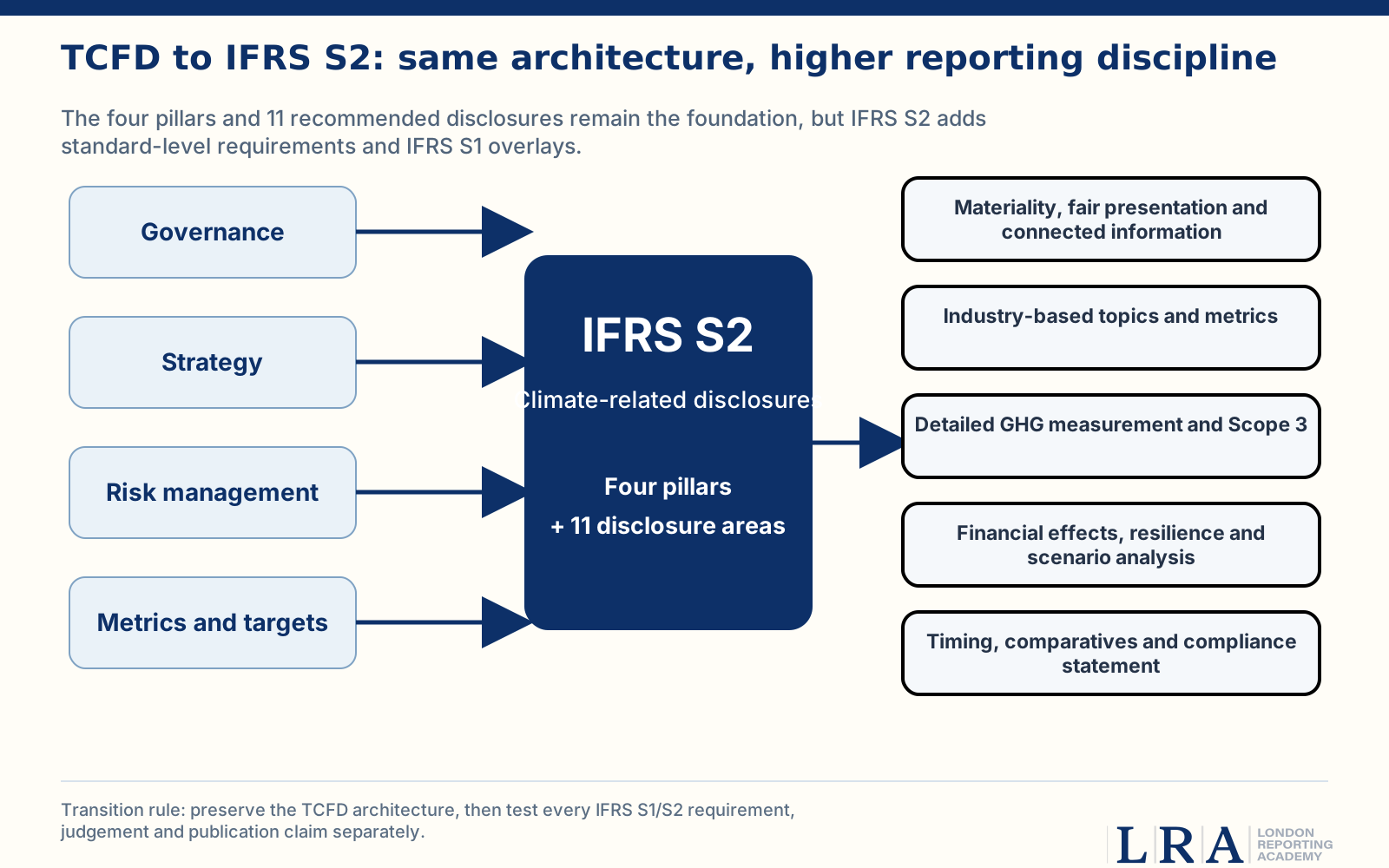
The TCFD recommendations established the now-familiar governance, strategy, risk management, and metrics and targets architecture. IFRS S2 keeps that architecture, which means existing ownership, risk registers, scenario work and climate metrics can often be reused. The transition challenge sits in the depth, connectivity and discipline of the information rather than the headings alone.
IFRS S2 is a disclosure Standard applied together with IFRS S1. It therefore brings requirements about fair presentation, material information, the reporting entity, connected information, timing, comparatives, sources of guidance, judgements and the statement of compliance. A TCFD report may address some of these matters voluntarily, but the report must be tested against the issued ISSB requirements rather than against the presence of 11 headings.
The four pillars and 11 disclosures: transition map
In practice
| TCFD recommended disclosure | IFRS S2 continuity and additional depth | Transition action |
|---|---|---|
| Governance (a): board oversight | Retained. IFRS S2 asks for the governance body or individual, mandates or terms of reference, skills and competencies, how and how often they are informed, and how oversight is reflected in strategy, major transactions and targets. | Reconcile committee mandates, calendars, papers and minutes to the published description. |
| Governance (b): management role | Retained with greater specificity about delegated roles, reporting lines, controls and procedures. | Document management ownership and distinguish preparation, review, challenge and approval. |
| Strategy (a): risks and opportunities over time | Retained. IFRS S2 requires physical/transition classification for risks, time horizons, and use of reasonable and supportable information without undue cost or effort. | Build a controlled risk/opportunity register and define time horizons consistently with strategic planning. |
| Strategy (b): effects on businesses, strategy and financial planning | Expanded to business model and value-chain concentrations, response and resource allocation, transition plans, current and anticipated financial effects and capital deployment. | Trace each material item to affected assets, activities, geographies, cash-flow channels and planned resources. |
| Strategy (c): resilience under scenarios | Retained and expanded. Scenario analysis must inform the climate-resilience assessment; disclosures cover methods, scenarios, assumptions, uncertainty, results and capacity to adapt. | Create a proportional scenario-analysis method, governance record and annual resilience update. |
| Risk management (a): identify and assess risks | Expanded to inputs and parameters, scenario analysis, nature and likelihood of effects, prioritisation and changes in process. | Align climate processes with enterprise risk management while retaining climate-specific methods and evidence. |
| Risk management (b): manage risks | Retained, with information on policies and processes used to monitor and manage risks and opportunities. | Show controls, owners, escalation and the connection to strategy and capital decisions. |
| Risk management (c): integration | Retained. Integration must be explained, not merely asserted. | Evidence how climate information changes risk appetite, planning, investment or operating decisions. |
| Metrics (a): metrics used | Expanded by cross-industry metric categories, industry-based metrics and entity-specific information where necessary. | Map existing KPIs to IFRS S2 requirements and test industry guidance and definitions. |
| Metrics (b): Scope 1, 2 and 3 GHG emissions | Substantially more detailed: absolute gross emissions, organisational boundary, Scope 2 location-based information and contractual instruments, Scope 3 categories, methods, inputs, assumptions and financed emissions where applicable. | Rebuild the inventory-to-disclosure trace and close boundary, category, method and factor gaps. |
| Targets (c): targets and performance | Expanded to target characteristics, baseline, milestones, performance, revisions, use of carbon credits, validation and links to international climate agreements where relevant. | Create a target register and challenge vague, unapproved or unsupported transition claims. |
In practice
IFRS S1 overlays that a TCFD crosswalk often misses
| Overlay | What must be tested | Typical hidden gap |
|---|---|---|
| Materiality | Whether omitting, misstating or obscuring information could reasonably influence primary-user decisions in the context of the complete sustainability-related financial disclosures. | The TCFD report includes topics because they are interesting or expected, but does not document ISSB materiality judgements. |
| Reporting entity and value chain | The sustainability-related financial disclosures use the same reporting entity as the financial statements while considering relevant value-chain exposures. | Operational climate data follows a different group boundary and is not reconciled. |
| Fair presentation and additional information | Specific requirements are not a maximum; additional information is provided when needed to understand effects on prospects. | The crosswalk treats the Standard as a checklist and misses entity-specific concentrations or dependencies. |
| Connected information | Relationships between risks, strategy, metrics, targets, financial effects and the financial statements are understandable. | Climate content sits in a standalone chapter with no connection to capital expenditure, impairment assumptions or funding plans. |
| Timing and comparatives | Disclosures cover the same period and are issued at the same time as related financial statements, subject to applicable reliefs; comparatives are provided as required. | The sustainability report is published months later or uses a different cut-off. |
| Compliance statement | An explicit and unreserved statement is made only when all IFRS Sustainability Disclosure Standards requirements are met. | Marketing language says “IFRS S2 compliant” based on a partial mapping or selected metrics. |
In practice
A practical six-stage transition programme
| Stage | Action | Output and control |
|---|---|---|
| 1. Freeze the baseline | Inventory all TCFD disclosures, data sources, calculation methods, owners, assurance scope and publication locations. | Controlled baseline and document register. |
| 2. Map requirements | Map each TCFD disclosure to IFRS S2 and the relevant IFRS S1 overlays at paragraph and data-field level. | Gap matrix with direct, partial, absent and not-material conclusions. |
| 3. Prioritise gaps | Separate wording gaps from data, method, governance, financial-effects and system gaps. | Remediation plan with owners, dependencies and delivery dates. |
| 4. Rebuild controls | Define metric ownership, reconciliations, model governance, evidence retention, review and board approval. | IFRS-aligned control matrix and evidence pack. |
| 5. Dry run | Prepare a mock set of disclosures and perform technical, finance, legal, assurance and consistency reviews. | Issue log, revised judgements and corrected cross-references. |
| 6. Control the claim | Confirm applicable jurisdictional modifications, reliefs, comparatives and the basis for any compliance statement. | Final publication memorandum and approval record. |
Hypothetical example: a TCFD leader with an IFRS S2 gap
A hypothetical listed property group has published a TCFD report for three years. It describes board oversight, two scenarios, flood risk and a 2035 emissions target. The transition review finds that the risk narrative is strong but the Scope 3 inventory excludes several material categories, the Scope 2 disclosure is market-based only, financial effects are described without explaining why quantitative information is not provided, and the scenario work is not linked to asset-level investment decisions.
The group retains the four-pillar structure, but adds a reporting-entity reconciliation, a climate risk and opportunity register, location-based Scope 2 emissions, a documented Scope 3 category assessment, industry-based real-estate metrics, current and anticipated financial-effects analysis and an approved resilience conclusion. It does not use an unreserved compliance statement until the full set of requirements and local adoption rules have been checked.
In practice
Weak versus stronger transition evidence
| Weak approach | Stronger approach |
|---|---|
| “Our TCFD report already covers all four pillars, so no further assessment is needed.” | Maps the 11 TCFD disclosures and all IFRS S1/S2 overlays, with requirement-level conclusions. |
| A narrative update adds “in line with IFRS S2”. | A controlled dry run tests data, methods, materiality, financial effects, timing, comparatives and claims. |
| Scenario analysis is presented as a standalone consultant report. | Scenario inputs, limitations, governance and strategic decisions are traceable to the published resilience assessment. |
| Assurance over selected emissions is described as assurance of IFRS S2 reporting. | The assurance statement and report wording precisely identify subject matter, criteria and scope. |
Common transition mistakes
Using a pillar-level crosswalk when the real gaps sit at metric, method, boundary or evidence level.
Assuming the TCFD use of “material” is enough without applying the IFRS S1 materiality requirements to the complete report.
Treating the TCFD recommendation to disclose Scope 3 emissions “if appropriate” as the IFRS S2 test.
Keeping sustainability and financial reporting calendars separate without an authorised cut-off and post-balance-sheet process.
Publishing a generic “resilient” conclusion without showing vulnerabilities, assumptions, uncertainty and capacity to adapt.
Ignoring industry-based guidance because the existing TCFD report used only cross-industry metrics.
Using “IFRS S2 aligned” or “compliant” before the basis, jurisdiction and completeness of the claim are approved.
Readiness
TCFD-to-IFRS S2 gap checklist
- All four pillars and 11 recommended disclosures are mapped to current IFRS S2 requirements.
- IFRS S1 materiality, fair presentation, reporting entity, connectivity, timing and comparatives are included.
- Physical risks, transition risks and opportunities are identified with time horizons and concentrations.
- Current and anticipated financial effects are connected to financial planning and the financial statements.
- Scenario analysis is proportionate, governed and linked to the resilience assessment.
- Industry-based guidance and entity-specific information have been considered.
- Scope 1, Scope 2 and Scope 3 methods, boundaries, factors and data quality are controlled.
- Target and carbon-credit disclosures are complete and approved.
- Cross-references are accessible and material information is not obscured.
- The final publication claim matches the actual basis of preparation and jurisdictional requirements.
In practice
Related requirements and next steps
| Relation | Reference | Why it matters |
|---|---|---|
| Direct | IFRS S2 and February 2026 IFRS Foundation TCFD comparison | Detailed continuity and differences across the four pillars. |
| Direct | IFRS S1 paragraphs 10-24, 54-75 and application guidance | Fair presentation, materiality, sources, timing, compliance and judgements. |
| Next step | IFRS S2 Scenario Analysis and Climate Resilience guides | Deep implementation of the largest strategy gap. |
| Next step | IFRS S2 Scope 1, 2 and 3 measurement guide | Close the most common quantitative gap. |
Compared with TCFD, IFRS S2 asks for more detailed GHG information, subject to materiality. This includes absolute gross emissions, organisational-boundary information, location-based Scope 2 and contractual instruments, Scope 3 categories, methods, inputs, assumptions and financed-emissions information where applicable.
Questions
Questions people ask
Does IFRS S2 replace TCFD?
A strong TCFD-aligned report provides a useful starting architecture for IFRS S2 because IFRS S2 integrates the four TCFD pillars and the 11 recommended disclosures. Transition is not, however, a re-labelling exercise.
Are the four pillars unchanged?
The TCFD recommendations established the now-familiar governance, strategy, risk management, and metrics and targets architecture. IFRS S2 keeps that architecture, which means existing ownership, risk registers, scenario work and climate metrics can often be reused.
What extra GHG disclosures are required?
Compared with TCFD, IFRS S2 asks for more detailed GHG information, subject to materiality. This includes absolute gross emissions, organisational-boundary information, location-based Scope 2 and contractual instruments, Scope 3 categories, methods, inputs, assumptions and financed-emissions information where applicable.
Can a TCFD report claim IFRS S2 compliance?
IFRS S2 is a disclosure Standard applied together with IFRS S1. It therefore brings requirements about fair presentation, material information, the reporting entity, connected information, timing, comparatives, sources of guidance, judgements and the statement of compliance. A TCFD report may address some of these matters voluntarily, but the report must be tested against the issued ISSB requirements rather than against the presence of 11 headings.
Sources
Primary sources
Framework references
Disclosures this page affects
Take it with you
The checklists as a working spreadsheet
Every checklist and table on this page, with empty status, owner and evidence columns for your team to fill in and keep.
✓ Knowledge Hub AI Assistant · Human-in-the-loop

Ask about this guide
It answers from this page, and reaches into the linked disclosure cards when your question is about the standard itself.
Go deeper · IFRS S1 / S2
Certified IFRS S1 & S2 (ISSB) Applied Sustainability Reporting
This page settles one requirement. The IFRS S1 & S2 course walks the whole ISSB workflow — governance, strategy, risk management, metrics and targets — with drafting exercises on your own data.