Short answer
The answer, before the reasoning
Yes. One controlled master data and evidence model can support IFRS S1/S2, ESRS, GRI and CDP and can substantially reduce repeated collection, calculation and review. It cannot produce one universal materiality conclusion, boundary, reporting period, level of granularity or compliance claim.
The master layer should retain stable metric definitions, source data, evidence, methods, owners, controls and versions. Separate framework decision layers then determine whether, how and where each item is reported. The most reliable architecture therefore reuses data and evidence while preserving framework-specific materiality, scope, timing, presentation and sign-off.
Rule
IFRS-INT-001
Can One Dataset Support IFRS S1/S2, ESRS, GRI and CDP? A master data model for shared evidence, controlled adjustments and framework-specific reporting decisions
In practice
Type
| Type | Tier | Audience — Current context |
|---|---|---|
| Multi-framework data architecture guide | Tier 4 · Interoperability Guide | Reporting, finance, sustainability, data, risk, IT, assurance and programme-management teams — Current IFRS, GRI and CDP materials checked to 1 August 2026; 2026 revised ESRS adoption status separately flagged |
Why this question matters
The practical risk is not a lack of terminology. It is that a familiar framework, dataset or metric is treated as a complete reporting conclusion without testing the governing IFRS requirements, materiality, evidence and publication claim.
Quick orientation
Quick orientation
- Applies to
- Organisations preparing two or more investor, impact, regulatory or environmental disclosure outputs from overlapping data.
- Primary decision
- Which information can be mastered once and which judgements or transformations must remain framework-specific?
- Key sources
- IFRS S1/S2, ESRS-ISSB Interoperability Guidance, GRI interoperability materials and CDP framework-alignment resources.
- Common confusion
- Equating one shared data field with one shared disclosure requirement or compliance conclusion.
The correct design principle: one evidence base, controlled output adapters
Interoperability works best below the final disclosure. Source data, calculation files, policies, minutes, risk records and data-owner confirmations can often be collected once. A controlled data model can also standardise units, factor versions, organisational identifiers, geographies and evidence links. This reduces duplicate requests and inconsistent numbers.
The final outputs still answer different questions. IFRS S1/S2 focus on sustainability-related risks and opportunities that could affect the entity’s prospects and the information needs of investors, lenders and other creditors. GRI focuses on the organisation’s most significant impacts on the economy, environment and people. ESRS combine impact and financial materiality under EU requirements. CDP is a questionnaire and disclosure system with environmental modules, scoring logic and framework mappings. Similar datapoints can therefore require different inclusion decisions, narratives, boundaries or supporting explanations.
Four layers of a master reporting model
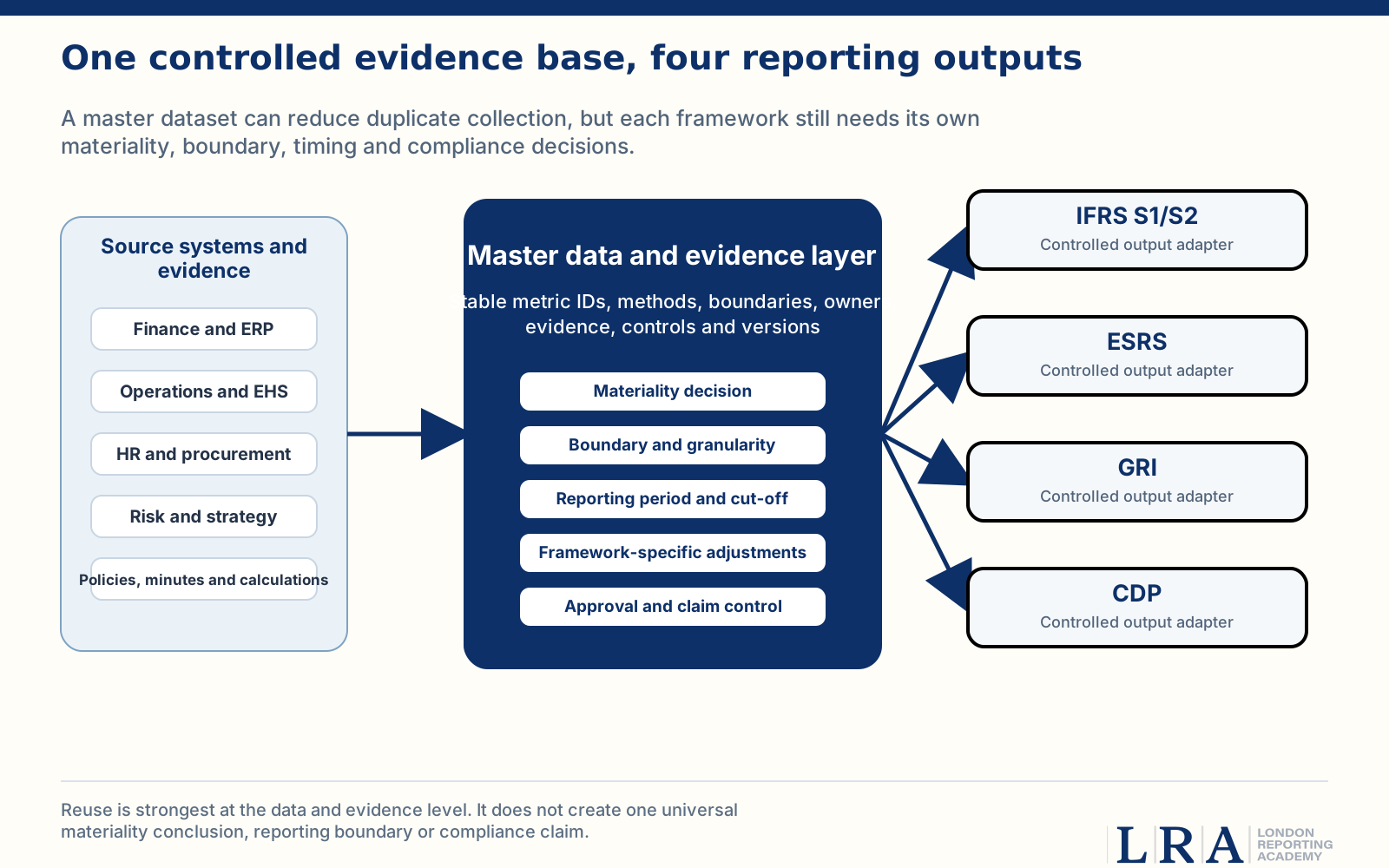
In practice
| Layer | Purpose | Minimum control |
|---|---|---|
| 1. Source and evidence | Original transactions, meter data, HR records, supplier information, risk registers, policies, contracts, calculations and approvals. | Immutable source reference, owner, extraction date, access level and retention rule. |
| 2. Master data objects | Stable definitions for entities, sites, products, workers, emissions, energy, water, incidents, targets, risks and impacts. | Unique ID, unit, boundary, method, factor/version, period, estimate status and data-quality attributes. |
| 3. Framework decision layer | Materiality, inclusion, disaggregation, boundary, timing, narrative, omission and claim decisions for each framework. | Documented criteria, preparer, reviewer, approval and version. |
| 4. Output adapters | ISSB disclosure, ESRS sustainability statement, GRI Content Index/report and CDP response. | Controlled transformation, reconciliation, cross-reference, final sign-off and publication lock. |
In practice
Recommended master data fields
| Field group | Example fields | Why it matters |
|---|---|---|
| Identity | Metric ID, concept ID, legal entity, site, product, activity, geography and value-chain relationship. | Enables traceable aggregation and framework-specific boundaries. |
| Measurement | Unit, numerator, denominator, method, factor source/version, gross/net status, estimate/proxy and uncertainty. | Prevents the same label from hiding different calculations. |
| Time | Reporting period, measurement date, cut-off, restatement status and publication cycle. | Supports different calendars without silently mixing periods. |
| Evidence | Source-system extract, calculation file, policy, approval, external evidence and confidentiality class. | Allows review and assurance without searching across email chains. |
| Ownership and controls | Data owner, preparer, reviewer, control performed, exceptions and remediation. | Creates accountability and segregation of duties. |
| Framework mappings | Potential IFRS, ESRS, GRI and CDP references, relationship type and residual differences. | Supports reuse while keeping mapping conditional and versioned. |
| Publication decisions | Materiality conclusion, boundary adjustment, disaggregation, location, omission, assurance scope and claim. | Makes the final output reproducible and reviewable. |
In practice
What can be shared, and what must remain separate
| Reporting output | Strong candidates for reuse | Separate decisions that remain necessary |
|---|---|---|
| IFRS S1/S2 | GHG inventory, energy data, risk register, scenario inputs, policies, financial-effects analysis, governance evidence. | Investor-focused materiality, same reporting entity as financial statements, current/anticipated financial effects, ISSB timing and compliance statement. |
| ESRS | Many environmental and social datasets, policies, action plans, targets, value-chain evidence and financial-risk analysis. | Double materiality, EU scope and value-chain rules, ESRS-specific datapoints, location in the sustainability statement, digital tagging and legal/assurance requirements. |
| GRI | Impact inventory, stakeholder and due-diligence evidence, environmental/social metrics, policies and management approach. | Significant-impact assessment, Sector/Topic Standard selection, GRI reporting boundary logic, Content Index and statement of use. |
| CDP | Climate, forests, water, governance, risk, scenario, transition, targets and emissions data. | Questionnaire routing, scoring-relevant completeness, response period, requested granularity, definitions and platform validation. |
Rule
VERSION GATE
The joint 2024 ESRS-ISSB Interoperability Guidance was prepared against the first ESRS set. The European Commission adopted revised ESRS on 3 July 2026, but the delegated act was not in force until publication in the Official Journal at the source-check date. Mapping and data models must therefore carry an ESRS version field and be revalidated when the revised text becomes legally effective.
In practice
Controlled reporting adjustments
| Adjustment | Example | Required evidence |
|---|---|---|
| Boundary adjustment | A GHG figure is measured for the accounting group, while an impact disclosure requires additional value-chain information. | Boundary reconciliation and explanation of included/excluded activities. |
| Materiality adjustment | A workforce metric is not material for IFRS S1 but is required or material under ESRS or GRI. | Separate decision records; no forced common conclusion. |
| Granularity adjustment | CDP requests country or facility detail while the ISSB disclosure is aggregated. | Data lineage proving that output totals reconcile to the same master records. |
| Timing adjustment | CDP submission occurs before annual financial reporting is authorised. | Cut-off protocol, estimate flag, subsequent-event review and controlled refresh. |
| Definition adjustment | A “worker” or “renewable energy” definition differs between outputs. | Versioned definition mapping and transformation rule. |
| Narrative adjustment | The same underlying incident supports impact disclosure, risk disclosure and questionnaire response with different emphasis. | Shared evidence plus framework-specific drafting and legal review. |
In practice
A seven-step implementation workflow
| Step | Action | Output |
|---|---|---|
| 1 | Inventory current reports, questionnaires, spreadsheets, systems and evidence. | Data and disclosure landscape. |
| 2 | Define stable concepts, IDs, entities, sites, periods, units and access levels. | Master data dictionary. |
| 3 | Build calculation and evidence lineage for priority metrics and narratives. | Traceable data objects and evidence objects. |
| 4 | Create versioned mappings to framework requirements without claiming equivalence. | Mapping register with residual differences. |
| 5 | Design separate materiality, boundary, timing, omission and claim workflows. | Framework decision records. |
| 6 | Generate controlled output adapters and reconciliations. | Draft reports, Content Index and questionnaire responses. |
| 7 | Operate annual change control for standards, factors, structures and corrections. | Version log, review queue and approved release. |
Hypothetical example: one GHG dataset, four outputs
A hypothetical manufacturer maintains one controlled GHG inventory with entity, site, source, scope, category, factor, calculation method, data-quality and evidence fields. The inventory supports IFRS S2, ESRS E1, GRI climate disclosures and CDP. The published values are not produced by copying the same table four times.
The IFRS output applies ISSB materiality and links emissions to transition risk, targets and financial effects. The ESRS output applies double materiality and EU-specific disclosures. The GRI output explains significant climate impacts and management. CDP requests additional questionnaire detail and may use a different submission cut-off. Reconciliations show which totals are common, which are transformed and why.
In practice
Weak versus stronger architecture
| Weak approach | Stronger approach |
|---|---|
| A single spreadsheet has columns labelled IFRS, ESRS, GRI and CDP. | Stable master objects, evidence lineage, versioned mappings and separate decision workflows. |
| One materiality flag controls all outputs. | Impact, financial, regulatory and questionnaire decisions are recorded separately. |
| Differences are fixed manually in the final report. | Controlled transformations are defined, reviewed, reconciled and repeatable. |
| “Aligned across all frameworks” is used as a marketing claim. | The basis of each report and any residual differences are described precisely. |
Common mistakes
Designing the database around disclosure numbers rather than stable business concepts and source evidence.
Treating interoperability guidance or mappings as a formal statement of equivalence.
Using one “material” flag for investor materiality, impact materiality, double materiality and questionnaire completeness.
Losing the reporting-period version of ESRS, CDP questions, GRI Standards or ISSB guidance.
Combining organisational and value-chain boundaries without a reconciliation.
Allowing manual last-mile adjustments with no owner, formula, evidence or approval.
Assuming a CDP response, GRI report or ESRS statement automatically fulfils IFRS compliance requirements.
Readiness
Master data readiness checklist
- Every metric and narrative claim has a stable ID and evidence owner.
- Entity, site, value-chain, period and methodology dimensions are stored separately.
- Source, factor and framework versions are visible.
- Materiality and boundary decisions are framework-specific and approved.
- All transformed outputs reconcile to the master record.
- Estimates, proxies, uncertainty and remediation are retained.
- Confidential and restricted evidence is access-controlled.
- Changes to standards automatically trigger mapping and article review.
- Compliance and assurance claims are approved outside the data engineering workflow.
In practice
Related requirements and next steps
| Relation | Reference | Why it matters |
|---|---|---|
| Direct | IFRS S1 and IFRS S2 | Investor-focused disclosure requirements, timing, entity and compliance. |
| Interoperability | ESRS-ISSB Guidance, GRI-ESRS Index and GRI-ISSB materials | Official or joint mapping support with explicit limits. |
| Application | CDP 2026 framework alignment and mappings | Questionnaire-level reuse and routing. |
| Next step | Internal Controls over IFRS Sustainability Disclosures | Govern the master data model and evidence trail. |
The frameworks do not use the same materiality test. IFRS applies investor-focused materiality to information about risks and opportunities that could affect prospects, whereas ESRS applies impact materiality and financial materiality; the same evidence can support both assessments, but the tests and outcomes remain separate.
Store stable source data at entity, site, activity and value-chain level, with explicit organisational and value-chain boundary fields and a reconciliation to each framework's reporting perimeter. The framework decision layer can then apply the relevant boundary adjustment without changing the underlying evidence.
A CDP response does not by itself establish IFRS S2 compliance. The same controlled emissions data may support both outputs, but IFRS still has its own materiality, reporting-entity, financial-effects, timing and compliance tests, while CDP has separate questionnaire detail and submission logic.
Questions
Questions people ask
Can one GHG inventory support all frameworks?
Yes. One controlled master data and evidence model can support IFRS S1/S2, ESRS, GRI and CDP and can substantially reduce repeated collection, calculation and review.
Do frameworks use the same materiality?
The frameworks do not use the same materiality test. IFRS applies investor-focused materiality to information about risks and opportunities that could affect prospects, whereas ESRS applies impact materiality and financial materiality; the same evidence can support both assessments, but the tests and outcomes remain separate.
How should boundaries be stored?
Store stable source data at entity, site, activity and value-chain level, with explicit organisational and value-chain boundary fields and a reconciliation to each framework's reporting perimeter. The framework decision layer can then apply the relevant boundary adjustment without changing the underlying evidence.
Does CDP disclosure equal IFRS S2 compliance?
A CDP response does not by itself establish IFRS S2 compliance. The same controlled emissions data may support both outputs, but IFRS still has its own materiality, reporting-entity, financial-effects, timing and compliance tests, while CDP has separate questionnaire detail and submission logic.
Sources
Primary sources
- IFRS S1 General Requirements
- IFRS S2 Climate-related Disclosures
- ESRS-ISSB Standards Interoperability Guidance, May 2024
- European Commission adoption of revised ESRS, 3 July 2026
- European Commission CSRD delegated acts and status
- GRI and ISSB interoperability considerations for GHG emissions
- GRI-ESRS Interoperability Index, November 2024
- GRI and IFRS Foundation joint statement, May 2026
- CDP framework alignment and 2026 disclosure resources
- CDP Disclosure 2026
Framework references
Disclosures this page affects
Take it with you
The checklists as a working spreadsheet
Every checklist and table on this page, with empty status, owner and evidence columns for your team to fill in and keep.
✓ Knowledge Hub AI Assistant · Human-in-the-loop

Ask about this guide
It answers from this page, and reaches into the linked disclosure cards when your question is about the standard itself.
Go deeper · IFRS S1 / S2
Certified IFRS S1 & S2 (ISSB) Applied Sustainability Reporting
This page settles one requirement. The IFRS S1 & S2 course walks the whole ISSB workflow — governance, strategy, risk management, metrics and targets — with drafting exercises on your own data.