Short answer
The answer, before the reasoning
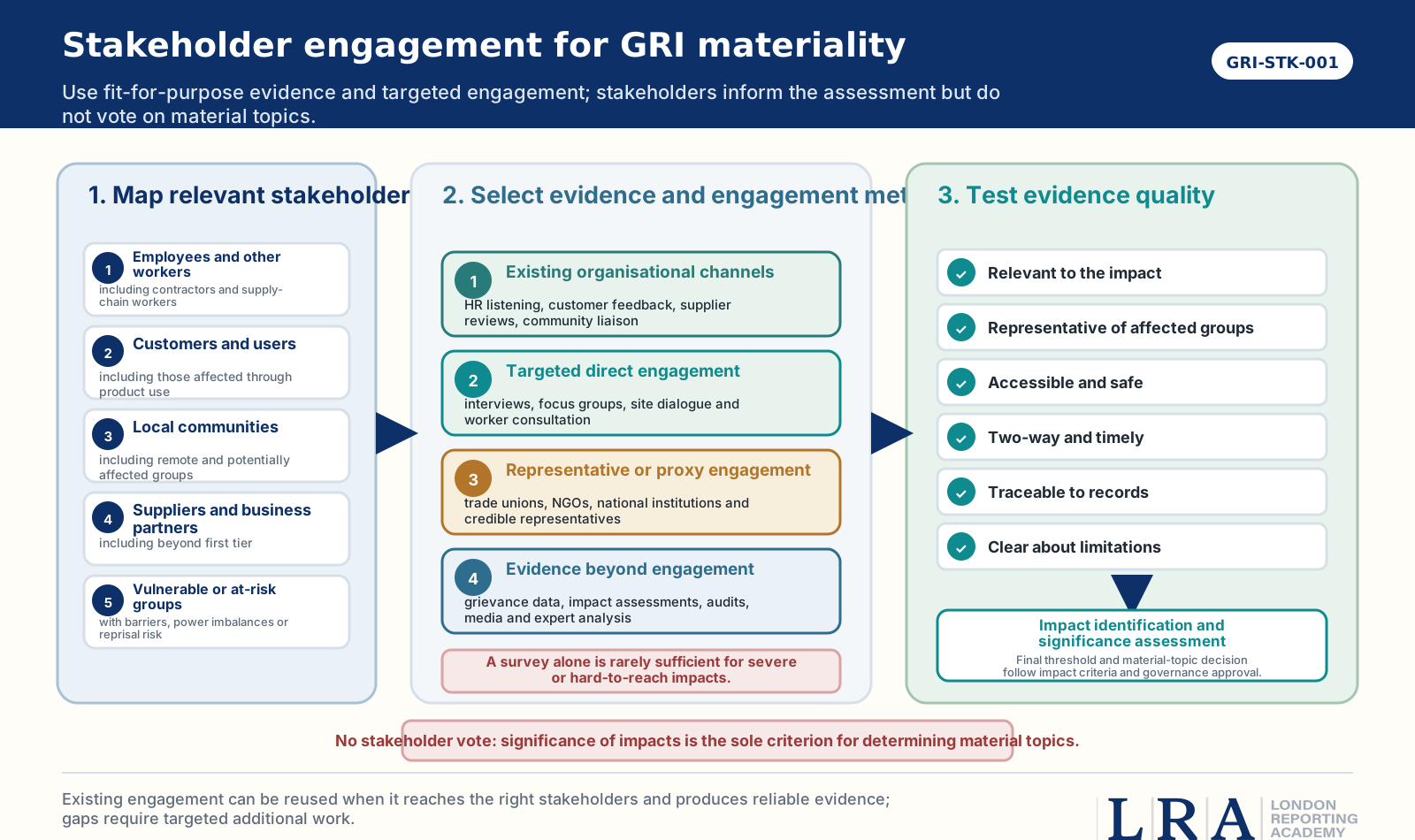
Stakeholder engagement is an evidence input to GRI materiality, not a vote that determines material topics. Existing HR, customer, supplier, community and grievance processes can be reused when they reach the relevant affected stakeholders, are meaningful and safe, generate traceable evidence, and are suitable for the impact being assessed.
Additional targeted engagement is needed when existing channels miss vulnerable or remote groups, are designed for another purpose, suppress dissent, provide only aggregated satisfaction scores, or do not address a potentially severe impact.
Quick orientation
Quick orientation
- Applies to
- Organisations designing or refreshing a GRI materiality process, especially where existing engagement channels are fragmented across functions.
- Primary decision
- Which stakeholder evidence can be reused, where targeted engagement is necessary, and how the input affects the impact assessment.
- Key sources
- GRI 2, Disclosure 2-29; GRI 3, Step 1, Step 3, Step 4, Box 2 and Disclosure 3-1.
- Common confusion
- Equating a high stakeholder popularity score with significance of impact, or treating one generic survey as sufficient evidence for all topics and groups.
What the GRI Standards require and recommend
GRI guidance characterises meaningful engagement as two-way, conducted in good faith, responsive and ongoing, often before decisions are made. It also highlights barriers, at-risk or vulnerable groups, accessible information, privacy and other human rights, feedback integration and engagement through business partners. In materiality work, GRI 3 advises direct consultation where possible, appropriate representatives or credible proxies where it is not, and prioritisation of the most severely affected or potentially affected stakeholders for engagement.
What GRI does not require
A universal annual stakeholder survey or a fixed list of stakeholder categories.
A numerical vote in which stakeholders choose the final material topics.
Equal engagement intensity for every stakeholder group and every possible impact.
Direct consultation with every individual in a global value chain where this is impracticable or unsafe.
Disclosure of personal, confidential or identifying grievance information.
A separate engagement exercise where existing evidence is demonstrably fit for the materiality purpose.
Rule
NORMATIVE CORE
Disclosure 2-29 requires the organisation to describe the stakeholder categories it engages with, the purpose of engagement, and how it seeks to ensure meaningful engagement. Disclosure 3-1 requires the organisation to specify the stakeholders and experts whose views informed the process of determining material topics. GRI 3 requires the organisation to describe how impacts were identified and prioritised, including methods, sources, evidence, scope, limitations, assumptions, judgements and the threshold used.
In practice
The fit-for-purpose test for existing engagement
| Test | Question to ask | Evidence that supports reuse — Trigger for additional work |
|---|---|---|
| Relevance | Does the channel address the actual or potential impact being assessed? | Questions, complaints or records relate directly to working conditions, product safety, pollution, access, discrimination or another identified impact. — The channel measures general satisfaction, reputation or service quality but not the impact. |
| Stakeholder coverage | Does it reach people whose interests are affected or could be affected? | Participant list or category map includes affected workers, communities, customers, suppliers or representatives. — Only senior management, investors or easy-to-reach customers are represented. |
| Vulnerability and barriers | Can at-risk groups participate safely and meaningfully? | Language support, accessible channels, confidential options, non-retaliation controls and tailored outreach are documented. — Power imbalance, literacy, disability, migration status, gender, remoteness or fear of retaliation limits participation. |
| Two-way character | Can stakeholders explain, challenge and receive a response? | Minutes, interview notes, feedback loops and records of organisational response exist. — The process is a one-way questionnaire with no opportunity to clarify or challenge. |
| Independence and candour | Is the information distorted by the person collecting it or by the relationship? | Independent facilitation, protected channels, representative bodies or triangulation reduce bias. — A supplier audit is conducted only by the buyer; a line manager administers the employee survey; community participants depend on the organisation. |
| Timeliness | Is the evidence current enough for the reporting-period decision? | Recent records are linked to current operations, incidents and stakeholder conditions. — The last engagement predates a new site, acquisition, product, contractor or significant incident. |
| Traceability | Can a reviewer see how the input affected the assessment? | Source ID, date, method, participant category, impact link, limitation and decision record are retained. — Only a slide with average scores remains; raw evidence, methodology and rationale are missing. |
In practice
Comparison of common methods
| Method | Best use | Strength — Main limitation — Minimum evidence |
|---|---|---|
| Interviews | Sensitive or complex impacts; understanding experience, causal pathways and severity. | Depth, clarification and ability to explore unexpected issues. — Small sample, interviewer bias, confidentiality and power imbalance. — Interview guide; selection rationale; consent/privacy protocol; anonymised notes; coding and limitation record. |
| Focus groups | Shared experiences, community or workforce dynamics, testing interpretations. | Interaction reveals disagreement, group norms and collective concerns. — Dominant voices can suppress others; unsafe for some sensitive topics. — Facilitator protocol; group composition; attendance category; safeguards; minutes; dissent and limitations. |
| Surveys | Broad reach, recurring monitoring and comparable signals where questions are well designed. | Scale, standardisation and trend analysis. — Self-selection, low response, shallow answers and false precision. — Questionnaire; population and sample; response rate; demographic/segment analysis; bias and confidence caveats. |
| Grievance and complaint data | Actual harm signals, recurring patterns, remediation gaps and vulnerable groups. | Operational, often longitudinal, and linked to concrete events. — Under-reporting, inconsistent classification and fear of retaliation. — Channel description; access and non-retaliation controls; case taxonomy; closure data; escalation and root-cause review. |
| Existing HR or customer processes | Workforce, contractor, customer and product impacts when the process captures more than engagement or satisfaction. | Efficient reuse of established channels and historical data. — Designed for management objectives rather than affected-stakeholder evidence. — Purpose assessment; question/field mapping; population coverage; privacy controls; materiality relevance memo. |
| Supplier processes | Labour, environmental and integrity impacts in the supply chain. | Can combine audit, grievance, traceability and corrective-action evidence. — Buyer-controlled audit data may miss worker experience or deeper tiers. — Supplier map; audit methodology; worker voice; corrective actions; tier and geographic limitations. |
| Community forums | Site, land, water, nuisance, safety, livelihood and cultural impacts. | Place-based context and ongoing relationship evidence. — May exclude remote, dissenting or less powerful groups. — Stakeholder map; invitations; accessibility; representation; issues log; commitments and follow-up. |
| External evidence and proxies | Remote stakeholders, future generations, ecosystems, conflict settings or situations where direct engagement is not possible. | Adds independent sector, scientific, rights-holder or civil-society insight. — Proxy evidence can misrepresent the affected group if used uncritically. — Credibility criteria; relevance to impact and geography; conflict-of-interest review; reason direct engagement was not possible. |
In practice
A seven-step stakeholder evidence workflow
| Step | Action | Owner / input — Output / control |
|---|---|---|
| 1 | Start from the impact inventory, not a generic stakeholder list. | Materiality lead; activities, relationships, products, locations, incidents and sector evidence. — Impact-to-stakeholder map showing who is affected or could be affected. |
| 2 | Identify affected groups, including remote, indirect and vulnerable stakeholders. | Human rights, HR, procurement, operations, community, product and legal teams. — Stakeholder map with barriers, rights and representation needs. |
| 3 | Inventory existing channels and datasets. | HR surveys, works councils, customer service, supplier audits, community relations, grievances, external research. — Evidence catalogue with owner, purpose, population, date, access and limitations. |
| 4 | Apply the fit-for-purpose test. | Materiality team and subject-matter specialists. — Reuse decision: sufficient, usable with caveats, or gap requiring additional engagement. |
| 5 | Design targeted engagement or proxy evidence for the gaps. | Engagement lead; affected-group safeguards and method selection. — Approved engagement brief, consent/privacy controls and evidence plan. |
| 6 | Translate evidence into impact assessment without converting views into votes. | Impact assessors; significance criteria and expert review. — Documented effect on impact description, severity, likelihood, context, threshold or management response. |
| 7 | Validate, approve and disclose the process. | Potential information users, experts, reporting owner and governance body. — Disclosure 3-1 narrative, source register, limitations, approval record and feedback trail. |
In practice
How stakeholder views should influence the assessment
| Stakeholder evidence may inform | It should not automatically determine |
|---|---|
| Whether an impact exists, who is affected, how it occurs and whether the organisation’s description is accurate. | A topic’s materiality merely because many respondents select or recognise the topic. |
| The scale, scope, irremediable character or likelihood of an impact, especially where lived experience reveals facts not visible in corporate data. | A universal severity score without reference to the actual characteristics of the impact. |
| Context, vulnerability, cumulative effects, barriers to remedy and the credibility of prevention or remediation measures. | A decision to exclude a severe impact because the affected group is small, hard to reach or unpopular with other stakeholders. |
| Testing of thresholds, topic labels, report usability and whether material conclusions appear incomplete. | Management’s responsibility to apply the GRI significance criteria and approve the final list. |
Hypothetical example: an apparel retailer using existing channels
The team applies the fit-for-purpose test. The employee survey covers retail employees but not agency cleaners, warehouse contractors or supply-chain workers. Customer scores do not address purchasing practices or garment-worker impacts. Supplier audits provide useful control evidence but contain limited confidential worker voice and do not cover all subcontractors. Existing channels are therefore retained as inputs but are not treated as sufficient.
Additional work includes confidential worker interviews through an independent local partner, analysis of grievance and remediation records, interviews with trade unions and civil-society organisations, and targeted procurement interviews on lead times and price pressure. The materiality team uses this evidence to refine the impact description and assess severity and likelihood. Labour rights remains material even though it did not receive the highest customer vote. The file records why the evidence was added, how stakeholder safeguards were managed and how the conclusions changed.
Hypothetical scenario
HYPOTHETICAL SCENARIO
Orchard Apparel operates stores and buys garments from factories in several countries. Its first materiality plan relies on the annual employee engagement survey, customer satisfaction scores and supplier social-audit results. The survey shows high employee satisfaction, customers rank climate above labour rights, and most audited factories receive acceptable scores.
Illustrative only. It shows how the decision is made, not wording that can be copied or relied on.
In practice
Weak versus stronger stakeholder evidence
| Criterion | Weak approach | Stronger approach |
|---|---|---|
| Starting point | Begins with a standard list of ESG topics and asks stakeholders to rank them. | Begins with activities, relationships and identified impacts, then maps affected stakeholders and evidence needs. |
| Existing channels | Assumes all engagement data are suitable because they already exist. | Assesses purpose, coverage, barriers, safety, timeliness and traceability before reuse. |
| Vulnerable groups | Uses the same online survey for everyone. | Adapts method, language, confidentiality, facilitation and representation to the affected group. |
| Decision rule | Average stakeholder score becomes the materiality threshold. | Stakeholder evidence informs the significance assessment; the organisation applies and documents the GRI criteria. |
| Conflicting views | Averages differences away or reports only the majority view. | Records disagreement, tests evidence quality and explains how competing evidence affected the judgement. |
| Audit trail | Keeps a presentation with charts. | Retains source IDs, method, participants, safeguards, limitations, findings, changes and approvals. |
In practice
Common mistakes and corrections
| Mistake | Risk | Correction |
|---|---|---|
| Stakeholder vote determines material topics | Popular or visible issues displace more severe impacts; responsibility for the judgement is obscured. | Use stakeholder views as evidence and document the separate significance decision. |
| One survey for all stakeholders | Questions, access and confidentiality do not fit very different groups or impacts. | Segment affected groups and select proportionate methods. |
| Only engaging stakeholders with whom the organisation has direct contact | Workers deeper in the supply chain, remote communities or future generations disappear from the evidence base. | Use business partners, credible representatives, proxies and external expertise with clear limitations. |
| Treating grievance counts as incidence rates | Low complaint numbers can reflect fear, inaccessibility or distrust rather than low impact. | Assess channel accessibility, retaliation risk, awareness, classification and under-reporting. |
| No record of how engagement changed the assessment | The process looks ceremonial and cannot be reviewed. | Link each material stakeholder input to the impact, judgement, threshold, management action or disclosure it influenced. |
| Publishing sensitive stakeholder evidence | People may be identified or exposed to retaliation; legal and ethical duties may be breached. | Separate public summary, internal evidence and restricted personal or case data; use aggregation and legal/privacy review. |
Rule
MYTH VERSUS REALITY
Myth: “Stakeholders choose the material topics.” Reality: stakeholders help the organisation understand and test impacts. GRI 3 states that the significance of impacts is the criterion for determining material topics. The organisation remains responsible for applying the criteria, documenting judgement, testing the result and obtaining the appropriate approval.
In practice
Stakeholder map fields
| Field | What to record |
|---|---|
| Stakeholder category and subgroup | Affected group, location, relationship to activity/product and any distinction between rights-holders, information users and other interested parties. |
| Impact linkage | Actual or potential impact, affected interest or right, value-chain position, and why the group is relevant. |
| Vulnerability and barriers | Power imbalance, language, literacy, disability, migration status, remoteness, gender, culture, retaliation or digital access. |
| Engagement route | Direct, representative, proxy, business partner, expert or external evidence, with rationale. |
| Method and timing | Interview, survey, focus group, grievance data, forum, audit or other method; date, frequency and relation to decisions. |
| Safeguards | Consent, privacy, confidentiality, non-retaliation, independent facilitation, data minimisation and escalation. |
| Evidence and limitation | Source ID, participant/coverage information, findings, bias, gaps and confidence. |
| Decision effect | How the input changed or confirmed impact identification, significance, threshold, management action or disclosure. |
| Owner and approval | Functional owner, reviewer, external facilitator where used, and approval of conclusions. |
Readiness
Evidence checklist before sign-off
- The stakeholder map derives from actual and potential impacts, not only from corporate influence or communication priority.
- Existing engagement channels have been tested for purpose, affected-group coverage, barriers, safety, two-way communication, timeliness and traceability.
- The process includes individuals or groups without a direct relationship to the organisation and those unable to articulate their own views where relevant.
- The degree of engagement reflects the severity of the impact and prioritises the most severely affected or potentially affected stakeholders.
- Targeted engagement, representatives, proxies or credible experts address important evidence gaps.
- Grievance and complaint data are interpreted with channel-access and under-reporting limitations.
- Personal and sensitive data are separated from the public reporting record and protected appropriately.
- Each material input is linked to an impact, assessment judgement, management response or disclosure.
- Conflicting evidence and minority or dissenting views have not been silently averaged away.
- Disclosure 3-1 accurately names the stakeholders and experts whose views informed the process and describes material limitations.
An employee survey can be used as one evidence input when its purpose, population, safety, accessibility, traceability and limitations make it fit for the impacts being assessed. It is not a stakeholder vote and does not stand in for affected people it fails to reach, so add targeted engagement where agency workers, contractors, supply-chain workers or other relevant groups are missing.
Grievance data can be reused where the channel is safe, accessible, representative and fit for the impact, but it should not automatically replace interviews. Counts can be distorted by access barriers and under-reporting, so triangulate them with affected-stakeholder interviews, representatives, credible proxies or other evidence where the channel misses relevant groups or potentially severe impacts.
Self-check
- Why can a high stakeholder ranking be insufficient to make a topic material under GRI?
- Which six tests would you apply before reusing an employee or customer survey for materiality?
- When can a credible representative or proxy be more appropriate than direct engagement?
- What record demonstrates that stakeholder engagement influenced the assessment rather than serving as a communications exercise?
Questions
Questions people ask
Do stakeholders vote on GRI material topics?
Stakeholder engagement is an evidence input to GRI materiality, not a vote that determines material topics. Existing HR, customer, supplier, community and grievance processes can be reused when they reach the relevant affected stakeholders, are meaningful and safe, generate traceable evidence, and are suitable for the impact being assessed.
Can an employee survey be used for GRI materiality?
An employee survey can be used as one evidence input when its purpose, population, safety, accessibility, traceability and limitations make it fit for the impacts being assessed. It is not a stakeholder vote and does not stand in for affected people it fails to reach, so add targeted engagement where agency workers, contractors, supply-chain workers or other relevant groups are missing.
When is additional stakeholder engagement needed?
Stakeholder engagement is an evidence input to GRI materiality, not a vote that determines material topics. Existing HR, customer, supplier, community and grievance processes can be reused when they reach the relevant affected stakeholders, are meaningful and safe, generate traceable evidence, and are suitable for the impact being assessed. Additional targeted engagement is needed when existing channels miss vulnerable or remote groups, are designed for another purpose, suppress dissent, provide only aggregated satisfaction scores, or do not address a potentially severe impact.
Can grievance data replace interviews?
Grievance data can be reused where the channel is safe, accessible, representative and fit for the impact, but it should not automatically replace interviews. Counts can be distorted by access barriers and under-reporting, so triangulate them with affected-stakeholder interviews, representatives, credible proxies or other evidence where the channel misses relevant groups or potentially severe impacts.
How should vulnerable groups be engaged?
GRI guidance characterises meaningful engagement as two-way, conducted in good faith, responsive and ongoing, often before decisions are made. It also highlights barriers, at-risk or vulnerable groups, accessible information, privacy and other human rights, feedback integration and engagement through business partners.
In practice
Related standards and practical connections
| Relationship | Reference | Practical connection |
|---|---|---|
| Direct | GRI 2, Disclosure 2-29 | Stakeholder categories, purpose and meaningful-engagement approach in ongoing activities. |
| Direct | GRI 3, Disclosure 3-1-b | Stakeholders and experts whose views informed the material-topic process. |
| Implementation | GRI 3, Box 2 and Steps 1-4 | Affected groups, barriers, representatives, severity-based prioritisation and use of evidence in significance assessment. |
| Supporting | GRI 2, Disclosures 2-25 and 2-26 | Remediation, grievance mechanisms, advice and concerns as evidence inputs. |
| Supporting | GRI 1, Verifiability and Balance | Traceability, limitations, dissenting evidence and balanced public explanation. |
Sources
Primary sources
- GRI 2: General Disclosures 2021 — Disclosure 2-29 and guidance on stakeholder categories, purpose, meaningful engagement, barriers, feedback and human rights
- GRI 3: Material Topics 2021 — Step 1, Box 2, Step 3, Step 4 and Disclosure 3-1
- GRI 1: Foundation 2021 — section 2.4 and reporting principles relevant to stakeholder evidence
- GRI Standards Glossary 2025 — Definitions of stakeholder, impact and business relationships
Framework references
Disclosures this page affects
Take it with you
The checklists as a working spreadsheet
Every checklist and table on this page, with empty status, owner and evidence columns for your team to fill in and keep.
✓ Knowledge Hub AI Assistant · Human-in-the-loop

Ask about this guide
It answers from this page, and reaches into the linked disclosure cards when your question is about the standard itself.
Go deeper · GRI
Certified GRI Standards Training
This page settles one disclosure. The GRI Standards Certified Training — two live days, taken as a bundle with an ESRS course — walks the whole cycle: material topics, datapoints, evidence, the Content Index and assurance readiness, with exercises on your own data.
Available as two live training days online or on-site in London, bundled with an ESRS course.