Short answer
The answer, before the reasoning
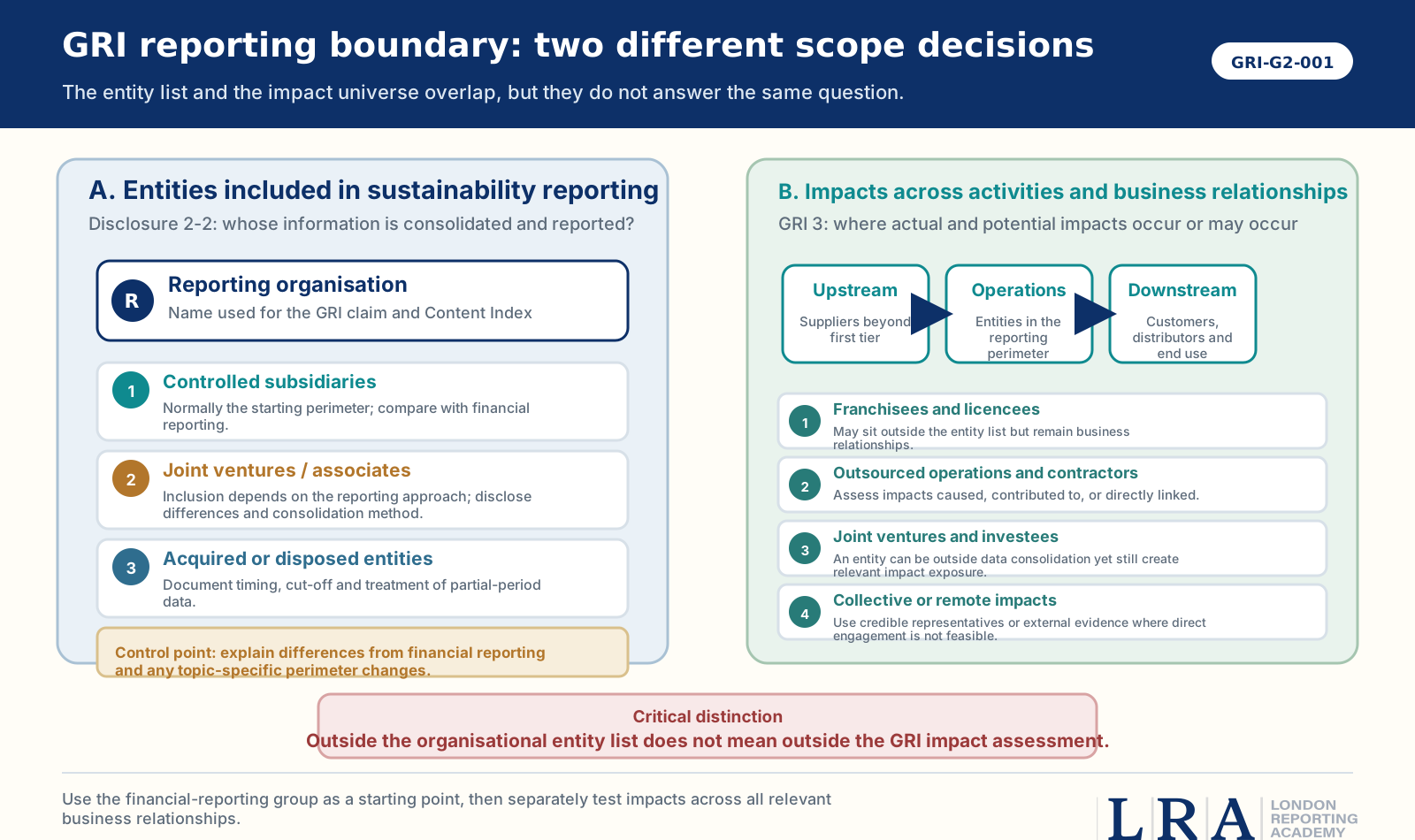
GRI reporting involves two related but different scope decisions. First, the organisation identifies the entities whose sustainability information is consolidated and disclosed under GRI 2-2.
Second, it identifies actual and potential impacts across its own activities and relevant business relationships when determining material topics under GRI 3. An entity can therefore sit outside the consolidated sustainability-reporting list and still be central to the impact assessment. Financial consolidation is a useful starting point, not a substitute for either decision.
Quick orientation
Quick orientation
- Applies to
- Groups with subsidiaries, investments, joint arrangements, franchises, outsourced operations, complex supply chains or significant downstream impacts.
- Primary decision
- Which entities supply consolidated sustainability information, and which activities or relationships must be assessed for impacts.
- Key sources
- GRI 2, Disclosure 2-2; GRI 2, Disclosure 2-6; GRI 3, section 1 and Disclosure 3-1.
- Common confusion
- Treating the financial group, the sustainability-reporting entity list and the universe of impacts as one identical boundary.
In practice
Three concepts that must be kept separate
| Concept | Working meaning | Why it matters |
|---|---|---|
| Reporting organisation | The organisation making the GRI reporting claim and named in the statement of use. It may be a single legal entity or a group, but the scope must be clear and consistent. | The claim, GRI content index, entity list and reporting period must refer to the same reporting organisation. |
| Entities included in sustainability reporting | The entities listed under Disclosure 2-2 and used as the basis for GRI 2 disclosures and the organisation’s material-topic process. GRI recommends using the same group as financial reporting and requires differences to be specified. | This is the entity and data-consolidation perimeter. It determines whose information is aggregated, adjusted, reconciled and explained. |
| Impact universe across business relationships | The activities and relationships through which the organisation causes, contributes to or is directly linked to actual or potential impacts. It can extend beyond first-tier suppliers and beyond entities consolidated in the report. | This prevents the materiality assessment from stopping at legal ownership or operational control when significant impacts occur elsewhere in the value chain. |
Rule
TERMINOLOGY NOTE
“Organisational boundary” and “impact boundary” are useful practitioner shorthand, but the GRI Standards use more precise language: entities included in sustainability reporting, activities, value chain and business relationships. Use the shorthand only after defining what it means in the methodology.
What GRI requires
What GRI does not require
GRI does not state that every subsidiary, associate or joint venture must be consolidated in exactly the same way for every sustainability metric.
GRI does not make financial control the sole test for whether an impact is considered in materiality assessment.
GRI does not turn every supplier, customer, franchisee or contractor into a reporting entity merely because its impacts are relevant.
GRI does not prescribe one universal consolidation method. The organisation must select, apply and explain an approach that is appropriate to the disclosure and evidence.
GRI does not permit a value-chain impact to be ignored simply because the underlying entity sits outside the reporting organisation’s financial statements.
Rule
NORMATIVE CORE
Disclosure 2-2 requires the organisation to list all entities included in sustainability reporting, identify differences from the entities in public financial reporting, and explain the consolidation approach when the organisation consists of multiple entities. The consolidation explanation must address minority interests, mergers, acquisitions and disposals, and whether the approach differs across GRI 2 disclosures and material topics. Disclosure 3-1 requires the organisation to describe how it identified impacts across its activities and business relationships, and to disclose the scope, limitations and exclusions used in that work.
In practice
A practical decision tree for each entity or relationship
| Step | Decision question | Action and evidence |
|---|---|---|
| 1 | What is the reporting organisation making the GRI claim? | Define the parent, group or standalone entity. Record the legal and reporting name, reporting period, ownership structure and approved claim scope. |
| 2 | Is the entity included in public financial reporting? | Use the financial entity register as the starting list. Identify the basis of consolidation and any minority interests or partial-period treatment. |
| 3 | Will the entity be included in sustainability reporting? | Decide whether its data is consolidated for GRI reporting. If the list differs from financial reporting, record the difference and rationale. Include any additional sustainability-reporting entities separately. |
| 4 | Does the consolidation method change by disclosure or material topic? | Document the metric-specific boundary, ownership share, operational-control rule, acquisition/disposal date, estimation or exclusion. Ensure Disclosure 2-2 explains the differences. |
| 5 | Can activities or products connected to the entity create significant impacts? | Assess impacts even if the entity is not in the reporting list. Consider cause, contribution and direct linkage, geography, sector, affected stakeholders and value-chain position. |
| 6 | Does a reported disclosure require data beyond the entity perimeter? | Check the relevant Topic Standard and methodology. Some disclosures require value-chain information, while others concern the reporting organisation’s own workforce, operations or governance. |
| 7 | Are conclusions traceable and approved? | Retain the entity map, impact map, data-boundary register, reconciliations, judgement papers and approval record. Make the public explanation consistent with the underlying files. |
In practice
How common structures should be treated
| Structure | Entity-list question | Impact-assessment question — Typical evidence |
|---|---|---|
| Controlled subsidiary | Normally starts inside the financial group and is commonly included in sustainability reporting. Any exclusion or different metric boundary needs a documented basis and public explanation where relevant. | Assess the subsidiary’s own operations, workforce, products and business relationships. Do not assume group averages capture site-specific or country-specific impacts. — Legal-entity register; consolidation schedule; site list; data-owner confirmation; partial-period or exclusion memo. |
| Associate or minority holding | Not automatically consolidated merely because the organisation has an interest. Decide whether it is included and explain minority-interest adjustments if used. | Consider impacts linked to the investment or relationship, especially where the organisation has leverage, a board role or exposure to severe impacts. — Investment register; ownership and governance rights; impact screening; methodology for proportional or other data treatment. |
| Joint venture | May be included in sustainability reporting even where financial accounting uses equity accounting or another method. The chosen sustainability approach must be explicit. | Assess the venture’s impacts and the organisation’s involvement. Joint control does not make impacts disappear when the venture is outside full consolidation. — Joint-venture agreement; financial treatment; operational responsibility; impact assessment; partner data and sign-off. |
| Acquired or disposed entity | Explain how mergers, acquisitions and disposals are reflected, including the period of inclusion and any restatement or comparability consequence. | Consider pre- and post-transaction impacts where relevant to the reporting period and ongoing responsibility. Avoid erasing a significant event through a year-end snapshot. — Transaction date; cut-off rule; data availability; restatement decision; disposal obligations; period-specific scope memo. |
| Franchise or licence network | Usually not a reporting entity solely because it carries the brand. Some franchise operations may nevertheless be included depending on the reporting design and control facts. | Franchisees are business partners and may generate labour, customer, community or environmental impacts directly linked to the organisation’s products or services. — Contract terms; brand and operational requirements; grievance data; audit results; stakeholder evidence; value-chain map. |
| Outsourced operation or contractor | The contractor is generally not converted into a group entity. Data may still be needed for specific disclosures or to explain a managed operation. | Assess impacts arising through outsourced security, logistics, manufacturing, cleaning, recruitment or other services, including impacts on non-employee workers. — Service contract; workforce model; site responsibility; incident data; procurement and supplier-assurance records. |
| Upstream supplier | Usually outside the entity list. A supplier may still provide data used in a Topic Standard disclosure. | Assess impacts across the supply chain, including beyond first tier where products or sourcing regions create likely significant impacts. — Supplier map; spend and volume data; country/commodity risk; audits; worker or community evidence; traceability limits. |
| Downstream customer or product use | Customers and end users are usually outside the entity list. | Consider impacts linked to product use, distribution, disposal, access, safety, financing or customer practices where the relationship connects the organisation to the impact. — Product-risk assessment; customer terms; incident data; end-use studies; complaints; sector and scientific evidence. |
In practice
Build two linked registers, not one overloaded spreadsheet
| Register | Minimum fields | Control point |
|---|---|---|
| Entity and consolidation register | Entity ID; legal name; ownership; control or interest; financial-reporting treatment; sustainability-reporting inclusion; reporting period; consolidation method; metric exceptions; acquisition/disposal dates. | Reconcile to the audited financial entity list and explain every difference. Lock the version used for publication. |
| Impact and relationship register | Activity or relationship; value-chain position; geography; product/service; affected stakeholders; actual/potential impact; involvement; significance evidence; data source; limitation; material-topic linkage. | Confirm that relationships outside the entity list have not been screened out by default. Link each material topic to the affected activities and relationships. |
| Disclosure boundary register | Disclosure identifier; metric or narrative; included entities/sites; value-chain scope; method; estimate; exclusion; reason; data owner; reviewer; public boundary note. | Check consistency across the report and record why boundaries legitimately differ between disclosures. |
Hypothetical example: a group with a joint venture and outsourced logistics
The team retains the financial group as the starting entity list but performs a separate decision for sustainability reporting. It includes the packaging joint venture in selected sustainability datasets because the venture supplies most of the group’s packaging and reliable operational data are available. It explains that the venture is not fully consolidated in the financial statements and documents how its data are treated. For other disclosures, the venture is outside the consolidated metric and this difference is recorded.
The impact assessment then considers franchise labour practices, contractor road-safety incidents, upstream agricultural sourcing and downstream packaging waste. None of those relationships automatically becomes a reporting entity. However, the impacts remain within the assessment universe, and the relevant material-topic disclosures describe the relationship, the organisation’s involvement and the data limitations. The resulting report therefore has a transparent entity perimeter and a broader, evidence-based impact analysis.
Evidence retained for the example
Approved legal-entity and financial-consolidation lists, with ownership and transaction dates.
A sustainability entity register that identifies additions, exclusions and metric-specific treatments.
A joint-venture methodology paper covering data rights, proportionality, controls and sign-off.
A business-relationship map for franchisees, contractors, suppliers and customers.
Impact-screening records showing why specific relationships were prioritised or scoped out.
A disclosure-level boundary register and reconciliation to published notes.
Approval by the reporting owner and the appropriate governance or review body.
Hypothetical scenario
HYPOTHETICAL SCENARIO
Northshore Foods plc prepares consolidated financial statements for the parent and eight controlled subsidiaries. It also owns 40% of a packaging joint venture, operates through franchisees in two markets and outsources regional logistics. The reporting team initially proposes to collect all GRI data only from the eight consolidated subsidiaries because that matches the financial perimeter.
Illustrative only. It shows how the decision is made, not wording that can be copied or relied on.
In practice
Weak versus stronger boundary disclosure
| Criterion | Weak wording | Stronger approach |
|---|---|---|
| Entity list | “The report covers the Group.” | Names or links to the entities included, identifies the reporting organisation and specifies differences from financial reporting. |
| Consolidation | “Data are consolidated where available.” | Explains the method, minority interests, acquisitions/disposals, metric-specific variations and incomplete coverage. |
| Value chain | “Supplier impacts are outside our boundary.” | Separates data consolidation from impact identification and explains which upstream/downstream relationships were assessed. |
| Exclusions | Excludes a high-risk region without explanation. | Describes the exclusion, why it exists, how it affects conclusions and what remediation or data plan is in place. |
| Consistency | Different metrics use different perimeters with no control. | Uses a disclosure boundary register and concise public boundary notes so legitimate differences are traceable. |
In practice
Common mistakes and how to correct them
| Mistake | Why it fails | Correction |
|---|---|---|
| Copying the financial perimeter without a GRI review | Financial accounting answers a different purpose and may not show additional sustainability entities or value-chain impacts. | Use it as the starting register, then perform the GRI 2-2 and GRI 3 decisions separately. |
| Treating ownership percentage as the only boundary rule | A 40% holding can create important impacts; a 100% subsidiary can require a metric-specific exclusion or estimate. | Document control, interest, influence, data method and impact relevance rather than relying on one percentage. |
| Calling all value-chain entities “in scope” without precision | This blurs entity consolidation, impact assessment and disclosure-specific data, making the report hard to audit. | State exactly whether an entity is included in reporting, assessed for impacts, or supplies data for a particular disclosure. |
| Using “not applicable” for missing subsidiary data | Missing coverage usually indicates incomplete information, not that the disclosure does not apply. | Use the appropriate reason for omission where permitted, specify the missing entities and describe the plan to close the gap. |
| No treatment for acquisitions or disposals | A year-end entity snapshot can distort trends and omit significant events during the reporting period. | Set a cut-off method, record partial-period treatment and assess whether restatement or explanatory context is needed. |
| No approval of boundary changes | Uncontrolled changes create inconsistent metrics, repeated rework and unsupported public statements. | Require change requests, owner/reviewer sign-off and a locked publication perimeter. |
Rule
MYTH VERSUS REALITY
Myth: “If an entity is not consolidated in the financial statements, it is outside GRI.” Reality: financial reporting is the recommended starting point for the entity list, but GRI requires transparent differences and asks the organisation to identify impacts across activities and business relationships. Exclusion from entity consolidation does not remove an impact from assessment.
Readiness
Boundary evidence and approval checklist
- The reporting organisation and legal/reporting name are unambiguous.
- The sustainability entity list is complete, version-controlled and reconciled to financial reporting.
- Differences from the financial group are documented and ready for Disclosure 2-2.
- Minority interests, acquisitions, disposals and partial-period data are addressed.
- Every metric has a defined entity, site and value-chain boundary where relevant.
- The materiality process includes activities and business relationships outside the consolidated entity list.
- Upstream, downstream, franchise and outsourced impacts have been screened using credible evidence.
- Scope limitations and exclusions are specific and do not conceal a material gap.
- Data owners have confirmed completeness and the reviewer has reconciled published boundary notes to source files.
- Boundary judgements and changes have the required management or governance approval.
Joint ventures need a disclosure-specific inclusion assessment rather than a blanket treatment across every GRI metric. Disclosure 2-2 requires the entity list, differences from financial reporting and the consolidation approach; a joint venture may be included in selected datasets where the method and evidence support it, while its impacts must still be considered through business relationships even when it is outside consolidated metrics.
Metric boundaries can differ within one GRI report when the approach is appropriate to each disclosure and supported by evidence. Define the entity, site and value-chain perimeter for every metric, document methods, estimates and exclusions, reconcile legitimate differences and explain them under Disclosure 2-2 where relevant.
Self-check
- Which part of GRI 2-2 addresses differences from financial reporting and metric-specific consolidation approaches?
- What evidence would you expect for a joint venture included in one metric but excluded from another?
- How would you explain the distinction between entity perimeter and impact universe to a board member in one sentence?
Questions
Questions people ask
Should GRI use the same entities as financial reporting?
First, the organisation identifies the entities whose sustainability information is consolidated and disclosed under GRI 2-2. Second, it identifies actual and potential impacts across its own activities and relevant business relationships when determining material topics under GRI 3. An entity can therefore sit outside the consolidated sustainability-reporting list and still be central to the impact assessment.
Are joint ventures included in a GRI report?
Joint ventures need a disclosure-specific inclusion assessment rather than a blanket treatment across every GRI metric. Disclosure 2-2 requires the entity list, differences from financial reporting and the consolidation approach; a joint venture may be included in selected datasets where the method and evidence support it, while its impacts must still be considered through business relationships even when it is outside consolidated metrics.
Do supplier impacts sit outside the GRI boundary?
Second, it identifies actual and potential impacts across its own activities and relevant business relationships when determining material topics under GRI 3. An entity can therefore sit outside the consolidated sustainability-reporting list and still be central to the impact assessment.
How should acquisitions and disposals be treated?
Disclosure 2-2 requires the organisation to list all entities included in sustainability reporting, identify differences from the entities in public financial reporting, and explain the consolidation approach when the organisation consists of multiple entities. The consolidation explanation must address minority interests, mergers, acquisitions and disposals, and whether the approach differs across GRI 2 disclosures and material topics.
Can metric boundaries differ within one report?
Metric boundaries can differ within one GRI report when the approach is appropriate to each disclosure and supported by evidence. Define the entity, site and value-chain perimeter for every metric, document methods, estimates and exclusions, reconcile legitimate differences and explain them under Disclosure 2-2 where relevant.
In practice
Related standards and practical connections
| Relationship | Reference | Practical connection |
|---|---|---|
| Direct | GRI 2, Disclosure 2-2 | Entity list, differences from financial reporting and consolidation approach. |
| Supporting | GRI 2, Disclosure 2-6 | Activities, value chain and other business relationships. |
| Direct | GRI 3, section 1 and Disclosure 3-1 | Impact identification across activities and business relationships, including scope and exclusions. |
| Supporting | GRI 1, Completeness and Verifiability principles | Sufficient coverage, traceable decisions, original sources, assumptions and controls. |
| Glossary | Business partner and business relationships | Terminology for franchisees, suppliers, customers, investees and entities beyond first tier. |
Sources
Primary sources
- GRI 2: General Disclosures 2021 — Disclosure 2-2 and its guidance on financial-reporting alignment, additional entities and business relationships
- GRI 2: General Disclosures 2021 — Disclosure 2-6 on activities, value chain and other business relationships
- GRI 3: Material Topics 2021 — Step 1 and Disclosure 3-1 on entities, activities, business relationships, scope, limitations and exclusions
- GRI 1: Foundation 2021 — Completeness, Verifiability and section 5.1 on alignment with financial reporting
- GRI Standards Glossary 2025 — Definitions of business partner, business relationships and value chain
Framework references
Disclosures this page affects
Take it with you
The checklists as a working spreadsheet
Every checklist and table on this page, with empty status, owner and evidence columns for your team to fill in and keep.
✓ Knowledge Hub AI Assistant · Human-in-the-loop

Ask about this guide
It answers from this page, and reaches into the linked disclosure cards when your question is about the standard itself.
Go deeper · GRI
Certified GRI Standards Training
This page settles one disclosure. The GRI Standards Certified Training — two live days, taken as a bundle with an ESRS course — walks the whole cycle: material topics, datapoints, evidence, the Content Index and assurance readiness, with exercises on your own data.
Available as two live training days online or on-site in London, bundled with an ESRS course.