Short answer
The answer, before the reasoning
Under GRI, an impact is an effect the organisation has or could have on the economy, environment or people through its activities or business relationships. A genuine positive impact therefore requires evidence of a beneficial effect or credible contribution to sustainable development - not merely expenditure, participation, a policy, a product launch or an output count.
Reducing a negative impact is important and should be reported as prevention, mitigation, remediation or performance improvement; it becomes a separate positive-impact claim only where an additional beneficial effect is demonstrated. Positive impacts do not offset unresolved negative impacts, which must be assessed and reported separately.
Rule
GRI-BAS-002
Positive vs Negative Impacts in GRI Reporting: What Counts and How to Evidence It How to distinguish genuine positive impact, reduction of negative impact, outputs and unsupported benefit claims
In practice
Type
| Type | Tier | Audience — Current context |
|---|---|---|
| Deep explainer / evidence guide | Tier 3 - Deep Guide | Reporting teams, programme owners, consultants, reviewers and communications teams — GRI 1 impact concept and GRI 3 material-topic guidance checked to 1 August 2026 |
Why impact language is often overstated
Sustainability communications frequently call every programme a positive impact: money invested, volunteers mobilised, employees trained or products sold. Those facts can be useful, but they usually describe inputs, activities or outputs. GRI's impact concept is about the effect on the economy, environment or people.
The evidence challenge is strongest for positive claims because programme owners understandably want to show success. A balanced report tests whether the claimed benefit occurred, who experienced it, over what period, with what limitations and whether the same activity produced adverse effects.
Quick orientation
Quick orientation
- Applies to
- Materiality assessments, management disclosures, programme evaluations, ESG claims and report examples involving benefits or harm.
- Primary decision
- Is the statement about an activity, output, outcome or effect on the economy, environment or people?
- Key sources
- GRI 1 section 2.1 Impact; GRI 3 Step 2 on positive and negative impacts; GRI 1 reporting principles.
- Common confusion
- Treating the organisation's intention or level of spending as evidence that a positive impact occurred.
In practice
Core distinctions
| Concept | What it means | What it is not |
|---|---|---|
| Negative impact | An actual or potential adverse effect on the economy, environment or people, including human rights. | Only a breach of law, a financial loss to the organisation or a public controversy. |
| Positive impact | An actual or potential beneficial effect or contribution to sustainable development through activities or business relationships. | A charitable intention, activity count, marketing claim or assumed benefit. |
| Reduction of negative impact | Prevention, mitigation or remediation that lowers the severity, scope, likelihood or duration of harm. | Automatically a new positive impact or permission to ignore residual harm. |
| Activity / input | Resources and actions undertaken by the organisation. | Evidence of a change for affected people, the environment or the economy. |
| Output | Immediate deliverable produced by the activity. | The outcome or longer-term impact experienced by stakeholders or ecosystems. |
| Outcome | A change in behaviour, access, condition or experience that may support an impact claim. | Automatic proof that the organisation caused the change. |
What GRI says about positive and negative impacts
Impacts can be actual or potential, negative or positive, short- or long-term, intended or unintended, and reversible or irreversible.
The materiality process identifies both negative and positive impacts across activities and business relationships.
When resources are limited, GRI 3 recommends identifying negative impacts first so that applicable responsible-business-conduct expectations are addressed.
To identify positive impacts, the organisation assesses how it contributes or could contribute to sustainable development through products, services, investments, procurement, employment practices or tax payments.
Activities intended to create a positive contribution can also create negative impacts, and those negative impacts cannot be offset by the benefits.
Reporting principles such as accuracy, balance, completeness and verifiability apply to impact claims.
A practical evidence ladder
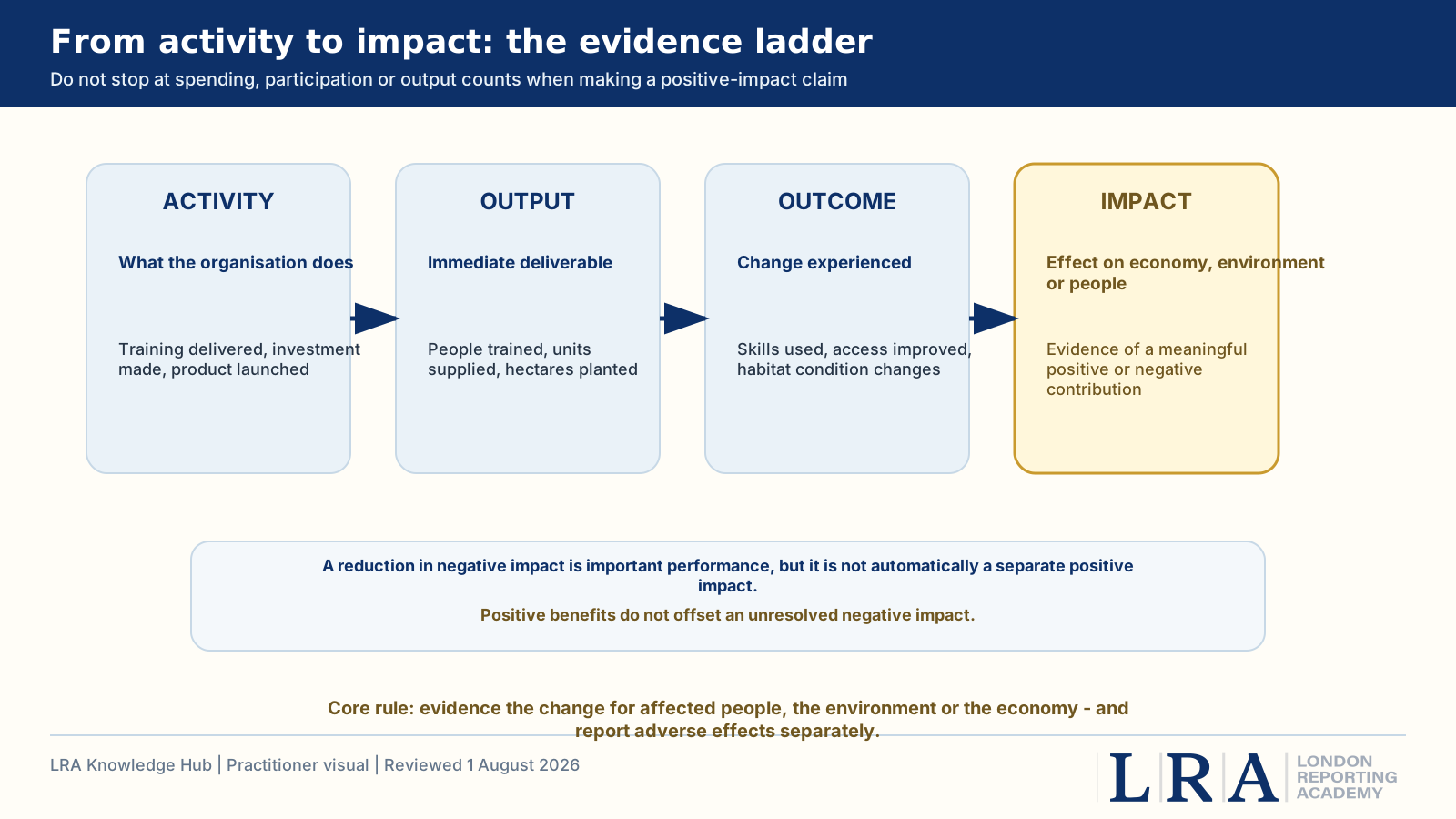
In practice
| Level | Typical evidence | Claim that can be supported |
|---|---|---|
| Activity / input | Budget, staff time, policy, programme design, procurement or investment decision. | The organisation undertook or funded an activity. |
| Output | Participants, products, training hours, grants, infrastructure, trees planted or services delivered. | The activity produced a defined deliverable at a stated scale. |
| Outcome | Changes in access, knowledge, behaviour, income, health, safety, environmental condition or service use. | A change occurred for a defined group or environmental receptor. |
| Impact / contribution | Outcome evidence plus baseline, duration, stakeholder evidence, attribution or contribution analysis, unintended effects and limitations. | The organisation contributed to a beneficial or adverse effect on the economy, environment or people. |
In practice
Evidence standards for a positive-impact claim
| Evidence question | What a stronger claim shows |
|---|---|
| Affected stakeholder or receptor | Who or what experienced the change, including groups that may be overlooked or adversely affected. |
| Baseline and period | The starting condition, reporting period and whether the change persisted. |
| Scale and scope | How many people, locations, ecosystems or economic actors were affected and how deeply. |
| Mechanism | Why the activity is expected to lead to the outcome and which assumptions connect the stages. |
| Contribution versus causation | Whether the organisation caused the change, contributed alongside others or can only report an association. |
| Stakeholder perspective | How affected people or credible representatives describe the benefit, burden or unintended consequence. |
| Negative effects | Adverse outcomes created by the same activity and how they are prevented, mitigated or remediated. |
| Limitations and uncertainty | Data gaps, selection bias, estimates, weak attribution, short follow-up or missing counterfactual information. |
| Governance and review | Owner, methodology, evidence source, challenge process and approval of the public claim. |
Counterfactual caution: what would have happened anyway?
GRI does not prescribe a universal counterfactual method. As implementation practice, teams should avoid claiming that an observed benefit was caused by the organisation when the evidence only shows that the programme and outcome occurred at the same time. A comparison group, trend baseline, participant evidence, expert assessment or a reasoned contribution analysis can strengthen the claim. Where this is not available, use contribution language and explain the limitation.
In practice
Examples across four domains
| Domain | Activity or output only | Potential positive impact with evidence — Negative-impact check |
|---|---|---|
| Employment | 500 jobs created and 20,000 training hours delivered. | Sustained employment for previously unemployed local residents, with skills progression, living-wage evidence and stakeholder feedback. — Job insecurity, discrimination, low pay, unsafe work or displacement of existing livelihoods. |
| Products and services | 100,000 affordable-energy units sold. | Verified increase in reliable and affordable clean-energy access for underserved users, with evidence of actual use and reduced dependence on harmful alternatives. — Product safety, affordability barriers, lifecycle impacts, rebound effects or exclusion of vulnerable users. |
| Community investment | GBP 2 million donated and three schools built. | Improved attendance, educational access or learning conditions for the intended communities over a defined period, confirmed with local stakeholders. — Land acquisition, dependency, unequal access, safeguarding failures or substitution for public obligations. |
| Environment | 50,000 trees planted or emissions reduced by 15%. | Improved ecosystem condition, species recovery or verified avoided harm over time; the emissions reduction is transparently reported as mitigation of climate impact. — Monoculture, water stress, land conflict, leakage, residual emissions or use of positive restoration claims to distract from ongoing damage. |
In practice
Reduction of negative impact versus positive impact
| Statement | Classification | Better reporting approach |
|---|---|---|
| Lost-time injuries fell by 30%. | Evidence that a negative workforce impact may have been reduced; not by itself a separate positive impact. | Report the trend, boundary, severity, actions, residual injuries and worker evidence. |
| Wastewater pollutant concentration fell below the prior baseline. | Mitigation or performance improvement in a negative environmental impact. | Report absolute load, receiving-water condition, remaining impacts and method. |
| A remediation programme restored access to land for affected households. | Remediation of an actual negative impact; it may also produce positive outcomes for rights-holders. | Report the original harm, remedy agreed with affected people, implementation and outcome evidence separately. |
| A product enables users to avoid a harmful alternative. | Potential positive impact if actual adoption, beneficiary effect and wider adverse effects are evidenced. | Use outcome and contribution evidence, not sales volume alone. |
Hypothetical case: community employment programme
A hypothetical logistics company opens a facility in a high-unemployment area and hires 240 local residents. The initial draft calls this a major positive community impact. The reviewer separates the evidence: jobs and training are outputs; twelve-month retention, wage progression and improved access to stable employment are outcomes; local worker interviews support a contribution to employment and household income. The same review identifies long shifts and transport barriers affecting some workers. The final report presents the positive contribution with its scope and limitations and reports the negative workforce impacts and corrective actions separately.
In practice
Weak versus stronger impact claims
| Weak claim | Why weak | Stronger wording pattern |
|---|---|---|
| Our programme positively impacted 10,000 people. | Impact is undefined and the figure may count participants or reach. | The programme delivered [output] to [group]; follow-up evidence indicates [specific outcome] for [number/proportion] over [period], with [limitations]. |
| We planted trees and therefore restored biodiversity. | Planting is an activity; ecosystem restoration requires condition and persistence evidence. | The organisation planted [species/area] and monitors survival, habitat condition and species indicators; current evidence supports [limited outcome], not full restoration. |
| Reduced emissions created a positive climate impact. | A reduction may be mitigation of a negative impact, not a separate positive effect. | Absolute and intensity emissions changed by [amount]; the organisation reports the reduction as mitigation, boundary, method and residual emissions. |
| Community investment generated social value. | No beneficiary, outcome or methodology is specified. | The investment supported [defined outcome] for [affected group], based on [evidence], while [adverse effects or uncertainty] remain. |
Common mistakes and impact-washing signals
Calling expenditure, volunteering hours or participation an impact.
Using intended benefit as evidence of actual benefit.
Counting everyone reached as someone positively affected.
Reporting only the numerator and not the affected population or baseline.
Making causal claims from correlation or a short-term survey.
Ignoring stakeholder accounts that challenge the organisation's definition of success.
Presenting a reduction in harm as if no residual negative impact remains.
Using a positive programme to offset, balance or distract from a separate severe negative impact.
Selecting only favourable geographies, participants or time periods.
Publishing a quantified social or environmental value without a transparent methodology and sensitivity analysis.
Myth
Any ESG activity that has a beneficial intention counts as a positive impact under GRI.
Reality
The activity is only the starting point. A positive-impact claim requires evidence of a beneficial effect or credible contribution to sustainable development, together with scope, affected stakeholders, adverse effects and limitations.
Readiness
Impact-washing prevention checklist
- The claim identifies the affected people, environmental receptor or economic system.
- Activity, output, outcome and impact are not used as synonyms.
- The baseline, period, boundary and unit are defined.
- The evidence includes affected-stakeholder or credible proxy input where relevant.
- Causation is not claimed where only contribution or association is supported.
- Unintended and negative impacts from the same activity are assessed.
- Positive impacts are not netted against or used to offset negative impacts.
- The claim states limitations, uncertainty and missing counterfactual evidence.
- The methodology and source records are available for review.
- Communications wording has been reconciled with the materiality and evidence files.
Self-check
- What changed for the affected stakeholder or environmental receptor, beyond the organisation's activity?
- How do we know the change occurred and persisted?
- What other factors may have produced the same outcome?
- What negative effects did the same programme create or fail to resolve?
Questions
Questions people ask
What is a positive impact under GRI?
Under GRI, an impact is an effect the organisation has or could have on the economy, environment or people through its activities or business relationships. A genuine positive impact therefore requires evidence of a beneficial effect or credible contribution to sustainable development - not merely expenditure, participation, a policy, a product launch or an output count.
Is reducing a negative impact a positive impact?
A genuine positive impact therefore requires evidence of a beneficial effect or credible contribution to sustainable development - not merely expenditure, participation, a policy, a product launch or an output count. Reducing a negative impact is important and should be reported as prevention, mitigation, remediation or performance improvement; it becomes a separate positive-impact claim only where an additional beneficial effect is demonstrated.
Are jobs created a positive impact?
The initial draft calls this a major positive community impact. The reviewer separates the evidence: jobs and training are outputs; twelve-month retention, wage progression and improved access to stable employment are outcomes; local worker interviews support a contribution to employment and household income.
Can positive impacts offset negative impacts?
Reducing a negative impact is important and should be reported as prevention, mitigation, remediation or performance improvement; it becomes a separate positive-impact claim only where an additional beneficial effect is demonstrated. Positive impacts do not offset unresolved negative impacts, which must be assessed and reported separately.
What evidence supports a positive-impact claim?
The activity is only the starting point. A positive-impact claim requires evidence of a beneficial effect or credible contribution to sustainable development, together with scope, affected stakeholders, adverse effects and limitations.
In practice
Related standards and next learning steps
| Relation | Reference | Why it matters |
|---|---|---|
| Direct | GRI 1 section 2.1 Impact | Defines positive and negative effects on the economy, environment and people. |
| Direct | GRI 3 Step 2 | Guides identification of positive and negative impacts and prohibits offsetting adverse impacts with benefits. |
| Supporting | GRI 1 reporting principles | Accuracy, balance, completeness and verifiability for public claims. |
| Comparison | GRI Due Diligence and Business Relationships | Applies cause, contribution and direct linkage to negative impacts. |
| Evidence | GRI Evidence Pack | Retains programme data, methodology, stakeholder evidence and approvals. |
Sources
Primary sources
Take it with you
The checklists as a working spreadsheet
Every checklist and table on this page, with empty status, owner and evidence columns for your team to fill in and keep.
✓ Knowledge Hub AI Assistant · Human-in-the-loop

Ask about this guide
It answers from this page, and reaches into the linked disclosure cards when your question is about the standard itself.
Go deeper · GRI
Certified GRI Standards Training
This page settles one disclosure. The GRI Standards Certified Training — two live days, taken as a bundle with an ESRS course — walks the whole cycle: material topics, datapoints, evidence, the Content Index and assurance readiness, with exercises on your own data.
Available as two live training days online or on-site in London, bundled with an ESRS course.