Short answer
The answer, before the reasoning
AI can accelerate repeatable and reviewable tasks in GRI reporting: extracting candidate requirements from an approved source pack, proposing mappings, drafting data requests, comparing periods, checking consistency and assembling a first-pass Content Index. It should not make final decisions on impact identification, significance, material topics, stakeholder interpretation, reporting boundaries, legal prohibitions, confidentiality, evidence validity, assurance conclusions or the organisation's statement of use.
Those decisions depend on facts, rights-holder perspectives, professional judgement and accountability. A safe workflow therefore treats AI as an assistive production tool, records its sources and outputs, and requires qualified human review and approval before any claim is published.
Rule
GRI-IMP-001
Using AI for GRI Reporting: What Can Be Automated and What Requires Human Judgement A human-in-the-loop workflow for extraction, mapping, drafting, evidence validation, materiality decisions and final publication claims
In practice
Type
| Type | Tier | Audience — Current context |
|---|---|---|
| Decision guide / operating model | Tier 3 · Deep Guide | Reporting teams, consultants, reviewers, data owners, legal teams and governance sponsors — GRI 1-3 requirements and general AI risk-management sources checked to 1 August 2026 |
The responsibility does not move to the model
GRI requirements apply to the reporting organisation. An AI system can produce text, classifications or anomaly flags, but it does not become the data owner, materiality approver, legal adviser, assurance provider or highest governance body. The organisation must still apply the reporting principles, retain verifiable evidence and support every judgement.
There is also no single “AI accuracy” control. Risks differ by task: a summarisation error, an invented disclosure number, an incorrect calculation, a confidentiality breach and an overconfident materiality conclusion require different controls. The operating model should classify the use case before the tool is used.
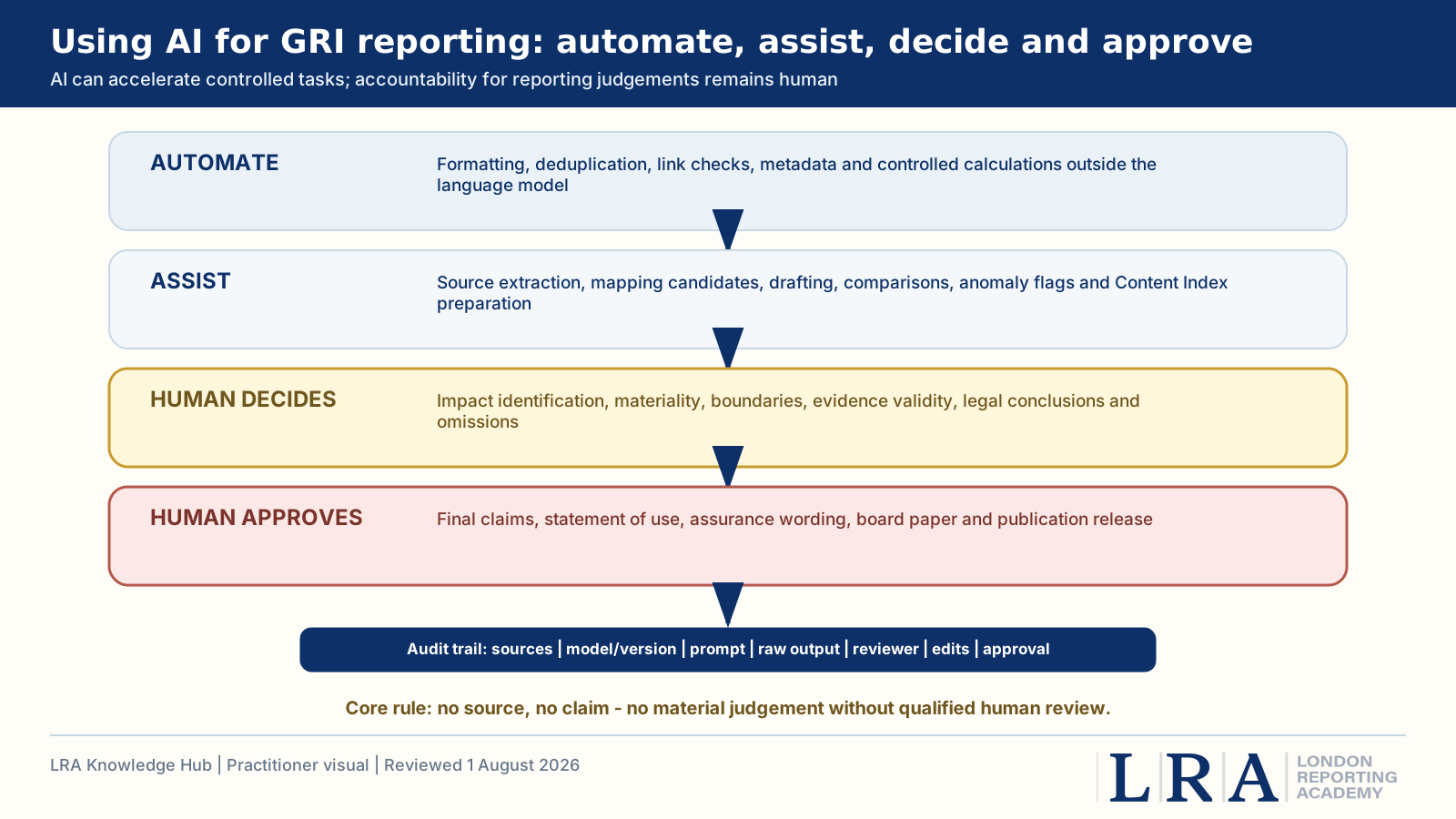
Four zones: automate, assist, decide and approve
In practice
| Zone | Suitable examples | Human control |
|---|---|---|
| Automate | Formatting, deduplication, metadata population, link checking, file comparison and deterministic calculations performed in controlled code. | Approve rules and test outputs; do not ask a language model to perform material calculations that should be reproducible in code. |
| Assist | Extract candidate requirements, map source paragraphs to disclosures, draft data requests, compare prior-year wording, flag units/periods, create first-pass Content Index entries and translate approved text. | Review every output against approved sources and organisation evidence. |
| Human decides | Identify actual and potential impacts, assess significance, set thresholds, define boundaries, choose omissions, evaluate stakeholder evidence and validate estimates. | Named qualified owner documents rationale, evidence, uncertainty and dissent. |
| Human approves | Final statement of use, assurance wording, legal conclusions, material topics, board paper, public claims and release decision. | Independent technical/legal/governance approval as appropriate. |
In practice
Safe and useful AI-assisted use cases
| Use case | Value | Minimum control |
|---|---|---|
| Source extraction | Find candidate requirements, definitions and guidance in a controlled source set. | Retrieval limited to approved editions; exact paragraph and disclosure identifiers verified by a human. |
| Disclosure mapping | Propose links between report text, data tables and GRI requirements. | Treat mappings as candidates; review requirement-level completeness and relevance. |
| Data-request drafting | Convert requirements into owner, period, unit, boundary, method and evidence fields. | Technical owner confirms the requested scope and does not accept invented methodology. |
| Prior-year comparison | Identify changed numbers, wording, boundaries, restatements and missing disclosures. | Reconcile against controlled versions and source systems. |
| Consistency checks | Flag inconsistent units, dates, organisation names, targets, claims and cross-references. | Investigate flags; do not assume the model's preferred version is correct. |
| Content Index assistance | Draft locations, disclosure titles, reasons-for-omission fields and link tests. | Publisher and technical reviewer verify every entry and precise location. |
| Drafting support | Create a first draft from an approved claim ledger and evidence pack. | Prohibit new normative claims; mark examples and unresolved source gaps. |
| Red-team prompts | Search for overclaim, false equivalence, hidden boundary and unsupported causality. | Human reviewer evaluates findings and source basis. |
| Translation and plain language | Localise approved content and create reader-friendly explanations. | Preserve canonical terms, conditions, identifiers and version; bilingual technical check. |
In practice
Decisions that should not be delegated
| Decision | Why AI output is insufficient | Required human evidence |
|---|---|---|
| Impact identification | The model may reproduce common sector issues but miss organisation-specific, location-specific or rights-holder impacts. | Due diligence, site/value-chain evidence, grievances, affected-stakeholder input and expert analysis. |
| Significance and material topics | Severity, likelihood, scale, scope, irremediable character and thresholds require accountable judgement. | Methodology, assumptions, competing views, decision log and approval. |
| Stakeholder interpretation | Sentiment summaries can erase minority, vulnerable or severe-impact perspectives. | Source records, representation analysis and human contextual review. |
| Reporting and impact boundaries | A model can confuse financial consolidation with the reach of impacts. | Entity register, business-relationship map, topic-specific coverage and approvals. |
| Evidence validation | Fluent text cannot prove that source data are complete, accurate or authorised. | System extracts, calculation files, reconciliation, owner confirmation and controls. |
| Legal prohibition or confidentiality | AI cannot give a final organisation-specific legal conclusion or assess protected-person risk reliably. | Qualified legal/privacy/security review and specific decision record. |
| Assurance interpretation | The model may generalise a selected-indicator conclusion to the whole report. | Signed assurance report, scope matrix and assurance-specialist review. |
| Final GRI claim | The statement of use depends on the complete controlled reporting package. | Final GRI 1 checklist, Content Index, approvals and published version. |
Human-in-the-loop workflow
1. Classify the use case and risk. Define whether the system will automate, assist, inform a decision or draft a public claim.
2. Approve the source and data perimeter. Use current official standards, controlled organisation records and permitted access levels.
3. Define the output contract. State the required schema, prohibited claims, confidence labels and what the system must flag as unknown.
4. Generate with traceability. Preserve source anchors, model/version, prompt/template, retrieval set and output.
5. Perform technical and evidence review. Validate disclosure identifiers, boundaries, calculations, facts, examples and limitations.
6. Escalate specialist decisions. Route legal, human-rights, scientific, actuarial, assurance or privacy issues to qualified reviewers.
7. Approve the canonical answer and public wording. Separate preparation from final technical or governance approval.
8. Archive and monitor. Retain accepted edits, rejected outputs, incident records, regression tests and update triggers.
In practice
Audit-trail fields for every material AI-assisted task
| Field | Purpose |
|---|---|
| Task and use-case ID | Connects the output to an approved process and risk classification. |
| Model/provider/version | Supports reproducibility, incident review and change management. |
| Prompt or workflow version | Shows the instruction and prohibited-claim controls applied. |
| Source set and access level | Identifies which standards, evidence and restricted records were available. |
| Raw output | Preserves what the system generated before human editing. |
| Reviewer and qualifications | Shows who tested technical, legal or subject-matter accuracy. |
| Corrections and rationale | Captures hallucinations, omissions, rejected mappings and accepted judgement. |
| Final approved output | Links to the controlled report text, table, index entry or data request. |
| Date and update trigger | Ensures the output is re-reviewed when standards, evidence or the model change. |
Hallucination and over-reliance controls
No source, no normative claim: the system must return a source gap rather than complete the logic from memory.
Use retrieval from approved documents and store exact source anchors with each claim.
Verify all GRI numbers, titles, editions, effective dates and reasons-for-omission rules independently.
Perform calculations in transparent spreadsheets or code, not free-form language generation.
Separate candidate mapping from approved mapping and candidate wording from published wording.
Use a do-not-say registry for compliance, certification, equivalence, assurance and causal-impact claims.
Require confidence labels and preserve conditions with the statement they qualify.
Run regression tests on known difficult scenarios and compare outputs when the model or prompt changes.
Block personal, grievance, privileged or client-confidential information from unapproved systems.
Monitor errors and near misses, and withdraw AI-generated content that cannot be verified.
How NIST and OECD guidance can support the control model
NIST's voluntary AI Risk Management Framework organises risk management through Govern, Map, Measure and Manage. Its Generative AI Profile adds actions tailored to generative-AI risks, while the Playbook offers suggested implementation actions rather than a mandatory checklist. The OECD AI Principles reinforce transparency, explainability, robustness, safety and accountability. These are general governance sources; they do not change the GRI requirements or make an AI output technically correct.
Hypothetical case: an AI-generated Content Index
A hypothetical reporting team asks a generative-AI tool to build a GRI Content Index from a draft report. The tool identifies many correct disclosure references but invents two disclosure numbers, marks several partial requirements as complete and describes a selected-emissions assurance statement as covering the report. The controlled workflow catches the errors because each entry must link to an approved source requirement, exact report location and evidence owner. The final reviewer rejects the invented identifiers, records incomplete requirements precisely and narrows the assurance wording.
In practice
Weak versus stronger AI workflow
| Weak workflow | Risk | Stronger workflow |
|---|---|---|
| Upload the report and ask, “Is this GRI compliant?” | Undefined scope, unsupported legal/technical conclusion and false confidence. | Run a requirement-level checklist from approved standards; AI proposes evidence links and a human approves each finding. |
| Ask AI to choose material topics from a survey. | Stakeholder voting replaces impact assessment. | AI organises evidence; qualified humans assess significance and document judgement. |
| Let the model calculate emissions from narrative inputs. | Non-reproducible arithmetic and hidden assumptions. | Use controlled calculation logic; AI can explain the approved methodology. |
| Publish an AI draft after grammar review. | Technical hallucinations survive because fluency is mistaken for accuracy. | Technical, evidence and claim review precede editorial polishing and release. |
| Use confidential client evidence in a public chatbot. | Privacy, privilege, contract and security exposure. | Apply approved environment, access controls, minimisation and restricted retrieval. |
Common mistakes
Treating a high-confidence tone as evidence of correctness.
Using an uncontrolled web search when current official standards are available in the source pack.
Allowing the model to merge GRI, ESRS and IFRS requirements into a false equivalence.
Failing to preserve the exact condition or exception attached to a normative statement.
Using AI to make a reason-for-omission or legal conclusion without counsel.
Accepting automated mapping at disclosure-title level while missing sub-requirements.
Keeping no record of model, prompt, source set or human edits.
Putting restricted grievance or personal information into an unapproved environment.
Delegating final claim and publication approval to the same person who generated the draft.
Myth
AI can determine material topics objectively because it can analyse more data than a human team.
Reality
AI can organise evidence and surface patterns, but significance depends on impact facts, severity, likelihood, affected-stakeholder perspectives, assumptions and accountable judgement. More data does not remove the need for a defensible human decision.
Readiness
AI readiness checklist for a GRI team
- Approved use cases and prohibited uses are documented.
- Current official source packs and terminology are controlled.
- Data classification and permitted AI environments are defined.
- Each output type has a schema, confidence rule and human owner.
- Normative claims require exact source anchors.
- Calculations remain reproducible outside the language model.
- Materiality, legal, assurance and final-claim decisions have mandatory human gates.
- Raw outputs, edits, reviewers and approvals are logged.
- Regression tests cover disclosure identifiers, omissions, boundaries and claims.
- Incident, correction and model-change processes are active.
For each material AI-assisted task, retain the use case, model, provider and version, prompt or workflow version, approved source and retrieval set, input classification, output, source anchors, confidence and limitations, human review and final decision. Preserve accepted edits, rejected outputs, incidents, regression tests and update triggers so the result can be reproduced and re-reviewed when evidence, standards or the model changes.
Self-check
- Could the AI output be independently reproduced from the retained source set?
- Which part of the task is factual extraction, and which part is professional judgement?
- Who is accountable for rejecting a persuasive but unsupported answer?
- What confidential information was exposed to the model, and was that exposure authorised?
Questions
Questions people ask
Can AI prepare a GRI report?
AI can accelerate repeatable and reviewable tasks in GRI reporting: extracting candidate requirements from an approved source pack, proposing mappings, drafting data requests, comparing periods, checking consistency and assembling a first-pass Content Index. It should not make final decisions on impact identification, significance, material topics, stakeholder interpretation, reporting boundaries, legal prohibitions, confidentiality, evidence validity, assurance conclusions or the organisation's statement of use. Those decisions depend on facts, rights-holder perspectives, professional judgement and accountability.
Can AI determine material topics?
AI can accelerate repeatable and reviewable tasks in GRI reporting: extracting candidate requirements from an approved source pack, proposing mappings, drafting data requests, comparing periods, checking consistency and assembling a first-pass Content Index. It should not make final decisions on impact identification, significance, material topics, stakeholder interpretation, reporting boundaries, legal prohibitions, confidentiality, evidence validity, assurance conclusions or the organisation's statement of use.
Can AI create a GRI Content Index?
AI can accelerate repeatable and reviewable tasks in GRI reporting: extracting candidate requirements from an approved source pack, proposing mappings, drafting data requests, comparing periods, checking consistency and assembling a first-pass Content Index. It should not make final decisions on impact identification, significance, material topics, stakeholder interpretation, reporting boundaries, legal prohibitions, confidentiality, evidence validity, assurance conclusions or the organisation's statement of use.
What AI audit trail should be retained?
For each material AI-assisted task, retain the use case, model, provider and version, prompt or workflow version, approved source and retrieval set, input classification, output, source anchors, confidence and limitations, human review and final decision. Preserve accepted edits, rejected outputs, incidents, regression tests and update triggers so the result can be reproduced and re-reviewed when evidence, standards or the model changes.
How can hallucinations be controlled in ESG reporting?
The tool identifies many correct disclosure references but invents two disclosure numbers, marks several partial requirements as complete and describes a selected-emissions assurance statement as covering the report. The controlled workflow catches the errors because each entry must link to an approved source requirement, exact report location and evidence owner.
In practice
Related standards and next learning steps
| Relation | Reference | Why it matters |
|---|---|---|
| Direct | GRI 1 reporting principles | Accuracy, completeness and verifiability of AI-assisted outputs. |
| Direct | GRI 3 materiality process | Impact identification and significance remain judgement-based. |
| Implementation | NIST AI RMF and GenAI Profile | General risk-management architecture for AI use. |
| Implementation | OECD AI Principles | Transparency, robustness and accountability context. |
| Application | GRI Evidence Pack and Internal Controls | Traceability, access, review and approval. |
Sources
Primary sources
Take it with you
The checklists as a working spreadsheet
Every checklist and table on this page, with empty status, owner and evidence columns for your team to fill in and keep.
✓ Knowledge Hub AI Assistant · Human-in-the-loop

Ask about this guide
It answers from this page, and reaches into the linked disclosure cards when your question is about the standard itself.
Go deeper · GRI
Certified GRI Standards Training
This page settles one disclosure. The GRI Standards Certified Training — two live days, taken as a bundle with an ESRS course — walks the whole cycle: material topics, datapoints, evidence, the Content Index and assurance readiness, with exercises on your own data.
Available as two live training days online or on-site in London, bundled with an ESRS course.