Short answer
The answer, before the reasoning
GRI requires organisations reporting in accordance with the Standards to apply eight reporting principles: Accuracy, Balance, Clarity, Comparability, Completeness, Sustainability context, Timeliness and Verifiability. The principles should operate as a control framework across data collection, drafting, review and approval.
Accuracy requires correct and sufficiently detailed information; Balance requires an unbiased account of negative and positive impacts; Completeness requires enough information to assess impacts during the reporting period; and Verifiability requires evidence and decision records organised so quality can be examined. The remaining principles shape context, consistency, accessibility and timing.
Educational practitioner material. Requirements, GRI guidance and LRA implementation practice are distinguished throughout. Illustrative scenarios, scoring anchors and wording require adaptation to the organisation’s facts, sectors, locations, evidence and reporting context. This material is not legal or assurance advice.
Quick orientation
Quick orientation
- Applies to
- Reporting teams, data owners, editors, legal reviewers, internal audit, assurance teams and governance bodies preparing or approving GRI information.
- Primary decision
- How to turn the eight GRI reporting principles into drafting rules, evidence expectations and review controls.
- Key source
- GRI 1: Foundation 2021, section 4, Reporting principles.
- Common confusion
- The principles are not a decorative statement in the basis of preparation. An organisation reporting in accordance with GRI must apply all eight to the reported information.
Technical status
Current technical status
This article is based on GRI 1: Foundation 2021, effective for reporting from 1 January 2023. It distinguishes binding requirements from GRI guidance and from LRA implementation practice. Check the current GRI Resource Center before publication or client use.
All eight principles at a glance
In practice
| Principle | GRI requirement in practical language | Primary control question |
|---|---|---|
| Accuracy | Report information that is correct and sufficiently detailed to allow assessment of impacts. | Can a reviewer reproduce the figure or trace the narrative to evidence, and are estimates and limitations clear? |
| Balance | Report information in an unbiased way and provide a fair representation of negative and positive impacts. | Does the report explain setbacks, adverse outcomes and limitations as well as achievements? |
| Clarity | Present information in a way that is accessible and understandable. | Can the intended user find, interpret and use the information without specialist guesswork? |
| Comparability | Select, compile and report information consistently so users can analyse changes over time and relative to other organisations. | Are periods, boundaries, definitions, methods and restatements sufficiently consistent and transparent? |
| Completeness | Provide sufficient information to assess the organisation’s impacts during the reporting period. | Are material topics, boundaries, significant events, data gaps and management information complete enough for an assessment? |
| Sustainability context | Report impacts in the wider context of sustainable development. | Are results related to relevant limits, needs, conditions, goals or affected-system context rather than presented as isolated company numbers? |
| Timeliness | Report on a regular schedule and make information available in time for users to make decisions. | Does the reporting process deliver current information at a predictable time, with late events and estimates controlled? |
| Verifiability | Gather, record, compile and analyse information so it can be examined to establish quality. | Can a person independent of the preparer trace the claim, evidence, judgement, control and approval? |
Accuracy: correct, detailed and transparent about uncertainty
Accuracy is not limited to arithmetic correctness. GRI requires information that is correct and sufficiently detailed to support assessment of impacts. Quantitative accuracy depends on data collection, compilation and analysis methods. Qualitative accuracy depends on detail and consistency with available evidence. The report should distinguish measured and estimated data, explain calculation bases and disclose material uncertainty or limitations.
Define who owns each metric and narrative claim, and who performs an independent review.
Maintain a methodology file with definitions, units, boundaries, formulas, source systems, estimates and restatement rules.
Use a claim ledger for qualitative assertions such as “reduced”, “effective”, “safe” or “restored”.
State uncertainty where it could affect the user’s interpretation; do not use polished narrative to hide an unresolved data gap.
In practice
| Strong disclosure signals | Red flags | Evidence and review tests |
|---|---|---|
| Boundary, unit, period, method, source, calculation basis and estimate status are visible. Qualitative statements match incident, grievance, monitoring and governance evidence. | Rounded figures without method; unsupported superlatives; inconsistent totals; estimates presented as measurements; claims of effectiveness based only on activities. | Recalculate or reperform samples; reconcile to source systems; inspect estimate assumptions; compare narrative claims with contrary evidence; review error margins and change controls. |
Balance: report the full direction of performance
Balance requires an unbiased and fair representation of negative and positive impacts. It does not require equal word counts or a mechanically “neutral” tone. It requires that selection, emphasis, imagery, headlines and context do not create a misleadingly favourable impression. Positive initiatives cannot cancel material negative impacts, and a report should not turn corrective action into evidence that the underlying harm was minor.
In practice
| Strong disclosure signals | Red flags | Evidence and review tests |
|---|---|---|
| Material adverse impacts, incidents, missed targets, limitations and unresolved issues are presented alongside progress. Trend explanations include both favourable and unfavourable drivers. | Only awards and case studies; negative data buried in appendices; absolute achievements without denominator; revised target presented without explaining the missed original target. | Search for contrary evidence in grievances, incidents, audits, litigation, regulator correspondence and board papers; challenge title and graphic emphasis; compare positive claims with outcome metrics. |
Rule
Balance test
Ask what a reasonable user would conclude after reading the report. If the same underlying evidence would lead an internal risk committee to a materially less favourable conclusion, the public narrative needs challenge.
Completeness: enough to assess impacts, not “include everything”
Completeness requires sufficient information for users to assess impacts during the reporting period. It is not a demand to publish every available datapoint. The organisation should cover all material topics and the relevant boundaries, periods, locations, value-chain relationships, significant events and limitations needed to understand the impacts and management response.
In practice
| Completeness dimension | Review questions |
|---|---|
| Topic coverage | Are all material topics covered, including uncomfortable or newly emerged topics? Are reasons for omission used only where permitted and properly explained? |
| Boundary | Does the report identify the entities and business relationships relevant to each impact, rather than applying one corporate boundary automatically to every topic? |
| Period | Are current-period impacts, significant events after data cut-off and changes in operations, acquisitions or closures considered? |
| Information depth | Are impact description, policies/commitments, actions, effectiveness, stakeholder engagement and limitations sufficient under Disclosure 3-3? |
| Data gaps | Are unavailable, estimated or incomplete data visible, with the affected scope and improvement action? |
| Cross-references | Do references lead to current, accessible and specific information rather than generic webpages or obsolete documents? |
Verifiability: design the evidence trail before drafting
Verifiability means that information is gathered, recorded, compiled and analysed so its quality can be examined. It does not mean that external assurance is mandatory for every GRI report. GRI recommends ways to enhance credibility, including internal controls and external assurance, but the reporting principle itself is the underlying evidence discipline.
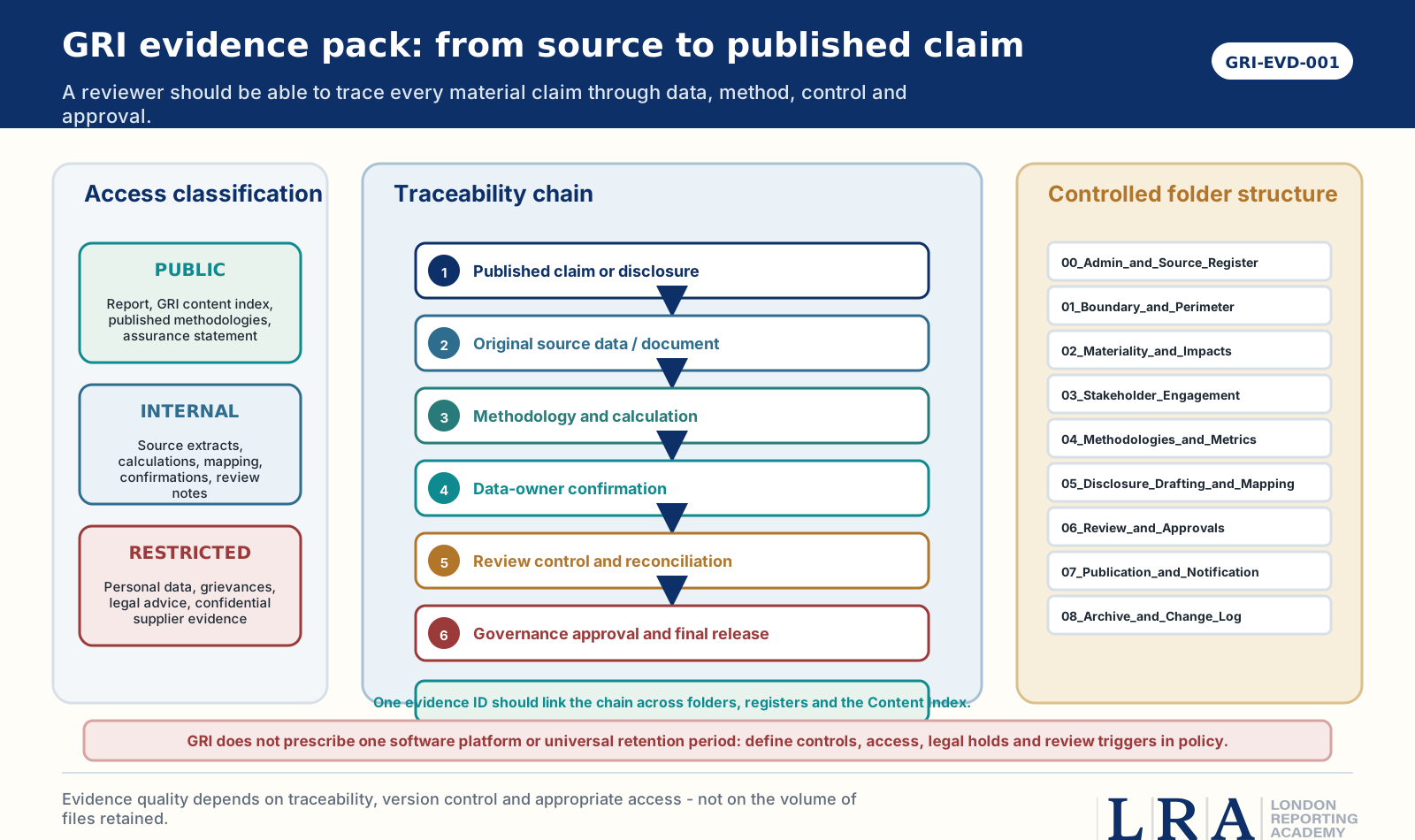
Retain source extracts, methodology versions, calculations, review comments, approvals and publication files under stable identifiers.
Separate public evidence from restricted personal, grievance, commercially sensitive or legally privileged records while maintaining controlled traceability.
Design systems so another person can examine the process, not only the final number.
Record why a judgement was made and which alternative was rejected, especially for materiality, estimates, boundaries and claims of effectiveness.
In practice
| Strong disclosure signals | Red flags | Evidence and review tests |
|---|---|---|
| Original sources, transformations, assumptions, review notes and approvals are identifiable. Decision processes such as materiality and threshold setting are documented. | Spreadsheet figures with no lineage; narrative copied from prior year; unsupported estimates; no evidence for claims of effectiveness; preparer is sole approver. | Trace a sample from published claim to source; inspect access and version controls; reperform calculations; review minutes and judgements; confirm retention and restricted-evidence arrangements. |
In practice
Clarity, comparability, sustainability context and timeliness
| Principle | Strong practice | Frequent failure |
|---|---|---|
| Clarity | Plain-language explanation precedes technical detail; tables have units and boundaries; navigation and cross-references are specific; jargon is defined consistently. | Dense policy language, unexplained acronyms, ambiguous charts, inaccessible tables or links that require the reader to search for the disclosure. |
| Comparability | Methods and definitions are stable; changes are explained; prior periods are restated where appropriate; intensities include denominators and absolute figures; peer comparisons use genuinely comparable bases. | Method changes create artificial improvement; boundaries shift without explanation; one-year snapshots; selective peer metrics or inconsistent units. |
| Sustainability context | Performance is related to affected-system conditions, scientific or policy thresholds, community needs, sector context and the organisation’s contribution to sustainable development. | A reduction is called “sustainable” without reference to the level needed, local conditions or the organisation’s total impact. |
| Timeliness | Reporting schedule, data cut-off, estimates and late-event process are defined; high-priority information reaches governance and users when relevant. | Report issued so late that decisions rely on obsolete information; late incidents omitted without explanation; inconsistent reporting intervals. |
Sustainability context: the principle most often reduced to a slogan
Sustainability context asks the organisation to explain its impacts in relation to wider sustainable development. A company-only trend can be accurate yet misleading if it ignores the condition of the system affected. A 10% reduction in water withdrawal may still be inadequate in a critically stressed basin; a living-wage programme covering one site may not address the workforce most exposed to low pay; a biodiversity restoration activity may not compensate for habitat loss elsewhere.
Use location-specific context where the impact depends on water stress, air quality, ecosystem condition, community needs or rights.
Distinguish an internal target from the external level of performance needed to avoid or address the impact.
Explain the organisation’s contribution rather than claiming sole causation for a wider system outcome.
Avoid converting an SDG icon or policy alignment statement into evidence of the organisation’s actual impact.
Comparability: consistency without freezing the methodology
Comparability does not prohibit improving a method. It requires the change to be transparent and the resulting information to remain usable. When a boundary, factor, estimate, definition or calculation changes, explain the reason and effect. Restate prior periods where appropriate and practicable, or clearly mark the break in series. Where peer comparisons are used, test whether scope, sector, geography, units and calculation methods are sufficiently similar.
In practice
| Change | Control |
|---|---|
| New emission factor or measurement method | Quantify the effect where possible; update methodology; decide whether prior data need restatement; explain the basis. |
| Acquisition or disposal | Explain boundary change; present like-for-like information or a bridge; avoid attributing structural change to performance. |
| New material topic | Explain why it emerged and what period or value-chain scope is covered; do not imply earlier absence of disclosure meant absence of impact. |
| Improved supplier data | Separate real performance change from replacement of estimates; retain both data-quality and impact trends. |
| Target revision | Explain the original target, performance, reason for change and effect on comparability; do not silently reset the baseline. |
A nine-step editorial and control workflow
1. Define the disclosure claim and the GRI requirement or principle it is intended to satisfy.
2. Assign the owner, reviewer, source systems, boundary, period and evidence class.
3. Draft the factual core before promotional framing: impact, metric, method, action, outcome and limitation.
4. Perform the accuracy test: reconcile figures, inspect estimates and challenge qualitative assertions against evidence.
5. Perform the completeness test: check topic, boundary, period, value-chain scope, incidents, limitations and cross-references.
6. Perform the balance test: search for adverse evidence, missed targets, contradictory trends and disproportionate visual emphasis.
7. Perform the comparability and sustainability-context tests: explain changes and place the result in the relevant wider context.
8. Perform the clarity, timeliness and verifiability tests: user review, accessibility, data cut-off, evidence trace and approval record.
9. Approve and retain the final claim ledger, calculations, source extracts, review findings, resolution and publication version.
In practice
Worked editorial example - water use
| Weak wording | Why it is weak | More decision-useful wording |
|---|---|---|
| “We reduced water consumption by 12% and remain committed to water stewardship.” | No boundary, period, denominator, basin context, method, adverse effects, target basis or uncertainty. The positive trend may create an unbalanced impression. | “Absolute water withdrawal across operated sites fell 12% from 4.2 to 3.7 million m3 between 2025 and 2026, mainly because Site C closed for four months. On a like-for-like basis, withdrawal fell 3%. Two sites are in high water-stress basins and accounted for 41% of withdrawal. Community complaints at Site D increased, and our investigation of seasonal borehole effects remains open. Figures include metered withdrawal and estimates for two small sites; the estimation method and limitations are described in the data note.” |
Rule
Why the stronger version works
It improves accuracy through units, period, method and estimate status; balance through the complaint and open investigation; comparability through like-for-like analysis; completeness through boundary and limitations; sustainability context through basin stress; and verifiability through a referenced data note. It is illustrative wording and must be adapted.
In practice
Principle-by-principle review tests
| Principle | Minimum review test |
|---|---|
| Accuracy | Reperform a sample calculation; trace a qualitative claim to evidence; verify estimates and uncertainty wording. |
| Balance | Review contrary evidence and negative trends; test headlines, case studies and graphics for selective emphasis. |
| Clarity | Ask a non-specialist user to locate the answer, boundary, method and limitation; check accessibility and definitions. |
| Comparability | Reconcile periods, boundaries, units, methods and restatements; isolate structural and methodology effects. |
| Completeness | Map every material topic and required disclosure to content, evidence, scope and omissions; inspect late events and value-chain gaps. |
| Sustainability context | Identify the relevant external condition, threshold, need or goal and explain the organisation’s contribution without overclaim. |
| Timeliness | Confirm reporting schedule, cut-off, estimate process and treatment of significant information arising before publication. |
| Verifiability | Trace the claim to source, transformation, owner, reviewer, approval and retained version; confirm restricted evidence is controlled. |
Common mistakes
Publishing a statement that the principles were applied without embedding principle-specific review controls.
Treating balance as equal positive and negative word counts rather than fair representation.
Treating completeness as volume and adding immaterial detail while omitting material limitations or value-chain impacts.
Calling a disclosure verifiable because it was reviewed by management, although source evidence and decisions cannot be traced.
Using a company-only trend without sustainability context or a denominator needed for interpretation.
Changing methods or boundaries and presenting the resulting movement as performance.
Assuming external assurance can repair weak underlying data ownership, documentation or review controls.
Using polished visuals that omit units, boundaries, periods, negative results or uncertainty.
Readiness
Evidence checklist
- [ ] Disclosure requirements matrix and topic-to-content map.
- [ ] Metric methodology, data lineage, reconciliations, estimates, restatements and reviewer sign-off.
- [ ] Narrative claim ledger with source evidence and counter-evidence review.
- [ ] Balance review using incidents, grievances, audit findings, missed targets and legal/regulatory information.
- [ ] Completeness review across entities, business relationships, periods, material topics and significant events.
- [ ] Sustainability-context sources and documented reasoning for external thresholds or local conditions used.
- [ ] Comparability bridge for method, boundary, acquisition, factor and baseline changes.
- [ ] Final approval record and retained public and restricted evidence versions.
Self-check
- Can a reader understand the organisation’s impact, not only its programme or target?
- Would the report still feel fair after adding all material adverse evidence known to governance?
- Can an independent reviewer reproduce the key figures and examine the materiality and drafting judgements?
- Are trend improvements separated from boundary, method, estimate or acquisition effects?
- Does sustainability context change the reader’s interpretation of the company-only result?
Related standards and next reading
GRI 1: Foundation 2021 - section 4 Reporting principles and section 5.2 on enhancing credibility.
GRI 2: General Disclosures 2021 - Disclosure 2-5 on external assurance and Disclosure 2-14 on approval.
GRI 3: Material Topics 2021 - Disclosure 3-1 methodology and Disclosure 3-3 management of material topics.
Related: GRI Materiality Thresholds - How to Set, Approve and Defend the Cut-Off.
Related: Actual vs Potential Impacts under GRI - Definitions, Examples and Assessment Logic.
Sources
Primary sources
- Global Reporting Initiative, GRI 1: Foundation 2021, especially sections 2.1, 4 and 5.2
- Global Reporting Initiative, GRI 2: General Disclosures 2021, especially Disclosures 2-12, 2-14, 2-23 to 2-26 and 2-29
- Global Reporting Initiative, GRI 3: Material Topics 2021, especially section 1 and Disclosures 3-1 to 3-3
- Global Reporting Initiative, GRI Standards Glossary, current online edition
Take it with you
The checklists as a working spreadsheet
Every checklist and table on this page, with empty status, owner and evidence columns for your team to fill in and keep.
✓ Knowledge Hub AI Assistant · Human-in-the-loop

Ask about this guide
It answers from this page, and reaches into the linked disclosure cards when your question is about the standard itself.
Go deeper · GRI
Certified GRI Standards Training
This page settles one disclosure. The GRI Standards Certified Training — two live days, taken as a bundle with an ESRS course — walks the whole cycle: material topics, datapoints, evidence, the Content Index and assurance readiness, with exercises on your own data.
Available as two live training days online or on-site in London, bundled with an ESRS course.