Short answer
The answer, before the reasoning
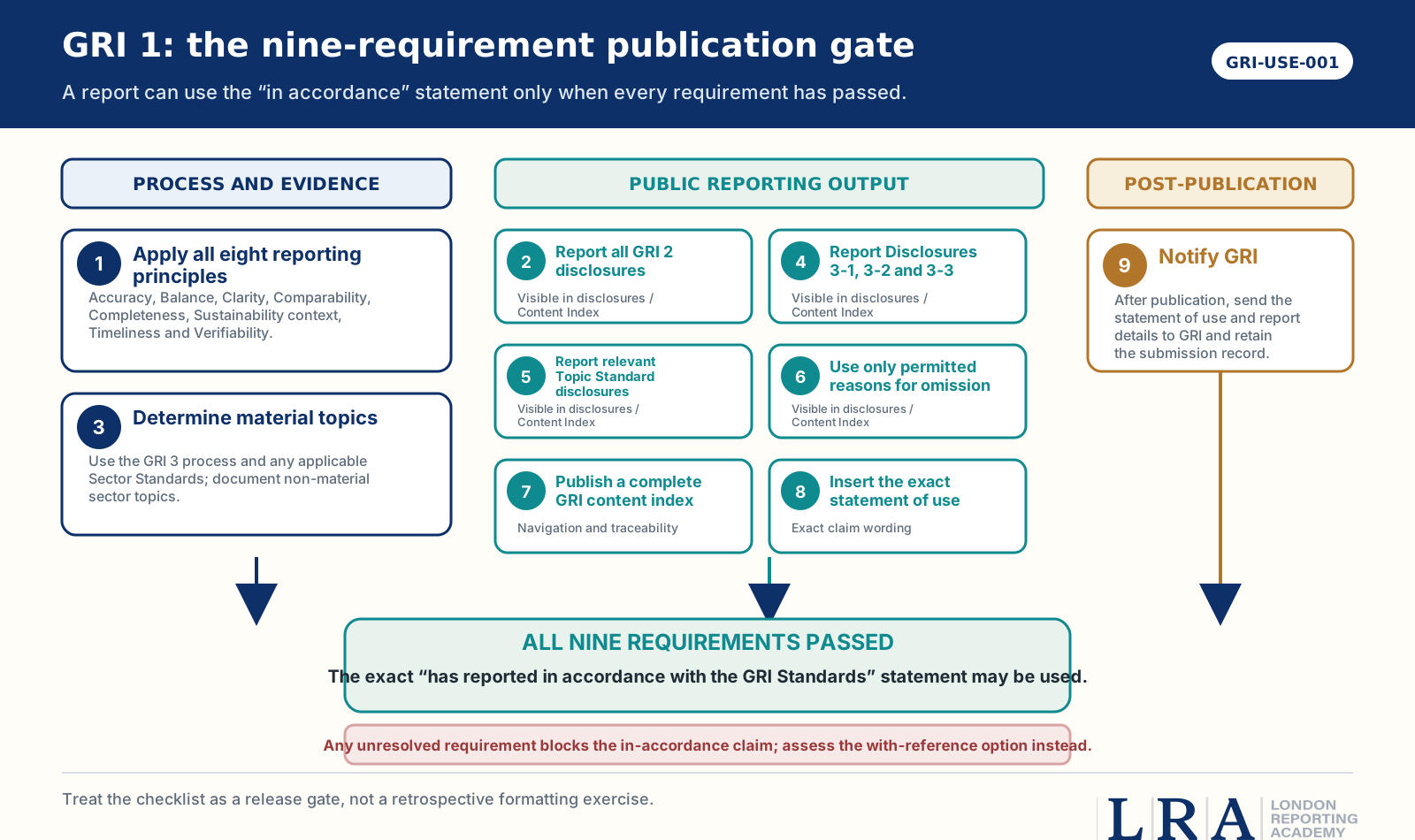
An organisation can state that it has reported in accordance with the GRI Standards only when all nine requirements in GRI 1 have been satisfied. The checklist is cumulative: applying the reporting principles, reporting GRI 2, determining material topics, reporting GRI 3, reporting relevant Topic Standard disclosures, using only permitted reasons for omission, publishing a complete GRI content index, inserting the prescribed statement of use and notifying GRI.
One unresolved requirement blocks the in-accordance claim; formatting the report after the fact cannot cure a missing process, disclosure or evidence decision.
A reviewer therefore needs two views of compliance. The first is the public-output view: what must be visible in the report, website or GRI content index. The second is the process-and-evidence view: what the organisation must have done and retained to support the public claim. GRI 1 contains both kinds of expectation, and a credible release gate tests them together.
Quick orientation
Quick orientation
- Applies to
- Any organisation intending to use the GRI 1 statement for reporting in accordance with the GRI Standards.
- Primary decision
- Whether every requirement has passed and the in-accordance statement can be released.
- Key source
- GRI 1: Foundation 2021, section 3; supported by GRI 2 and GRI 3.
- Fallback
- Where all nine requirements are not met, assess whether the three requirements for reporting with reference to the GRI Standards are satisfied.
The architecture of GRI 1
In practice
| Layer | Purpose | What the reviewer checks |
|---|---|---|
| Purpose and system | Explains impact reporting, the GRI Standards architecture and how organisations report using Universal, Sector and Topic Standards. | The reporting claim is based on impacts and the correct standard editions, not on a generic ESG narrative. |
| Reporting principles | Sets the information-quality requirements: Accuracy, Balance, Clarity, Comparability, Completeness, Sustainability context, Timeliness and Verifiability. | Methods, estimates, boundaries, limitations, changes and evidence support the published information. |
| Nine requirements | Creates the cumulative gate for reporting in accordance. | Every requirement has a documented pass; no critical item is left for “post-publication clean-up”. |
| With-reference option | Provides a reporting route where selected GRI information is used but all nine in-accordance requirements are not met. | The organisation does not overclaim and fulfils the separate content-index, statement and notification requirements. |
| Additional recommendations | Encourages alignment with financial reporting and credibility measures such as internal controls, external assurance and stakeholder or expert panels. | Recommendations are not mislabelled as mandatory, but the organisation explains how credibility is supported. |
In practice
Requirement 1: the eight reporting principles as review tests
| Principle | Reviewer question |
|---|---|
| Accuracy | Are quantitative and qualitative claims sufficiently correct and detailed for users to assess impacts? Are estimates, assumptions and measurement uncertainty clear? |
| Balance | Does the report represent positive and negative impacts without selective emphasis, omission or disproportionate presentation? |
| Clarity | Can the intended user understand the structure, language, definitions, tables and navigation? |
| Comparability | Are periods, methods, definitions, units and restatements consistent enough to compare performance and impacts? |
| Completeness | Is there sufficient information to assess impacts during the reporting period, including relevant entities, locations, events and missing coverage? |
| Sustainability context | Are impacts placed in the wider context of sustainable development, local conditions, scientific limits or societal expectations where relevant? |
| Timeliness | Is the information reported regularly and released soon enough to support decisions, without sacrificing quality? |
| Verifiability | Can another person trace the information to original sources, reproduce calculations, examine assumptions and review key decisions? |
Rule
NON-OMITTABLE GRI 2 DISCLOSURES
GRI 1 does not permit reasons for omission for Disclosure 2-1 Organisational details, 2-2 Entities included in sustainability reporting, 2-3 Reporting period, frequency and contact point, 2-4 Restatements of information, or 2-5 External assurance. A report that omits one of these disclosures cannot cure the gap by adding an omission note.
In practice
Requirement 3: process actions versus publication output
| Process action and evidence | What must be visible to the report user |
|---|---|
| Understand the organisation’s activities, relationships, stakeholders and sustainability context; identify actual and potential impacts; assess significance; set and document a threshold; use applicable Sector Standards; test and approve the result. | Disclosure 3-1 explains the process, including impact identification, prioritisation, stakeholders and experts. Disclosure 3-2 lists material topics. The content index lists applicable Sector topics found not material and explains why. |
| Retain impact inventories, source evidence, stakeholder records, expert input, assumptions, criteria, scoring or qualitative assessment, threshold rationale, Sector Standard review and approval. | The public explanation is proportionate but specific enough to show the actual method, scope, limitations, judgements and governance, rather than a generic claim that “stakeholders were consulted”. |
Requirement 5: relevant does not mean every disclosure in a Topic Standard
The organisation first identifies the disclosures that are relevant to its impacts for each material topic. A Topic Standard is not an indivisible reporting package. At the same time, the organisation cannot exclude a relevant disclosure merely because data are difficult to collect or performance is poor. Where an applicable Sector Standard lists a Topic Standard disclosure for a material topic, the organisation either reports it or, if it is genuinely not relevant to the organisation’s impacts, uses “not applicable” with the required explanation.
Rule
CONTROL QUESTION
Can the reviewer trace every material topic to GRI 3-3 and to the relevant Topic Standard disclosures, with an explicit decision for disclosures highlighted by the applicable Sector Standard?
In practice
Requirement 6: the four permitted reasons for omission
| Reason | When it may be used | Minimum explanation |
|---|---|---|
| Not applicable | The disclosure or a requirement genuinely does not apply to the organisation’s characteristics, or a Sector-listed Topic Standard disclosure is not relevant to the organisation’s impacts for the material topic. | Why it does not apply or why the disclosure is not relevant to the impacts. Do not use it merely because a policy, committee, process or data point does not yet exist. |
| Legal prohibitions | Law forbids collecting the required information or reporting it publicly. | The nature of the prohibition and its effect on the disclosure, without breaching the law. |
| Confidentiality constraints | The law does not prohibit reporting, but the organisation considers the information confidential and cannot publish it. | Why confidentiality prevents disclosure and, where possible, a useful non-confidential alternative. Use exceptionally. |
| Information unavailable / incomplete | The required item exists but information is unavailable, incomplete or not of adequate quality, including missing entities, sites or geographies. | What is missing, the affected scope and, where possible, the steps and timeframe for obtaining the information. Use exceptionally. |
In practice
Requirement 7: content-index completeness test
| Element | Reviewer test |
|---|---|
| Title and claim | The document is clearly titled “GRI content index” and contains the approved statement of use. |
| Standards used | The title of GRI 1 and all applicable Sector Standards are correctly named and versioned. |
| Material topics | The list matches Disclosure 3-2 and the report. Sector topics found not material are listed with explanations. |
| Disclosures and sources | Every reported disclosure is listed with its title and the GRI Standard or other source from which it comes. |
| Sector references | Required Sector Standard reference numbers are present for disclosures drawn from applicable Sector Standards. |
| Locations | Links or page/section references lead to substantive information, not to a generic chapter or inaccessible file. |
| Omissions | Each permitted omission identifies the precise disclosure or requirement, the allowed reason and the explanation. |
| Standalone-report link | If the content index sits outside a standalone report, the report itself contains a working link or reference to the index. |
Requirement 8: statement pattern and claim control
The precise final sentence should be checked directly against the current GRI 1 text before publication. The organisation name and dates must not be copied from a prior-year template without reconciling them to Disclosure 2-1, Disclosure 2-2 and Disclosure 2-3.
Rule
DRAFTING PATTERN
Use the reporting organisation’s name, the mandated core phrase “has reported in accordance with the GRI Standards”, and the reporting period’s start and end dates. Place the completed statement in the GRI content index. Do not replace it with “GRI compliant”, “GRI aligned”, “prepared under GRI”, “GRI certified” or similar wording.
Requirement 9: publication and notification
Notification occurs after the report has been published, because the organisation needs final links and the final statement of use. GRI’s official FAQ describes the report-registration system and also explains the email requirement in GRI 1. Treat the operational channel as an update trigger: verify the current GRI instructions at each publication cycle, submit through the current arrangement and retain the confirmation in the final-release evidence pack.
In practice
Process evidence versus public visibility
| Category | Examples | Release implication |
|---|---|---|
| Primarily process and evidence | Application of reporting principles; impact inventory; significance assessment; threshold; stakeholder evidence; Topic Standard relevance decisions; calculations; review trail. | These files may not be published in full, but the public disclosures must accurately describe the process and a reviewer must be able to inspect the basis. |
| Must be visible to report users | GRI 2 disclosures; 3-1, 3-2 and 3-3; relevant Topic Standard disclosures; omissions; content index; statement of use; links and locations. | A complete internal file cannot compensate for missing public information. |
| Post-publication control | Notification or report registration, archived final links, confirmation and immutable release copy. | The organisation needs a close-out owner and evidence that the publication requirement was completed. |
Hypothetical example: a report that passes seven of nine gates
The report cannot use the in-accordance statement at that stage. The correct response is not to weaken the review or add a broad disclaimer. The team must complete the Sector Standard assessment, prepare the missing 3-3 disclosure and correct the omission logic, or move to the with-reference option if the required work cannot be completed before publication and the three with-reference requirements are met. The claim follows the evidence; the claim does not redefine the evidence threshold.
Hypothetical scenario
HYPOTHETICAL SCENARIO
A manufacturing group has a detailed materiality assessment, reports most GRI 2 disclosures, publishes GRI 3-1 and 3-2, and maps Topic Standard metrics. The draft content index contains the proposed in-accordance statement. During final review, the team discovers that one applicable Sector Standard was not assessed, GRI 3-3 is missing for one material topic, and the index uses “data not collected” rather than a permitted reason for omission.
Illustrative only. It shows how the decision is made, not wording that can be copied or relied on.
In practice
Common mistakes at publication
| Mistake | Why it blocks or weakens the claim | Correction |
|---|---|---|
| Using the statement before the checklist is complete | The wording becomes a target rather than the conclusion of compliance review. | Lock the statement until a named reviewer signs all nine requirements. |
| Treating the content index as the compliance exercise | A well-formatted index can still point to incomplete or non-substantive disclosures. | Test the underlying disclosure first, then test the index location and title. |
| Using a reason for omission for 2-1 to 2-5 | GRI 1 expressly excludes these disclosures from the omission mechanism. | Report the disclosure substantively or do not make the in-accordance claim. |
| Reporting 3-3 only once for the whole report | Disclosure 3-3 is required for each material topic. | Use a material-topic-to-3-3 register and verify one complete response per topic. |
| Reporting every Topic Standard disclosure automatically | Creates irrelevant data collection and may misrepresent the logic of relevance. | Select disclosures based on impacts and apply the Sector Standard test. |
| Using an invented omission such as “commercially sensitive” without analysis | The reason may not match an allowed category and may hide a reportable alternative. | Apply the permitted reason precisely, explain it and retain the evidence. |
| Calling a report GRI certified or verified | GRI does not certify or verify the quality of the report or the organisation’s in-accordance claim. | Use the prescribed statement only and describe assurance or GRI services accurately and separately. |
| Forgetting post-publication notification | The ninth requirement remains incomplete. | Assign a publication close-out owner and retain confirmation. |
Rule
MYTH VERSUS REALITY
Myth: “A report is in accordance if it contains enough GRI indicators.” Reality: the in-accordance claim depends on all nine GRI 1 requirements. The number of metrics cannot replace the reporting principles, material-topic process, GRI 2 and GRI 3 disclosures, Sector Standard review, omission discipline, content index, statement or notification.
Readiness
Final publication release checklist
- The reporting organisation, entity scope and reporting period are locked and consistent throughout the report.
- All eight reporting principles have a documented review outcome, including balance, completeness and verifiability.
- Every GRI 2 disclosure has substantive information; no omission is used for 2-1 to 2-5.
- The materiality method follows GRI 3 and every applicable Sector Standard has been reviewed.
- Disclosure 3-1 matches the actual process and evidence; 3-2 matches the approved list.
- Every material topic has a complete 3-3 response.
- Relevant Topic Standard disclosures are mapped, and Sector-listed disclosures have an explicit report/not-applicable decision.
- Only the four permitted reasons for omission are used, with precise explanations and evidence.
- The GRI content index contains every required element and every link has been tested.
- The statement of use uses the approved wording, organisation name and period and is placed in the content index.
- The highest governance body disclosure under 2-14 and the material-topic approval evidence are consistent with actual governance.
- The final publication files are immutable, notification is assigned, and registration or email confirmation will be archived.
A report can still be in accordance where it uses a reason for omission that GRI 1 permits for the specific requirement and gives the corresponding explanation in the Content Index. The mechanism is unavailable for Disclosures 2-1 to 2-5, 3-1 or 3-2, and an invented explanation such as merely stating that data were not collected does not satisfy the gate.
Yes, Disclosure 3-3 is required for each material topic rather than once for the report as a whole. If a requirement within 3-3 cannot be met, the organisation must identify it in the Content Index and provide a permitted reason for omission and the required explanation; difficulty collecting data does not by itself remove the topic-level obligation.
Self-check
- Can an organisation use the in-accordance statement if eight of nine requirements are met?
- Which five GRI 2 disclosures cannot use reasons for omission?
- What must be reported for every material topic under Requirement 4?
- Why is the content index necessary but not sufficient to support the reporting claim?
Questions
Questions people ask
What are the nine GRI 1 requirements?
Myth: “A report is in accordance if it contains enough GRI indicators.” Reality: the in-accordance claim depends on all nine GRI 1 requirements. The number of metrics cannot replace the reporting principles, material-topic process, GRI 2 and GRI 3 disclosures, Sector Standard review, omission discipline, content index, statement or notification.
Can a report be in accordance with an omission?
A report can still be in accordance where it uses a reason for omission that GRI 1 permits for the specific requirement and gives the corresponding explanation in the Content Index. The mechanism is unavailable for Disclosures 2-1 to 2-5, 3-1 or 3-2, and an invented explanation such as merely stating that data were not collected does not satisfy the gate.
Which GRI 2 disclosures cannot be omitted?
GRI 1 does not permit reasons for omission for Disclosure 2-1 Organisational details, 2-2 Entities included in sustainability reporting, 2-3 Reporting period, frequency and contact point, 2-4 Restatements of information, or 2-5 External assurance. A report that omits one of these disclosures cannot cure the gap by adding an omission note.
Is GRI 3-3 required for every material topic?
Yes, Disclosure 3-3 is required for each material topic rather than once for the report as a whole. If a requirement within 3-3 cannot be met, the organisation must identify it in the Content Index and provide a permitted reason for omission and the required explanation; difficulty collecting data does not by itself remove the topic-level obligation.
When should an organisation notify GRI?
Notification occurs after the report has been published, because the organisation needs final links and the final statement of use. GRI’s official FAQ describes the report-registration system and also explains the email requirement in GRI 1. Treat the operational channel as an update trigger: verify the current GRI instructions at each publication cycle, submit through the current arrangement and retain the confirmation in the final-release evidence pack.
In practice
Related standards and practical connections
| Relationship | Reference | Practical connection |
|---|---|---|
| Primary | GRI 1: Foundation 2021 | Reporting principles, nine requirements, content index, statement, omissions, notification and with-reference option. |
| Direct | GRI 2: General Disclosures 2021 | All GRI 2 disclosures and non-omittable 2-1 to 2-5. |
| Direct | GRI 3: Material Topics 2021 | Materiality process, material-topic list and 3-3 for every material topic. |
| Implementation | Applicable GRI Sector Standards | Likely material topics, Sector references and disclosures to consider for material topics. |
| Implementation | Relevant GRI Topic Standards | Topic-specific disclosures selected based on the organisation’s impacts. |
| Supporting | GRI Content Index Template and Report Registration FAQs | Publication and notification tools; they do not replace the standard. |
Sources
Primary sources
- GRI 1: Foundation 2021 — sections 3-5, including reporting principles, nine requirements, reasons for omission, content index, statement of use and notification
- GRI 2: General Disclosures 2021 — all disclosures, including 2-14 governance review and approval information
- GRI 3: Material Topics 2021 — material-topic process and Disclosures 3-1, 3-2 and 3-3
- GRI Content Index Template — official GRI content index template and supporting materials
- GRI Standards Report Registration System FAQs — current GRI report registration and notification FAQs
- GRI Report Services Methodology 2026 — official explanation that GRI Report Services do not verify or certify in-accordance reporting
Framework references
Disclosures this page affects
Take it with you
The checklists as a working spreadsheet
Every checklist and table on this page, with empty status, owner and evidence columns for your team to fill in and keep.
✓ Knowledge Hub AI Assistant · Human-in-the-loop

Ask about this guide
It answers from this page, and reaches into the linked disclosure cards when your question is about the standard itself.
Go deeper · GRI
Certified GRI Standards Training
This page settles one disclosure. The GRI Standards Certified Training — two live days, taken as a bundle with an ESRS course — walks the whole cycle: material topics, datapoints, evidence, the Content Index and assurance readiness, with exercises on your own data.
Available as two live training days online or on-site in London, bundled with an ESRS course.