Short answer
The answer, before the reasoning
Yes. A well-governed sustainability data foundation can support both GRI and ESRS reporting, especially where the same operational facts, calculations and evidence are relevant to impact reporting. But one undifferentiated dataset does not by itself satisfy both frameworks.
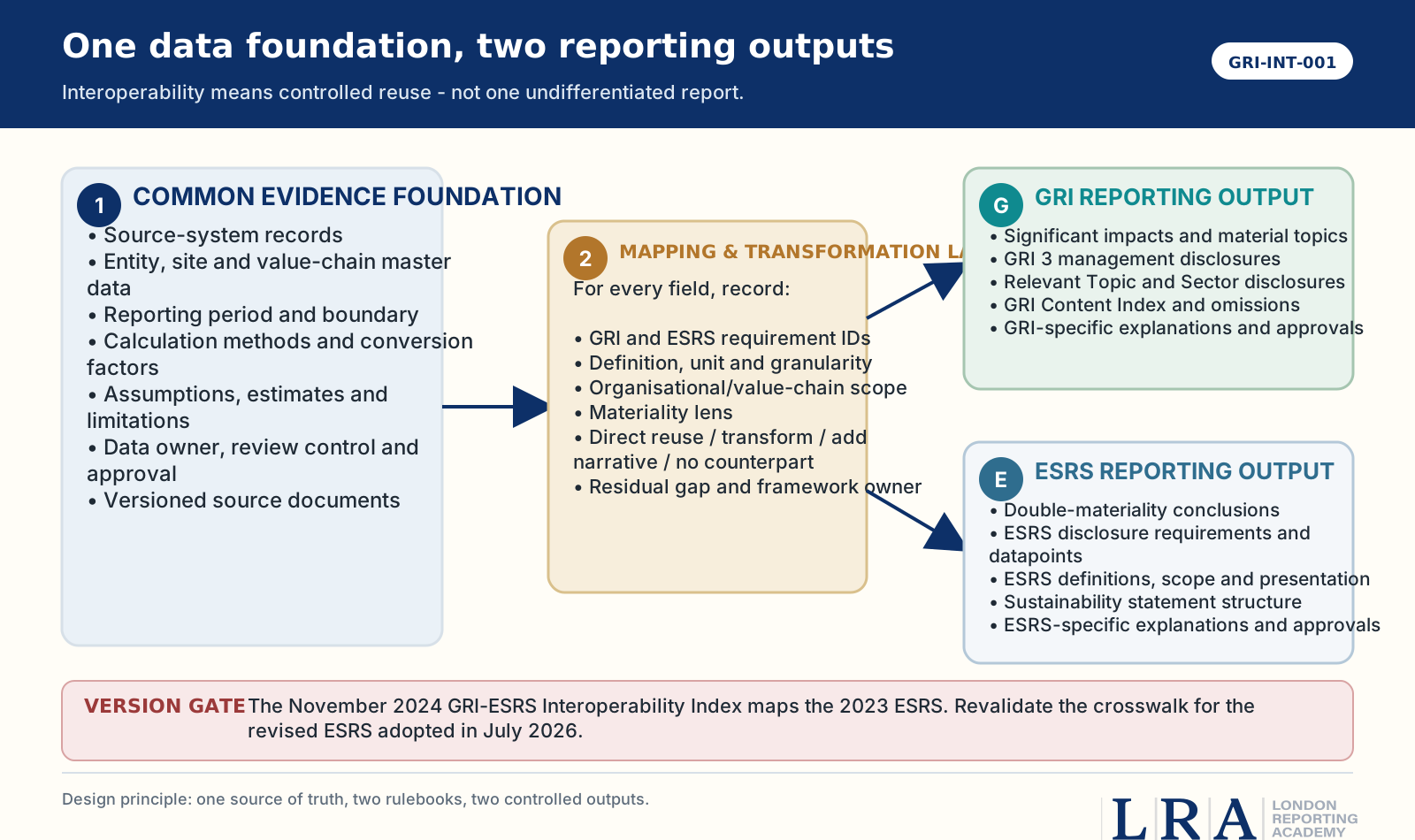
Materiality conclusions, definitions, boundaries, granularity, narrative requirements, transformations, approvals and publication claims must still be tested separately. The practical design is one source of truth, two rulebooks and two controlled reporting outputs.
In practice
Type
| Type | Interoperability guide | Tier — Tier 4 · Expert / Transition |
|---|---|---|
| Audience | Reporting architects, data owners, consultants, reviewers and assurance teams | Current context — GRI Standards; November 2024 GRI-ESRS Index; revised ESRS adopted 3 July 2026 |
Why this question matters
Organisations often face two expensive and equally risky extremes. In the first, separate GRI and ESRS projects duplicate meters, invoices, workforce records, stakeholder evidence and calculations. In the second, a single “ESG dataset” is assumed to be automatically compliant with both frameworks, even though the same field may use a different definition, reporting boundary, level of granularity or materiality condition.
Interoperability should reduce duplication without hiding residual differences. The strongest design treats shared source evidence as an asset, records how each framework uses or transforms it, and keeps framework-specific conclusions and approvals visible.
Quick orientation
Quick orientation
- Applies to
- Organisations preparing GRI reporting alongside ESRS sustainability statements, or designing a common reporting data platform.
- Primary decision
- Which data and evidence can be reused directly, which need transformation, and which remain framework-specific.
- Key sources
- GRI-EFRAG Interoperability Index, GRI Universal Standards, applicable ESRS edition and official implementation materials.
- Common confusion
- Treating interoperability as full equivalence or assuming that matching topic names mean matching disclosure requirements.
In practice
What interoperability means - and what it does not mean
| Term | Practical meaning |
|---|---|
| Shared source evidence | The same underlying record - for example an invoice, meter reading, site register, grievance record or HR extract - can support more than one reporting requirement. |
| Direct reuse | The field can be used without substantive change after confirming period, boundary, definition, units and control status. |
| Transformation | The source can be reused after aggregation, disaggregation, reclassification, conversion, estimation or addition of metadata. |
| Common evidence, different narrative | The same evidence supports different explanations because the frameworks ask different questions or apply different materiality lenses. |
| Framework-specific item | The information, conclusion or approval exists only because one framework requires it. |
| Equivalence | A much stronger claim that the requirements are fully interchangeable. It should not be made unless scope, materiality, definitions, boundary and disclosure detail have all been verified. |
The official interoperability boundary
A mapping can show correspondence, partial correspondence or absence of a counterpart; it does not replace reading the underlying requirement.
Differences can arise from granularity or data type, scope and definitions even where the subject matter looks similar.
GRI material topics are grounded in significant impacts. ESRS uses double materiality and adds the financial-materiality lens under its own rules.
A common project can share evidence, systems and governance, but each reporting claim must be approved against its own requirements.
Rule
NON-AUTHORITATIVE IMPLEMENTATION GUIDANCE
The November 2024 GRI-ESRS Interoperability Index describes a high level of interoperability in impact reporting and maps relationships between the 2023 ESRS and the GRI Standards. It is explicitly non-authoritative. It supports implementation and a “with reference” route for ESRS reporters, but it does not mean that reporting in accordance with GRI is sufficient for ESRS, or that ESRS reporting automatically meets every requirement needed for a GRI “in accordance” claim.
Rule
CURRENT-VERSION WARNING - JULY 2026
The European Commission adopted revised ESRS on 3 July 2026, with application planned for financial years beginning on or after 1 January 2027 and early adoption for financial year 2026 permitted once the delegated act enters into force. The November 2024 GRI-ESRS Interoperability Index maps the 2023 ESRS. Any production crosswalk used for the revised ESRS therefore needs a controlled revalidation rather than automatic carry-forward.
In practice
What can often be shared
| Reusable layer | Typical examples | Control needed |
|---|---|---|
| Entity, site and value-chain master data | Legal entities, sites, activities, products, suppliers, workforce categories and geographic identifiers. | Versioned reporting perimeter, ownership and effective dates. |
| Operational source data | Energy invoices, fuel records, emissions measurements, water data, waste records, employee data and incident logs. | Source-system traceability, units, period, completeness and quality checks. |
| Calculation methods | Conversion factors, estimation models, consolidation rules and restatement logic. | Method version, approval, input lineage and recalculation control. |
| Policies and governance evidence | Approved policies, committee terms, board minutes, responsibilities and controls. | Current version, approval date, scope and evidence-retention rules. |
| Stakeholder and impact evidence | Complaints, engagement records, due-diligence findings, impact assessments and remediation records. | Confidentiality, affected-stakeholder context, impact linkage and balanced evidence. |
| Assurance evidence | Data-owner sign-offs, reconciliations, control testing and change logs. | Clear distinction between shared control evidence and framework-specific assurance conclusions. |
In practice
What normally remains separate
| Framework-specific layer | Why it cannot be collapsed safely |
|---|---|
| Materiality conclusions | GRI and ESRS use related but not identical decision models, terminology and outputs. A shared evidence pool can support both assessments, but the conclusions require separate tests. |
| Required granularity | One framework may request a total while another requires breakdowns, location detail, value-chain categories, policy coverage or comparative information. |
| Definitions and boundaries | The same label can use different inclusions, exclusions, consolidation logic or defined terms. |
| Narrative disclosures | The information need, context and required explanation may differ even when the supporting evidence is shared. |
| Content architecture | GRI Content Index references and ESRS disclosure architecture have different publication mechanics. |
| Claims and approvals | “In accordance with GRI” and compliance with applicable ESRS are distinct conclusions and should have separate review and sign-off. |
A seven-step interoperable data design
Build the common evidence foundation. Establish master data for entities, sites, activities, value-chain categories, reporting periods, units and owners before mapping requirements.
Create a requirement register by edition. Record the relevant GRI requirement or disclosure and the applicable ESRS requirement or datapoint separately, including effective dates.
Map at the information-field level. Do not map only at the topic or standard level. Identify the exact field, definition, boundary, granularity, data type and narrative context.
Classify the relationship. Use controlled labels such as direct reuse, transform, shared evidence/different narrative, framework-specific or no counterpart.
Record residual differences. For every reuse decision, state what still needs to be added, excluded, disaggregated, reclassified, narrated or approved.
Generate separate reporting views. Produce a GRI view with material topics, Topic and Sector disclosures and the GRI Content Index, and an ESRS view with its own material matters, disclosures and sustainability-statement structure.
Apply version and change control. A change to GRI, ESRS, the reporting perimeter or a methodology should automatically place the affected mappings, datasets and narratives into review.
Recommended reuse classification
In practice
| Class | Definition | Example |
|---|---|---|
| A - Direct reuse | Same field after confirming definition, period, boundary, unit and control. | A controlled site-energy total used in both reporting workflows where the required scope is aligned. |
| B - Transform | Same source data, but aggregation, breakdown, conversion or reclassification is needed. | Energy invoices converted into renewable/non-renewable categories and activity-level reporting. |
| C - Shared evidence, different narrative | The records are common but the framework-specific explanation differs. | Stakeholder evidence supports an impact conclusion and also informs an ESRS double-materiality assessment. |
| D - Framework-specific | The field or conclusion is required only by one framework. | A GRI Content Index reason for omission or a distinct ESRS presentation requirement. |
| E - No counterpart / unresolved | No reliable mapping exists or the current source material is insufficient. | A revised ESRS requirement not yet covered by the November 2024 interoperability crosswalk. |
Hypothetical example: one energy data foundation, different outputs
A sound system stores the source record once, attaches the calculation method and controls once, and produces separate reporting views. It also preserves the reason for any difference. For example, a site may sit outside one reporting boundary but inside another, or a renewable-energy claim may require additional contractual-instrument evidence for one disclosure. The system should show the residual gap rather than silently forcing the values to match.
Illustrative mapping record
Hypothetical scenario
HYPOTHETICAL SCENARIO
A multinational manufacturer holds monthly electricity, fuel, heating and steam records by site, supplier and energy source. The source data are reconciled to finance and approved by site owners. The organisation can reuse this foundation for GRI 103: Energy 2025 and ESRS climate reporting. However, it still needs a mapping layer: GRI 103 asks for information relevant to the organisation's energy-related impacts, including internal consumption, self-generation, upstream and downstream consumption, intensity and reductions. The applicable ESRS edition may organise energy information within a different materiality, definition and presentation architecture. The common invoices and calculations are reusable; the relevance test, classifications, disclosures, narratives and approvals are not automatically identical.
Illustrative only. It shows how the decision is made, not wording that can be copied or relied on.
In practice
| Field | GRI view | ESRS view — Residual control |
|---|---|---|
| Purchased electricity | Use where relevant to energy impacts and GRI 103 disclosure requirements. | Use under the applicable revised ESRS requirements and materiality conclusion. — Confirm renewable/non-renewable classification, contractual instruments, location/market treatment and perimeter. |
| Energy reduction | Report under GRI 103-5 where relevant, with baseline and method. | Map to the applicable ESRS target/action/metric architecture. — Separate activity data from claims of outcome or effectiveness. |
| Materiality evidence | Supports significant-impact and material-topic conclusions. | Supports impact and financial materiality conclusions under ESRS. — Preserve separate criteria, thresholds, decisions and approvals. |
In practice
Weak versus stronger operating model
| Weak design | Stronger design |
|---|---|
| Two teams collect the same source data independently. | One controlled source dataset with common owners, lineage and quality controls. |
| A spreadsheet says “GRI = ESRS” at topic level. | A field-level mapping records definition, boundary, granularity, direction of reuse and residual differences. |
| One materiality score is copied into both reports. | Common evidence supports separate GRI and ESRS decision tests and outputs. |
| Narrative is copied word for word. | Narrative is generated from shared evidence but checked against each framework's information need. |
| The 2024 crosswalk is treated as timeless. | Crosswalk edition and source documents are versioned; revised ESRS trigger revalidation. |
In practice
Common mistakes
| Mistake | Risk | Correction |
|---|---|---|
| Calling interoperability “equivalence” | Creates an unsupported compliance claim and hides residual differences. | Use precise relationship labels and preserve the limitations. |
| Mapping only standard titles | Misses differences in individual requirements, data types and definitions. | Map at requirement and information-field level. |
| Using one reporting boundary by default | Produces inconsistent or incomplete values. | Store boundary metadata and reconcile framework-specific perimeters. |
| Ignoring narrative and governance data | The platform covers metrics but not policies, impacts, decisions or approvals. | Include evidence objects and framework-specific narrative templates. |
| Treating “not material” as “no data needed” | Removes evidence needed to support the materiality conclusion and future reviews. | Retain the evidence and decision record even when a disclosure output is not required. |
| Failing to revalidate after a standard update | Old mappings continue to drive current reports. | Use version gates, update triggers and blocked mappings pending review. |
Rule
MYTH VERSUS REALITY
Myth: “If the numbers are the same, the disclosure is interoperable.” Reality: numerical equality is only one test. A defensible reuse decision also checks definition, period, boundary, units, granularity, materiality condition, narrative context, evidence and approval.
Readiness
Implementation checklist
- A single master register exists for entities, sites, activities, value-chain positions and periods.
- Every field has a data owner, source, calculation method, unit, boundary, quality status and review control.
- GRI and ESRS requirements are stored separately by edition and linked through a versioned mapping record.
- The mapping states direction of reuse and residual differences rather than only “match / no match”.
- Materiality decisions and reporting claims have separate framework-specific approvals.
- Narrative disclosures can trace back to evidence, not only to a prior-year paragraph.
- Revised ESRS adopted in July 2026 have triggered a review of mappings based on the 2023 ESRS.
- The system can produce separate GRI and ESRS views without duplicating source data or concealing differences.
- Could a reviewer identify exactly which transformations turn one source field into each reported value?
- Does the system preserve separate GRI and ESRS materiality conclusions and publication claims?
- Would a change in either framework automatically identify the affected fields, narratives and approvals?
In practice
Related standards and mapping relationships
| Relationship | Instrument | Role |
|---|---|---|
| Interoperability | GRI-ESRS Interoperability Index, November 2024 | Non-authoritative mapping of the GRI Standards and the 2023 ESRS. |
| Direct | GRI 1: Foundation 2021 and GRI 3: Material Topics 2021 | GRI reporting claim, significant impacts, material topics and disclosure selection. |
| Comparison / current edition | Revised ESRS adopted 3 July 2026 | Current ESRS rulebook requiring controlled revalidation of older crosswalks. |
| Implementation example | GRI 103: Energy 2025 and applicable ESRS climate disclosures | Shared operational evidence with framework-specific relevance, classification and presentation. |
Questions
Questions people ask
Can the same sustainability data support GRI and ESRS?
A well-governed sustainability data foundation can support both GRI and ESRS reporting, especially where the same operational facts, calculations and evidence are relevant to impact reporting. But one undifferentiated dataset does not by itself satisfy both frameworks.
Does GRI-ESRS interoperability mean the standards are equivalent?
A well-governed sustainability data foundation can support both GRI and ESRS reporting, especially where the same operational facts, calculations and evidence are relevant to impact reporting. But one undifferentiated dataset does not by itself satisfy both frameworks. Materiality conclusions, definitions, boundaries, granularity, narrative requirements, transformations, approvals and publication claims must still be tested separately.
Which data can be reused directly and which need transformation?
A well-governed sustainability data foundation can support both GRI and ESRS reporting, especially where the same operational facts, calculations and evidence are relevant to impact reporting. But one undifferentiated dataset does not by itself satisfy both frameworks. Materiality conclusions, definitions, boundaries, granularity, narrative requirements, transformations, approvals and publication claims must still be tested separately.
Can one materiality assessment serve both GRI and ESRS?
A well-governed sustainability data foundation can support both GRI and ESRS reporting, especially where the same operational facts, calculations and evidence are relevant to impact reporting. But one undifferentiated dataset does not by itself satisfy both frameworks. Materiality conclusions, definitions, boundaries, granularity, narrative requirements, transformations, approvals and publication claims must still be tested separately.
Does the November 2024 interoperability index cover the revised 2026 ESRS?
The European Commission adopted revised ESRS on 3 July 2026, with application planned for financial years beginning on or after 1 January 2027 and early adoption for financial year 2026 permitted once the delegated act enters into force. The November 2024 GRI-ESRS Interoperability Index maps the 2023 ESRS.
Sources
Primary sources
- GRI-ESRS Interoperability Index, November 2024 - Non-authoritative
- European Commission - revised ESRS adoption - Adoption on 3 July 2026 and current regulatory context
- EFRAG - revised ESRS delegated act - Application from financial years beginning on or after 1 January 2027 and early-adoption context
- GRI 1: Foundation 2021 - GRI reporting requirements, claims and Content Index architecture
- GRI 3: Material Topics 2021 - Significant-impact and material-topic process
Framework references
Disclosures this page affects
Take it with you
The checklists as a working spreadsheet
Every checklist and table on this page, with empty status, owner and evidence columns for your team to fill in and keep.
✓ Knowledge Hub AI Assistant · Human-in-the-loop

Ask about this guide
It answers from this page, and reaches into the linked disclosure cards when your question is about the standard itself.
Go deeper · GRI
Certified GRI Standards Training
This page settles one disclosure. The GRI Standards Certified Training — two live days, taken as a bundle with an ESRS course — walks the whole cycle: material topics, datapoints, evidence, the Content Index and assurance readiness, with exercises on your own data.
Available as two live training days online or on-site in London, bundled with an ESRS course.